
Amazon Alexa API Executive Summary
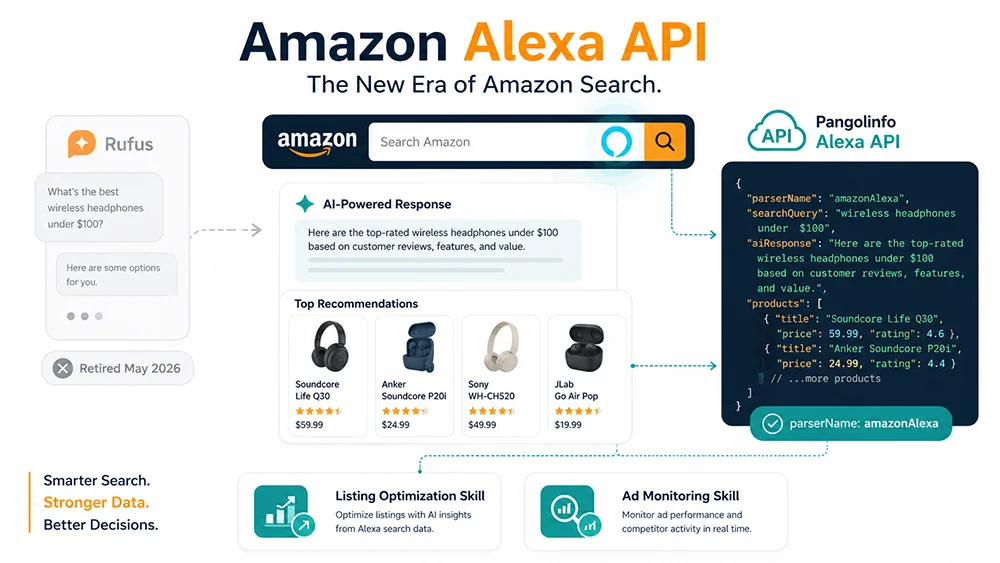
Amazon has retired its Rufus AI shopping assistant and merged its capabilities with Alexa+ to create Alexa for Shopping, an agentic AI embedded directly into Amazon’s main search bar. This shift means every search now passes through an AI layer that forms recommendations before users see traditional listings. Pangolinfo offers the world’s first third-party solution for this new era, centered on the Amazon Alexa API for structured AI content retrieval, plus complementary tools for listing optimization and Prompts Ad monitoring. This article outlines the key differences between Rufus and Alexa for Shopping, the structural changes to Amazon’s traffic logic, and a practical four-step framework for sellers to adapt.
The Two-Minute Context: What Changed and Why It Matters
Rufus was not retired because it failed. Amazon’s own data: 300M+ users helped in 2025, 115% MAU growth YoY, interactions up nearly 400%. Amazon merged Rufus’s product intelligence with Alexa+’s long-term user memory and embedded the result into the most valuable real estate on Amazon — the main search bar. The name changed. The capability escalated significantly.
For sellers, one sentence captures the strategic shift: before a user sees your listing, Alexa has already formed a recommendation, often without them scrolling past the AI summary at all. The AI’s characterization of your product lands before your copy does. Sellers who cannot observe, measure, and influence that characterization are operating in an information blind spot that grows more consequential as Alexa adoption compounds.
Pangolinfo’s Three-Tool Solution for the Alexa Era
Pangolinfo is the world’s first third-party service capable of systematically retrieving Amazon Alexa for Shopping search result data. Three products address the full stack of what sellers need:
Tool 1: Pangolinfo Alexa API — See What Alexa Is Saying
The Pangolinfo Scrape API‘s Alexa module is the only third-party interface that returns structured data from Alexa’s AI-generated content layers. Key fields returned:
- ai_summary.text: Full text of the AI summary Alexa displays at the top of search results for any keyword or natural language query.
- ai_summary.mentioned_brands: The brands Alexa explicitly names in the summary — your primary brand visibility metric in the AI era.
- products[].ai_reason: Alexa’s stated rationale for recommending each product — the semantic language the AI uses to describe product value.
- ads[]: Prompts Ad placements — brand, ASIN, position, and ad copy for competitive intelligence on paid AI visibility.
- price_history: 12-month price range data for systematic competitive pricing analysis.
For teams building e-commerce AI agents, the Pangolinfo Amazon Scraper Skill exposes these capabilities as MCP-compatible tools, enabling LLMs to query Alexa search data via natural language.
Tool 2: Listing Optimization Skill — Make Alexa Recommend You
Knowing what Alexa says about competitors is only useful if you can act on it. The Pangolinfo Listing Optimization Skill combines Alexa API data with your current listing text to surface three categories of AI-readability gaps:
- Semantic blind spots: Missing audience tags, use-case descriptions, and quantified decision information that prevent Alexa from understanding who the product is for and why it fits their need.
- Differentiation dilution: Copy segments where your listing is semantically indistinguishable from competitors — Alexa will merge these into the same category during comparison summaries.
- Q&A and A+ Content gaps: High-frequency question dimensions Alexa draws from that your current content does not address, weakening the AI’s understanding of your product.
After implementing recommendations, you can re-query the Alexa API for the same keyword and compare whether Alexa’s characterization of your product shifts toward the intended positioning — a closed-loop optimization cycle.
Tool 3: Ad Monitoring Skill — Own the Prompts Ad Intelligence Layer
Prompts Ads went live on CPC billing on March 25, 2026. The competitive intelligence gap: sellers have no visibility into which competitors are running Prompts Ads, what keywords they cover, or what ad copy they use. The Pangolinfo Ad Monitoring Skill closes this gap by continuously tracking:
- Which competitors are actively bidding in your category’s AI ad placements
- The keyword coverage and semantic focus of their ad copy
- Position fluctuations over time — identifying when competitors scale up or pull back
- Category-level competitive intensity benchmarks for informed budget allocation
For no-code monitoring, AMZ Data Tracker provides a visualization dashboard for all three data streams. For technical integration, see the Pangolinfo documentation center.
What Are the 7 Core Differences Between Alexa for Shopping and Rufus?
| Dimension | Rufus (Retired) | Alexa for Shopping (Current) |
|---|---|---|
| Technical Role | AI-assisted shopping chatbot | Agentic AI shopping representative |
| Entry Point | Separate icon in page corner | Integrated directly into main search bar |
| Underlying Architecture | Single shopping-specific model (RAG) | Multi-model reasoning (site data + user behavior + web) |
| Core Capabilities | Review summaries, product Q&A, basic comparison | Full purchase lifecycle: price tracking, auto-reorder, Buy for Me |
| Personalization | Current session only | Long-term cross-device user memory |
| Access Requirements | Amazon account login required | Free for all US users, no subscription needed |
| Ad Integration | Minimal ad presence | Prompts Ads (CPC), AI-native ad placements |
The Shift That Matters Most for Sellers: Entry Point
The single most consequential change for sellers is where Alexa lives. Rufus was tucked into a corner of the product detail page — an optional feature that many users never discovered. Alexa for Shopping is embedded in the main search bar itself, the single highest-traffic element on Amazon. Every search now passes through an AI layer before reaching traditional ranked results. The AI decides what to summarize, what to recommend, and what to compare — before the user ever scrolls to the organic listings.
The Most Underappreciated Change: Agentic Execution
Rufus could tell a user that Product A had better reviews than Product B. Alexa for Shopping can monitor Product A’s price for a year, alert the user when it drops below $49, automatically add it to the cart, and schedule a monthly reorder once purchased. This transformation from advisor to agent fundamentally changes the seller’s relationship with the platform: you are no longer just optimizing for a user who is actively shopping — you are optimizing for an AI that is managing that user’s ongoing relationship with your product category.
How Has Amazon’s Traffic Logic Changed? 5 Structural Shifts
Shift 1: Search Intent Over Keyword Matching
The A9 algorithm was primarily a keyword matching and ranking system. A user typed “queen bed frame” and A9 matched that string against listing content, weighted by conversion rate and sales velocity. Alexa for Shopping processes natural language intent. A user might now type: “a queen bed frame that’s cheap, easy to assemble, works without a box spring, and has storage underneath.” Alexa does not match keywords — it parses a scenario, identifies audience attributes, and evaluates which products best answer that composite need. Listings that contain structured audience and use-case information have a structural advantage over listings that only stack keywords.
Shift 2: Pre-Decision AI Filtering
By the time a user clicks into your listing, Alexa may have already formed an opinion about your product. The AI summary at the top of search results highlights key differentiators, summarizes review sentiment, and notes price positioning. Canopy Management’s analysis confirms that sellers have decreasing control over the first impression — the AI’s characterization of a product often lands before the seller’s own copy does. The implication: your listing must be written for AI comprehension first, not just for the user who ultimately reads it.
Shift 3: Traffic Distribution Becomes Multi-Layered
Previously, traffic distribution was relatively linear: keyword ranking determined exposure, and better SEO produced more impressions. Now, exposure flows through multiple parallel channels: traditional ranked results, Alexa AI summary recommendations, Alexa-mediated comparison results, and Prompts Ad placements. A product that ranks 15th by keyword could appear in the AI summary recommendation if Alexa’s reasoning determines it best matches the user’s stated needs. The new traffic equation is: Traffic = Keyword Rank + AI Recommendation Probability + Personalization Match + Price/Review/Conversion Signals.
Shift 4: Price Transparency at 12-Month Depth
Rufus’s price history visibility extended 90 days. Alexa for Shopping tracks a full year. The artificial inflation-before-discount tactics that once created the appearance of a deal are now visible to any user who asks. Alexa can present a year-long price chart, making it easy to identify whether a “sale” represents a genuine discount or a manufactured one. Long-term pricing integrity becomes a competitive differentiator; short-term price manipulation becomes a liability.
Shift 5: Repurchase Moves from User-Driven to AI-Driven
Alexa for Shopping deeply integrates with Subscribe & Save and purchase history. It reads previous orders, predicts replenishment timing, sends proactive reminders, and can automatically add items to the cart. For sellers in consumables, personal care, pet supplies, and household goods, a meaningful portion of future repeat purchases may never involve a conscious search decision at all — Alexa will simply initiate it. Building high repurchase rates and strong post-purchase satisfaction is now a direct input into the AI’s recommendation probability for your product category.
What Sellers Should Actually Do: A Four-Step Framework
Context first: YouGov’s January 2026 data shows only 14% of Americans have used an AI shopping assistant and 14% would allow AI to auto-purchase. The shift is gradual. The framework below is prioritized accordingly — structured adjustment, not panic overhaul.
Step 1: Run a Listing AI Readability Audit with the Listing Optimization Skill
Before rewriting anything, use the Pangolinfo Listing Optimization Skill to diagnose your current gaps. It will surface which audience signals, use-case descriptions, and differentiation elements are missing — and which sections are semantically identical to competitors, making differentiation invisible to Alexa’s comparison summaries. Rewrite with direction, not guesswork.
The four types of AI-parseable information your listing needs:
- Audience signals: renters, college students, first apartments, families on a budget, frequent movers.
- Scenario signals: small bedroom, no box spring, apartment with tight stairwells, under-bed storage required.
- Quantified decision signals: Not “heavy duty” — “supports 1,200 lbs with 12 reinforced steel slats.” Not “noise free” — “rubber-wrapped contact points with foam pads eliminate squeaking.”
- Explicit differentiation: State clearly what separates you from competitors using the same adjectives. AI does not infer differentiation that is not written.
Step 2: Validate Optimization with Alexa API Data
After revising your listing, query the Alexa API for your target keywords and compare whether your brand appears in ai_summary.mentioned_brands and whether the ai_reason field for your ASIN reflects the positioning you intended. This closes the feedback loop — data-confirmed optimization rather than hope-based revisions.
Step 3: Monitor Prompts Ad Competition with the Ad Monitoring Skill
Before setting AI advertising budgets, understand who is already competing in Prompts Ad placements in your category, what keywords they cover, and how competitive intensity varies by time and query type. The Ad Monitoring Skill provides this intelligence continuously — informing when to enter, at what volume, and with what messaging angle.
Step 4: Invest in Q&A, A+ Content, and Subscribe & Save
Alexa draws on Q&A and A+ Content when generating AI summaries — these are direct input channels into Alexa’s understanding of your product. Proactively populate Q&A for high-frequency buyer questions; use A+ to deliver structured audience, use-case, and comparison content. For replenishment categories, Subscribe & Save enrollment gives Alexa a direct pathway to recommend your product for repeat purchases — high-satisfaction S&S subscribers are a key AI repurchase signal.
Python Implementation: Calling the Pangolinfo Alexa API
import requests
import json

# Replace with your Pangolinfo Console API Key
API_KEY = "YOUR_PANGOLINFO_API_KEY"
# Official API docs: https://docs.pangolinfo.com/cn-api-reference/amazonAlexaAPI/amazonAlexaAPI
API_URL = "https://scrapeapi.pangolinfo.com/api/v2/scrape"

def get_alexa_data(prompts, screenshot=False):
    """
    Query Pangolinfo Alexa API for Amazon Alexa for Shopping product recommendations.

    Args:
        prompts    - List of natural language prompts (max 5 per request)
        screenshot - Whether to capture a page screenshot (default: False)
    Returns:
        Full API response; data.json[] contains per-round conversation results
    Notes:
        Each prompt costs 6 API credits. Avg response time ~30s. Default QPS: 3.
    """
    headers = {
        "Authorization": f"Bearer {API_KEY}",
        "Content-Type": "application/json"
    }
    payload = {
        "parserName": "amazonAlexa",
        "param": prompts,       # Array of prompts; each element = one conversation round
        "screenshot": screenshot
    }
    try:
        # Alexa responses are slow; allow at least 60-90 seconds
        response = requests.post(API_URL, headers=headers, json=payload, timeout=90)
        response.raise_for_status()
        return response.json()
    except requests.exceptions.HTTPError as e:
        print(f"HTTP error [{response.status_code}]: {response.text[:300]}")
        return None
    except Exception as e:
        print(f"Request exception: {str(e)}")
        return None

def analyze_alexa_results(response, your_brand=None):
    """
    Parse Alexa API response and extract competitive intelligence:
    - Brand visibility in AI-recommended product lists
    - Products grouped by Alexa category titles (ASIN, price, rating, AI description)
    - follow_up_questions: reveals Alexa's conversational decision-guiding path (AEO)
    """
    if not response or response.get("code") != 0:
        print(f"API error response: {response}")
        return

    results = response.get("data", {}).get("json", [])
    task_id = response.get("data", {}).get("taskId", "")
    print(f"Task ID: {task_id} | {len(results)} conversation round(s) returned\n")

    for i, round_data in enumerate(results):
        prompt    = round_data.get("prompt", "")
        content   = round_data.get("content", "")
        groups    = round_data.get("products", [])    # Products grouped by Alexa category titles
        followups = round_data.get("follow_up_questions", [])

        print(f"{'='*55}")
        print(f"Round {i+1} | Prompt: {prompt}")
        print(f"{'='*55}")
        print(f"Alexa Response:\n{content}\n")

        # -- Brand Visibility Check (core KPI for Listing Optimization validation) --
        if your_brand:
            brand_lower = your_brand.lower()
            brand_in_products = any(
                brand_lower in item.get("title", "").lower() or
                brand_lower in item.get("describe", "").lower()
                for group in groups
                for item in group.get("items", [])
            )
            visible = brand_in_products or brand_lower in content.lower()
            status = "YES ✅ — in recommended products" if visible else "NO ❌ — optimize Listing AI readability"
            print(f"Brand '{your_brand}': {status}\n")

        # -- Recommended Products (Alexa grouped by category) --
        total = sum(len(g.get("items", [])) for g in groups)
        print(f"Recommended: {total} products in {len(groups)} category group(s)")
        for group in groups:
            print(f"\n  Category: {group.get('title', 'Uncategorized')}")
            for item in group.get("items", []):
                print(f"    ASIN: {item.get('asin')}  |  {item.get('price', 'N/A')}  |"
                      f"  ⭐{item.get('score', '-')} ({item.get('ratingsCount', '-')} ratings)")
                print(f"    Title: {item.get('title', '')[:70]}")
                if item.get("describe"):
                    print(f"    AI Desc: {item['describe'][:100]}")

        # -- Follow-up Questions (AEO decision path — key for Q&A and A+ content strategy) --
        if followups:
            print(f"\nAlexa Follow-up Questions (conversational routing):")
            for q in followups:
                print(f"  · {q}")
        print()

if __name__ == "__main__":
    your_brand = "YourBrandName"  # Replace with your brand name

    # Multiple prompts per request (each billed at 6 credits)
    prompts = [
        "affordable queen bed frame easy assembly apartment no box spring",
        "best wireless earbuds under 50 dollars for commuting",
    ]

    print("Calling Pangolinfo Alexa API — avg response time ~30 seconds...")
    response = get_alexa_data(prompts, screenshot=False)
    analyze_alexa_results(response, your_brand=your_brand)

    # Save full JSON for longitudinal trend analysis
    if response and response.get("code") == 0:
        with open("alexa_results.json", "w", encoding="utf-8") as f:
            json.dump(response, f, ensure_ascii=False, indent=4)
        print("Full data saved to alexa_results.json")
Get your API key at the Pangolinfo Console. Full field reference: Alexa API Official Docs.
Use Case 1: AI Recommendation Brand Visibility Tracking
Run weekly API queries for your 10–20 target keywords and check whether your brand or ASINs appear in Alexa’s recommended product groups. A brand absent from Alexa’s recommendations is invisible to Alexa-mediated shopping sessions. Establishing a weekly baseline and tracking shifts creates an objective feedback loop for Listing Optimization Skill efforts — no guesswork, just data.
Use Case 2: follow_up_questions AEO Path Analysis
Alexa’s follow_up_questions field reveals the decision path it routes users through — which buying considerations it surfaces, what objections it anticipates, and which attributes drive next-step engagement. Map the follow-up questions for your core keywords to find content gaps in your Q&A, A+ Content, and listing copy that Alexa is trying to compensate for on your behalf.
Use Case 3: Category Cluster and Competitor Characterization
Alexa groups recommended products into themed category titles (e.g., “Budget-Friendly Options”, “Top Picks for Small Spaces”). These groupings reveal the semantic clusters Alexa has formed around your keyword. Track which cluster your product falls into — and how Alexa’s describe field characterizes it — to understand whether your Listing is sending the right semantic signals.
Use Case 4: Listing Optimization Closed-Loop Testing
Capture Alexa’s response for your target keyword before and after revising your Listing. If your ASIN appears in Alexa’s recommendations and the describe field reflects the intended positioning, optimization is working. If not, revisit signal clarity. This creates a measurable, data-confirmed approach to AI-era Listing optimization that replaces intuition with evidence.
Frequently Asked Questions
Is Alexa for Shopping the same as the Alexa on my Echo device?
Not exactly. Alexa for Shopping is purpose-built for Amazon’s e-commerce experience, combining Rufus’s product knowledge base with Alexa+’s personalization layer, purchase history, and Echo device data. The Alexa on Echo speakers is a broader home assistant; shopping is one of its many capabilities. They share the same underlying model but serve different primary contexts.
Will my keyword rankings drop now that Rufus is retired?
Rufus’s core technology is absorbed into Alexa for Shopping — not deleted. The optimization principles that applied to Rufus (clear semantic structure, scene-based copy, complete Q&A) remain valid. The real change is how traffic distributes: Alexa AI summaries now occupy the top of search results, potentially diverting clicks before users reach ranked listings. Proactive optimization for AI readability is the key priority — audience positioning, use case specificity, and clear differentiation.
What data does the Pangolinfo Alexa API retrieve, and which marketplaces are supported?
The API retrieves Alexa AI Search Summaries (full text + mentioned_brands), AI-recommended product lists with ai_reason fields, AI comparison module data, 12-month price history, and Prompts Ad placements. US marketplace is live, with UK, Germany, Japan, and additional markets in ongoing rollout. See the Pangolinfo documentation center for full field specifications and endpoint details.
What are the Listing Optimization Skill and Ad Monitoring Skill?
The Listing Optimization Skill analyzes your listing against Alexa API data to surface AI-readability gaps — missing audience signals, differentiation dilution, and Q&A content gaps — with specific rewrite recommendations and before/after AI summary validation. The Ad Monitoring Skill continuously tracks Prompts AI ad placements in your category, covering competitor keyword coverage, ad copy patterns, position changes, and competitive intensity over time. Both are available in the Pangolinfo documentation center.
How significant is the Alexa shift for smaller sellers?
YouGov’s January 2026 data: 14% of Americans have used an AI shopping assistant, 14% would allow AI to auto-purchase. The transition is gradual — but Alexa MAU grew 115% YoY, directional signal is clear. Smaller sellers should start with the Listing Optimization Skill for an AI readability audit. API and Ad Monitoring Skill investment can scale as AI-mediated traffic share grows.
Conclusion: The Search Bar Changed. Your Strategy Should Too.
Rufus’s retirement is the opening of a new era, not the end of an old one. AI is no longer a sidebar feature — it is the front door of Amazon shopping. Sellers who build the data infrastructure to observe, measure, and influence what Alexa says about their products will compound those advantages as AI adoption grows. Those who cannot see the AI layer are optimizing blind.
Three capabilities to build now: use the Listing Optimization Skill to close AI readability gaps before competitors do; use the Alexa API to monitor your brand’s AI visibility and validate optimization results; use the Ad Monitoring Skill to understand the Prompts Ad competitive landscape before allocating budget.
Pangolinfo is the world’s first and only third-party provider of Amazon Alexa for Shopping search data. The sellers, tool builders, and data teams who establish this capability early will enter the AI-competitive era with information advantages that cannot be improvised at the last moment.
Amazon Alexa API Complete Deep-Dive Series: 10 Articles
The complete path from core concepts to hands-on implementation — start with the article that matches your role:
- Article 01: What Is Amazon Alexa for Shopping?
- Article 02: Alexa vs Rufus — 7 Core Differences
- Article 03: Amazon AEO Listing Optimization Guide
- Article 04: Listing Optimization Skill Guide
- Article 05: Alexa Ad Monitoring Skill in Action
- Article 06: Alexa API Developer Integration Tutorial
- Article 07: Alexa Competitor Ranking Monitor
- Article 08: Prompts Ad Routing Strategy
- Article 09: Alexa Category Insights for Product Selection
- Article 10: Case Study Collection
Start monitoring what Alexa says about your products. Register at the Pangolinfo Console for free API credits, or visit the Documentation Center for Alexa API, Listing Optimization Skill, and Ad Monitoring Skill specifications.
Closing thought: The search bar changed. The underlying competition never did — it is still about who understands their customer most clearly, communicates product value most precisely, and reads the signals others miss. In the age of Alexa, those signals flow through AI. The question is whether you are reading them.