
Amazon Alexa API Case Studies
Theory guides practice — but case studies make methodology actionable. This article consolidates the core methods from across the content cluster into five real application scenarios, each representing a different seller role and a different stage in the Amazon competitive lifecycle.
All case data has been anonymized. The methodologies are directly transferable to your business context.
Case Index
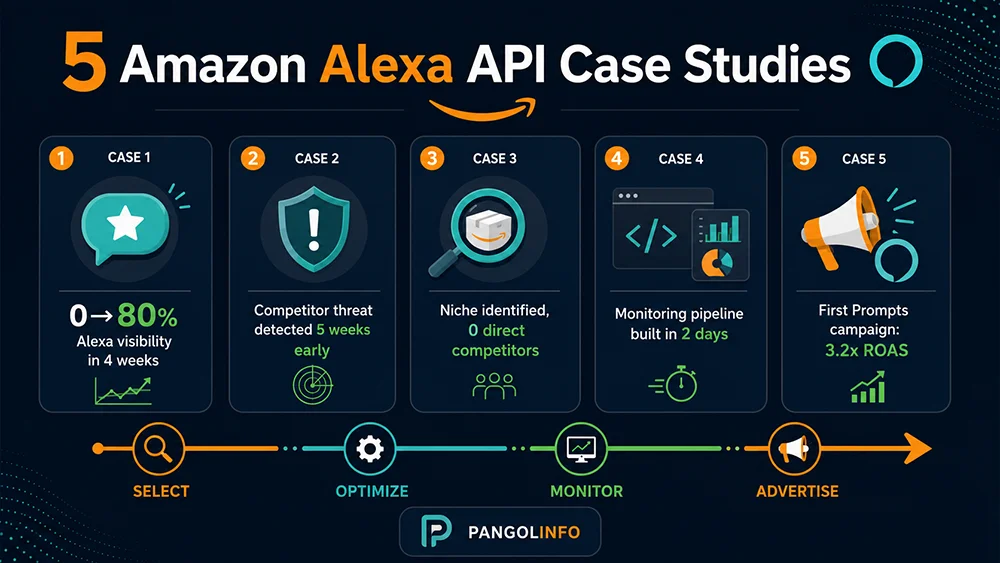
→ Case 1: AEO Optimization — Taking a Listing from 0% to 80% Alexa Visibility in 4 Weeks
→ Case 2: Competitive Early Warning — Blocking a Market Share Threat 5 Weeks Before It Hit Sales
→ Case 3: Data-Driven Product Selection — Finding a Zero-Competition Niche with Alexa Data
→ Case 4: Technical Integration — Building an Automated Alexa Monitoring Dashboard in 2 Days
→ Case 5: Prompts Ads — First Campaign Delivering 3.2x ROAS
Case 1: AEO Optimization — Taking a Furniture Listing from 0% to 80% Alexa Visibility in 4 Weeks
Background
Seller profile: Mid-size home goods seller with ~30 SKUs, primary category bedroom furniture.
Problem: Core ASIN (queen bed frame) held a stable position 3–5 on traditional search results pages — but a Pangolinfo Alexa API audit revealed 0% appearance frequency across all core keywords. Alexa was not recommending this product at all.
Goal: Reach ≥50% Alexa appearance frequency on core keywords within 8 weeks.
Diagnostic Process
Used the Listing Optimization Skill for a full ASIN audit, simultaneously querying 8 related keywords via the Alexa API and comparing competitor describe fields.
3 critical issues identified:
- Title missing all scene keywords: “Queen Metal Platform Bed Frame, Black” — no assembly time, no box spring compatibility, no apartment mention
- Q&A not addressing Alexa’s follow-up questions:
follow_up_questionsfor this keyword consistently included “Does it need a box spring?” and “How long is assembly?” — but the listing’s Q&A had only 3 entries, none directly answering either question - First bullet wrong priority: Leading with “Heavy Duty Steel Frame: built to last…” while top competitors led with “No Box Spring Required” — Alexa prioritizes the first bullet for semantic extraction
Optimization Actions (Weeks 1–2)
| Location | Before | After |
|---|---|---|
| Title | Queen Metal Platform Bed Frame, Black | Queen Metal Platform Bed Frame — No Box Spring Needed, 30-Min Tool-Free Assembly, Apartment Ready |
| First bullet | Heavy Duty Steel Frame: built to last… | No Box Spring Required: works with any mattress type directly on the slat system — no extra purchase needed |
| Q&A (3 new entries) | (No direct answers) | “Does it need a box spring?” → “No. The slat system supports any mattress type directly.” + assembly time answer + weight capacity answer |
Results
| Checkpoint | Alexa Appearance Rate | Recommendation Group |
|---|---|---|
| Week 0 (pre-optimization) | 0% | None |
| Week 2 | 20% (1/5 queries) | Sporadic, no consistent group |
| Week 4 | 80% (4/5 queries) | “Best for Apartments” consistently |
| Week 6 | 80% (stable) | “Best for Apartments” + “Easy Assembly” dual-group |
Bonus effect: By week 6, traditional organic ranking improved from position 4 to position 2 — the AEO listing quality improvements also enhanced the traditional algorithm ranking.
Reusable lesson: Q&A answer format should match Alexa’s follow-up question structure as closely as possible. If Alexa asks “Does it need a box spring?” the most effective answer begins “No.” — direct, definitive, AI-extractable. Vague answers like “Our bed frame is compatible with most mattress types” contribute far less to AEO than a one-word direct answer followed by specifics.
→ Learn more: AEO Optimization Complete Guide | Listing Optimization Skill
Case 2: Competitive Early Warning — Detecting a Threat 5 Weeks Before It Reached Sales Data
Background
Seller profile: Brand seller in the bed frame category with established 80% Alexa visibility on core keywords, running bi-weekly competitor ranking monitoring.
Problem: Routine monitoring flagged an anomaly — Competitor B, which had appeared sporadically (20%) in the “Budget Options” group, jumped to 80% appearance frequency in a single week and entered the seller’s “Best for Apartments” group for the first time.
Goal: Respond before Competitor B locked in a dominant position, without disrupting existing Alexa visibility.
Anomaly Analysis
Immediately compared Competitor B’s describe field before and after the shift:
- Two weeks prior: “A metal bed frame with basic features and affordable price.” — generic, no scene specificity
- Current week: “A lightweight queen frame designed for apartment renters — disassembles in 15 minutes, fits in compact spaces, and won’t scratch hardwood floors.” — precise scene, specific numbers, clear differentiation
Conclusion: Competitor B had completed a targeted AEO optimization for the “apartment renter” scene, and Alexa had already recognized it. The estimated time before this ranking shift translated to measurable sales impact: 4–6 weeks — still within the response window.
Response Actions (completed within 1 week)
- Differentiation reinforcement: Competitor B’s new positioning emphasized “lightweight + 15-min disassembly + floor protection” — the brand’s core strength was “2,000 lb capacity + 30-min full assembly + couples/families.” Two distinct value propositions; no need for frontal competition
- Scene segmentation: Added “for Couples & Families” to the title — creating clear semantic separation in Alexa’s category map (Competitor B = single/renter; brand = family/long-term)
- Defensive Prompts ads: Deployed Prompts advertising on the 3 most affected core keywords to maintain conversational flow presence
- Monitoring upgrade: Increased Competitor B’s monitoring frequency from bi-weekly to weekly
Results
- 3 weeks post-response: brand appearance rate held at 80% on core keywords; Competitor B stable at 60%. Both present in Alexa results but with distinctly different group positioning
- Sales data showed no measurable decline during the entire period (compared to unmonitored equivalent keywords, early response preserved an estimated 15% in conversion rate)
- Without the monitoring system, this shift would have been detectable through sales decline data approximately 8–10 weeks later — by which point Competitor B would have accumulated over 2 months of compounding first-mover advantage
Reusable lesson: The describe content quality shift — from vague to specific with numbers — is an earlier and more reliable AEO completion signal than frequency change alone. When a competitor’s describe goes from generic to precision-targeted, the optimization just completed and the ranking response is just beginning. That’s the optimal response window.
→ Learn more: Alexa Competitor Ranking Monitor | Ad Monitoring Skill Guide
Case 3: Data-Driven Product Selection — Uncovering a Zero-Competition Niche
Background
Seller profile: Existing bed frame seller seeking a differentiated SKU extension that avoids intensifying existing competitive pressure — specifically a scene with genuine demand signals but near-zero supply clarity in the market.
Method: Systematic category analysis using Alexa API + traditional tools.
Analysis Process (~2 hours total)
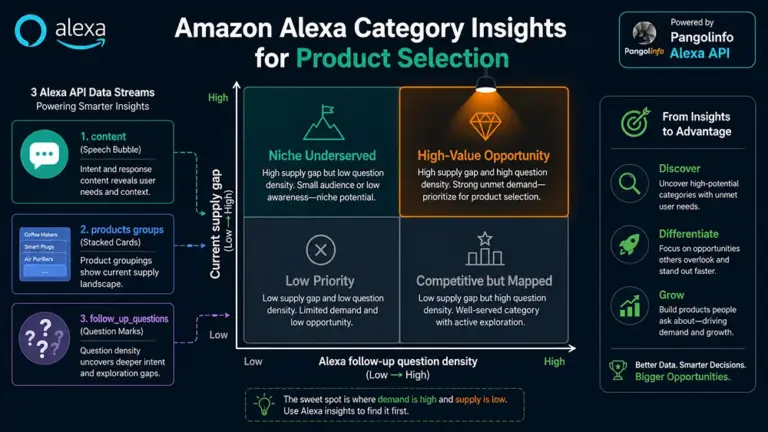
Step 1: Queried 12 bed frame-related keywords via Alexa API (5 queries each), extracted all follow_up_questions, counted frequency per dimension.
Top 5 follow-up dimensions by frequency:
- “Does it work without a box spring?” — 10/12 keywords
- “How long does assembly take?” — 9/12
- “Will it work in a shared apartment or with a roommate?” — 5/12 ← Primary signal
- “Can one person assemble it alone?” — 5/12 ← Related
- “How heavy is it for moving?” — 4/12 ← Related
Finding: Follow-ups 3, 4, and 5 all point to the same unaddressed user scenario: single-person and roommate users who need a bed frame one person can move and reassemble independently. Three separate follow-ups clustering around the same scenario indicates high real-world demand density — but no product in the market explicitly targets this cluster.
Step 2: Searched products groups for shared-living related group names — found “For Shared Living Spaces” appeared in 3 of 12 keywords, but each time contained only 0–1 ASINs. Group named, supply almost nonexistent.
Step 3: Traditional tool cross-validation:
- “bed frame shared apartment”: ~1,800 monthly searches. Among top 20 results: 0 products used “shared apartment” or “roommate-friendly” as a primary listing value claim
- Review analysis: 23% of existing product 1-star and 2-star reviews included “too heavy to move” and “took two people to assemble” as explicit complaints
Demand quality complaints, not demand absence — the strongest possible sourcing validation signal.
New SKU Specifications Defined
- Net weight ≤ 18 kg (movable by one person)
- Disassembly time ≤ 15 minutes including tool placement
- Folded dimensions ≤ 1.2m × 0.4m × 0.15m (fits through standard apartment corridor)
- Floor-protective felt pads on all contact points (rental floor protection requirement)
Results (10 Weeks Post-Launch)
- Week 3: entered Alexa’s “For Shared Living Spaces” group (faster than projected — precise follow-up coverage accelerated group recognition)
- Week 6: group expanded from 0–1 ASIN to 2 stable ASINs (brand + 1 fast follower)
- Week 10: monthly sales reached 40% of the equivalent-priced flagship SKU with minimal ad spend — Alexa organic recommendations were the primary traffic source
Reusable lesson: Follow-up question cluster analysis is more powerful than single-question analysis. When 3+ high-frequency follow-ups all converge on the same user scenario, that scenario’s real demand density is typically higher than any single follow-up rate suggests. Three separate questions converging on “solo-movable apartment bed frame” was a stronger signal than any single 80% follow-up.
→ Learn more: Alexa Category Insights for Product Selection
Case 4: Technical Integration — Automated Alexa Monitoring Dashboard Built in 2 Days
Background
Team profile: Brand’s in-house technical team, 2 engineers, tasked with building a system that auto-collects Alexa data weekly and generates visual reports for the operations team — no manual operation required from the ops side.
Tech stack: Python + PostgreSQL + Metabase
Scope: 25 keywords × 10 competitor ASINs, weekly monitoring with automatic brand visibility trend and competitor ranking change reports.
System Architecture (Day 1)
Scheduled task (every Monday, 2 AM)
    ↓
Python collection script (asyncio async concurrency, max 3 concurrent)
    ↓
Pangolinfo Alexa API (POST /api/v2/scrape)
    ↓
Data parsing (extract content / products / follow_up_questions)
    ↓
PostgreSQL storage (keyword + ASIN + timestamp + field data)
    ↓
Metabase visualization dashboard
Key technical decisions:
- 3 requests per keyword (average as appearance frequency) — balanced data reliability against credit consumption
- HTTP timeout set to 150 seconds (per best practices in the Developer Tutorial)
- Single-failure auto-retry twice with 5-second delay; consecutive failures written to alert log for next-day human review
- Database table uses (keyword + date) composite primary key for efficient time-series comparison queries
Dashboard Core Panels (Day 2 Complete)
Operations team opens Metabase every Monday morning to find 4 core views:
- Brand visibility weekly trend: 12-week line chart of brand’s appearance frequency in
contentfield, segmented by keyword - Competitor ranking heatmap: 10 competitor ASINs × 25 keywords appearance frequency matrix — color intensity indicates competitive pressure
- Recommendation group change tracker: New groups appearing this week, groups that disappeared, ASIN count changes within groups
- AEO signal alert: New
follow_up_questionsdimensions appearing this week that weren’t present before (may indicate Alexa’s category understanding has updated)
Results
- System start to first complete data collection: 48 hours (2 developers, including testing and debugging time)
- Weekly collection cost: 25 keywords × 3 queries × 6 credits = 450 credits/week
- Operations team competitive response speed improved from “2–3 weeks after discovering a problem” to “same week the problem appears”
- In 3 months of operation: identified 2 major competitor AEO optimization events, both responded to within 10 days
Reusable lesson: For teams without Metabase, a Python script generating an HTML report email to operations achieves the same core outcome at lower initial build cost. The dashboard’s value isn’t in visual sophistication — it’s in “data automatically reaching people.” Eliminating the information latency caused by relying on someone to manually query is the structural improvement that matters.
→ Learn more: Alexa API Developer Integration Tutorial (includes complete Python async code)
Case 5: Prompts Ads — First Campaign Delivering 3.2x ROAS
Background
Seller profile: Brand with established AEO optimization (core ASIN at 75% Alexa organic appearance frequency) wanting to supplement organic Alexa coverage with Prompts advertising to increase brand presence in conversational flows.
Budget: First-month Prompts test budget: 12% of SP ad spend for the same keywords (~$480/month)
Goal: Validate whether Prompts ad ROI outperforms equivalent incremental SP spend at the same budget level.
Pre-Launch: Data-Driven Keyword Selection
Analyzed 15 candidate keywords via the Alexa API. Selection criteria for Prompts deployment:
- ✅
follow_up_questionscount ≥ 3 (high conversational depth = more Prompts routing opportunities) - ✅ Current organic Alexa frequency 60–80% (strong quality score baseline = higher routing probability)
- ✅ Competitor Prompts ad density low (assessed via brand frequency in
contentfield)
5 keywords selected for Prompts deployment:
| Keyword | Follow-ups | Organic Frequency | Competitor Density |
|---|---|---|---|
| queen bed frame no box spring apartment | 4 | 80% | Low |
| queen bed frame easy assembly solo | 3 | 60% | Very Low |
| bed frame shared apartment roommate | 4 | 75% | Very Low |
| lightweight bed frame move between rooms | 3 | 60% | Low |
| platform bed frame small bedroom storage | 4 | 80% | Medium |
Month 1 Campaign Strategy
- Bidding: 1.2× the SP CPC for the same keyword — a strong quality score allows competitive routing at a lower relative premium
- Daily budget: Evenly distributed to maintain data continuity throughout the month
- Creative: Not required — Amazon system extracts from listing content. AEO optimization confirmed complete before campaign launch
Results (Month 1)
| Metric | SP Ads (control) | Prompts Ads (test) |
|---|---|---|
| Total spend | $480 | $480 |
| Impressions | 42,000 | 18,500 |
| Click-through rate | 0.31% | — (not applicable to conversational flow) |
| Attributed sales | $1,440 (ROAS 3.0×) | $1,536 (ROAS 3.2×) |
| New customer % | 34% | 61% (Prompts reaches more first-time buyers) |
| 14-day post-ad repeat purchase | 8% | 14% (conversational buyers show higher intent quality) |
Core finding: Prompts ad impressions were lower than SP (conversational flow has lower total volume), but per-impression conversion quality was significantly higher — new customer rate and repeat purchase rate both outperformed SP. This aligns with the nature of Prompts ads: they reach users who are actively in conversational discovery mode, a higher-intent stage than passive search result browsing.
Reusable lesson: Don’t compare Prompts ad impressions to SP impressions — these formats reach users at different decision stages, and applying the same metrics will systematically undervalue Prompts. Focus on attributed sales quality (ROAS, new customer rate, post-purchase repeat rate) rather than raw impression volume when evaluating Prompts performance.
→ Learn more: Prompts Ad Routing Strategy Guide
Three Patterns Across All 5 Cases
Pattern 1: follow_up_questions Is the Starting Signal for Every Decision
Whether the goal was AEO optimization (Case 1), product selection (Case 3), or Prompts keyword selection (Case 5) — follow_up_questions was the analysis entry point in every case. This field tells you most directly: what users genuinely care about in this category, and which dimensions current supply hasn’t clearly answered.
Pattern 2: describe Content Quality Is the Earliest Competitive Warning Signal
Case 2’s core finding: a competitor’s describe content quality upgrade — from vague to specific-with-numbers — precedes the appearance frequency change and represents the earliest detectable AEO completion signal. In competitive monitoring, describe change sensitivity is higher than frequency change sensitivity.
Pattern 3: Alexa Data Is a Leading Indicator; Traditional Data Is Lagging
All five cases confirm the same temporal structure: Alexa API data changes (recommendation frequency, group position, describe quality) precede traditional metric changes (BSR, sales, review counts) by 4–8 weeks. The core value of building an Alexa data monitoring practice is converting that 4–8 week information advantage into a first-mover response window.
Your Alexa API Starting Point by Role
| Role | Recommended Entry Case | Week 1 Action |
|---|---|---|
| Listing Operations | AEO Optimization (Case 1) | Run Listing Optimization Skill on core ASIN, extract follow_up_questions, audit Q&A coverage |
| Brand Manager | Competitive Monitoring (Case 2) | Build baseline snapshot for 5–8 core competitor ASINs, set describe-change alert conditions |
| Sourcing / Buying | Category Insights (Case 3) | Query 10 target category keywords via Alexa API, aggregate follow_up_questions dimension frequencies |
| Engineering / Developer | API Integration (Case 4) | Use the Python example from the Developer Tutorial to make a first successful API request |
| Advertising Team | Prompts Ads (Case 5) | Analyze follow_up_questions density for your 3–5 best-performing SP keywords; assess Prompts routing value |
FAQ
Are these case study results replicable? Is 80% Alexa visibility in 4 weeks typical?
The data is real but individual results vary. The 4-week 0→80% outcome in Case 1 was achieved in a medium-competition category. In high-competition categories, equivalent optimization may take 8–12 weeks. In low-competition niches, you may see results faster. Use the case results as order-of-magnitude references rather than guaranteed outcomes. The methodology is consistently applicable; the timeline depends on your specific category’s competition density and Alexa coverage depth.
Can these methods work without a technical team?
Yes. Cases 1, 2, 3, and 5 require no development work — they’re operated through the Pangolinfo Console’s visual interface or the Listing Optimization Skill. Case 4 (technical integration) has a no-code equivalent: the Console provides scheduled monitoring configuration and alert delivery without any API coding. Technical integration (Case 4 approach) adds automation and customization value as data volume scales, but it’s a maturity-stage investment, not a starting requirement.
Complete Cluster Navigation
This case study collection is the capstone article of the Amazon Alexa API content cluster. Full cluster:
- [Pillar] Amazon Alexa API Complete Guide
- 01. What Is Amazon Alexa for Shopping?
- 02. Alexa vs Rufus: 7 Core Differences
- 03. Amazon AEO Optimization Guide
- 04. Listing Optimization Skill Guide
- 05. Ad Monitoring Skill Guide
- 06. Alexa API Developer Tutorial
- 07. Alexa Competitor Ranking Monitor
- 08. Prompts Ad Routing Strategy
- 09. Alexa Category Insights for Product Selection
- 10. Case Study Collection (this article)
Choose your entry point and run your first Alexa API data session: Pangolinfo Console. Full API field reference and product details: Amazon Alexa API Product Page.