
Amazon Prompts Ad Routing Strategy
There’s an emerging consensus in the Amazon advertising community: Prompts ads are the highest-value ad format to establish early positioning in right now. But most sellers’ understanding stops at “a new ad slot” — they don’t know how routing decisions work, how to improve their routing probability, or what data to use to prioritize their investment.
This article covers three things: how Prompts ad routing actually works, how to use Alexa API data to predict which keywords have the highest routing competition and value, and how listing optimization directly improves your semantic match quality score — the factor that separates brands who appear in Alexa conversations from brands who don’t.
What Are Prompts Ads and Where Do They Appear?
Prompts ads are Amazon’s native ad format for the Alexa for Shopping conversational flow. The defining difference from traditional formats is context of appearance:
- Traditional SP ads: Appear in search result product grids labeled “Sponsored” — users see them after completing a keyword search
- Prompts ads: Appear within Alexa’s conversational response flow in natural language — users encounter them while actively dialoguing with Alexa about a purchase decision
A real-world Prompts ad scenario: a user asks Alexa “I need a bed frame for a studio apartment that assembles easily and doesn’t need a box spring.” Alexa responds: “I found several options for you. The [Brand Name] [Product Name] is a great choice for apartment renters because it assembles in about 30 minutes without tools and works directly on the platform without a box spring…” — the [Brand Name] recommendation here may be a Prompts ad placement.
From the user’s perspective, Prompts ads are deeply integrated with Alexa’s organic recommendations — they feel more like AI-curated advice than traditional advertising. This is Prompts ads’ core value: reaching users who are in active, conversational decision-making mode rather than passive browsing.
The Routing Mechanism: How Alexa Decides Which Prompts Ad to Show
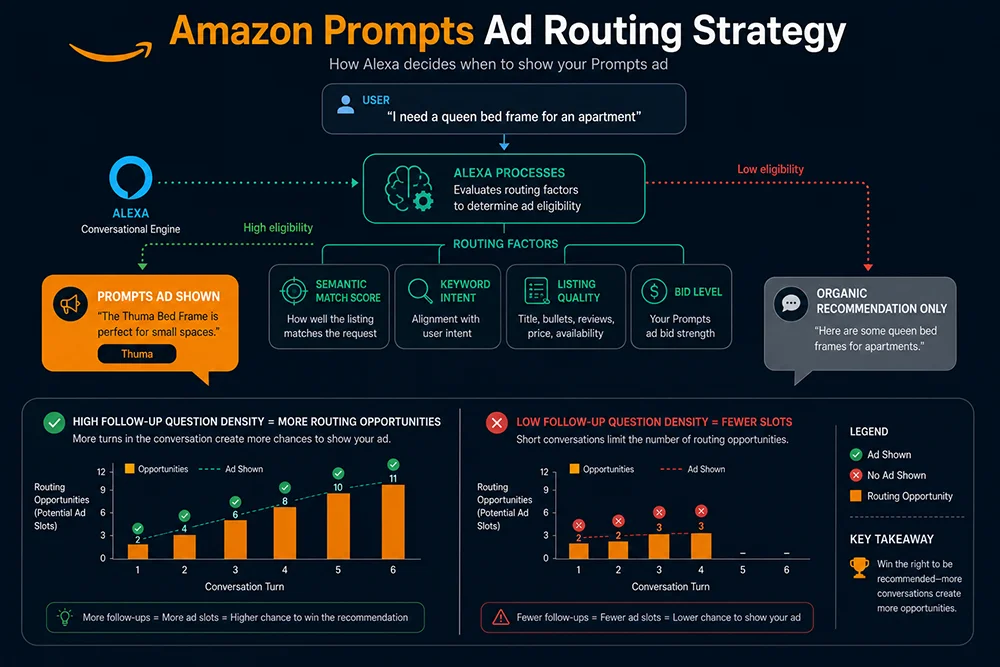
Prompts ad routing is not a pure price auction. It operates on a bid × semantic match quality score dual-factor decision model.
Factor 1: Bid Level
Similar to SP ads, Prompts ads support keyword or audience-level bidding. Higher bids improve routing probability at equivalent quality scores. But unlike SP ads, bid is not the sole routing determinant.
Factor 2: Semantic Match Quality Score
This is the most critical — and most commonly overlooked — routing factor. Alexa’s system evaluates:
- The semantic relevance of your listing content to the user’s current conversational intent
- How completely your listing covers the scene, audience, and functional dimensions the user’s query implies
- Whether your product’s differentiation can be clearly extracted and presented in Alexa’s AI summary
A listing with a low quality score will be outrouted by competitors with better semantic match — even if your bid is higher.
Factor 3: User Intent Type
Alexa classifies user intent: exploratory (“find me a few options for…”), comparative (“which is better between A and B?”), and decisional (“I need a specific product that…”). Different intent types trigger different routing priorities. Decisional intent queries typically have the highest Prompts ad routing value.
Factor 4: Category Competitive Density
Each keyword can trigger a limited number of Prompts ad slots in Alexa’s conversational flow (typically 1–2). More advertisers competing for the same keyword means higher routing competition and higher cost-per-impression.
| Routing Factor | Traditional SP Ads | Prompts Ads | Strategic Implication |
|---|---|---|---|
| Bid level | Primary determinant | Important but not sole factor | High bids necessary but insufficient |
| Semantic quality score | No equivalent factor | Equal weight to bid | Listing AEO optimization directly improves ad performance |
| Keyword matching | Exact / broad / phrase match | Semantic intent matching | Keyword research needs to shift toward intent and scene analysis |
| User intent type | Not differentiated | Routed by intent classification | Decisional intent keywords produce higher Prompts ad ROI |
Using Alexa API Data to Predict Routing Competition
Without data, your Prompts ad investment decisions are blind — you don’t know which keywords are worth bidding on, which competitors have already claimed the conversation slots, or which use-case dimensions represent the highest-value entry points.
Three fields from the Pangolinfo Alexa API directly support Prompts ad routing analysis:
The content Field: Measure Competitor Ad Penetration
Check how frequently competing brand names appear in Alexa’s AI summary text, and where in the text they appear. High brand frequency in the content field correlates with both active Prompts ad investment and strong semantic quality scores from those competitors.
Analysis method: Query the same keyword 3–5 times across different times of day. Record brand appearance frequency. Brands appearing in 60%+ of responses are almost certainly actively running Prompts ads with strong quality scores. Brands appearing 20% or less may be in the conversation organically but not running aggressive Prompts campaigns.
The follow_up_questions Field: Identify High-Value Ad Routing Entry Points
This is the most important Prompts ad strategy data source available. The core analysis logic:
- High follow-up question frequency on a dimension = High-value user decision point = High-conversion Prompts ad scenario
- If Alexa frequently asks “Does it need a box spring?” for your keyword, that dimension is a primary decision gate for buyers in your category
- Prompts ads that clearly address this dimension in their Alexa-extracted content will receive the highest semantic match quality scores for routing on that keyword
Step-by-step process:
- Query 10–15 core keywords through the Alexa API
- Extract all
follow_up_questionsand count frequency per dimension - The 3–5 most frequently appearing follow-up dimensions are the highest-value scenes for Prompts ad content alignment
- Cross-reference with your listing — any dimension not clearly addressed in your listing is a gap that must be closed before Prompts ads can perform there
The products[].describe Field: Analyze Competitor Ad Content Strategy
Alexa’s AI descriptions of recommended products (describe) reflect competitors’ listing semantic strengths — and by extension, the semantic dimensions fueling their Prompts ad quality scores.
Identify which value dimensions Alexa consistently highlights when describing each competitor. Dimensions where your listing is weak relative to competitors are your quality score gaps — closing those gaps is more valuable than raising your bid.
Practical Example: Bed Frame Category Routing Analysis
Querying “queen bed frame apartment” 5 times via the Alexa API:
| Analysis Dimension | Data Result | Strategic Meaning |
|---|---|---|
| Brand frequency in content | Brand A: 4/5 times; Brand B: 3/5; Brand C: 1/5 | Brand A/B have deep Prompts ad coverage; Brand C has minimal investment |
| Top follow-up dimensions | “No box spring” (5/5), “Assembly time” (4/5), “Weight capacity” (3/5) | These 3 dimensions are the highest-value Prompts ad routing entry points |
| Competitor describe emphases | Brand A emphasizes “30-min assembly”; Brand B emphasizes “2,000 lb capacity” | Both top brands own one high-value dimension; “apartment-friendly” niche remains unclaimed |
Strategic conclusion: Target the “apartment-friendly” unclaimed niche — optimize listing for that dimension and bid on related scene-specific keywords where routing competition is lowest. Avoid directly competing against Brand A/B’s entrenched “assembly time” and “weight capacity” positions until quality score parity is established.
How Listing Optimization Raises Your Routing Quality Score
Prompts ad content doesn’t require separate creative — Amazon’s system extracts your listing content and presents it in natural language within Alexa’s response. Your listing’s AI readability quality is your Prompts ad content quality.
Three listing actions that directly improve routing quality scores:
Action 1: Lead with High-Frequency Follow-Up Dimensions in Title and First Bullet
Take the 2–3 most frequently appearing follow_up_questions dimensions and include them in your title and first bullet using specific, concrete language. This is the most direct quality score improvement action — Alexa extracts these dimensions immediately to assess routing relevance for conversational queries.
Rewrite example:
- ❌ Before: “Metal Queen Platform Bed Frame, Heavy Duty, Easy Assembly, Black”
- ✅ After: “Metal Queen Platform Bed Frame — No Box Spring Needed, 30-Min Tool-Free Assembly, 2,000 lbs Capacity, Apartment & Studio Friendly”
Action 2: Provide Specific Answers to Every High-Frequency Follow-Up Question in Q&A
The Q&A section is one of the highest-weighted content areas in Alexa’s routing quality score evaluation. Every question that appears in follow_up_questions for your keywords should have a clear, specific, numerically grounded answer in your Q&A section — not a generic non-answer.
Action 3: Validate with the Listing Optimization Skill
After making listing changes, run the Listing Optimization Skill to confirm the changes improved your AI readability score. Re-query the same keywords via Alexa API two weeks later to measure whether brand visibility in the content field has increased — this is your quality score improvement signal.
SP vs. Prompts Ad Budget Allocation Framework
Prompts ads and SP ads address the same buyer base at different decision stages — they’re complementary, not competitive:
- SP ads: Catch explicit search intent — the user already knows what they want and is actively querying for it
- Prompts ads: Catch conversational discovery — the user is describing a need, comparing options, seeking recommendations
Phased Budget Allocation
| Phase | Prompts Budget vs. SP | Strategic Focus | Validation Metric |
|---|---|---|---|
| Test (Weeks 1–4) | 10–15% of SP budget for same keywords | Collect routing data; identify which keywords generate Prompts impressions | Alexa content brand visibility before/after |
| Optimize (Weeks 5–8) | 15–25% of SP | Increase bids on high-ROI keywords; pause low-impression keywords | Prompts impression volume + attributed conversions |
| Scale (8+ weeks) | Dynamic, ROAS-based | Expand to adjacent scene keywords; add defensive brand-term coverage | Brand conversation visibility vs. competitor trend |
Keyword Prioritization for Prompts Ad Deployment
- Deploy first: Keywords with follow_up_questions count ≥ 3 + your listing clearly covers those dimensions + competitor Prompts ad presence is low
- Deploy next: Your own brand terms + top 2–3 competitor brand terms (defensive coverage)
- Defer: Keywords with 0–1 follow-up questions (short user decision chain, low conversational value) + categories where competitors have dominant quality scores and deep ad saturation
Category Routing Characteristics: Where Prompts Ads Deliver Most Value
High follow-up density categories (strong Prompts ad value)
- Furniture / home goods: Size compatibility, assembly complexity, weight ratings, style matching — rich multi-dimensional decision process
- Health / fitness equipment: Target user level, space requirements, noise considerations, training outcomes
- Baby & toddler products: Safety certification, age-appropriateness, material sourcing, compatibility
- Electronics accessories: Device compatibility, connector specs, charging speed, brand certification
Low follow-up density categories (Prompts ad value is lower)
- Consumables / everyday basics: Short decision chain, users typically jump straight to price comparison without extended Alexa dialogue
- Standard-spec commodities: Generic batteries, standard light bulbs — limited differentiation dimensions, minimal Alexa follow-up space
Quick test: Query your core keywords via the Alexa API. If follow_up_questions returns ≥ 3 questions covering multiple decision dimensions, your category has strong Prompts ad value. If you consistently see fewer than 2 follow-up questions, prioritize SP budget and use Prompts ads minimally or defensively only.
FAQ
How do I measure Prompts ad effectiveness?
Use a two-source measurement approach: (1) Amazon Ads console Prompts-specific impression count and attributed sales data; (2) Alexa API before/after comparison — measure brand mention frequency in the content field before and 2–4 weeks after launching Prompts ads, and track competitor relative visibility on the same keywords. The two data sources cross-validate: if ads are routing successfully, Alexa visibility should improve; if visibility improved but ad metrics are flat, quality score may be improving organically through AEO work.
If competitors already dominate Prompts ad slots in my category, is there still an opportunity?
Yes — adjust strategy rather than give up. Two entry approaches: (1) Scene segmentation — compete in less-saturated scene-specific long-tail keywords (“apartment-friendly queen bed frame” rather than “queen bed frame”) where competitor coverage is thinner; (2) Quality score competition — if your listing’s semantic quality score can exceed competitors’ through focused AEO optimization, you can win routing at equal or lower bid levels. Use the Ad Monitoring Skill to identify competitor weak spots in the category follow-up question landscape.
Should Prompts ad spend come from new budget or be reallocated from SP?
For sellers with stable SP ROI: treat Prompts ads as incremental budget, not SP reallocation. Cutting proven SP budget to fund Prompts ads before you have routing performance data is unnecessary risk. Start Prompts as a supplemental layer at 10–15% of SP spend for the same keywords, build a data foundation over 4 weeks, then adjust allocation based on observed performance.
The Bottom Line
The core logic of Prompts ad routing: the brand whose listing most accurately addresses the user’s conversational intent gets routed — not simply the brand that bids the most.
The data-driven playbook:
- Use the Pangolinfo Alexa API to collect
follow_up_questionsfor your core keywords - Identify the 3–5 highest-frequency decision dimensions as primary routing targets
- Use the Listing Optimization Skill to diagnose and improve those dimensions’ AI readability
- Deploy Prompts ads on quality-score-ready keywords, prioritizing underserved niche scenes
- Track results and competitive shifts using the Ad Monitoring Skill
→ Pillar Page: Amazon Alexa API Complete Guide
→ AEO Foundation: Amazon AEO Optimization Guide
→ Competitive Intelligence: Ad Monitoring Skill Guide
→ Developer Integration: Pangolinfo Alexa API Developer Tutorial
Start your Prompts ad routing analysis now: query your core keywords’ follow_up_questions data via the Pangolinfo Console to identify your highest-value conversational ad entry points. Full Alexa API field reference: Amazon Alexa API Product Page.