

Why Is Amazon Multi-Variation Price Scraping So Much Harder Than It Looks?
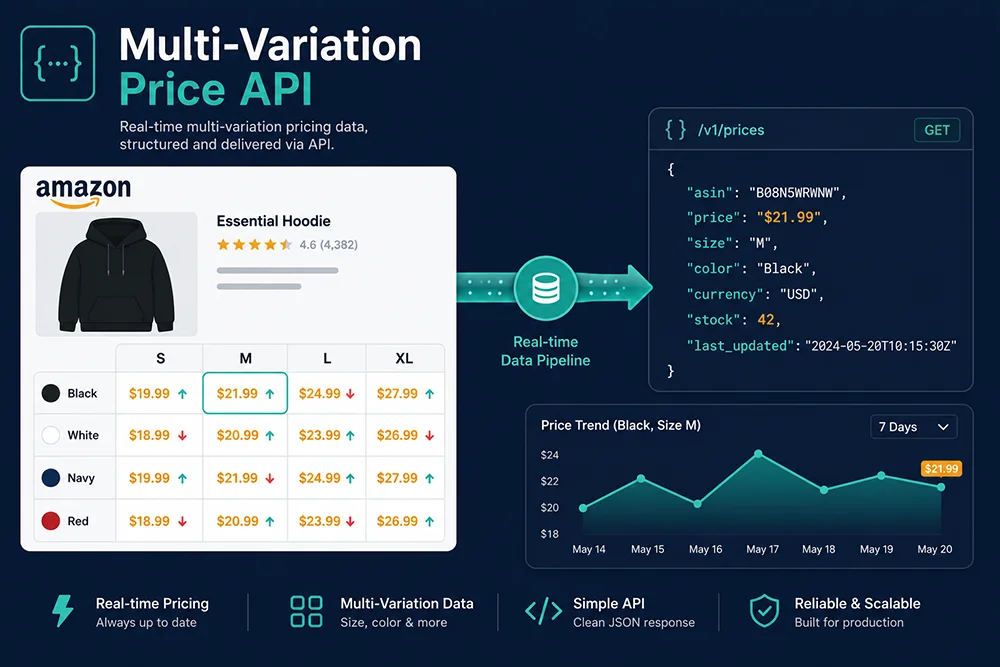
Amazon multi-variation price scraping catches most developer teams off guard: what appears to be a simple “get the price of this product” task reveals itself as a multi-layered problem involving dozens of independent child ASINs, JavaScript-rendered price switching, geo-restricted data, and update cycles measured in minutes. According to Jungle Scout’s 2025 Seller Report, the average apparel listing has 14.3 variations while consumer electronics accessories average 23 — meaning a 500-SKU monitoring list may require tracking over 8,000 individual child ASINs, each with prices that can change multiple times per hour.
This isn’t a problem you solve by “just scraping more.” It requires rethinking your data collection architecture from the ground up. This guide walks through the technical reality of variation price collection and presents a practical, scalable approach.
How Does Amazon’s Variation Data Structure Actually Work?
Understanding why Amazon multi-variation price scraping is uniquely challenging starts with the platform’s underlying data model. Amazon organizes variation products using a parent ASIN / child ASIN hierarchy: the parent ASIN is a logical grouping node that doesn’t participate in transactions; the child ASINs — one per distinct variation combination — are the sellable units with independent prices, inventory levels, and rankings.
Why Can’t You Just Scrape the Parent ASIN Page for All Prices?
When a user navigates to a variation product URL, Amazon renders a single child ASIN’s data by default — the one corresponding to the currently selected dimension combination. Other variants’ prices are loaded via asynchronous JavaScript requests, triggered only when a user interacts with the variation selector (clicking a size tile or color swatch). A raw HTTP request to the parent ASIN page captures only the default variant’s HTML; the remaining N-1 variant prices simply don’t exist in the static response.
The structural complexity compounds when you consider cross-category variation patterns. Apparel typically uses a two-dimensional Color × Size matrix, which can yield 40+ child ASINs for a single parent. Consumer electronics might use three-dimensional combinations (Capacity × Color × Model Year). Home goods often feature non-standard dimensions like Bundle Count × Material. Any self-built scraper targeting multiple categories must handle each of these schemas independently — a significant ongoing maintenance burden.
What Anti-Scraping Mechanisms Make Variation Price Collection Particularly Difficult?
Beyond structural complexity, Amazon’s bot detection stack creates additional friction that multiplies in proportion to the number of variations you’re targeting. Three mechanisms are most commonly encountered in production:
First, IP rate limiting at the parent-ASIN level. When a single IP address makes sequential requests to multiple child ASINs under the same parent, Amazon’s systems pattern-match this as automated behavior faster than unrelated ASIN requests. Based on empirical testing, a non-rotated IP typically begins receiving 503 responses or CAPTCHA redirects after 5–8 consecutive requests to child ASINs within the same variation family.
Second, geo-restriction affecting price accuracy. Amazon’s marketplace prices are region-isolated — a request from a non-local IP address often returns either a missing price field, a cached stale price, or a redirect to the marketplace homepage rather than the true local pricing. Accurate variation price data requires infrastructure with genuine residential IP coverage matching the target marketplace.
Third, JavaScript rendering requirements. The asynchronous price-loading triggered by variation selection depends on browser runtime execution — pure HTTP requests cannot trigger the XHR calls that fetch non-default variant prices. Capturing these requires headless browser automation (Playwright, Puppeteer), which adds hardware overhead, request latency, and additional failure modes to the collection pipeline.
Self-Built Scraper vs. Scrape API: Which Makes More Sense for Variation Price Collection?
The trade-off between building in-house and using a commercial API widens considerably in the multi-variation price scraping context. Here’s an honest comparison across three dimensions:
Total Cost of Ownership
A self-built system capable of reliably scraping Amazon multi-variation prices needs: a residential proxy pool (market rate $3–8/GB, averaging $300–800/month for moderate volumes), headless browser server infrastructure ($60–120/month for a basic cluster), CAPTCHA solving integration ($1–3 per thousand solves), and engineering time for development and ongoing maintenance (a mid-level scraping engineer runs $4,000–7,000/month). All-in, expect $1,500–4,000 per month to keep such a system operational — with costs spiking whenever Amazon updates its rendering pipeline or tightens its detection logic.
Using Pangolinfo Scrape API eliminates all fixed infrastructure costs. Pricing is strictly per-request, meaning you pay only for data you actually collect. For a team scraping 50,000 child ASINs per day, the monthly API cost typically runs 60–70% below the equivalent self-built system cost — while delivering higher data accuracy and zero maintenance burden.
Reliability and Data Freshness
Amazon updates its page structure or variation API response format approximately every 2–4 months. Each change breaks self-built parsers, typically requiring 3–7 days to diagnose and patch — during which price data goes dark. Commercial API providers absorb these updates internally, maintaining stable response contracts regardless of upstream changes. For teams where price data feeds into automated repricing or purchase decision systems, the cost of a 7-day data outage can far exceed the annual API subscription cost.
Data Accuracy
The most common failure mode of self-built variation scrapers isn’t “no data” — it’s “wrong data.” Teams frequently discover they’ve been collecting cached prices, prices from the wrong marketplace, or prices for only the default variation. Pangolinfo’s infrastructure uses marketplace-local residential IPs and includes dedicated parsing logic for Amazon’s variation-switching mechanism, ensuring that price fields for each child ASIN reflect the actual localized price a customer in that marketplace would see.
How to Implement Amazon Multi-Variation Price Scraping with Pangolinfo Scrape API
Pangolinfo Scrape API includes dedicated parsing for Amazon variation products. A single request to a parent ASIN returns the complete variation matrix with individual pricing for each child ASIN — eliminating the need to issue N separate requests for an N-variation product.
Key Fields in the Variation Price Response
The variations array in each API response contains one node per child ASIN, with the following core fields:
asin— Child ASIN identifierprice— Current selling price (currency + value)list_price— Original/strikethrough price (when present)price_prime— Prime member price (when applicable)availability— Stock statusvariant_dimensions— Key-value pairs defining the variation, e.g.,{"Color": "Midnight Black", "Size": "XL"}buybox_seller— Current Buy Box winner details
API Call Efficiency: Parent ASIN vs. Individual Child ASIN Requests
For a parent ASIN with 30 child variations, requesting child ASINs individually consumes 30 API credits. A single parent ASIN request returns all variation base prices in one call, reducing API consumption by roughly 60–80% for full-matrix price collection use cases. The individual child ASIN request pattern remains useful when you need deeper per-variant data (Customer Says, A+ content, full review counts) beyond what the variation matrix returns.
For teams integrating price monitoring into AI-driven workflows, the Pangolinfo Amazon Scraper Skill enables direct API calls from within AI Agent frameworks — making it straightforward to build “price anomaly detected → automated analysis triggered → decision recommendation delivered” pipelines without custom integration code.
Python Code Example: Batch Amazon Multi-Variation Price Collection
The following example demonstrates how to call Pangolinfo Scrape API from Python to collect full variation price matrices for a list of parent ASINs and identify pricing anomalies across the variation set.
import requests
import json
import time
from typing import List, Dict, Optional

API_KEY = "your_pangolinfo_api_key"
BASE_URL = "https://api.pangolinfo.com/v1/amazon/product"

def fetch_variation_prices(parent_asins: List[str], marketplace: str = "US") -> Dict:
    """
    Batch-collect Amazon variation price matrices for a list of parent ASINs.

    Args:
        parent_asins: List of parent ASINs, e.g. ["B08N5WRWNW", "B09G9FPHY6"]
        marketplace: Target marketplace code — US, UK, DE, JP, CA, etc.

    Returns:
        Dict keyed by parent ASIN containing full variation price data
    """
    results = {}

    for asin in parent_asins:
        payload = {
            "asin": asin,
            "marketplace": marketplace,
            "include_variations": True,
            "fields": [
                "price", "list_price", "price_prime",
                "availability", "variant_dimensions", "buybox_seller"
            ]
        }

        headers = {
            "Authorization": f"Bearer {API_KEY}",
            "Content-Type": "application/json"
        }

        try:
            response = requests.post(
                BASE_URL, json=payload, headers=headers, timeout=30
            )
            response.raise_for_status()
            data = response.json()

            variations = data.get("data", {}).get("variations", [])
            results[asin] = {
                "parent_asin": asin,
                "total_variations": len(variations),
                "fetched_at": data.get("fetched_at"),
                "variants": [
                    {
                        "child_asin": v["asin"],
                        "dimensions": v.get("variant_dimensions", {}),
                        "price": v.get("price"),
                        "list_price": v.get("list_price"),
                        "prime_price": v.get("price_prime"),
                        "in_stock": v.get("availability") == "In Stock",
                        "buybox_seller": v.get("buybox_seller", {}).get("name")
                    }
                    for v in variations
                ]
            }

        except requests.RequestException as e:
            print(f"[ERROR] Failed to fetch ASIN {asin}: {e}")
            results[asin] = {"error": str(e)}

        time.sleep(0.5)  # Respect API rate limits

    return results


def find_price_outliers(
    variation_data: Dict,
    threshold_pct: float = 0.20
) -> List[Dict]:
    """
    Identify variations whose price deviates from the sibling average
    by more than threshold_pct. Useful for detecting mispriced variants
    or aggressive competitor undercutting on specific size/color combos.
    """
    outliers = []

    for parent_asin, data in variation_data.items():
        if "error" in data or not data.get("variants"):
            continue

        priced_variants = [
            v for v in data["variants"]
            if v.get("price") and v["in_stock"]
        ]

        if len(priced_variants) < 2:
            continue

        prices = [
            float(v["price"].replace("$", "").replace(",", ""))
            for v in priced_variants
        ]
        avg_price = sum(prices) / len(prices)

        for variant, price in zip(priced_variants, prices):
            deviation = abs(price - avg_price) / avg_price
            if deviation > threshold_pct:
                outliers.append({
                    "parent_asin": parent_asin,
                    "child_asin": variant["child_asin"],
                    "dimensions": variant["dimensions"],
                    "price": price,
                    "avg_price_siblings": round(avg_price, 2),
                    "deviation_pct": round(deviation * 100, 1),
                    "direction": "above" if price > avg_price else "below"
                })

    return sorted(outliers, key=lambda x: x["deviation_pct"], reverse=True)


# Usage example
if __name__ == "__main__":
    # Competitor parent ASINs to monitor
    target_asins = [
        "B08N5WRWNW",  # Competitor A
        "B09G9FPHY6",  # Competitor B
        "B0BDJH3H79",  # Competitor C
    ]

    print(f"Fetching variation price matrices for {len(target_asins)} parent ASINs...")
    variation_prices = fetch_variation_prices(target_asins, marketplace="US")

    # Summary output
    for asin, data in variation_prices.items():
        if "error" not in data:
            print(f"\nParent ASIN: {asin}")
            print(f"  Total variations: {data['total_variations']}")
            print(f"  Fetched at: {data['fetched_at']}")
            for v in data["variants"][:3]:
                dims = " / ".join(f"{k}: {val}" for k, val in v["dimensions"].items())
                print(f"  [{dims}] Child: {v['child_asin']} → ${v['price']}")

    # Detect price outliers across variation sets
    outliers = find_price_outliers(variation_prices, threshold_pct=0.15)
    if outliers:
        print(f"\n⚠️  Found {len(outliers)} variants priced >15% from sibling average:")
        for item in outliers[:5]:
            dims = " / ".join(f"{k}: {v}" for k, v in item["dimensions"].items())
            print(
                f"  {item['parent_asin']} [{dims}] "
                f"${item['price']} vs avg ${item['avg_price_siblings']} "
                f"({item['direction']} by {item['deviation_pct']}%)"
            )
Tiered Monitoring: Maximize Coverage Within Budget
The most cost-efficient multi-variation price scraping strategy isn’t uniform high-frequency polling across all ASINs — it’s tiered scheduling based on competitive priority. Tier 1 (core competitors, Top 20 ASINs) runs hourly; Tier 2 (secondary competitors) runs every 4 hours; Tier 3 (category-level scanning, Top 100 ASINs) runs once daily. This allocation typically enables 3x more SKU coverage within the same API budget compared to flat-rate polling.
Frequently Asked Questions
Why is Amazon multi-variation price scraping harder than scraping regular products?
Amazon variation products share a parent ASIN but each child ASIN has independent pricing, inventory, and rankings. Loading a parent ASIN page renders only the selected variant’s price in static HTML — other variants load via JavaScript. Capturing the full variation price matrix requires either cycling through all dimension combinations or using an API that returns the complete variation data in a single structured response.
How often do Amazon variation prices change?
High-competition categories like electronics and apparel can see price changes every 15–60 minutes. During peak periods like Black Friday, top listings can update 20–40 times per day. For pricing decision systems, monitor core competitor ASINs at least hourly; 15–30 minute intervals for the highest-priority targets.
Can I scrape Amazon variation prices with Python requests?
Yes, but the total cost of ownership is prohibitive. Amazon’s anti-scraping stack requires a rotating residential proxy pool ($200–800/month), headless browser infrastructure, and CAPTCHA solving services. All-in cost is typically 3–5x higher than a commercial Scrape API, with lower reliability and significant maintenance overhead.
What variation price fields does Pangolinfo’s API return?
The API returns: current selling price, list price, Prime member price, child ASIN identifier, variant dimension key-value pairs (Color, Size, etc.), availability status, and Buy Box seller details — all as structured JSON requiring no HTML parsing.
How do I control costs when scraping large variation datasets?
Use tiered monitoring: core competitor ASINs hourly, secondary competitors every 4 hours, category rankings daily. This 3-tier approach typically covers 3x more SKUs within the same budget versus uniform polling. Pangolinfo charges per request with no minimums, making demand-driven scheduling cost-efficient.
The Right Approach to Amazon Multi-Variation Price Scraping
Amazon multi-variation price scraping isn’t about raw scraping power — it’s about getting the complete variation matrix accurately, reliably, and sustainably at scale. The parent/child ASIN structure, JavaScript-rendered price switching, geo-restrictions, and rapid price update cycles each create failure points that compound in a self-built solution. For teams with steady data needs, a commercial Scrape API delivers superior total cost of ownership against any in-house build once you account for infrastructure, maintenance, and data accuracy across the full variation set.
If you’re building an Amazon competitor price monitoring system or developing a SaaS tool that requires real-time variation price data, start with a free trial of Pangolinfo Scrape API, or review the API documentation for the complete variation price field reference.
🚀 Start your free trial of Pangolinfo Scrape API and automate Amazon multi-variation price scraping → Get Started