
Amazon Alexa Category Insights for Product Selection
Product selection is the most upstream decision in e-commerce — and the one with the lowest error tolerance. Choose the wrong category or the wrong differentiation angle, and every downstream investment in operations, advertising, and content amplifies that initial mistake.
Traditional sourcing tools (Jungle Scout, Helium 10, Brand Analytics) show you a market picture built from historical sales and keyword search volume — that picture is real, but it describes demand that has already been expressed and supply that already exists to meet it. The Pangolinfo Alexa API surfaces a different picture: the actual intent dimensions users articulate when describing their needs in AI conversations, and the specific places where current product supply hasn’t been clearly recognized by the AI.
This article covers three things: how to use Alexa API’s three data fields for category insights, how to translate those insights into differentiation opportunities, and how to integrate this dimension into a complete sourcing decision framework.
The Blind Spot in Traditional Sourcing Tools
What traditional tools tell you:
- Monthly search volume for target keywords
- Estimated monthly revenue for top 10 ASINs
- Category review density (entry barrier)
- Which keywords have relatively lower competition scores
What traditional tools can’t tell you:
- The specific decision dimensions users focus on when describing a purchase need in natural language
- Whether existing product listings clearly answer those dimensions in AI-readable terms
- Which user scenarios have insufficient semantic supply — where current products exist but AI can’t confidently recommend any of them
- Which follow-up questions Alexa consistently asks users that no current product clearly answers
This gap has become more strategically significant since Alexa took over Amazon’s search bar — users increasingly use natural language conversation to express purchasing needs rather than typing keywords. Traditional tools’ core data source (keyword search volume) is partially losing relevance, while Alexa API data comes directly from AI’s interpretation of user intent at the conversational layer.
3-Field Category Analysis Method
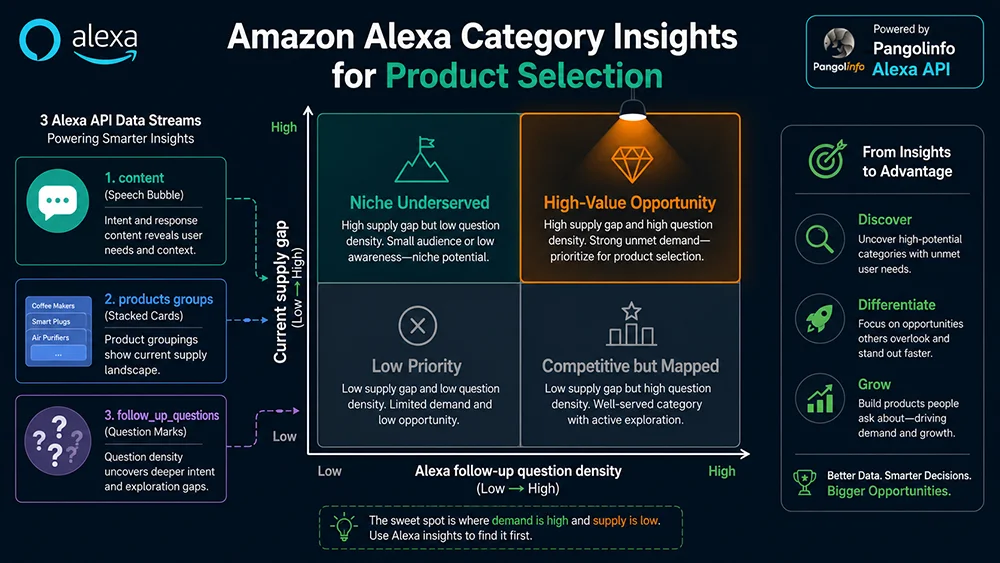
Field 1: follow_up_questions — Deconstruct the Category’s Core Decision Dimensions
follow_up_questions are the clarifying questions Alexa asks users after delivering recommendations. These questions represent Alexa’s data-driven understanding of the most critical purchase decision gates for that category — surfaces where existing product supply hasn’t provided clear enough answers.
Product selection use:
- Each follow-up question represents one user decision dimension — these are candidate differentiation directions
- High-frequency follow-up dimensions = unmet needs where supply-side semantic clarity is insufficient
- A product with an extremely clear answer to a high-frequency follow-up question starts with a structural AEO advantage from day one
Example — Bed frame category follow_up_questions analysis (10 queries):
| Follow-up Question | Frequency (10 queries) | Sourcing Implication |
|---|---|---|
| Does it need to work without a box spring? | 9/10 | No-box-spring design is the largest unmet need — clearest differentiation entry point |
| How long does assembly take? | 8/10 | Fast assembly is a core value signal; under 30 minutes tool-free is the competitive threshold |
| Do you need under-bed storage space? | 7/10 | High storage demand — premium add-on dimension for apartment scenarios |
| What’s the maximum weight capacity you need? | 6/10 | Weight rating is a hard threshold for certain users; 2,000+ lbs is a premium niche |
| Will it work in a shared apartment? | 4/10 | ⭐ Roommate / shared living scenario — almost no current product explicitly targets this |
Sourcing insight: Higher follow-up frequency indicates more widespread user need AND more insufficient supply-side clarity (if supply were clear, Alexa wouldn’t keep asking). The “shared apartment” dimension (4/10) has lower raw frequency but near-zero current product supply explicitly targeting roommate scenarios — making it the highest-margin differentiation opportunity of the group.
Field 2: products[].title (Recommendation Group Names) — Map the Category’s Semantic Layers
Alexa’s recommendation group names (e.g., “Best for Apartments,” “Heavy-Duty Options,” “Budget-Friendly Picks”) are the AI’s semantic map of user need segmentation in that category.
Product selection use:
- Collecting all group names across 10+ keyword queries gives you Alexa’s complete user scenario map for the category
- A user scenario that never gets its own named group despite being present in follow_up_questions may indicate supply is too sparse to form a recognizable cluster — a supply gap
- Conversely, a scenario that frequently gets its own named group has sufficient user density to justify specialized positioning
Example — Group names appearing across “queen bed frame” keyword variants:
| Recommendation Group | Frequency | ASINs in Group | Sourcing Value |
|---|---|---|---|
| Best for Apartments | 8/10 queries | 3–5 (maturing) | Established segment; need strong differentiation to compete |
| Heavy-Duty Options | 7/10 queries | 2–3 | Hard-need segment with clear buyer profile; good niche |
| Budget-Friendly Picks | 5/10 queries | 3–4 (crowded) | High price competition; limited differentiation upside |
| Easy Assembly Options | 4/10 queries | 1–2 | ⭐ Named group exists but sparse supply — clear entry opportunity |
| For Tall Beds / High-Profile | Sporadic | 0–1 | ⭐ Ultra-niche: user demand present but almost zero supply |
Sourcing insight: “Easy Assembly Options” already exists as a named group (proving sufficient user density) but has only 1–2 ASINs populating it — this is supply-side scarcity in a verified demand segment. It’s the highest-priority entry signal of the group.
Field 3: content (AI Summary) — Analyze the Category Narrative
Alexa’s AI summary is the AI’s “official narrative” about the category — it shapes the user’s initial mental model of what this category offers.
Product selection use:
- If a specific scene word appears repeatedly in the content, that scene occupies a central position in Alexa’s category understanding — high-value positioning anchor
- If content uses vague language when describing a product feature (“some options include,” “you might consider”), it often signals that supply in that dimension isn’t clear enough for Alexa to make confident claims — an opportunity
- If content repeatedly endorses specific brands by name, those brands have established strong semantic associations with that category — direct competition is expensive; find a differentiation angle instead
3-Step New Product Evaluation Framework
When evaluating a candidate category or product direction, apply these three steps using Alexa data:
Step 1: Category Alexa Coverage Depth (5 minutes)
Run 5 Alexa API queries on the category’s core keyword. Check these three indicators:
- ✅
follow_up_questionsreturns ≥ 3 distinct questions → complex decision chain, multiple differentiable dimensions - ✅
productsreturns 2+ groups with meaningfully different themes → visible user scenario segmentation - ✅
contentis rich with specific brand and product mentions → Alexa has deep category understanding; data is reliable
All three met: proceed to Step 2. Two or more not met: Alexa data has limited value for this category; rely primarily on traditional tools.
Step 2: Differentiation Gap Identification (15 minutes)
Query 8–12 related keywords (core keywords + scene keywords + use-case keywords) through the Alexa API. Aggregate:
- All
follow_up_questions— identify dimensions appearing in ≥ 3 of 5 queries - All
products[].titlegroup names — identify named groups with fewer than 3 ASINs populating them - In
content, flag vague language around product features (“some options,” “a few choices,” “can vary”)
Cross-reference: high-frequency follow-up dimension × low-ASIN named group = highest-value differentiation opportunity.
Step 3: Traditional Tool Cross-Validation (30 minutes)
Take the differentiation direction identified in Step 2 (e.g., “queen bed frame easy assembly small apartment”) into traditional tools:
- Jungle Scout / Helium 10: Check monthly search volume for the scene-specific keyword (>500/month indicates baseline demand) and current ASIN count
- Amazon front-end search: Among the top 20 results, count how many explicitly position their listing around that scene keyword as the primary value claim
- Review analysis: Check existing product reviews for complaints related to that scene — if the complaints are about product quality rather than absence of products, demand is real and underserved by current supply quality
All three pointing in the same direction gives strong confidence the opportunity is genuine and actionable.
Category Maturity Model: Reading Alexa Signal Patterns
Different category maturity stages produce distinct Alexa data signature patterns. Understanding these patterns helps time your entry decision:
| Category Stage | Alexa Signature | Entry Strategy |
|---|---|---|
| Early Stage (sparse Alexa coverage) | products empty or ≤ 2 ASINs; short content; fewer than 2 follow-up questions | Proceed cautiously — sparse coverage may indicate insufficient user base or AI hasn’t built enough category understanding yet |
| Growth Stage (rich but unstable recommendations) | 2–3 groups but names vary across queries; rich follow_up_questions; multiple brands mentioned but rankings shift | Enter proactively — category is being rapidly semanticized; early movers can establish stable recommendation associations. This is the optimal entry window. |
| Mature Stage (stable recommendations) | 3+ consistent named groups; 2–3 brands appear high-frequency in content; stable follow-up question structure | Differentiated entry — dominant brands hold core recommendation positions; find scene niches where Alexa hasn’t yet formed a clear group |
| Saturated Stage (rigid recommendations) | Same 2–3 brands in 90%+ of queries; completely fixed group names; nearly identical follow_up_questions each time | Reconsider or redirect — semantic barriers are entrenched; consider adjacent or cross-category extensions rather than frontal competition |
Case Study: Finding the “Shared Apartment Bed Frame” Niche
A full category-to-sourcing-decision walkthrough (brand/ASIN anonymized):
Background
A seller already operating in the bed frame category wanted to find a differentiated SKU extension beyond their existing lineup — specifically a scene where Alexa showed clear demand signals but no major player had established supply-side clarity.
Analysis Process
Step 1: Queried 12 bed frame-related keywords through the Alexa API, extracted all follow_up_questions, and counted frequency per dimension.
Finding: “Will it work well in a shared apartment / roommate situation?” appeared in 5 of 12 keyword queries — but Alexa’s follow-up wording consistently lacked specific product options to offer (“this is something worth checking before you decide”). The question was asked but couldn’t be answered with confidence.
Step 2: Searched all 12 keyword product groups for shared/roommate-related group names. Found “For Shared Living Spaces” appeared as a group name in 3 keywords — but each time it contained only 0–1 ASINs. The group existed semantically; supply didn’t.
Step 3: Traditional tool validation: “bed frame shared apartment” — ~1,800 monthly searches. Among the top 20 Amazon results, zero products explicitly used “shared apartment” or “roommate-friendly” as a primary listing value claim. Review analysis: recurring complaints included “too bulky for shared rooms” and “hard to move between rooms” — demand quality complaints, not demand absence.
Conclusion: All three signals aligned — Alexa demand confirmed, supply gap confirmed, market size confirmed. High-confidence sourcing decision.
Product Positioning Directions
- Core value claims: Lightweight (movable by one person), fast disassembly (under 15 minutes), compact footprint (designed for smaller rooms)
- Primary listing scene keywords: “shared apartment,” “roommate-friendly,” “easy to move between rooms”
- Q&A must-answer dimensions: Can one person move it? Disassembly time? Folded storage size? Floor protection?
- Expected AEO performance: These scene dimensions appear consistently in Alexa follow_up_questions — a listing built around them should qualify for the “For Shared Living Spaces” group faster than a generic listing
Integrating Alexa Insights into a Complete Sourcing Framework
Alexa category insights are one dimension of a sourcing decision, not the whole picture. A recommended integrated framework:
| Decision Dimension | Data Source | Key Question |
|---|---|---|
| Market size | Jungle Scout / Helium 10 | Monthly search volume, estimated revenue, category growth trend |
| Competitive density | Amazon front-end + traditional tools | Top 20 review counts, price band distribution, brand concentration |
| Intent demand depth | Alexa API follow_up_questions | Which decision dimensions matter most to users? Which lack supply clarity? |
| Scene segmentation | Alexa API products groups | How is the category segmented? Which scene has the biggest supply gap? |
| Brand competitive landscape | Alexa API content | Which brands dominate AI recommendations? What’s the cost of frontal competition? |
| Supply quality gaps | Amazon reviews (Review Analyzer) | What are users consistently dissatisfied with in existing products? |
| Supply chain feasibility | Internal assessment / supplier research | Can the target scene’s product requirements be manufactured at target cost? |
Alexa data’s core contribution to this framework: the demand dimension map and supply gap identification that no traditional tool can provide — elevating the sourcing question from “can I make money in this category?” to “in which specific scene of this category can I build a structural AI recommendation advantage?”
FAQ
Is Alexa category insight data applicable to all Amazon categories?
Coverage depth varies significantly across categories. Categories with complex user decision chains — furniture, home goods, health, fitness, baby products, electronics accessories — have the richest Alexa data with detailed follow-up questions and clearly organized recommendation groups. Categories with short decision chains — food, fast-moving consumables, standard commodities — tend to have shallow Alexa coverage where traditional tools remain more reliable. Always run 5 test queries before committing to Alexa-based analysis for a new category.
Can Alexa data help estimate initial inventory quantities for a new product?
Not directly for absolute volume — but it can refine directional estimates. If a follow-up dimension appears in 4+ of 5 queries AND the scene-specific keyword shows 1,000+ monthly searches in traditional tools, you can combine that with a reasonable conversion rate estimate to build a rough first-order quantity model. For actual inventory planning, traditional tool sales volume data should still anchor the decision; Alexa data primarily improves confidence in the differentiation angle, not the volume estimate.
Can Alexa data be used for trend prediction in product research?
Yes, with caveats. New follow-up question dimensions that weren’t appearing 2–3 months ago but are now consistently emerging can serve as early signals of evolving user decision criteria — potentially indicating an emerging dimension worth targeting. To track this, run a monthly Alexa sampling session on your target categories and compare follow_up_questions across sessions. Dimensions appearing consistently in new data but absent from older snapshots deserve attention as potential next-wave differentiation opportunities.
The Bottom Line
Alexa category insights don’t replace traditional sourcing tools — they fill their blind spot. The shift is from “what’s selling well now” to “what are users asking that no existing product clearly answers.”
The highest-value sourcing opportunities consistently appear at one intersection: high-frequency follow-up question dimension × named recommendation group with sparse ASIN supply. That cross-reference is only possible with Alexa API data — and it’s systematically unavailable through any sales-volume-based tool.
→ Pillar Page: Amazon Alexa API Complete Guide
→ AEO optimization: Amazon AEO Optimization Guide— once a sourcing direction is confirmed, how to get a new product into Alexa recommendations fast
→ Competitive tracking: Alexa Competitor Ranking Monitor — after market entry, track how the competitive landscape evolves
→ Ad strategy: Prompts Ad Routing Strategy — the advertising layer to deploy alongside a new product launch
Run your first category insight query on the Pangolinfo Console — get your target category’s follow_up_questions dimension map and start identifying your differentiation opportunity. Full Alexa API field reference: Amazon Alexa API Product Page.