
Enterprise AI knowledge base governance fails not because it can’t retrieve, but because it can’t prove. Most knowledge bases answer “is this content here?” but not “when, where, by whom, why-priority, and what superseded this fact?” When an agent answers wrong, it’s often not model hallucination—it’s that it retrieved an expired, mis-scoped, or already-overridden version. We’ve put out that fire for clients more than once.
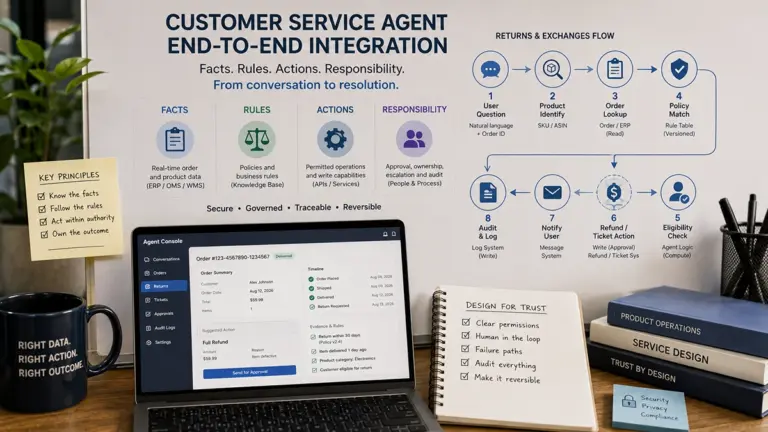
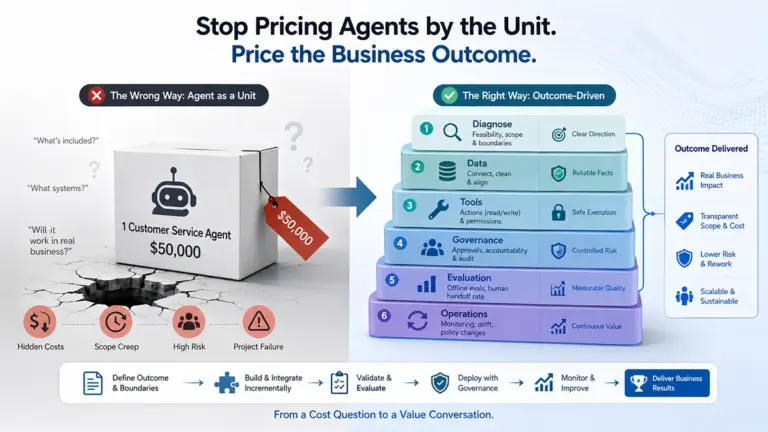
This is for the leader who is building an enterprise AI knowledge base, or who has already been burned by a RAG assistant that gives confident, wrong answers. The Enterprise AI Knowledge Base Governance problem is rarely about document volume — it is about whether the facts behind those documents are still true, still in scope, and still owned. The enterprise AI transformation series has covered five pieces so far: why a support agent must first learn to say “I don’t know” (see Support Agent Refusal), how to actually get work done once trust is set (see End-to-End Integration), how not to be fooled by “how much per agent” pricing (see Agent Is Not a Delivery Unit), the hardest system-integration wall in manufacturing (see Project Management Agent System Integration), and whether AI transformation should first observe the flow or rewrite the SOP (see AI Transformation SOP or Decision Flow). Here we tackle a more foundational, more overlooked question: is your knowledge base storing documents, or governing facts?
Why do more documents make support answers less reliable?
Let me start with a scar from our own past. A cross-border home-appliance client had 12,000 FAQs in their base. At RAG launch the boss was thrilled—”support won’t need to memorize the manual anymore.” Then month one surfaced a bizarre pattern in complaints: the more complex the question, the higher the agent’s error rate, and the more confidently it answered.
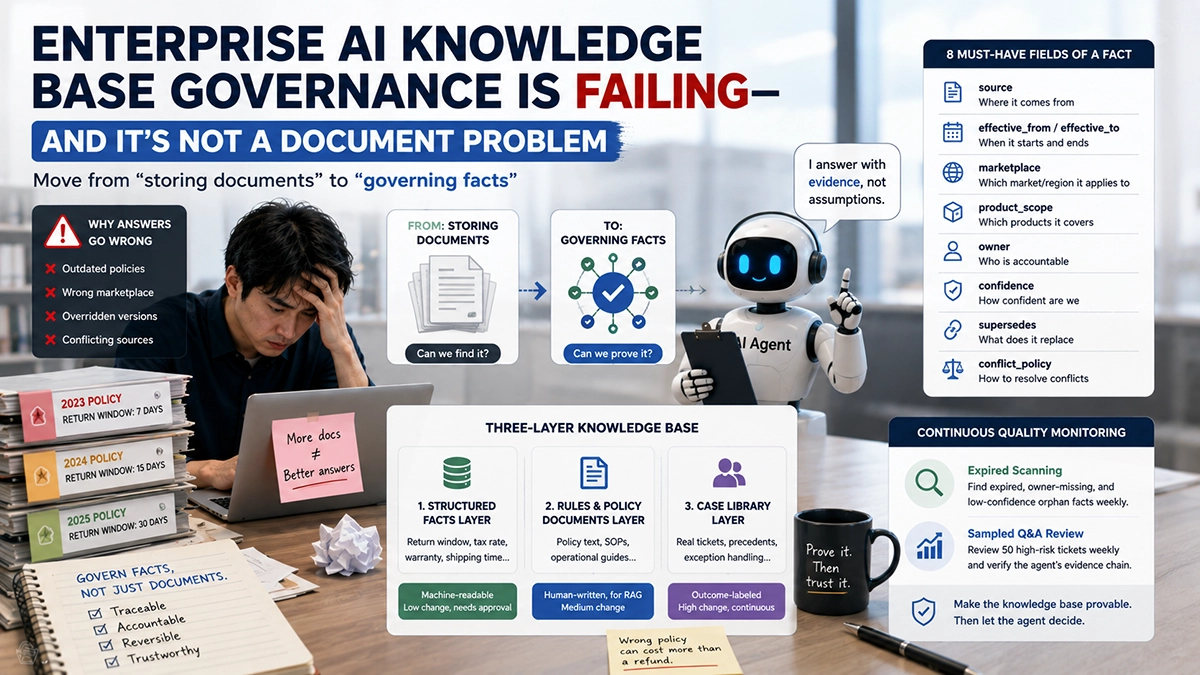
We pulled the logs. The root cause was plain: the same topic had multiple contradictory versions. A “return window” policy existed as a 2023 version (“7 days”), a 2024 version (“15 days”), and a 2025 version rolled back to “30 days” for one region’s regulation—none deleted, all recalled by similarity, the model having no idea which to trust. Worse, the old versions were still referenced by newer Q&As. The more documents, the denser the “version mines.”
This isn’t RAG’s fault. Nine out of ten RAG tutorials obsess over chunking, embedding, and recall—all about “how to find content.” But in enterprise settings, the fatal problem isn’t “not found,” it’s “found, but wrong, stale, or shouldn’t apply.” Treating enterprise AI knowledge base governance as “just dump the docs in” is the first wrong turn.
The first lesson of knowledge base governance: what metadata should one fact carry?
We have an internal rule: a knowledge entry without metadata doesn’t deserve to be in an enterprise base. Storing bare text is like tossing unmarked evidence into a courtroom—the agent grabs any piece and uses it. A “provable” enterprise fact needs at least these fields:
① source: where this fact comes from—policy text, contract, or some meeting note? Source sets its authority level.
② effective_from / effective_to: when it starts counting and when it expires. Without these, the agent treats a dead policy as current.
③ marketplace: US, EU, and JP regulations can differ by an ocean. A policy without a market tag is an accident waiting to be cross-recalled.
④ product_scope: does this cover one category, one SKU, or the whole store?
⑤ owner: who decides, who updates, who to verify with. A fact with no owner stays stale forever.
⑥ confidence: is this a hard policy, or a temporary “handle it this way for now”?
⑦ supersedes: does this override an older fact? The overridden version must be marked expired, not left to collide.
⑧ conflict_policy: when multiple hits conflict—default to human, or prioritize the higher-authority owner?
Adding these fields is more work than “drag the PDF in.” But it buys something valuable: every agent answer becomes traceable, accountable, and reversible. That is the essential difference between enterprise AI knowledge base governance and ordinary document retrieval—the former governs the reliability of facts; the latter only governs the reachability of information.
How to handle conflicting new/old policies and historical precedents?
With fields in place, the real test is conflict. Enterprise policy never evolves linearly: a new return rule may cover only some categories while the old one lingers; a precedent that held for customer A may not fit customer B.
Our playbook is three steps: filter, then rank, then adjudicate.
Step one, filter by effective scope first. The first gate at retrieval isn’t similarity—it’s whether effective_to has passed, whether marketplace matches, whether product_scope covers. Non-hits are dropped. This alone defuses 80% of “stale version mines.”
Step two, rank surviving hits by source authority. Contract beats meeting note; formal policy beats temporary support wording. The agent may cite the result, but must surface “here’s the basis I used” alongside it.
Step three, if a hard conflict remains (both hit, can’t resolve by authority), don’t guess—route to human. We’d rather a ticket wait 30 seconds than let the agent decide “15 or 30 days” on the enterprise’s behalf. Surfacing the conflict transparently (“two contradictory policies detected, routed to human”) causes far less damage than a wrong answer.
The backbone of Enterprise AI Knowledge Base Governance: layering facts, docs, cases
Going deeper, the base shouldn’t be one stew. We recommend three layers, each owning a different kind of content:
| Layer | Stores | Trait | Update freq |
|---|---|---|---|
| Structured facts | Enumerable fields: return window, tax, warranty, shipping scope | Full metadata, machine-decidable | Low, gated |
| Policy docs | Policy text, SOPs, guides | Human-written, RAG-recalled | Medium |
| Case library | Real handled tickets, precedents, exceptions | Outcome-labeled, few-shot reference | High |

The point isn’t “layer or not,” it’s don’t use the case library as the fact layer. A historical precedent being recalled by RAG as a “rule” is the classic overreach—a case is “handled this way once,” not “must be handled this way.” Once layered, the agent judges by facts, finds basis in docs, and learns feel from cases—each in its place, no cross-contamination.
Quality monitoring: expiry scan + sampled Q&A, how to run it?
A knowledge base isn’t “built and done”—it rots. We ship clients two ongoing monitors:
First, automated expiry scan. Weekly: pull every entry whose effective_to has passed but wasn’t marked superseded; every entry whose owner left or rotated over 90 days yet still holds facts; every entry untouched 180 days with confidence below threshold—flag as yellow. This batch of “orphan facts” is where rot breeds.
Second, high-risk sampled Q&A. Weekly, pull 50 high-risk real tickets (refunds, payouts, compliance, account), have the current base answer them, and a human verifies the evidence chain: which fact it cited, version right, market right. The hit rate on these 50 is the “health score” we give the base. Two straight weeks of decline means a cleanup, not more dumping.
Unconventional take: your first knowledge base shouldn’t aim for “complete”
This is the point I most want to make clear, and it’s the most counter-consensus. The biggest mistake in building a knowledge base is chasing “complete” from day one. Moving ten years of docs in, assuming the agent then knows everything—you just moved ten years of mess in too.
We advise the reverse: the first base holds only “provable few facts” plus a “question list.” The provable few are facts with full metadata you’ll vouch for; the question list is the high-frequency stuff you currently can’t answer, or would flinch answering. The latter is more valuable—it tells you exactly what the next version should add, instead of blindly hoarding.
A base that can say “I have a basis for this, I route that to human” beats a stuffed-but-mined “full base” by a mile. Making the unknown visible is itself the first step of governance. Enterprise AI knowledge base governance is, at its core, not about more information—it’s about facts that are credible, traceable, and controllable.
What this teaches Amazon e-commerce agents
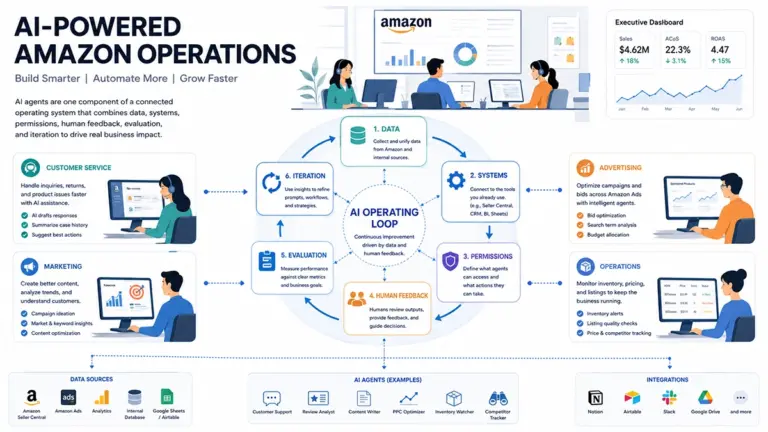
Amazon sellers might think: knowledge governance is back-office, what’s it to me? Everything. The class of “facts” an e-commerce agent leans on most—category policy, return rules, FBA timing, per-region compliance—is exactly the most expiry-prone, most easily overridden.
More subtly: your own policy changes, and so does the platform’s. The “shipping template for this region” the agent cites may have been valid last week and adjusted by Amazon this week. So every e-commerce fact needs, beyond internal fields, an “external fact source”—and that external Amazon fact layer is exactly what we at Pangolinfo fill. Through the Amazon Scraper API you can stably pull structured facts—products, policy pages, reviews, ad placement. Through the Amazon Data MCP, the agent fetches data as a tool, no per-project scraping rewrite. The Amazon Scraper Skill drops common data tasks into a conversational workflow. Fold “external platform facts” into the same effective_from / marketplace / owner governance, and your e-commerce agent won’t lose an account over a stale shipping rule.
Once the Amazon data layer is wired into the base, you can monitor call volume, quota, and success rate in real time from the Pangolinfo Console—stabilize and prove the external facts first, then let the agent decide on them.
Conclusion: Enterprise AI Knowledge Base Governance is about fact credibility, not doc volume
Back to the start—why does Enterprise AI Knowledge Base Governance fail? Not because you have too few docs, but because you stored docs without governing facts. Give every fact source, effective dates, market, owner, and supersedes; filter before ranking and route conflicts to human; layer structured facts / policy docs / case library; then monitor with expiry scans and weekly sampled Q&A. Do these and the base moves from “retrievable” to “provable.”
So next time someone says “our base just needs more docs,” hand them these fields: tell me, for that fact, when, where, owned by whom, what superseded it? If they can’t, more docs just move the mess into a vector store. This is part of the enterprise AI transformation series; the overall framework is at Enterprise AI Transformation Shouldn’t Start with Buying Agents.
Frequently Asked Questions
Why does an enterprise AI knowledge base fail?
Not too few docs, but docs stored without fact governance. Multiple policy versions coexist, expired ones unmarked, markets mis-scoped; by similarity the model can’t tell which to trust. Wrong answers usually trace to a wrong version, not hallucination.
What metadata should one enterprise fact carry?
At least eight: source, effective_from/to, marketplace, product_scope, owner, confidence, supersedes, conflict_policy. Without them a fact can’t be traced or rolled back—exactly what separates governance from mere retrieval.
How should the agent handle conflicting policies?
Filter by effective scope first (drop expired/mis-scoped), then rank by source authority and cite with basis, and if a hard conflict remains, don’t guess—route to human and surface the contradiction transparently.
How to layer structured facts, policy docs, case library?
Facts layer holds enumerable fields for machine judgment; policy layer holds text for RAG recall; case layer holds real tickets for few-shot reference. Key: never treat a case as a rule—”handled this way once” isn’t “must be handled this way.”
How to monitor knowledge base quality continuously?
Two gates: a weekly automated expiry scan (orphan facts—expired-unmarked, owner left, low-confidence stale), and 50 weekly high-risk sampled Q&As with human-verified evidence chains; hit rate is the health score. Decline two weeks running means cleanup, not more dumping.
External reference: Salesforce: Knowledge Article Lifecycle & Governance. This is a sub-article of the Pangolinfo enterprise AI transformation series; the pillar is at Enterprise AI Transformation, prior pieces at Support Agent Refusal, End-to-End Integration, Agent Is Not a Delivery Unit, Project Management Agent System Integration, and AI Transformation SOP or Decision Flow.