
The “Agent delivery unit” is the most dangerous pricing illusion I have seen in enterprise AI projects. A procurement manager asking “how much for one support agent” is structurally the same mistake as a boss asking “how much for a few trucks” — both try to price something defined by complexity using a headcount number. Treating an agent as a stable business boundary to quote is like using an org chart as an architecture diagram: it looks right, and it fails on contact.
This article is for the technical leads and buyers being buried under “agent project” quotes. The previous two sub-articles argued that a support agent’s first job is to know when to say no (see Customer Service Agent Refusal), and that trust, once earned, has to be turned into real action (see Customer Service Agent End-to-End Integration). This one goes one level upstream: before writing a line of code, how do you tell whether an agent quote is lying to you? I will break the “job title = software module” trap, then give you a six-layer pricing model and a “capability card” so you can put uncertainty on the table instead of paying for it in change orders.
A job title is not a software module: an agent is a runtime interface, not a business boundary
“We want a support agent.” I have heard it hundreds of times, and it almost never says what actually needs to be built. The problem is the word “support.” In an organization, “support” is a role backed by twenty-odd heterogeneous systems — order, ERP, ticketing, refunds, logistics, risk, knowledge base, QA, compliance — each with different permission granularity, data quality, and change frequency. Turning a role name directly into a software module is using an org chart as an architecture diagram: looks fine, deploys wrong.
So my first rule for any team: an agent is a runtime interface, not a stable business boundary. The interface can look different today and tomorrow; the business boundary — who may change what, who owns the fallout, where the data comes from, how often it changes — is what is actually valuable and actually drives cost. When you price by “one agent,” you are pricing the skin, not the skeleton. The skeleton is the six layers below.
Why the same support agent can vary tenfold in effort
I have seen two projects both called “post-sale agent,” one quoted at 80k, one at 800k, with feature lists that looked nearly identical. The gap is not the model. It is five hidden costs buried under the word “requirements”:
① Data quality: order state scattered across three systems that don’t agree — a month just to align; clean data, three days.
② System interface maturity: open APIs and read replicas connect smoothly; a ten-year-old ERP with no API means building a middleware layer first.
③ Permission granularity: “read-only” and “issue a refund” are two legally different projects; the latter’s approval, logging, and rollback are all invisible work.
④ Risk exposure: touching money or accounts requires human handoff and audit, and cost rises exponentially.
⑤ Evaluation & operations: launch is not the finish line — model drift, policy change, new categories need continuous evaluation, the part almost never quoted yet eating most of the long-term cost.
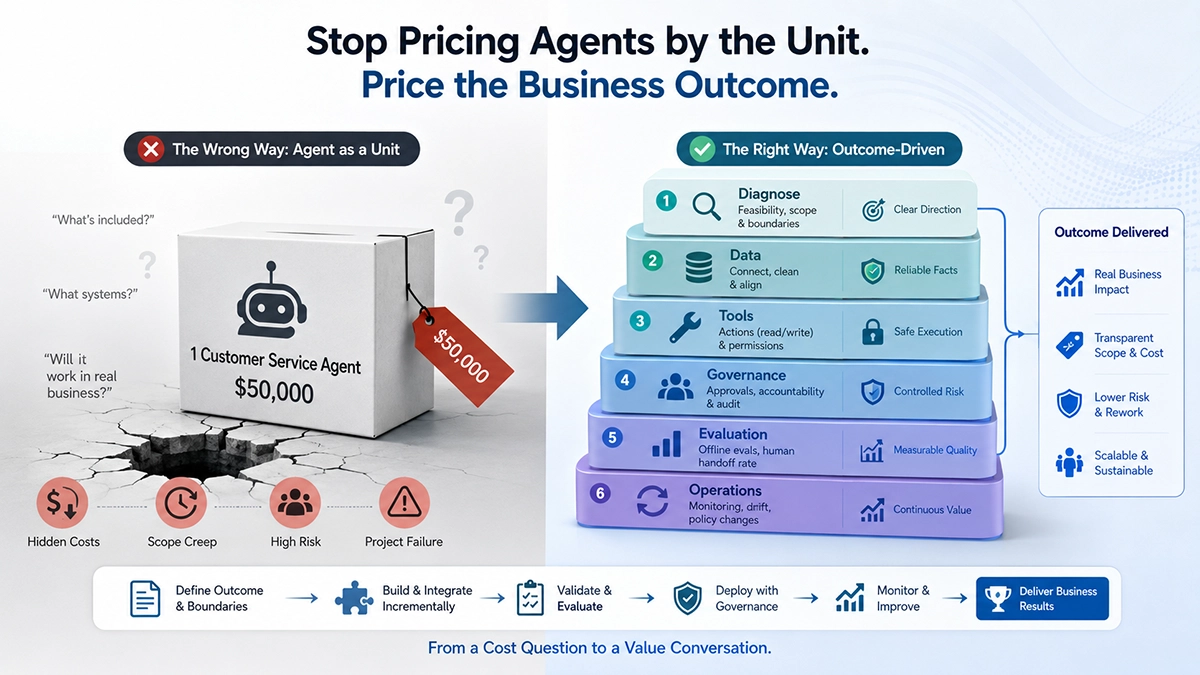
Unconventional take: The most toxic thing about the “Agent delivery unit” is that one deceptively precise unit price swallows all five uncertainties at once. A vendor quotes “one agent, $50k”; you think you bought a product, but you bought a shell that still needs data governance, interface maintenance, and post-launch evaluation. By the time the change orders arrive, the total has multiplied.
The six-layer pricing model: break the “Agent delivery unit” illusion into verifiable cost structure
Instead of asking “how much per agent,” price by the complexity of the business-outcome loop, layer by layer. This is our default framework at kickoff — six layers from diagnosis to operations; whichever is missing becomes tomorrow’s change order:
| Layer | What it prices | Common omission | Fixed-price? |
|---|---|---|---|
| 1 Diagnosis | current-state, feasibility, boundary definition | skipped, guessed | Yes |
| 2 Data | fact-source integration, cleaning, alignment | “just call an API” | Per interface/quality |
| 3 Tools | callable actions (read/write) wrapping | ignores permission & rollback | Per action risk |
| 4 Governance | versioning, approval, responsibility, audit | last two tables never drawn | Per rule complexity |
| 5 Evaluation | offline eval set, human-handoff rate | launch only, no eval | Ongoing service |
| 6 Operations | monitoring, drift, policy-change response | assumed zero, actually priciest | Ongoing service |
Read that table and you will see: the real worry is not the “agent unit price” but layers 5 and 6 — evaluation and operations — which never appear in a “one agent for $50k” quote yet decide whether this project is an asset or a liability in six months. Write the six layers into the contract and the vendor can no longer hide uncertainty behind a unit price.
What acceptance evidence should a procurement doc require?
Under the “Agent delivery unit” model, acceptance is usually one line: “demo runs, considered delivered.” That is a disaster. Between a running demo and real usability sits a whole acceptance-evidence package. We hard-require vendors to provide five artifacts in the procurement doc:
① Verifiable advisory-task list: not “can answer questions,” but “accuracy ≥ Y on sample set X.”
② Offline eval set: labeled real examples, updated with the business, not one-and-done.
③ Human-handoff-rate baseline: which scenarios must route to a human, what ratio, written down.
④ Rollback drill record: every write action demonstrates “how to undo”; no drill, no launch.
⑤ Change-response SLA: when policy or category changes, how fast does the vendor keep up.
Of these five, the first two answer “did it do it right,” the last three answer “what if it goes wrong, what if it changes.” Projects that accept only the first two will inevitably blow up on the third and fourth after launch. Writing acceptance evidence into the contract appendix beats watching a demo in a PPT ten times over.
How to turn a one-shot project into staged decisions? Replace agent count with a capability card
It is fair for procurement to want a price range. What is wrong is using a vague “agent” as the pricing unit. Our practice is to turn each scenario into a capability card, using the count and complexity matrix of cards to replace “number of agents”:
| Capability card field | Answers what question |
|---|---|
| Target outcome | What real state change must this agent deliver? |
| Sample tasks | 20 real cases, hard enough to expose boundaries |
| Fact source | Where data comes from, real-time or overnight, who maintains |
| Tools | Which reads/writes it may call, where the permission boundary is |
| Human handoff | Which cases must route to a human, what SLA |
| Audit | Six-field log fully captured, can it roll back |
| Metrics | Handoff rate, accuracy, latency — how measured |
| Change frequency | How often policy/category changes, who tracks |
Rollout advice: In phase one, price only verifiable advisory tasks — read + advise, no touching money or accounts. System write actions are priced separately by interface maturity and risk, never bundled into the “agent unit price.” This way you capture value at the lowest risk, then gradually open write permissions. More cards and higher complexity cost more — but expensively clear, unlike “one agent for $50k,” which is expensively vague.
Which work fits fixed-price, and which must be ongoing service?
Folding the six layers back, the pricing mode becomes clear:
Fits fixed-price: scope-clear, interface-stable, risk-controlled deliveries. Typically diagnosis (layer 1) and a tightly bounded PoC — you can write “what the deliverable is” into the contract.
Must be ongoing service: parts depending on external data, volatile policy, continuous evaluation and operations (layers 5, 6). Typically “post-launch evaluation and monitoring” — you cannot promise at signing “the model never drifts,” only “when it drifts, I find it and fix it within X.”
The trap: many vendors sneak layers 5 and 6 into fixed price, then go dark after launch. The professional move is to list them separately as ongoing service, billed monthly or per call. Short-term the total looks higher; long-term you are buying “keeps working,” not “works on delivery day.”
Where Pangolinfo fits
In the six layers, the “data” layer (layer 2) is where Amazon sellers often stall at the outermost ring — review sentiment, ad-placement ranking, Buy Box ownership, competitor price. These facts live outside your ERP yet get asked about in every complaint. Pangolinfo fills that external Amazon data layer so your agent’s fact table has a stable external source of truth.
The Amazon Data MCP lets the agent pull product, review, and ad-placement facts as tools without your team rebuilding scrapers each project; the Amazon Scraper API delivers structured facts at scale; the Amazon Scraper Skill puts common Amazon data tasks into a conversational workflow; AMZ Data Tracker is for no-code visual monitoring. Your internal tables (order, ERP, ticketing) you still wire yourselves, but making the Amazon layer short and stable makes the “fact source” field on the capability card far easier to fill.
Once the Amazon data layer is wired in, you can monitor fetch calls, quota, and success rate in the Pangolinfo Console — get the external data stable first, then talk about the “data” layer in the six-layer pricing.
Conclusion: stop pricing the Agent delivery unit; price the business-outcome loop
Back to the opening question — “how much for one agent.” Next time someone asks, hand them this line: the agent is not the delivery unit; the complexity of the business-outcome loop is. Use the six-layer pricing model to spread data, systems, permissions, risk, evaluation, and operations on the table; use the capability card to write down each scenario’s boundary, handoff, audit, and change frequency; make uncertainty explicit instead of letting it become change orders. Wanting a price range is fair; using a deceptively precise agent unit price to hide complexity you have not even defined is not.
This piece is the procurement-angle sub-article in our Enterprise AI Transformation series, in line with the previous two: first make the agent honest (refusal) → then define the delivery boundary (end-to-end integration) → finally talk pricing (this one). For the full framework, see our Enterprise AI Transformation pillar.
Frequently Asked Questions
Why can’t a job title become a software module directly?
A role (like “support”) sits on twenty-odd heterogeneous systems with different permission granularity, data quality, and change frequency. Turning the role name into a module is using an org chart as architecture. An agent is a runtime interface, not a stable business boundary; what actually drives cost and risk is the underlying structure — data, systems, permissions, risk, evaluation, operations — not the count of “one agent.”
Why can the Agent delivery unit cause a tenfold price gap?
Because “one agent” hides five variables: data quality, system interface maturity, permission granularity, risk exposure, and evaluation/operations. Two agents with similar feature lists can differ tenfold in hidden work — e.g., data alignment or a legacy ERP with no API. Pricing by agent unit is pricing the skin of a skeleton project.
How should you price an enterprise AI agent project?
Use the six-layer model instead of an agent unit price: diagnosis, data, tools, governance, evaluation, operations. The first two layers, scope-clear, can be fixed-price; the last two (evaluation, operations) depend on external data and policy change and must be listed as ongoing service. Procurement should hard-require five acceptance artifacts: verifiable task list, offline eval set, human-handoff baseline, rollback drill record, change-response SLA.
What acceptance evidence should a procurement doc require?
Five things: ① a verifiable advisory-task list (accuracy ≥ threshold on a sample set); ② an offline eval set updated with the business; ③ a human-handoff-rate baseline (which must route to a human, what ratio); ④ a rollback drill record for every write action; ⑤ a change-response SLA (how fast the vendor keeps up when policy/category changes). Projects that accept only “demo runs” will blow up on handoff, rollback, and change after launch.
Which AI work fits fixed-price, and which must be ongoing service?
Scope-clear, interface-stable, risk-controlled work (diagnosis + a tightly bounded PoC) fits fixed-price — you can write the deliverable into the contract. Work depending on external data, volatile policy, and continuous evaluation/operations (post-launch eval and monitoring) must be ongoing service, billed monthly or per call. Sneaking the latter into fixed price means the vendor often goes dark after launch.
External references: UiPath Agentic Orchestration, Salesforce Agentforce Implementation Guide. This is a sub-article of Pangolinfo’s Enterprise AI Transformation series; the pillar is Enterprise AI Transformation, with prior pieces Agent Refusal and End-to-End Integration.