How to Deliver Amazon Enterprise AI Transformation? Don’t Start by “Buying a Few Agents”

Pangolinfo
08/04, 2026

By Leo, Head of AI & E-commerce Data Solutions at Pangolinfo | Published: 2026-08-04 | Updated: 2026-08-04

Ecommerce AI transformation succeeds not when you buy a few agents, but when a business loop keeps running. For an Amazon business, a single customer service agent may connect to product knowledge, after-sales policy, conversation history, orders, refunds, tickets, ERP, permissions and audit trails. If that foundation isn’t ready, what you bought is a demo that answers questions, not a system that gets work done.

This article gives e-commerce managers evaluating customer service, marketing and advertising agents a more realistic decision framework: which work is best explored bottom-up by staff, which shared capabilities are worth consolidating into company systems, how to turn data and human feedback into fuel for the next round of capability, and how a procurement lead should break down a quote instead of mistaking a one-off custom build for ecommerce AI transformation.

Start with the data: why do most enterprise AI projects deliver no return?

Before discussing “how,” look at several widely cited 2025 studies. They come from different institutions using different methods, yet point to the same conclusion: the success of Amazon ecommerce AI transformation does not depend on how many agents you buy, but on whether AI is genuinely wired into business processes, data and accountability.

>40%
of agentic AI projects will be canceled by end of 2027
Gartner, 2025 · causes: rising costs, unclear value, weak risk controls
95%
of generative AI pilots delivered no measurable P&L impact
MIT NANDA, State of AI in Business 2025
6%
of companies qualify as true “AI high performers”
McKinsey, The State of AI 2025

In June 2025 Gartner predicted that over 40% of agentic AI projects will be canceled by the end of 2027, driven by rising costs, unclear business value and inadequate risk controls. Meanwhile the market is flooded with “agent washing” — of the thousands of vendors claiming to offer AI agents, Gartner estimates only around 130 are genuinely agentic; the rest are rebranded chatbots, RPA or assistants. Gartner’s advice is blunt: use agents only where there is clear value or measurable ROI, and redesign the workflow itself rather than bolting agents onto legacy systems.

MIT NANDA’s State of AI in Business 2025 found that 95% of enterprise generative AI pilots produced no measurable impact on the bottom line, with most stuck in pilot or prototype stages. The report stresses that the barriers are “organizational, not technological,” and the successful 5% share one trait: deep integration between AI and the business process it is meant to improve. Two counterintuitive findings matter for e-commerce leaders: first, back-office scenarios (customer service, operations) return more than the sales and marketing front office that receives the most budget; second, solutions from specialized external vendors succeed about 67% of the time — more than double the rate of internally built tools.

McKinsey adds the scaling view: 88% of organizations now use AI in at least one function, but only 39% report any EBIT impact, and most of that is under 5%; nearly two-thirds have not begun scaling AI across the enterprise. The action that truly separates leaders is “fundamentally redesigning workflows” — high performers are nearly three times as likely to do this as everyone else. In other words, treating AI as an entry point bolted onto old processes almost guarantees a place in the failing majority.

Why is “how much for three agents in total” the wrong question?

Reducing Amazon ecommerce AI transformation to a one-off purchase is many teams’ first instinct. If an 80-person e-commerce company launches agent projects for customer service, marketing and advertising at the same time, the most common procurement move is to list three roles and ask the vendor to quote “per agent.” That’s convenient for budget conversations but useless for judging the project, because a role is an org-chart label, not a technical delivery boundary.

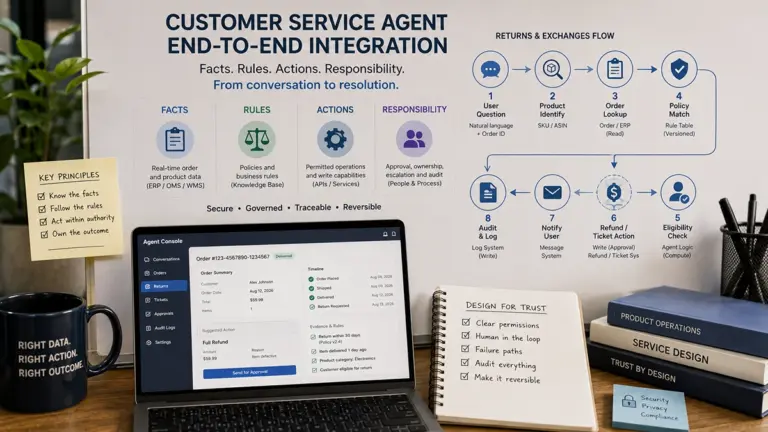
A customer service role might only need to generate suggested replies from policy — or it might need to look up orders, judge whether a return qualifies, edit tickets, trigger refunds and leave an audit trail. Both are called customer service agents, but the former is knowledge Q&A and the latter is cross-system business execution, with completely different data, permissions, exception handling and acceptance criteria. Covering both with one price usually just hides the complexity.

Break a quote into at least six layers: business diagnosis, data foundation, tool and system integration, permissions and risk control, launch evaluation, and ongoing operations. The number of agents can at most describe the interface layer — it can’t be the core unit of pricing.

Why doesn’t one role equal one SOP?

Turning a role into an SOP, then turning the SOP into a Skill, is a classic way to underestimate business complexity. Real after-sales support isn’t reading a policy document and outputting a fixed script. It first identifies the product and order, judges the customer’s situation, finds the currently effective policy, resolves conflicts with past precedents, decides whether human escalation is needed, and finally writes the action back to the system.

This chain involves at least four kinds of context. First, facts: product, inventory, order status, logistics and customer history. Second, rules: return policies, compensation limits, brand promises and regional differences. Third, actions: query orders, create tickets, change status, initiate refunds. Fourth, accountability: who is allowed to do what, which decisions need human approval, and how evidence is retained.

Iceberg diagram of an enterprise AI agent, with the chat entry point above the waterline and five foundational layers below: data, business rules, system tools, permission control and feedback loop
Figure 1: The AI agent iceberg model. The visible “answering questions” is just the tip above the water; what really decides success are the five layers below — data, rules, tools, permissions and feedback.
Delivery layerQuestion it must answerCommon omission
DataWhere are the facts? Are formats unified? Are they stale?Dumping PDFs, spreadsheets and chat logs straight into a knowledge base
RulesWhen policies conflict, which one wins?No effective date, priority or scope of application
ToolsCan the agent query, edit and initiate actions?Only web-reading ability, no order/ERP tools
PermissionsWhat can each employee see and execute?Every agent uses the same high-privilege account
FeedbackWhat went wrong? What did the human change?Tracking only satisfaction, never saving execution traces

How should a customer service agent start? Teach it to say “I don’t know” first

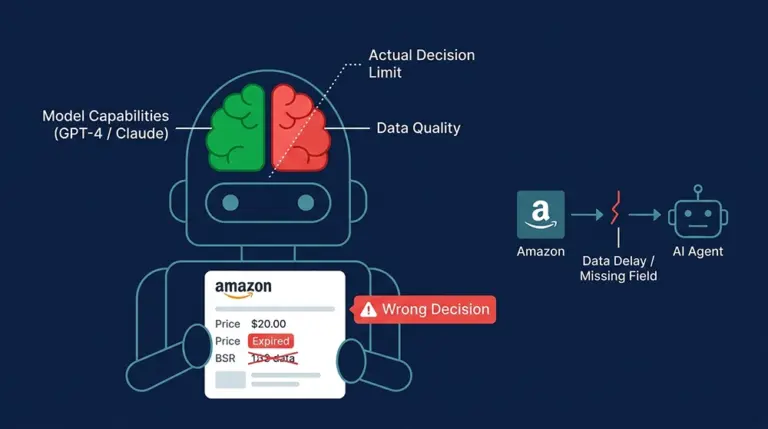
The most overlooked ability of a support bot isn’t answering — it’s declining to answer. Many demos make the model produce a complete answer after every question, dressing low-confidence guesses up as company policy, misleading customers and eroding the support team’s trust. This also explains why MIT found back-office support scenarios easier to get results from: their success criteria are clear and verifiable, a natural fit for having AI carry repetitive work first.

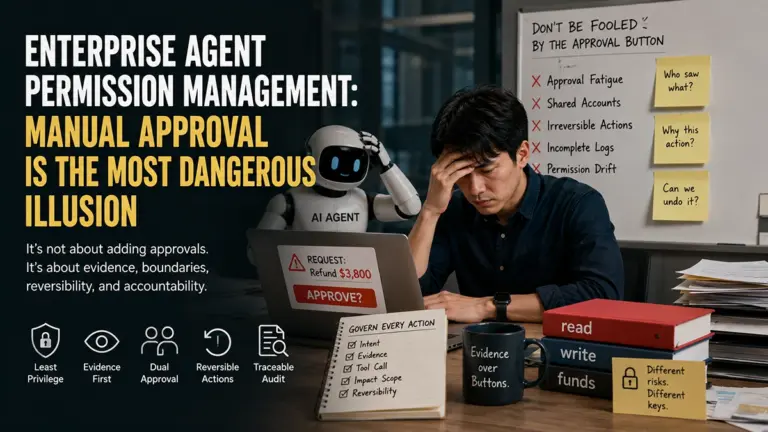
A steadier first phase is “suggested reply + confidence threshold + human handoff + issue logging.” For example, the agent may only answer from currently effective policy and product facts; when it can’t retrieve evidence, finds a policy conflict, or the order status doesn’t support an automatic decision, it must clearly state that information is insufficient, hand the conversation to a human, and log the question, the missing fields and how the human ultimately resolved it.

Amazon’s own practice reinforces this path. Its shopper-facing assistant Rufus reads product detail pages directly to answer questions, and Amazon has reported its user base grew roughly 115% year over year while driving substantial sales — which means your product facts, FAQs and review quality directly decide whether the AI “says the right thing for you.” Its seller-facing Seller Assistant (Project Amelia) is explicitly positioned as a “co-pilot, not a pilot”: it can summarize sales, surface inventory issues and give recommendations, but still needs human confirmation before acting. If platform-grade products are this cautious, an in-house customer service agent should make “suggest first, execute later, always handoff-able” the default design.

An executable customer service pilot:
1. Take 200 after-sales conversations from the last 30 days and manually tag them as “directly answerable,” “needs system lookup,” or “must be judged by a human.”
2. Add an effective date, applicable marketplace, product scope and owner to each policy.
3. Let the agent only generate suggested replies — never execute refunds.
4. Save low-confidence questions and human rewrites into an evaluation set.
5. Each week review the decline rate, human adoption rate, wrong-escalation rate and new knowledge items, then decide whether to open up order-lookup tools.

So a customer service agent is not simply a “cut headcount” project. In ecommerce AI transformation its value is, first, to carry the low-risk, repetitive, verifiable work so human agents can focus on exceptions; and second, to consolidate judgment once scattered in employees’ heads into checkable business assets.

For Amazon marketing and advertising agents, which tasks should go to staff first?

Marketing and advertising are more fluid than returns. The same product has different goals during launch, promotion and low-inventory periods; the ad performance of the same keyword set must be read alongside margin, inventory, review shifts, competitor moves and off-site campaigns. Freezing all of that into rigid “auto-bid, auto-budget, auto-edit” flows from day one is high risk — exactly the zone Gartner calls “unclear value, uncontrolled risk.”

The better starting point is the personal agent: have ad operators put search terms, placements, spend, conversion, organic rank and inventory into one context each day and ask the agent to generate anomaly explanations and hypotheses to verify; have marketers use an agent to compare new demand in reviews, competitor selling points and off-site consumer voices — this off-site brand buzz and voice of customer can be handed to the agent-facing VOC Insight MCP to aggregate into sentiment trends and competitor comparisons for a human to judge. People own adoption and decisions; the system provides speed, tracking and a record.

Screenshot of structured Amazon product and search data returned by the Pangolinfo Amazon Scraper API
Figure 2: The key for marketing and advertising agents is not “let the agent scrape the web,” but to give it structurally stable, traceable data. Shown: structured product and search data obtained via the Amazon Scraper API / Amazon Data MCP.

When you need a reliable entry point for on-Amazon data, use the Amazon Scraper API to fetch public data such as products, search, best-seller lists and ad placements, use the Amazon Review API to add reviews and Customer Says, and hand the results to an internal agent or BI. The point here is not “let the agent scrape web pages itself,” but to let the agent consume structurally stable, traceable data.

How many phases should Amazon ecommerce AI transformation have?

Three-phase roadmap for Amazon ecommerce AI transformation, from personal agents and workshops, to consolidated data and tools, to an evaluation and operations loop
Figure 3: The three-phase roadmap — first let staff cover the long tail with personal agents, then consolidate unified data and tools from recurring needs, and finally build an evaluation and operations loop.

Phase one: personal agents and workshops to cover the long tail

The goal of phase one is not to build one all-powerful enterprise agent, but to give employees their own working partner. Support can do suggested replies, policy retrieval and conversation summaries; advertising can do daily reports, anomaly explanations and competitor-change roundups; marketing can do review clustering, content drafts and campaign retrospectives. Tasks must be low-risk, human-verifiable and frequently changing, so staff will keep using them.

Turn recurring weekly problems into workshops: business staff bring real cases and break the task down together with the agent, recording which context helped, which tools were missing, and which step needed a human. After a few months, the company gets not a pretty demo, but real usage logs and a distribution of actual needs.

Phase two: consolidate data and tools from recurring needs

Only when multiple employees repeatedly solve the same kind of problem is it worth building a unified knowledge base, standard tools and a permission model. This is where you do data cleaning, field unification, source tagging, version management, conflict rules and access control; and expose orders, ERP, tickets or in-house systems as APIs, MCP or CLI so the agent can query and execute, not just read. This step is exactly what McKinsey calls “fundamentally redesigning workflows” — and where high performers differ most from the rest.

Phase three: build an evaluation and operations loop

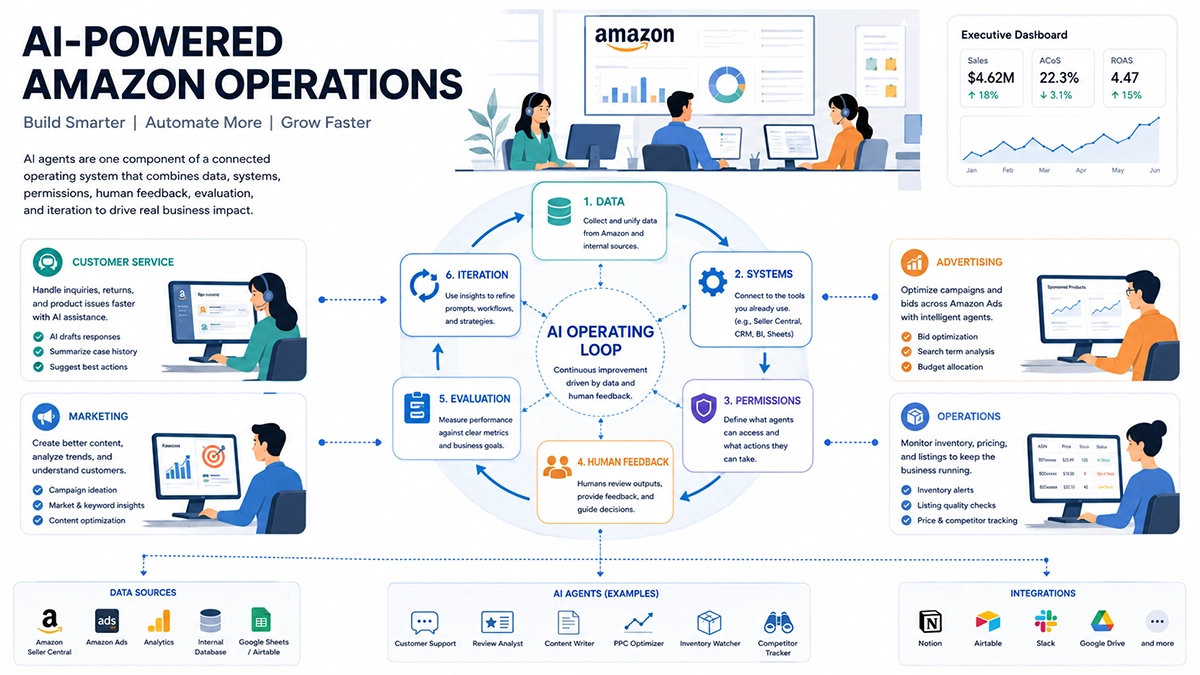
A mature enterprise AI system changes every day: models change, policies change, products change, how staff handle things changes, and external platform interfaces change. So delivery can’t end at “launch.” Every execution should record the input context, tools called, key judgments, human corrections, final result and exception reasons, then run regression tests against a fixed evaluation set.

You can write the loop as: execution trace → human correction → evaluation set → data/tool/policy update → production monitoring. That is the engineering foundation for an agent that keeps getting better at the business. Letting the agent freely rewrite its own SOP is not self-iteration; having the organization continuously produce verifiable improvement data is.

Circular evaluation and operations loop for an enterprise AI agent: execution trace, human correction, evaluation set, knowledge and tool update, production monitoring
Figure 4: The engineering loop that makes an agent better at the business — execution trace → human correction → evaluation set → knowledge/tool/policy update → production monitoring, then back to the start for continuous iteration.

Why do SAP, ERP, PLM and MES change the difficulty of an agent project?

There was once a startup idea for an agent to manage development projects for auto parts: feed in a development task and let the agent help the project manager push progress, identify risks and coordinate collaboration. On the surface it looks like a small project-management product; broken down, it turns out to require understanding materials, BOMs, engineering changes, suppliers, quality, production and delivery status — and connecting to SAP, PLM, MES and other systems. The real difficulty isn’t writing a prompt; it’s obtaining cross-system facts and keeping actions accountable and traceable.

An Amazon ecommerce company pursuing ecommerce AI transformation is structurally the same. The customer service agent must know orders and refunds; the advertising agent must know spend, conversion, inventory and margin; the marketing agent must know product facts, reviews and campaign rules. Does the external ERP have an API? Can the in-house system at least provide a read-only CLI first? Are the IDs consistent across systems? If you can’t answer these, the project shouldn’t enter the “build the agent” stage — it should first enter the “business and data readiness” stage.

Major platforms have started to stress this, and quite concretely. SAP’s Joule Agents are built on a Knowledge Graph and Business Data Cloud, using business objects, relationships and permissions as the agent’s source of facts, and controlling what an agent can see and do through unified identity and authorization services; SAP even offers Joule Studio for enterprises to build and orchestrate agents. Salesforce Agentforce uses the Einstein Trust Layer for grounding (constraining answers to trusted CRM data), data masking and auditing; developers use Topics and Actions to bound what the agent handles, and assign the agent its own least-privilege user identity. It explicitly adopts a shared responsibility model — the platform provides the mechanisms, the enterprise configures data, permissions and boundaries. UiPath puts orchestration, governance, audit and human-in-the-loop at the base of Agentic Automation, insisting that agents be supervised and reversible within controlled flows.

What these three methodologies share is clear: above the agent there must be grounding, permissions, audit and human handoff — precisely the parts that “pricing per agent” is most likely to omit. They prove the direction is right, but enterprises still have to do an even earlier job themselves: clearly define their own facts, rules, actions and lines of accountability.

How should enterprises procure and accept AI transformation services?

Procurement is where ecommerce AI transformation often goes wrong on paper. A procurement document shouldn’t just say “build three agents for customer service, marketing and advertising.” It should require the vendor to deliver a business-capability map: for each scenario, the input, source of facts, tools, permissions, human-handoff conditions, audit records, failure paths and evaluation metrics. Then split the project into four kinds of work: diagnosis, pilot, system integration and ongoing operations.

Procurement dimensionQuestion to askAcceptance evidence
BusinessWhich outcome exactly are we improving?Baseline, target, sample tasks and boundaries
DataAre the facts complete, current and traceable?Field catalog, sources, versions, quality report
SystemsWhat can the agent read and write?API/MCP/CLI inventory and failure drills
RiskWhen does it decline, hand off, or pause actions?Permission matrix, approval policy, audit log
IterationWho maintains it after launch, and how is regression run?Evaluation set, monitoring dashboard, versioning and rollback plan

Acceptance metrics should also be written into the contract, rather than a vague “it works well.” For customer service, advertising and marketing scenarios, track at least the following, and require the vendor to produce baseline data during the pilot:

MetricMeaningWhy it matters
Decline / handoff rateShare of cases where the agent says “insufficient information” and hands off to a humanToo low often means hard-coded answers and hallucination risk
Human adoption rateShare of suggested replies/plans adopted directly by humansMeasures whether the agent actually helps rather than adding review burden
Wrong-escalation rateShare of launched actions later corrected or rolled backDirectly affects customer experience and compliance risk
End-to-end completion rateShare of tasks closed correctly without human interventionDistinguishes “knowledge Q&A” from real business execution
Regression pass ratePass rate of a fixed evaluation set after each updateEnsures iteration doesn’t regress — the baseline of ongoing operations

Pricing should also shift from “how much per agent” to “what complexity does each phase solve.” If it’s only personal-agent training, the cost comes from training, templates and workshops; if you need to connect orders, ERP and tickets, the cost comes from interfaces, permissions, testing and operations; if you want the system to keep evolving, you also need evaluation, monitoring and long-term service. Bundling these layers into one per-agent price serves neither the buyer nor the vendor’s ability to deliver.

Build or buy? MIT’s 2025 report found solutions from specialized external vendors succeed about 67% of the time, more than double the rate of in-house tools. The pragmatic approach is layered: build the parts tightly bound to your business and requiring governance, and buy the general capability layer (such as external Amazon data collection and parsing) so every agent doesn’t reinvent the wheel.

What is Pangolinfo best suited to provide along this path?

Pangolinfo is better suited to fill the “external Amazon data layer” of Amazon ecommerce AI transformation, rather than packaging every internal system into one ready-made agent. Through the Amazon Scraper API, engineering teams can bring public data — products, search, best-seller lists, categories and ad placements — into their own applications; through the Amazon Review API, they can feed reviews and user feedback into customer service, product and marketing analysis.

When users move from “write code to call an API” to “let the agent fetch data directly,” Amazon Data MCP provides an agent-facing tool entry point (integration docs); while the Amazon Scraper Skill is better for putting common Amazon data tasks into a conversational workflow. Enterprises still need to determine internal data, permissions and business accountability themselves, but they can shorten the Amazon data-collection-and-parsing layer so every agent doesn’t have to maintain scraping logic — exactly the “buy the general layer from a specialist” division of labor described above.

Conclusion: build collaboration first, then consolidate systems

The order of Amazon ecommerce AI transformation should not be “buy a few agents and make staff bend to a new rigid process.” A more sustainable order is: first give employees personal agents and encourage them to explore long-tail needs with real work; then consolidate data, tools, permissions and rules from recurring tasks; and finally build execution records, human feedback and evaluation sets so the system updates as the business changes. The data supports this order — the few companies that truly win aren’t the ones that bought the most, but the ones that wired AI into process, data and accountability.

This is not an argument against professional custom development. On the contrary, custom development should happen after an enterprise already knows which needs are common, which systems are worth connecting and which actions need governance. What’s delivered then is no longer an isolated agent, but a set of AI operating capabilities the business can keep reshaping. For an Amazon company pursuing cross-border ecommerce AI transformation, external product and market data can be supplied by API, MCP and Skill, while the internal organization must genuinely wire in learning, feedback and accountability.

Frequently asked questions

Why can’t Amazon ecommerce AI transformation be priced by the number of agents?

Because an agent is only the runtime entry point. The real work sits in data cleaning, system integration, permissions, business rules, human handoff, monitoring and ongoing evaluation. End-to-end complexity varies enormously between roles.

Is the failure rate of enterprise AI projects really that high?

Multiple 2025 reports point the same way. Gartner predicts over 40% of agentic AI projects will be canceled by the end of 2027; MIT NANDA found 95% of generative AI pilots delivered no measurable P&L impact; McKinsey found 88% of organizations use AI but only about 6% are true high performers. The main cause is organizational and process-related, not model capability.

Should an Amazon business start with customer service, marketing or advertising agents?

Start with low-risk, frequently changing scenarios that staff are willing to use, delivered as personal agents and workshops, then pick common needs from real usage logs. Customer service can begin with suggested replies and handing off to humans; advertising can begin with data aggregation and diagnosis.

Once the knowledge base is ready, can the customer service agent work?

No. The knowledge base still needs sources, versions, freshness, permissions and conflict handling; a customer service agent usually also needs to connect to orders, refunds, tickets and ERP systems to complete end-to-end tasks.

Should you build agents in-house or buy from an external vendor?

MIT’s 2025 report found that solutions from specialized external vendors succeed about 67% of the time, more than double the rate of internally built tools. Build the parts tightly bound to your business and requiring governance; buy the general capability layer (such as external Amazon data collection) so every agent doesn’t reinvent it.

How does an agent keep getting better at understanding the business?

Record every execution trace, human correction, failure reason and final result to form an evaluation set, then update knowledge, tools, policies and Skills. Without this feedback loop, an agent will not improve on its own after launch.

Which layer is Pangolinfo best suited to solve in Amazon ecommerce AI transformation?

Pangolinfo is better suited to provide real-time Amazon product, search, review and best-seller data, plus API, Amazon Data MCP and Scraper Skill entry points for enterprise agents, SaaS and operations systems. Internal ERP and order systems still need separate assessment and integration.

Reference data: industry figures cited here come from public reports by Gartner (June 2025 forecast), MIT NANDA (State of AI in Business 2025) and McKinsey (The State of AI 2025); platform methodology references public materials from SAP Joule Agents, Salesforce Agentforce and UiPath Agentic Automation. To learn more about Pangolinfo’s agent-facing Amazon data access, see the Amazon Data MCP integration docs and the Pangolinfo documentation center.

Scan WhatsApp
to Contact

QR Code
Quick Test

联系我们,您的问题,我们随时倾听

无论您在使用 Pangolin 产品的过程中遇到任何问题,或有任何需求与建议,我们都在这里为您提供支持。请填写以下信息,我们的团队将尽快与您联系,确保您获得最佳的产品体验。

Talk to our team

If you encounter any issues while using Pangolin products, please fill out the following information, and our team will contact you as soon as possible to ensure you have the best product experience.