
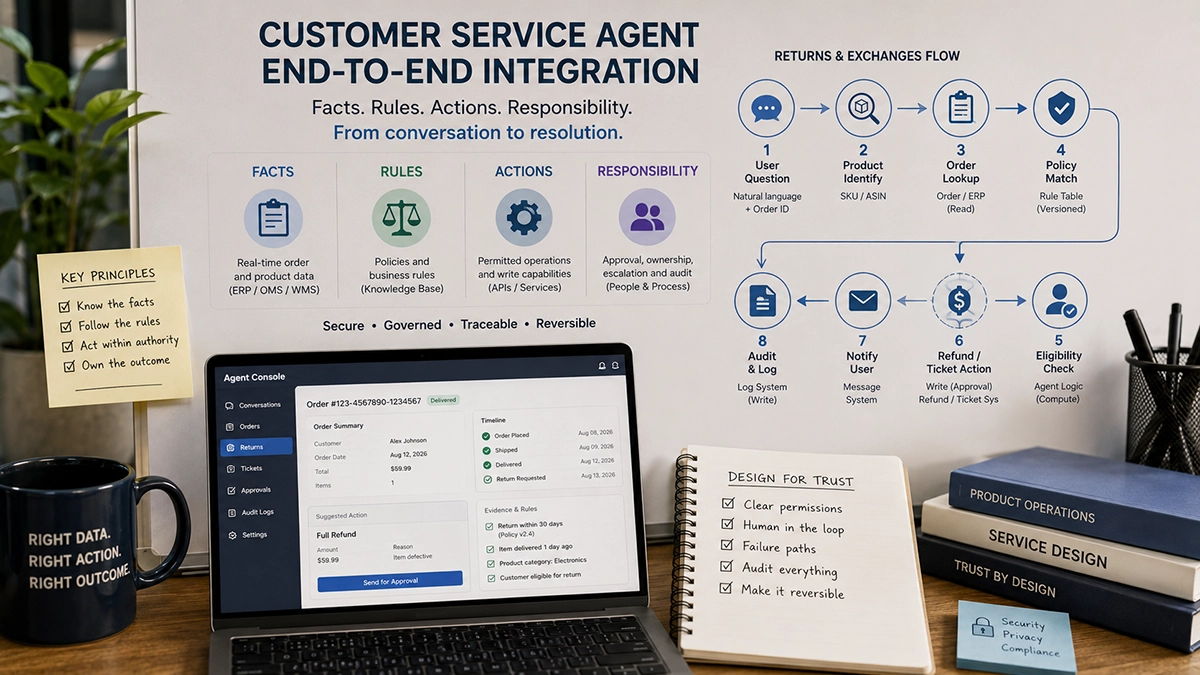
Customer Service Agent End-to-End Integration isn’t about stuffing more FAQs into a vector store — it’s about wiring up four tables: facts, rules, actions, and responsibility. A knowledge base tells your support agent what the rule is, but it can’t prove what’s happening with this specific order right now. Real end-to-end integration means connecting external facts and internal systems — without the last two tables, “end-to-end” is just a chattier search box.
This piece is for teams pushing a customer service agent from “can answer” toward “can act” — e-commerce, SaaS, and support orgs. The previous article argued the first capability a support agent needs is learning to say “I don’t know” (see Customer Service Agent Refusal) — that’s the trust foundation. This one goes one layer up: once the foundation exists, which systems do you actually connect before you can call it Customer Service Agent End-to-End Integration? I’ll start by clearing up the most common confusion — a Q&A bot and a transactional support agent are not the same thing — then hand you an end-to-end capability map for returns and exchanges, annotating every step with its inputs, source system, read/write permission, failure prompt, human owner, and rollback. Finally, which actions must sit behind human approval, how to design failure paths, and what “traceable” logging really means.
A Q&A bot and a transactional support agent are not the same thing
Most teams quietly assume “end-to-end support agent” = “Q&A bot plus a few tool calls.” That conflation is why so many projects stall halfway. A Q&A bot’s job is to explain the rule: how the return policy reads, how long the warranty lasts, who pays shipping. Its deliverable is a sentence. A transactional support agent’s job is to get the thing done: look up the real status of this order, decide if it qualifies for a return, fire a refund or open a ticket within its authority, notify the user, and leave a trail. Its deliverable is a real state change that happened.
Where’s the difference? The first only needs to read the knowledge base. The second must read + look up + write + audit. The moment you involve writing, you have to answer four questions: what changed, on what authority, who approved it, and how do you undo it if wrong. RAG tutorials cover almost only the first half — which is why most “end-to-end” demos stop at “a chattier search box.” They sound smooth, but when it’s time to actually refund, they still dump the user into the human queue they were supposed to replace.
Beyond the knowledge base: the four “tables” your agent needs
Break “can actually do things” apart, and a production agent needs to hold four tables at once. Miss one and it fills the gap by guessing — and guessing is where hallucinations come from. I call this the delivery boundary:
① Fact table: the real-time state of this order — SKU, quantity, delivery timestamp, refund progress, shipping trail. Sourced from the order / ERP system; the only truth about “what’s happening right now.”
② Rule table: return policy, warranty terms, per-market / per-category differences, effective dates and priorities. From the knowledge base, but versioned with conflict resolution — otherwise the agent answers today’s question with last year’s clause.
③ Action table: which writes the agent is allowed to trigger — read-only lookup, open ticket, low-value refund, change address — and the authority boundary of each.
④ Responsibility table: who approves each step, who takes over on failure, who rolls back on error, who owns the audit. Without this table, an action is an unowned risk.

Unconventional take: To judge whether a support agent is truly “Customer Service Agent End-to-End Integration,” don’t count how many APIs it connects to. Count whether it holds these four tables — especially the last two. I’ve watched too many post-mortems where the project didn’t fail from too few integrations, but because the action and responsibility tables were never drawn at all — so the agent quietly issued a refund with no one approving, no one owning, and no way to undo it.
No ERP API? You can still achieve Customer Service Agent End-to-End Integration
This is the question I get most, and the biggest misconception. Many companies’ ERPs genuinely have no external API, or only a read-only one. But “end-to-end” doesn’t mean “fully automated.” A pragmatic start is tiered — get the “look up” layer fully handled first:
1. Read-only: use a read replica, a middleware service, or a controlled CLI to pull order / shipping status. Let the agent see the facts, but touch no writes.
2. Semi-auto: the agent drafts a ticket or a refund suggestion, pushes it to a human for approval, and only prepares the context. The human clicks confirm in the ERP.
3. Low-risk automation: open automatic execution only for low-amount, low-risk, clearly-ruled actions (small compensation, ticket routing), every one logged and reversible.
I worked with a 3C seller on a ten-year-old ERP with zero APIs. They connected order-status lookup through a read replica, and the agent could accurately answer “where is my return right now” — already deflecting 60% of repeat calls from humans. Tickets and refunds still went through human approval. Is that end-to-end? For the business, yes — because it fully automated the highest-frequency, most deterministic “look up,” and humans only touched real exceptions. Too many teams get stuck on “no API, so we do nothing,” and hand the easiest 60% of value back to the human queue.
Which actions must sit behind human approval
Rank actions by risk and you’ll see “can be automated” and “should be automated” are different things. This table is our default when scoping a rollout:
| Action | Risk | Recommendation |
|---|---|---|
| Read-only lookup (order / shipping) | Low | Auto, but stamp data with its fetch time |
| Draft a ticket | Low | Auto, human confirms before submit |
| Low-value compensation / coupon | Medium | Set a cap + random sampling |
| Refund (any amount) | High | Human approval required; agent only proposes |
| Change address / recipient | High | Human + second verification (fraud) |
| Delete / ban account | Extreme | Agent forbidden; human only |
Key insight: Human approval is not the agent’s “exit ramp” — it’s a first-class node in its toolset. It should have an SLA (how fast to approve), an escalation path (what if the approver is offline), and a UI (the approver sees what evidence and which rule the agent used). Treating approval as a catch-all fallback quietly pushes responsibility back to humans while pretending you’ve automated — which is more dangerous than no agent, because it manufactures a “we’ve got this” illusion.
Designing failure paths and traceable logs
The most skipped part of tutorials and the most fatal part of production is: “what happens when the system doesn’t cooperate.” In reality: the order API times out, the shipping endpoint returns empty, policy versions conflict, the order number the user gave doesn’t exist. Each needs a preset failure behavior — not the agent inventing one on the spot. My rule for teams: “every write action gets three lines“:
Happy path: execute and notify the user.
Degraded path: not found / timeout → route to human and state what’s missing (e.g., “can’t find the shipping trail yet, routed to an agent”).
Rollback path: after execution, if something’s wrong, undo by audit ID. No rollback path → don’t ship the action.
For logs to be “traceable,” record at least six things: who triggered (user / session), on what evidence, which system was called, read/write result, who approved, when rolled back. This isn’t compliance overhead — it’s the only lifeline when you’re paged at 2 a.m. asking “why did we refund this customer twice.” A write action with no audit ID is a ticking bomb in production.
The end-to-end capability map for returns and exchanges
Put the four tables, tiered integration, and failure paths together, and the returns-and-exchanges flow looks like this. I’ve annotated every step with inputs, source, read/write, failure prompt, human owner, and rollback — you can lift it straight into a requirements skeleton:
| Step | Input | Source | R/W | Failure prompt | Human owner | Rollback |
|---|---|---|---|---|---|---|
| 1 User question | Natural language + order ID | Chat | Read | None | — | — |
| 2 Product identify | SKU / ASIN | Product master | Read | Fail → ask for order ID | — | — |
| 3 Order lookup | Order ID | Order / ERP (read) | Read | Timeout → human + note | Support lead | — |
| 4 Policy match | Market / category / date | Rule table (versioned) | Read | Conflict → take highest priority, flag | Policy owner | — |
| 5 Eligibility | Merged above | Agent logic | Compute | Low evidence → refuse, route human | Agent | — |
| 6 Refund / ticket | Amount / type | Refund / ticket sys | Write (approval) | Rejected → notify user | Approver | Undo by audit ID |
| 7 Notify user | Result | Message sys | Write | Send fail → retry + human | Agent | Resend |
| 8 Audit | Full chain | Log | Write | Store fail → alert | Data owner | Backfill |
Look at the map and you’ll notice: the only truly “automatic” steps are the reads in 2 and 3, and the notify in 7. Step 6’s write is always gated by a human. That’s exactly what Customer Service Agent End-to-End Integration should look like — automate the deterministic, verifiable reads; govern the risky, accountable writes. Many teams invert this: they rush to automate writes and never bother connecting reads, so the agent promises a refund while “not knowing the order state.” Failure is then inevitable.
What Pangolinfo adds at this layer
Connecting internal systems (order, ERP, ticketing) is on you — nobody can do that assessment but your team. What Pangolinfo fills is the “external Amazon data layer” — the real-time facts an agent needs when answering “what state is this SKU in, what does the market think, what are competitors priced at, what are reviewers complaining about.” That internal set of tables is yours to wire; but making the Amazon layer short and stable is what lets the agent earn the right to speak when it knows.
Through the Amazon Scraper API, you get structured facts on products, search, bestsellers, categories, reviews, and ad placements — so the agent can answer “is this ASIN in stock, is the price on the ad placement current” with evidence; through the Amazon Data MCP, the agent pulls data as a tool instead of every project rewriting scrape-and-parse logic; the Amazon Scraper Skill drops common Amazon data tasks into a conversational workflow. For no-code monitoring and tracking, there’s AMZ Data Tracker. Hand the Amazon collection and parsing layer to a specialist, and you keep your energy on the part that actually defines the delivery boundary — the four tables.
Once you wire the Amazon data layer into your support agent, you can monitor fetch calls, quota, and success rate in the Pangolinfo Console — get the data layer stable first, then worry about the four tables.
Conclusion: Customer Service Agent End-to-End Integration is a product definition, not backend plumbing
Back to the unconventional take: systems integration is not the agent’s “backend work” — it is the product definition itself. An agent with no action authority and no responsibility boundary, even if it connects ten systems, still feels like a search box to the user — just a chattier one. What you should draw first isn’t the architecture diagram, but the four tables: facts, rules, actions, responsibility. Write down “what can be looked up, what can be changed, who approves, how to undo” before you talk about connecting systems.
This fight shares one spine with the previous piece — “make the agent honest first”: boundary first, trust second, intelligence last. If you haven’t read it, start with Customer Service Agent Refusal to lay the trust foundation, then come back to draw this end-to-end capability map; for the bigger framework, see our Enterprise AI Transformation pillar.
Frequently Asked Questions
What’s the difference between a Q&A bot and a transactional support agent?
A Q&A bot only reads the knowledge base and outputs text (explains rules); a transactional agent must read + look up + write + audit, delivering a real state change (e.g., issue a refund, open a ticket). The former leans on RAG; the latter also connects order / ERP / ticketing systems and defines action and responsibility boundaries. Many “end-to-end” demos only reach the former.
What’s the minimum a customer service agent end-to-end integration must connect?
At least four tables: a fact table (real-time order / ERP state), a rule table (versioned policy with conflict resolution), an action table (which writes the agent may trigger and their authority), and a responsibility table (approver, owner, rollback, and audit per step). No ERP API? Start with a read replica for “lookup,” then gradually open ticketing and low-risk refunds.
Can you still do end-to-end without an open ERP API?
Yes — but step back from “full automation” to “tiered integration”: tier one reads order status from a replica; tier two has the agent draft ticket / refund suggestions for human approval; tier three opens automatic execution only for low-amount, low-risk actions, all logged. I’ve seen a team on a decade-old ERP with no API deflect 60% of repeat calls via read replica alone, with tickets and refunds still human-approved.
Which support actions must stay behind human approval?
Refunds (any amount), address / recipient changes (second verification for fraud), and delete / ban account (human only, agent forbidden) require a human. Low-value compensation can have a cap + sampling; read-only lookup and ticket drafts can be automatic. The point is to treat human approval as a first-class node (SLA, escalation, evidence UI), not a fallback.
How do you design failure paths and audit logs for a support agent?
Give every write action three lines: happy (execute + notify), degraded (not found → route human, state what’s missing), rollback (undo by audit ID; no rollback, no ship). Logs record at least six things: trigger, evidence, system called, read/write result, approver, rollback time. That’s the only thread for diagnosing incidents like “why did we refund twice.”
External references: SAP Joule Agents, UiPath Agents Governance. This article is part of Pangolinfo’s Enterprise AI Transformation series; see the pillar Enterprise AI Transformation and the previous piece Customer Service Agent Refusal.