

Most users avoid AI customer service not because models are weak, but because most agents treat “answer every question” as the goal. The capability to build first is customer service agent refusal: when evidence is thin, say clearly “I don’t know,” hand off to a human, and log the gap. Refusal is not failure — it is a demand sampler for the next round of knowledge-base work.
This article is for ecommerce, SaaS and support teams evaluating or already running a support bot. I will first unpack why users dodge AI support — the surface complaints are “no human feel,” “doesn’t understand me,” and “makes things up” — and show that the root cause is almost always an incomplete knowledge base and incomplete product data. Then I give a concrete design: when to answer, when to refuse, how 200 past conversations become your first evaluation set, and which counter-intuitive metrics to watch after launch.
Why Users Dodge AI Support: Three Misread Truths
Start with a fact people miss: users don’t hate the idea of AI. They hate a conversation that is confidently wrong. When we separate the three most common complaints, the root cause turns out to be strangely consistent.
Truth 1: “No human feel” is not a tone problem — it’s a recognition problem
Many teams think human feel comes from phrasing. It doesn’t. What users want is “you remember what I bought, where I’m stuck, and what we discussed.” When a bot treats every user as a blank text box and opens with a policy recital, that isn’t stiff tone — it’s that the bot was never connected to orders, logistics and history. Polite without context is more annoying than impolite without context.
Truth 2: “Doesn’t understand me” means it can’t hold context
When a user says “the cup arrived broken, I want a return,” at least three things are hidden behind it: identify the SKU, check the return window, decide refund versus reship. Many agents collapse this into “return policy FAQ” and dump a generic clause. The failure isn’t NLP quality; it’s the inability to map one sentence onto a stack of system facts — product facts, order state, policy version. All three must be present.
Truth 3: “Makes things up” is the most trust-destroying one
This is what makes users give up for good. When evidence is thin, a model will produce a plausible but entirely fabricated answer: a wrong refund window, a coupon that doesn’t exist, a delivery time pulled from nowhere. One confident lie destroys more goodwill than a hundred correct answers earn. The problem isn’t that the model “can hallucinate.” It’s that the system never told it to stay quiet when it should.
Summary: These three look like experience problems, but they share one root — the agent keeps answering when it lacks enough evidence. And “enough evidence” depends on two things: whether the knowledge base is sound, and whether the product data is sound.
The Root Is Not the Model — It’s Knowledge and Product Data
Eight out of ten bad AI support deployments fail not because someone picked the wrong model, but because they confused “documents” with “knowledge” and “fields” with “data.” Let’s take it apart.
Incomplete knowledge base: documents ≠ knowledge
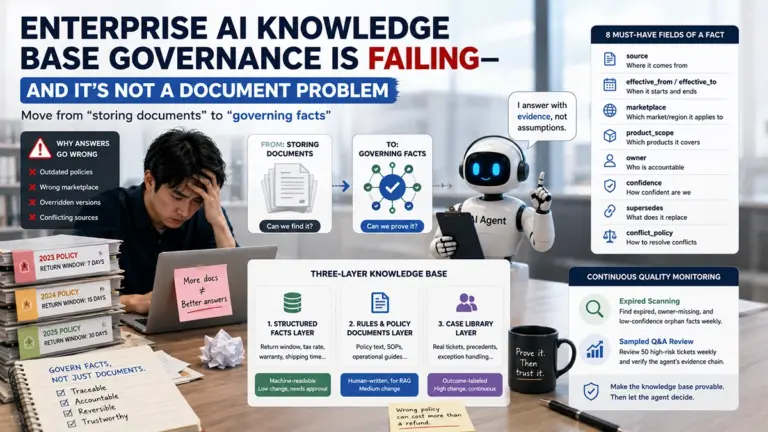
The usual move is to dump PDFs, spreadsheets and old chat logs into a vector store and declare the knowledge base done. But policies change: a return rule differs during a sale versus normal days, on the US site versus the CN site, across product categories. Without effective dates, scope, priority and a conflict-resolution rule, the agent may retrieve a clause uploaded last year and long expired. The more it “knows,” the more confidently it errs.
Incomplete product data: it can’t even answer “can this SKU ship to the US?”
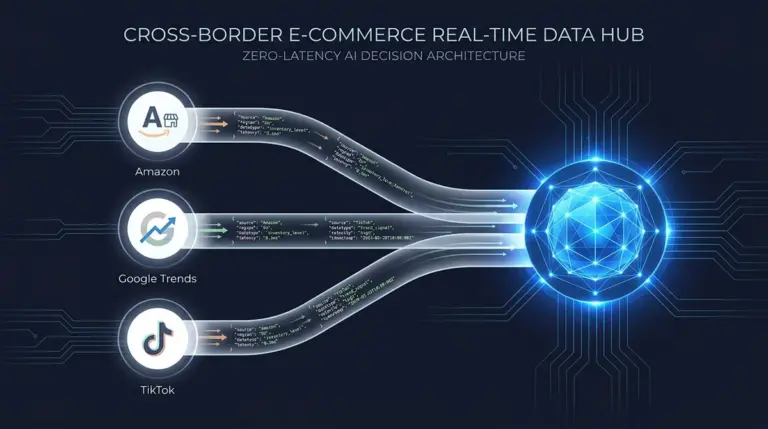
A huge share of support questions are about specific products: is it in stock, which variant still has the size, can this ZIP receive it, is the price shown on the ad placement current. These need not documents but real-time, structured, traceable product facts — ASIN, variant, inventory, ZIP pricing, ad placement status. If product data is hand-moved, scraped ad hoc, or lags by hours, the agent can only offer “probably” and “maybe.” Users want certainty.
No live access to orders and ticketing
The deeper gap: many support agents can only read, not look up or act. They can read policy but can’t check this user’s real order state; they can describe the flow but can’t open a ticket or initiate a refund. So in a half-informed state, they fill the blanks with guesses — which is the main source of hallucination. To kill hallucination, first let the agent check the system when it should.
The Overlooked Capability: Teach the Agent to Say “I Don’t Know”
Mainstream demos treat a high answer rate as proof of intelligence — every question gets a full reply, looks great live. But what a production system actually needs is the opposite: refuse, escalate and log when evidence is insufficient.
What “good refusal” means — not just “I don’t know”
A weak refusal is a cold “I don’t know, contact an agent.” A good refusal has at least three parts: first, state what evidence is missing (“I can’t yet verify the shipping status of this order”); second, give a clear next step (“I’ve routed you to a human, ~2 min wait”); third, record the gap (“logged missing field: tracking trail, queued for knowledge update”). Users don’t need an all-knowing bot. They need one that is honest, useful and not making things worse.
Refusal is not failure — it’s a sampler for the knowledge base
Reframe it: every refusal tells you “this knowledge or data isn’t ready yet.” Aggregate those refusals and you don’t get a pile of failures — you get a priority list for the next round of knowledge and data work. An agent that refuses, records and follows up is worth far more than one that guesses forever. It turns “I don’t know” into “we’ll know next week.”
How to Design Refusal and Handoff: The Three-Piece Set
Refusal shouldn’t rely on the model’s “judgment.” It should be engineered with a confidence threshold plus an evidence threshold plus explicit escalation rules.
| Trigger | Agent behavior | Backend action |
|---|---|---|
| Evidence found, confidence ≥ threshold | Draft reply with cited sources | Log trace for spot checks |
| No evidence / conflicting sources | State insufficiency, escalate | Write to “missing field” list |
| Order state incomplete / unverifiable | Refuse the conclusion, give process only | Retry read-only order lookup |
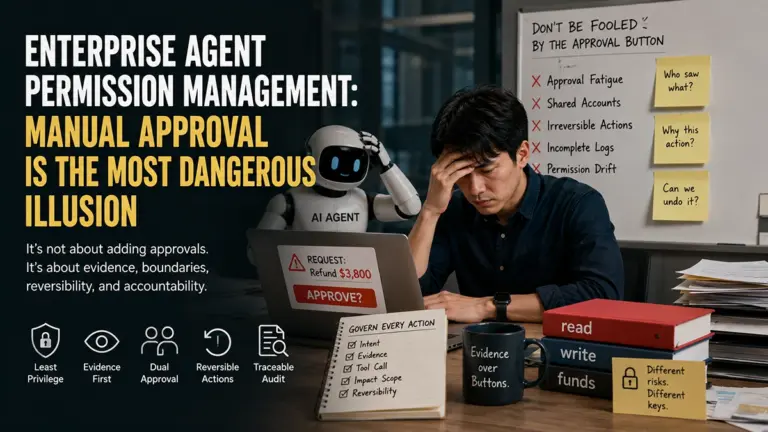
| Action exceeds permission (refund, ticket) | No execution, draft for approval | Push human approval, keep audit |
The only principle that matters: when it answers, it must show evidence; when it can’t, it must say what’s missing and to whom it handed off. Make both “answer” and “refuse” explainable and auditable, and the system earns trust.
From 200 Conversations to a First Evaluation Set
Don’t aim for full automation on day one. A realistic pilot starts with 200 real conversations.
1. Take 200 recent support conversations from the last 30 days; label each as directly answerable, system-dependent, or human-judgment.
2. Add an effective date, marketplace scope, product scope and owner to every policy so version conflicts can be adjudicated.
3. Let the agent produce suggested replies only; grant zero write permissions in phase one (no refunds, no ticket changes).
4. Structure and save low-confidence cases, final human handling, and human rewrites as an evaluation set.
5. Weekly review of refusal rate, human adoption rate, error escalation rate and new knowledge items; use the data to decide whether to open order-lookup tools.
The point isn’t “replace people fast.” It’s to first carry the low-risk, verifiable part, free human agents for real exceptions, and turn the judgment living in senior agents’ heads into a business asset the company can inspect and regression-test. Only after the evaluation set is solid and adoption stable do you open transactional tools.
What to Watch After Launch: The Counter-Intuitive Metrics
Most teams launch a support agent and stare at one number: auto-resolution rate. That is the most misleading metric — it tells you how many the agent caught, not whether what it caught was right, and certainly not whether it quietly amplified errors.
Independent observation: Don’t make auto-resolution rate a standalone KPI. Track “errors not amplified by automation” instead — high-quality refusal rate, post-handoff handling time, the share of human edits reused as knowledge, and recontact rate. Read together, these show the system is building trust rather than manufacturing polite incidents.
| Metric | What it measures | Why it matters |
|---|---|---|
| High-quality refusal rate | Did it refuse the right things | Direct signal of production reliability |
| Error escalation rate | Of wrong answers, how many were caught by humans | Size of the risk from guessing |
| Post-handoff handling time | Did handoff actually save time | Whether the agent lightens human load |
| Reusable knowledge share | How much of human edits回流 as knowledge | Whether the system self-improves |
| Recontact rate | Did users come back after refusal | The ultimate trust gauge |
Where Pangolinfo Fits
Back to the root cause: incomplete product data is a major source of support-agent hallucination. Pangolinfo is better positioned to supply the “external Amazon data layer” than to package all internal systems into a prebuilt agent. With the Amazon Review API, support and analytics teams get real customer feedback including Customer Says; with the Amazon Scraper API, they get structured facts on products, search, rankings, categories and ad placements, so the agent has something to stand on when answering “what’s the status of this SKU.”
When teams want agents to pull data directly instead of every agent rewriting scraping and parsing logic, Amazon Data MCP provides an agent-facing tool layer, and Amazon Scraper Skill packages common Amazon data tasks into conversational workflows. Orders, refunds, ERP and ticketing still need the company’s own integration and permission design — no one can substitute for that. Shorten and stabilize the external Amazon data path, and the support agent earns the right to speak when it knows and stay quiet when it doesn’t.
Conclusion: Make the Agent Honest Before You Make It Smart
Users dodge AI support because they’re dodging a conversation that pretends to understand. The fix isn’t a bigger model. It’s to first lay the foundation of knowledge base and product data, then teach the agent the most critical and most overlooked lesson: when evidence is insufficient, say “I don’t know,” and turn that into a better answer next time. When refusal becomes an explainable, logged, follow-up-able action, a support agent moves from a demo prop to a production system you can actually trust. In the broader enterprise AI transformation, support is the fight worth picking first — and the easiest to win trust with.
If you’re planning support or data agents for an Amazon business, read our pillar on why ecommerce AI transformation shouldn’t start by buying agents first, then come back to this refusal design to execute.
FAQ
Why do users avoid AI customer service?
Most AI agents feel robotic, miss context, and fabricate policies or delivery times. The visible problem is experience, but the root cause is an incomplete knowledge base, stale product data, and no live access to orders or ticketing systems — not a weak model.
Does saying ‘I don’t know’ mean the agent is weak?
No. Controlled refusal is a production requirement: when evidence is thin, the agent escalates and logs the gap, which builds trust. By contrast, a demo that answers every question often packages low-confidence guesses as company policy, which is riskier.
How do you decide when an agent should refuse?
Force a human handoff when retrieval finds no evidence, order state is incomplete, policy versions conflict, or the action exceeds permissions. Design it with a confidence threshold plus an evidence threshold plus explicit escalation rules — not by leaving it to the model.
How do 200 historical conversations become an evaluation set?
Label each as directly answerable, system-dependent, or human-judgment. Add effective dates, marketplace scope, product scope and an owner to every policy. Store the question, evidence, model answer, human edit and final outcome as first-version regression cases.
Which metrics matter after launch?
Do not chase auto-resolution rate alone. Track whether errors were amplified by automation, high-quality refusal rate, post-handoff handling time, the share of human edits reused as knowledge, and customer recontact rate. Together they show whether trust is being built.
References: Salesforce Agentforce Security, Agent-in-the-Loop research. This is a sub-article in Pangolinfo’s enterprise AI transformation series; the pillar is Ecommerce AI Transformation.