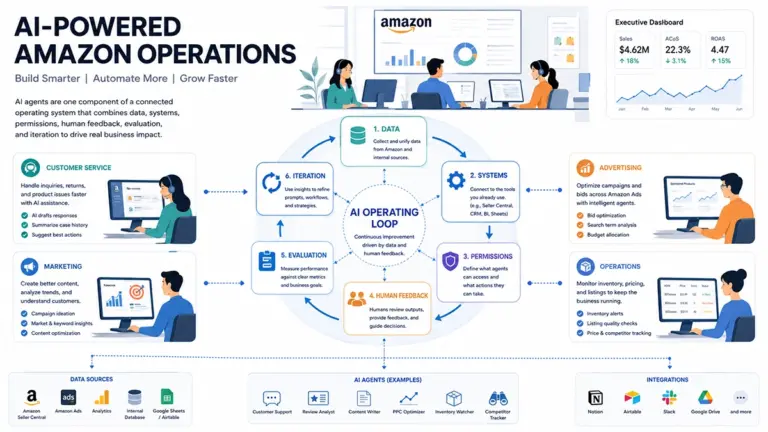

An “AI Transformation SOP” isn’t the question of whether to build one—it’s that most teams build it in the wrong order. What you should do first is let the agent step into your existing decision flow and record the context and the exceptions, not immediately re-engineer every flexible task into a fixed SOP. That reversal is exactly why so many RPA and low-code projects get quietly abandoned within six months of launch. We’ve fallen into this trap ourselves, and we’ve helped clients climb out of it.
This piece is for business leads who are under pressure to “do AI transformation” and are being seduced by every SOP tool on the market. The first four installments covered why a support agent must first learn to say “I don’t know” (see Support Agent Refusal), how to actually get things done once trust is established (see End-to-End Integration), how not to be fooled by “how much per agent” pricing (see Agent Is Not a Delivery Unit), and the hardest system-integration wall in manufacturing (see Project Management Agent System Integration). Here we tackle a more upstream, and more easily misfired, question: in AI transformation, should you rebuild the SOP, or let the agent simply enter the flow you already use?
Why does your rebuilt process get abandoned within six months?
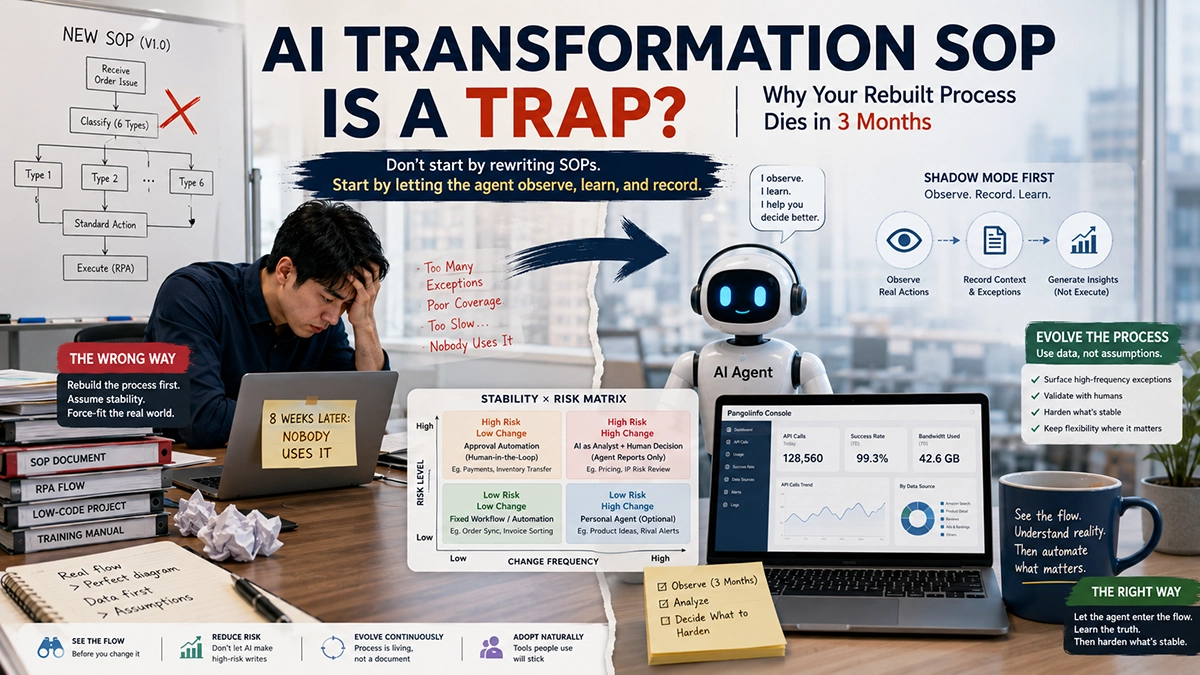
Let me start with a scar from my own past. Three years ago we helped a cross-border seller automate “order exception handling.” The team spent two months drawing a beautiful SOP: six exception categories, one standard action per category, plus a layer of RPA clicking through the backend. Launch week the boss was thrilled—the deck claimed “manual handling dropped from 40 minutes to 5.”
Eight weeks later, a follow-up visit revealed the truth: frontline staff simply weren’t using that SOP. Support agents still had three windows open, yelling in the group chat “who’s looking at this order?” When asked why, the answer was blunt—”those six categories don’t cover the weird stuff I hit daily; following the flow is actually slower.” The carefully designed SOP lost to the messy, long-tail reality of real business.
This isn’t an anecdote. Gartner’s 2024 hyperautomation retrospectives keep circling the same pattern: lots of RPA / low-code projects shine in the PoC phase, then their usage rate keeps sliding after launch until they’re forgotten. The root cause isn’t bad tooling—it’s the assumption that “business is stable and enumerable.” Real business is the opposite: rules shift, exceptions are the norm, and one person can hit a dozen situations the docs never wrote down.
The deadly allure of an AI Transformation SOP: why teams rebuild first
I’ve noticed nearly every AI transformation project falls into the same inertia: the reflex to “redraw the process” from day one. The boss says “redo this business with AI,” and the team’s first move is a whiteboard, a swimlane diagram, steps broken into standards—then they try to make the agent follow the picture rigidly. That playbook works great in high-certainty segments, but it hides a premise: you assume future business looks like today’s diagram.
Yet the places where an agent should add the most value are precisely the flexible zones that “won’t fit the picture”: an old customer suddenly changes payment terms, a bad review touches a variant not yet listed, a logistics snag forces a temporary switch of shipping country. You can’t draw these into an SOP today, and you won’t tomorrow, because their very appearance is the “exception.” Making AI Transformation SOP the primary goal is tantamount to demanding the business stop changing and become enumerable first—which is harder than doing AI.
Unconventional take: “AI Transformation SOP” is a term easily misread. An SOP is an outcome, not a starting line. The real question isn’t “how do I rewrite my SOP with AI,” but “which work deserves to be hardened into an SOP, and which work should let the agent do it alongside a human, recording as it goes.” Reverse that order and your odds of surviving three months climb sharply.
Stability × Risk: one matrix decides which automation to use
So how do you decide? We use a simple two-axis matrix internally: the horizontal axis is “change frequency,” the vertical is “risk level.” Drop each task into one of four quadrants, and the automation mode follows:
| Quadrant | Traits | Use | Typical example |
|---|---|---|---|
| Low risk · frequent change | Wrong is harmless, but it changes daily | Personal agent (carried by the human, not forced) | Daily product-idea digest, competitor quick briefs |
| Low risk · highly stable | Wrong is harmless, and it never changes | Fixed workflow / automation script | Scheduled order-status sync, invoice sorting |
| High risk · highly stable | Wrong is fatal, rules are clear | Approval automation (human-machine co-sign) | Payment instructions, inventory transfers |
| High risk · frequent change | Wrong is fatal, and it changes daily | Assisted analysis + human decision (agent reports only) | Promo pricing, IP-risk assessment |

The whole matrix boils down to one sentence: the faster something changes, the less it should be hard-coded into a fixed SOP; the higher the risk, the less an agent should decide alone. The bottom-left (low risk, high stability) is the true home of SOPs—it was stable anyway, so hardening it doesn’t cramp the business. The top-right (high risk, frequent change) is the most dangerous zone: there the agent can only be an advisor, and the human must still hold the pen.
The first lesson of an AI Transformation SOP: when to use a Skill, when a fixed workflow?
At the tooling layer, many people can’t tell where a “Skill” belongs versus a “fixed workflow.” My rule of thumb:
① Steps known, I/O stable: use a fixed workflow. “Classify and archive bad reviews by sentiment every day” has a clear path—automate it, cheapest peace of mind.
② Steps unknown, depends on live judgment: use a Skill. “Draft a handling suggestion for this complaint” needs the model to read context, check history, weigh options—can’t be pre-written.
③ The boundary: workflow wrapping a Skill—a fixed skeleton with one “smart judgment” node; standard actions normally, exceptions handed to the Skill which also flags them.
④ Red line: any “write” action (price change, refund, inventory move), however stable, stays workflow + human approval in version one—never a free-roaming Skill.
In short, AI Transformation SOP doesn’t reject fixed flows; it rejects “shoving every flexible task into a fixed flow.” Harden the stable fragments, leave the flexible ones to Skills and human judgment—that’s the sustainable structure.
Shadow mode: let the agent observe, not execute, for three months first
Then how do you safely let the agent enter the existing flow, instead of rewriting it? We use “shadow mode”: the agent does exactly one thing first—observe and record. It runs in the background alongside the human’s real operations, producing “here’s what I’d do,” but pushes to no one and executes nothing. Run it for a few weeks, compare its output against real human decisions, and two things surface:
First, the categories where the agent is scarily stable—these are the future candidates worth hardening. Second, where it keeps crashing is usually the “tacit knowledge” the docs never captured, known only to veteran staff. That second bucket is the gold mine: it tells you which “exceptions” are actually so frequent they should be formally folded into the process, and which “stabilities” were only assumed.
We generally require shadow mode to run at least one full business cycle (for e-commerce, roughly one promo season, about three months), emitting only “observation reports” and “risk alerts,” touching no write action. Once the data speaks, decide which fragments graduate into a workflow.
Turn high-frequency exceptions into new capability: processes are used into being, not written into being
Out of shadow mode you accumulate an “exception list.” Our practice is a monthly review: cluster the exceptions the agent flagged and humans confirmed.
If a category shows up every month for three straight months with a highly consistent handling method, that’s no longer an exception—it should be promoted to a standard action and written into a new workflow. Conversely, the sporadic, never-the-same ones stay with the Skill and the human. That’s the correct rhythm of “process evolution”: let the agent help you see the real shape of the business first, then harden according to that real shape—not take an imagined SOP and force the business to fit it.
I tell clients often: good AI transformation doesn’t deliver a smarter flowchart, it gives the organization, for the first time, the ability to re-engineer its own process. Changing a process used to mean three meetings and a month of diagramming; now the agent records daily and reviews monthly, and the process becomes alive, something that grows on its own.
Unconventional observation: an agent’s first value is helping the business SEE the process, not execute it
This is the point I most want to make clear, and it’s the most counter-consensus. An agent’s biggest value to an enterprise is, first, helping you see the process, and only second, executing it.
Most companies are “blind” to their own processes: nobody can say how many kinds of exceptions support actually handles daily, how much of pricing is gut-feel, exactly where cross-team friction jams. The agent stepping in as an “observer” makes that hidden cost visible for the first time. Once you see clearly, harden what should be hardened, cut what should be cut—that’s when transformation truly happens. Reverse it—let the agent execute a SOP you never saw clearly—and you’re letting a blind person drive; the smoother it runs, the harder you crash.
What this teaches Amazon e-commerce agents
Amazon sellers might ask: does this apply to me? Hugely. E-commerce operations are inherently a mix of “high risk, frequent change” and “low risk, frequent change”: a competitor drops price today, a category policy shifts tomorrow, a single bad review triggers a batch of refunds the day after.
Map this matrix over and you’ll see: product-idea inspiration and competitor briefs (low risk, frequent change) are perfect for a personal agent; payments and price changes (high risk) must be workflow + human approval; promo pricing and IP-risk assessment (high risk, ever-changing) get agent reports with the human holding the pen. And throughout the agent’s entry into the flow and recording of exceptions, the class of “external fact” it needs most—real-time ad placement rank, Buy Box ownership, review sentiment, competitor price—lives not in your ERP but on Amazon’s platform, changing by the minute.
That external Amazon fact layer is exactly what we at Pangolinfo fill. Through the Amazon Scraper API, you can stably pull structured facts—products, search, rankings, reviews, ad placement. Through the Amazon Data MCP, the agent fetches data as a tool, without rewriting scraping per project. The Amazon Scraper Skill drops common data tasks into a conversational workflow. Your internal tables (orders, inventory, ERP) still must be wired by you—but the layer most worth hardening first in an “AI Transformation SOP” is often this external real-time fact layer, because it’s both stable and critical.
Once the Amazon data layer is wired in, you can monitor call volume, quota, and success rate in real time from the Pangolinfo Console—stabilize the external facts first, then let the agent enter your decision flow.
Conclusion: an AI Transformation SOP should start with “observe,” not “rewrite”
Back to the start—AI Transformation SOP isn’t false, but it should be the outcome of process evolution, not the starting line of transformation. First let the agent enter your current decision flow, record context and exceptions, run shadow mode for a full cycle, then harden the stable, explainable fragments based on real data. Forcing flexible work into a fixed SOP is why most RPA and low-code projects don’t survive three months; conversely, letting the agent first help you “see” the process is what gives the organization the real ability to re-engineer it.
So next time someone tells you “the first step of our AI transformation is to SOP-ify the process,” hand them this matrix: first tell me, is that segment low-risk-high-stability, or high-risk-high-change? Harden the former, let the agent observe in the latter—get the order wrong and even the prettiest SOP is just talk on paper. This is part of the enterprise AI transformation series; the overall framework is at Enterprise AI Transformation Shouldn’t Start with Buying Agents.
Frequently Asked Questions
Should you even build an AI Transformation SOP?
Yes—but it’s an outcome, not a start. First put the agent into the existing flow to observe and record exceptions for a full cycle, then harden the fragments that prove stable and explainable. Rebuilding a fixed SOP upfront gets abandoned fast because business is long-tailed and ever-changing.
Why do RPA and low-code projects get unused after launch?
They assume business is stable and enumerable, while reality is full of exceptions and change. When the SOP can’t cover the weird cases frontline hits daily, staff route around it on instinct; usage slides until the project is forgotten.
When to use a Skill versus a fixed workflow?
Known steps with stable I/O → fixed workflow. Unknown steps needing live judgment → Skill. At the boundary, let a workflow wrap one “smart judgment” node. Any write action (price, refund, inventory) stays workflow + human approval in version one.
How does shadow mode let the agent observe without executing?
The agent runs in the background alongside real human ops, emitting only “here’s what I’d do” observation reports and risk alerts—no push, no auto-execute. Run at least one full business cycle (e-commerce ~ one promo season), compare against human decisions, then harden and open write permissions.
What use is this matrix for Amazon e-commerce agents?
E-commerce mixes risk and change constantly: inspiration and competitor briefs suit a personal agent; payments and price changes need workflow + human approval; promo pricing and IP-risk get agent reports with the human signing. External facts like ad rank, Buy Box, and review sentiment need a stable data source to complete the picture.
External reference: UiPath: The Definitive Guide to Agentic Orchestration. This is a sub-article of the Pangolinfo enterprise AI transformation series; the pillar is at Enterprise AI Transformation, prior pieces at Support Agent Refusal, End-to-End Integration, Agent Is Not a Delivery Unit, and Project Management Agent System Integration.