
Series Navigation: This report is Part 1 (A1) of a 4-part series and serves as the operational companion to our pillar resource, the Amazon Niche Discovery Workflow Guide. Explore the upcoming modules in this series: Part 2 (A2) Amazon Niche Research Workflow with AI (coming soon), Part 3 (A3) Amazon Niche Validation Scorecard (coming soon), and Part 4 (A4) Amazon Product Research Prompt Pack (coming soon).
Applying this amazon niche discovery workflow template to the “lick mat for dogs” market yields a final score of 31/100 and a verdict of CAUTION leaning STOP—proving the category is not a blue ocean and never an easy win for new entrants, while completing the entire audit in 60 minutes for 17 to 37 of your 60 free monthly credits.
1. What This Template Delivers in 60 Minutes
Product research often fails when sellers evaluate search volume in isolation while ignoring brand monopoly, zero survival rates for recent launches, and compressed sub-$10 margins. This amazon niche discovery workflow template replaces scattered browser tabs and intuition with an empirical, 60-minute validation audit. Instead of spending days manually copying Best Sellers Rank (BSR) figures and review counts, you run a standardized data pipeline that outputs a single 0–100 score and an immediate go/no-go decision.
Within one hour, a product manager or solo operator secures five concrete deliverables:
- A 28-Column Google Sheets Database: A copyable schema (Columns A through AB) that captures macro demand, organic search engine results page (SERP) distribution, voice of customer (VOC) defect metrics, and weighted scoring in a single row per niche.
- A 100-Point Weighted Scorecard: A five-dimension evaluation model anchored by our template’s recommended thresholds, separating raw demand (20 points) from structural barriers like traffic concentration (25 points) and the review wall (25 points).
- Five Hard Kill Switches: Automated red-flag rules (KS-01 through KS-05) designed to halt capital deployment the moment a category exhibits monopolized clicks, frozen launch survival, or unsustainable ad density.
- A Five-Stage AI Prompt Chain: Copy-paste prompts engineered for Gemini, Codex, or local AI agents connected to real-time e-commerce endpoints.
- A Verified Case Audit (“Lick Mat for Dogs”): A complete benchmark showing exactly how high search growth can mask a four-kill-switch trap.
To execute this workflow without manual scraping blocks or stale browser extension caches, the data pipeline connects directly to the Amazon Data MCP and the Niche Data API. Across the Pangolinfo infrastructure, you can orchestrate these calls directly inside agentic workspaces using the WorkBuddy Amazon Data Skill Guide. Three verified operational capabilities support this 60-minute benchmark:
- 21 Live Tools: The Amazon Data MCP exposes 21 live tools covering niche filtering, keyword SERP parsing, product detail page (PDP) extraction, and review retrieval.
- 99.9% Request Success Rate: Enterprise proxy rotation and automated header management maintain a 99.9% request success rate on live Amazon pages.
- 90%+ Sponsored-Placement Detection: The parser isolates paid ad slots from organic rankings with 90%+ sponsored-placement detection accuracy, preventing distorted organic price and review medians.
The 60-Credit Free Tier Allocation
You do not need an enterprise subscription to run your first audit. Pangolinfo provides a free tier of 60 credits per month with no credit card required. Verified credit costs across the live product and pricing pages follow a strict per-call and per-page schedule:
- Niche Filter API: 10 credits per call.
- Scraper API (SERP and PDP): 1 credit per page.
- Reviews API: 5 credits per page.
A single full validation consumes 17 to 37 credits in total: 1x Niche Filter API call (10 credits) + 2 pages of SERP scraping (2 credits) + 5 pages of PDP deep dives (5 credits) + 0 to 4 pages of the Reviews API (0–20 credits, depending on whether you pull paginated review feeds or rely on the PDP aiReviewsSummary object). Because 17 to 37 credits fit comfortably inside the 60-credit monthly free tier, you can validate one to three complete product niches every month at zero data cost.
2. The Template Itself: Copyable Google Sheets Headers
To standardize cross-niche comparisons, every candidate market must occupy a single row across 28 fixed columns (Columns A to AB). Copy the tab-separated block below and paste it directly into cell A1 of a blank Google Sheet using Paste special > Values only, then split text to columns by tab or comma as needed:
Niche keyword Search volume T90 Search volume T90 growth % Search volume T360 Search volume T360 growth % Price min Price max Price avg Price median (organic SERP) Product count Sponsored share % Top-5 products click share % Top-5 brands click share % Brand count Seller count Avg BSR Avg reviews Avg rating New launches T360 Successful launches T90 Return rate T360 Top organic ASIN Top organic price Top organic rating Top organic review count Top organic monthly sales Total score /100 VerdictThe reference table below defines all 28 columns—specifying the column letter, header name, data source, unit, operational definition, and the verified case value recorded for "lick mat for dogs".
| Col | Header Name | Source | Unit | Definition & Meaning | Case Value (lick mat for dogs) |
|---|---|---|---|---|---|
| A | Niche keyword | User Input / Niche API | Text | Primary canonical search term defining the product niche | lick mat for dogs |
| B | Search volume T90 | Niche Data API | Integer | Trailing 90-day total search volume across the niche | 463,314 |
| C | Search volume T90 growth % | Niche Data API | Percentage | Quarter-over-quarter search volume change over trailing 90 days | +2.8% |
| D | Search volume T360 | Niche Data API | Integer | Trailing 360-day cumulative search volume | 1,742,644 |
| E | Search volume T360 growth % | Niche Data API | Percentage | Year-over-year search volume growth over trailing 360 days | +145.9% |
| F | Price min | Niche Data API | USD ($) | Lowest active listing price recorded inside the niche | $4.40 |
| G | Price max | Niche Data API | USD ($) | Highest active listing price recorded inside the niche | $21.20 |
| H | Price avg | Niche Data API | USD ($) | Mean product price across all tracked niche listings | $8.87 |
| I | Price median (organic SERP) | Scraper API (SERP) | USD ($) | Median price across organic results on the live keyword SERP (range $3.99–$28.49) |
$9.99 |
| J | Product count | Niche Data API | Integer | Number of core tracked products constituting the niche snapshot | 20 |
| K | Sponsored share % | Niche Data API | Percentage | Percentage of tracked niche listings actively running sponsored ads | 95% |
| L | Top-5 products click share % | Niche Data API | Percentage | Combined click share captured by the top 5 individual ASINs | 58.3% |
| M | Top-5 brands click share % | Niche Data API | Percentage | Combined click share captured by the top 5 brands in the niche | 76.4% |
| N | Brand count | Niche Data API | Integer | Total distinct brands competing within the 20-product niche set | 13 |
| O | Seller count | Niche Data API | Integer | Total active merchants selling across the niche listings | 37 |
| P | Avg BSR | Niche Data API | Decimal | Average Best Sellers Rank metric reported by the niche snapshot | 33.87 |
| Q | Avg reviews | Niche Data API | Decimal | Mean customer review count across the tracked niche products | 2,227.1 |
| R | Avg rating | Niche Data API | Stars (1–5) | Mean star rating across all products in the niche snapshot | 4.455 |
| S | New launches T360 | Niche Data API | Integer | Number of new product launches entering the niche over 360 days | 6 |
| T | Successful launches T90 | Niche Data API | Integer | New launches achieving sustained revenue threshold in trailing 90 days | 0 |
| U | Return rate T360 | Niche Data API | Percentage | Trailing 360-day customer return rate across the niche | 1.52% |
| V | Top organic ASIN | Scraper API (SERP) | ASIN String | Rank #1 organic product identifier on the live keyword SERP | B09FPTDBRZ (LUKITO) |
| W | Top organic price | Scraper API (SERP) | USD ($) | Live retail price of the #1 organic listing | $8.99 |
| X | Top organic rating | Scraper API (SERP) | Stars (1–5) | Star rating of the #1 organic listing | 4.4 |
| Y | Top organic review count | Scraper API (SERP) | Integer | Total customer ratings accumulated by the #1 organic listing | 8,783 |
| Z | Top organic monthly sales | Scraper API (SERP) | Badge Text | Monthly unit sales badge displayed on the SERP for #1 organic | 6K+/mo |
| AA | Total score /100 | Formula / Agent | Points | Sum of the 5 weighted scorecard categories (0 to 100 scale) | 31/100 |
| AB | Verdict | Formula / Rule | Text | Final operational decision based on score and kill switches | CAUTION leaning STOP |
3. Five-Step Workflow Overview and 60-Minute Timeline
Executing the Amazon Niche Discovery Workflow Guide methodology requires strict timeboxing. Without a clock, sellers spend hours reading individual 1-star reviews on a niche that should have been disqualified at Minute 12 by its brand click concentration.
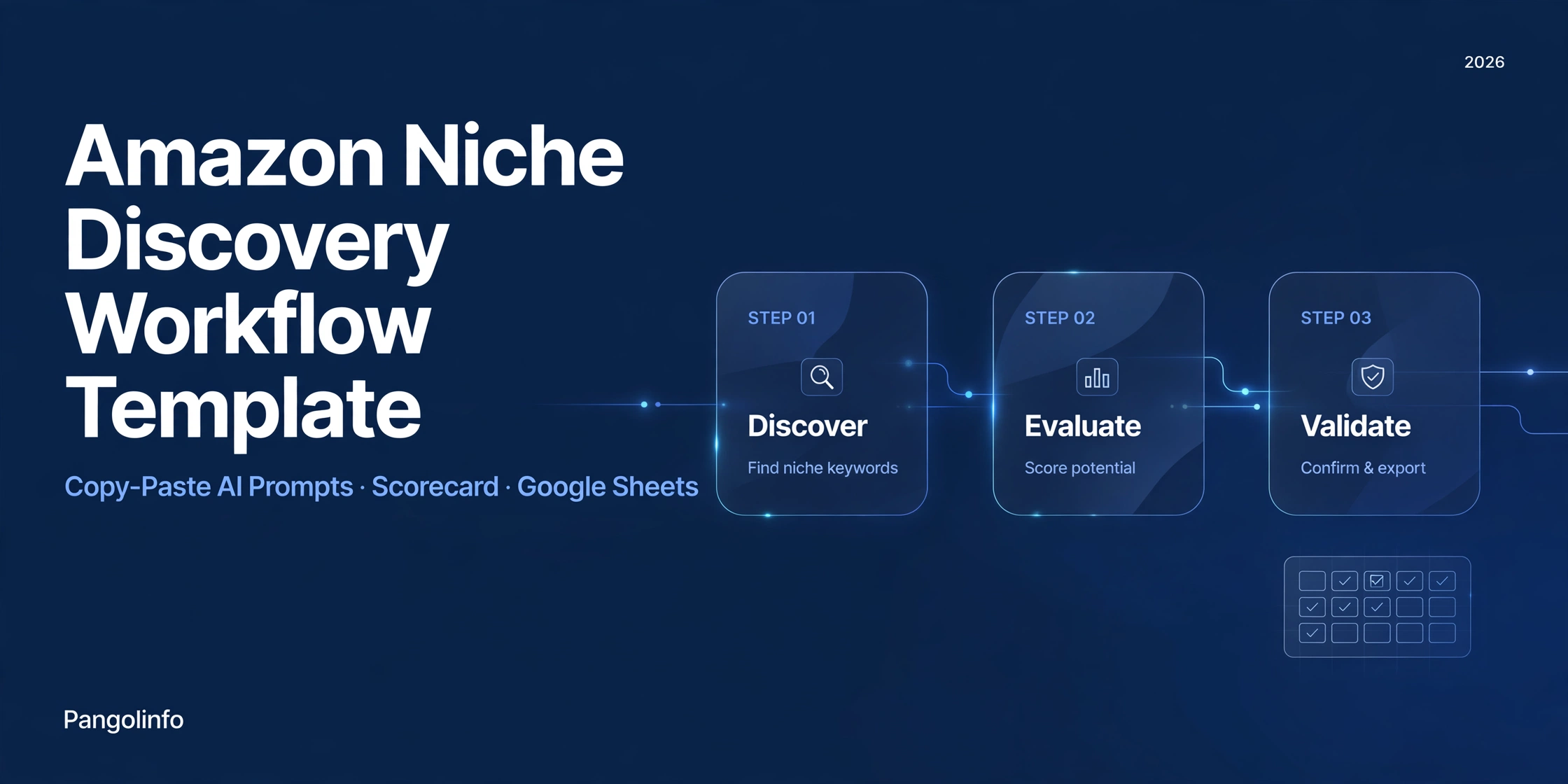
The workflow divides exactly 60 minutes across five sequential gates:
- Step 1: Niche Filter (Macro Snapshot): Query the Niche Data API to populate Columns A through H and J through U. Verify whether trailing 90-day and 360-day search volumes justify further inspection, and immediately check macro kill switches (brand click share, 90-day launch survival, sponsored share, and return rate).
- Step 2: SERP Scan (Live Shelf Verification): Pull the live keyword SERP via the Scraper API (
dog lick mat) to populate Column I and Columns V through Z. Separate sponsored placements from organic slots, measure the organic median price, and audit the review counts of the top 10 organic competitors. - Step 3: PDP Deep Dive (Benchmark Specification): Extract the live product detail pages for the top 5 organic ASINs (1 credit per page, 5 credits total). Confirm active availability—replacing any dead or unavailable ASINs—and inspect category BSR ranks, badge status (
Overall Pick), and fulfillment structure. - Step 4: VOC (Defect & Sentiment Extraction): Query the Reviews API or parse the live PDP
aiReviewsSummarypayload for the #1 organic benchmark (B09FPTDBRZ). Quantify positive vs. negative mention ratios across core functional themes (durability, grip, cleaning, suction) to determine whether a mold modification can solve customer complaints without blowing up manufacturing costs. - Step 5: Score and Decide (Scorecard & Kill Switch Gate): Run the 100-point weighted rubric and evaluate all five kill switches. Write the final score (
31/100) and verdict (CAUTION leaning STOP) into Columns AA and AB.
| Step | Workflow Stage | Primary Data Tool | Credits Used | Time Allocation | Key Output Columns |
|---|---|---|---|---|---|
| Step 1 | Niche Filter | Niche Data API | 10 credits (1 call) | 10 mins | Cols A–H, J–U |
| Step 2 | SERP Scan | Scraper API (SERP) | 2 credits (2 pages) | 12 mins | Col I, Cols V–Z |
| Step 3 | PDP Deep Dive | Scraper API (PDP) | 5 credits (5 pages) | 13 mins | ASIN status & BSR validation |
| Step 4 | VOC Extraction | Reviews API / PDP Summary | 0–20 credits (0–4 pages) | 15 mins | Defect theme matrix & quote |
| Step 5 | Score and Decide | Scorecard & Kill Switches | 0 credits | 10 mins | Cols AA–AB (31/100, Verdict) |
| Total | Full Niche Audit | Amazon Data MCP Suite | 17–37 credits | 60 mins | Complete 28-Col Row |
4. Scored Case: Lick Mat for Dogs
To demonstrate how the amazon niche discovery workflow template prevents bad capital allocation, we audit the "lick mat for dogs" market using two verified dataset pulls: a Niche API snapshot captured on 2026-08-02 and a live keyword SERP scrape for "dog lick mat" executed on 2026-11-06.
Macro Niche Snapshot (lick mat for dogs, 2026-08-02)
At first glance, top-line demand appears compelling. Trailing 90-day search volume (searchVolumeT90) stands at 463,314 with +2.8% growth, while trailing 360-day search volume (searchVolumeT360) reaches 1,742,644, surging +145.9% year-over-year. Return rates are exceptionally benign, with returnRateT360 sitting at just 1.52%.
However, examining the competitive and pricing distribution exposes immediate structural rot:
- Compressed Pricing: Across the 20 products tracked in the niche, prices span $4.40 to $21.20 with an average price of $8.87.
- Monopolized Clicks: While 13 brands and 37 sellers participate in the niche, the Top-5 products capture 58.3% click share, and the Top-5 brands control 76.4% click share.
- Incumbent Moat: The niche carries an average BSR of 33.87, an average rating of 4.455, and an average review count of 2,227.1.
- Pay-to-Play Saturation & Zero Launch Survival: Exactly 95% of tracked listings run sponsored ads. Over the trailing 360 days, 6 new launches entered the niche, but trailing 90-day successful launches (
successfulLaunchesT90) equal 0.
Live SERP Verification (dog lick mat, 2026-11-06)
Scraping the live SERP for "dog lick mat" returned 60 rows, split into 48 organic results and 12 sponsored slots. The top 4 positions on the page are all sponsored, forcing shoppers to scroll past a paid wall before seeing a single natural ranking.
- #1 Organic Benchmark: The top organic slot is held by LUKITO (ASIN
B09FPTDBRZ), priced at $8.99, carrying a 4.4-star rating, 8,783 reviews, a 6K+/mo sales velocity badge, and Amazon’s Overall Pick badge. - Organic Price Distribution: Across the 48 organic listings, prices range from $3.99 to $28.49, with an organic median price of $9.99.
- Organic Top-10 Review Wall: Ordered from rank #1 to #10, the review counts of the top 10 organic listings are: 8,783 / 2,792 / 2,792 / 1,302 / 2,792 / 236 / new / 784 / 31 / 1,105. Every single listing in the top 5 organic positions holds well over 1,300 reviews, and eight of the top ten exceed 200 reviews.
The 31/100 Scorecard Breakdown
Using our template’s recommended thresholds and category weights, "lick mat for dogs" scores 31 out of 100:
| Scoring Dimension | Template Recommended Weight | Case Score | One-Line Scoring Reason |
|---|---|---|---|
| 1. Demand & growth | 20 | 14 / 20 | Strong T360 volume (1,742,644, +145.9%) is tempered by decelerating T90 momentum (463,314, +2.8%). |
| 2. Traffic concentration | 25 | 4 / 25 | Top-5 brands monopolize 76.4% of clicks and Top-5 products take 58.3%, starving long-tail listings. |
| 3. Review wall & launch survival | 25 | 3 / 25 | Average reviews hit 2,227.1 (#1 organic at 8,783) and T90 successful launches sit at 0 out of 6 T360 entries. |
| 4. Acquisition cost | 15 | 2 / 15 | 95% niche sponsored share and 4 top-of-page sponsored slots collide with an $8.87 average / $9.99 median price. |
| 5. VOC & profit | 15 | 8 / 15 | Low 1.52% return rate and clear durability complaints (77.2% negative) offer a redesign angle, but sub-$10 pricing crushes hardware upgrade margins. |
| Total Score | 100 | 31 / 100 | Verdict: CAUTION leaning STOP |
Four Triggered Kill Reasons
Beyond the low 31/100 total score, the niche triggers four separate kill switches under our template’s recommended thresholds:
- Brand Oligopoly (KS-01 Triggered): Top-5 brands absorb 76.4% of all niche clicks, breaching our template’s recommended threshold of
> 65%and leaving fewer than a quarter of clicks for the remaining 8 brands and new challengers. - Dead Launch Window (KS-02 Triggered): Despite 6 new products launching over the past 360 days, 0 launches achieved success in the trailing 90 days (
successfulLaunchesT90 = 0), matching our template’s zero-survival stop rule. - Impenetrable Review Wall (KS-03 Triggered): The niche averages 2,227.1 reviews (exceeding our template’s
> 1,500cutoff), and the top 5 organic listings carry 8,783, 2,792, 2,792, 1,302, and 2,792 reviews—meaning all top-5 organic slots easily surpass the> 500review barrier. - Ad-to-Price Squeeze (KS-04 Triggered): Sponsored share stands at 95% (above our template’s
> 85%threshold) while the niche average price ($8.87) and organic SERP median price ($9.99) both sit well below our template’s< $12danger line, leaving insufficient gross dollar margin to absorb pay-per-click (PPC) acquisition costs.
5. Five Kill Switches — Quick Table
A high score in one dimension should never mask a fatal flaw in another. Even if a seller attempts to rationalize the 1.74 million annual searches, our template’s recommended thresholds enforce five automated kill switches. Triggering two or more kill switches mandates an immediate halt for standard private-label sellers. In the "lick mat for dogs" audit, four out of five kill switches fire.
| Kill Switch ID | Rule (Our Template’s Recommended Threshold) | Verified Case Value (lick mat for dogs) |
Triggered? |
|---|---|---|---|
| KS-01 | top5BrandsClickShare > 65% |
76.4% | Yes |
| KS-02 | successfulLaunchesT90 = 0 |
0 (with 6 new launches in T360) | Yes |
| KS-03 | Avg reviews > 1,500 AND Top-5 organic all > 500 reviews |
2,227.1 avg; Top-5 organic: 8,783 / 2,792 / 2,792 / 1,302 / 2,792 | Yes |
| KS-04 | Sponsored share > 85% AND Avg or median price < $12 |
95% sponsored; $8.87 avg / $9.99 organic median | Yes |
| KS-05 | returnRateT360 > 8% |
1.52% | No |
6. Prompt Chain, VOC and Profit Trial
To automate Steps 1 through 5 inside an AI agent (such as Gemini, Codex, or WorkBuddy), connect your environment to the Amazon Data MCP. Follow the setup instructions in the WorkBuddy Amazon Data Skill Guide and insert your API credentials into your local MCP configuration file.
Verified MCP Configuration
Use the verified Pangolinfo MCP server configuration below from Amazon Data MCP (replace <YOUR_PANGOLINFO_API_KEY> with your personal API token):
{
  "mcpServers": {
    "pangolinfo": {
      "url": "https://mcp.pangolinfo.com/mcp",
      "headers": {
        "Authorization": "Bearer <YOUR_PANGOLINFO_API_KEY>"
      }
    }
  }
}
The Five-Stage Copy-Paste Prompt Chain
Run these five English prompts sequentially in your MCP-enabled agent to populate your 28-column Google Sheet row.
Prompt 1 — Niche Filter Prompt (Step 1: 10 Credits):
Use the Pangolinfo Niche Data API tool to query the US marketplace niche "lick mat for dogs". Extract and tabulate the exact values for: searchVolumeT90, searchVolumeT90 growth %, searchVolumeT360, searchVolumeT360 growth %, price min, price max, price avg, product count, sponsored share %, top-5 products click share %, top-5 brands click share %, brand count, seller count, avg BSR, avg reviews, avg rating, new launches T360, successful launches T90, and returnRateT360. Flag any value that breaches our template's recommended thresholds: top5BrandsClickShare > 65%, successfulLaunchesT90 = 0, avg reviews > 1,500, sponsored share > 85% with avg price < $12, or returnRateT360 > 8%.Prompt 2 — SERP Scan Prompt (Step 2: 2 Credits):
Use the Pangolinfo Scraper API to fetch the first 2 pages of live US Amazon SERP data for the keyword "dog lick mat". Count total rows, organic rows, and sponsored rows. Identify how many of the top 4 overall positions are sponsored. Calculate the organic price min, organic price max, and organic median price. Extract the #1 organic listing's ASIN, brand, price, star rating, review count, monthly sales badge, and badge status. Finally, list the exact review counts for the top 10 organic listings in rank order.Prompt 3 — PDP Deep Dive Prompt (Step 3: 5 Credits):
Fetch the live Product Detail Pages (PDP) for the top 5 organic ASINs from the "dog lick mat" SERP (including B09FPTDBRZ). Verify active inventory status—if any target ASIN returns [ASIN_UNAVAILABLE], log the dead ASIN and switch the primary benchmark to the #1 live organic ASIN (B09FPTDBRZ). Report the exact category and subcategory BSR numbers separately without comparing BSR numbers across different categories, along with star rating distribution (1-3 star share) and embedded aiReviewsSummary data.Prompt 4 — VOC Extraction Prompt (Step 4: 0–20 Credits):
Extract the Voice of Customer (VOC) sentiment breakdown for benchmark ASIN B09FPTDBRZ. Query the Reviews API first; if the get_amazon_reviews endpoint returns 0 reviews, fall back immediately to the live PDP aiReviewsSummary object. Tabulate total mentions, positive mentions, negative mentions, and negative share % across all reported aspect themes, and extract verbatim customer failure quotes regarding product durability.Prompt 5 — Scoring & Verdict Prompt (Step 5: 0 Credits):
Evaluate the "lick mat for dogs" dataset using our template's recommended weights: Demand & growth (20), Traffic concentration (25), Review wall & launch survival (25), Acquisition cost (15), and VOC & profit (15). Evaluate all 5 kill switches (KS-01 through KS-05) against our template's recommended thresholds. Output the score per category with a one-line justification, the total score out of 100, the triggered kill switches, and a final row formatted as tab-separated values for Columns A through AB of the Google Sheets template.Operational Notes: Dead ASIN Switch & Reviews Endpoint Fallback
During live execution of Step 3 and Step 4, two real-world data anomalies occurred that every researcher must account for in an automated pipeline:
- Dead Sample ASIN Switch (
B0B178VDQQtoB09FPTDBRZ): Our initial historical sample target, ASINB0B178VDQQ, returned[ASIN_UNAVAILABLE](dead listing) on the live pull. Rather than aborting the audit or relying on stale cached reviews, the workflow switched the primary PDP and VOC benchmark to the live #1 organic leader, LUKITO (B09FPTDBRZ). get_amazon_reviewsFallback to Live PDPaiReviewsSummary: When querying the Reviews API during this test run, theget_amazon_reviewsendpoint returned0reviews 4 times that day. Instead of fabricating review samples or halting the pipeline, we extracted the VOC metrics directly from the live PDPaiReviewsSummarypayload returned by the Scraper API onB09FPTDBRZ—saving 20 review credits while capturing Amazon’s aggregated aspect sentiment across all 8,783 ratings.
VOC Deep Dive: Benchmark ASIN B09FPTDBRZ
On its live PDP, LUKITO (B09FPTDBRZ) holds 8,783 total ratings with a 4.4-star average. Critical ratings (1 to 3 stars) account for approximately 16% of the total pool, representing approximately 1,400 critical reviews. Its category rankings stand at BSR #1,328 in Pet Supplies and BSR #24 in Dog Feeding & Watering (note: BSR figures reflect relative velocity within their respective parent and subcategory trees and must never be compared across unrelated categories).
Parsing the live PDP aiReviewsSummary object reveals eight tracked customer sentiment themes:
| Aspect Theme | Total Mentions | Positive Mentions | Negative Mentions | Negative Share (%) | Operational Signal |
|---|---|---|---|---|---|
| Quality | 600 | 530 | 70 | 11.7% | Baseline silicone molding meets casual expectations |
| Pet preference | 446 | 437 | 9 | 2.0% | Dogs strongly engage with textured food pockets |
| Engagement | 362 | 353 | 9 | 2.5% | Effective for distraction during grooming/bathing |
| Functionality | 201 | 174 | 27 | 13.4% | Core licking and slow-feeding utility works as intended |
| Ease of cleaning | 299 | 166 | 133 | 44.5% | Deep peanut butter crevices trap residue in dishwashers |
| Grip | 269 | 115 | 154 | 57.2% | Mat slides across tile and hardwood floors during use |
| Suction | 257 | 154 | 103 | 40.1% | Rear suction cups detach from walls and shower tiles |
| Durability | 193 | 44 | 149 | 77.2% | Severe tearing and chewing destruction by aggressive dogs |
Four physical engineering flaws dominate the negative feedback: Durability (77.2% negative), Grip (57.2% negative), Ease of cleaning (44.5% negative), and Suction (40.1% negative). As one verbatim customer complaint summarized the durability failure:
“tore during first use, shredded into pieces within minutes”
Profit Trial & The Sub-$10 Hardware Dilemma
In theory, a 77.2% negative durability rate and a 57.2% negative grip rate offer a textbook product differentiation roadmap: thicken the food-grade silicone base, embed a rigid nylon or stainless-steel rim to prevent edge chewing, and widen the rear suction cup diameter.
In practice, the niche’s pricing ceiling destroys that roadmap. The niche average price is $8.87, the #1 organic benchmark (B09FPTDBRZ) sells for $8.99, and the organic SERP median price is $9.99. To contextualize how Amazon fulfillment and referral fees compress low-ASP items, a separate NovaData case cited in our research report—which is explicitly not our measurement for this ASIN—documented an $11.00 retail price leaving just $4.20 after standard platform fee deductions. We do not build a specific profit claim for B09FPTDBRZ on that external figure, because upgrading silicone shore hardness and mold weight to stop dogs from shredding the mat within minutes increases factory cost of goods sold (COGS) and FBA dimensional weight tiers, while 95% sponsored ad saturation forces new launches to bid aggressively against an $8.99 incumbent with 8,783 reviews.
7. 13-Point Pre-Launch Checklist and FAQ
Before committing tooling deposits or inventory capital to any candidate market in your Amazon Niche Discovery Workflow Guide pipeline, verify that your row in the 28-column sheet clears this condensed 13-point gate:
- Macro Volume Floor: Confirm
searchVolumeT90andsearchVolumeT360reflect sustained buyer demand rather than a single seasonal spike. - Growth Trajectory: Verify that both 90-day and 360-day search volume growth percentages are positive or stable.
- Price Ceiling Buffer: Ensure the niche average price and organic SERP median price sit at or above $12.00 to absorb FBA and PPC costs.
- Brand Click Dispersion (KS-01): Confirm
top5BrandsClickShareis at or below 65% under our template’s recommended thresholds. - Product Click Dispersion: Check that
top5ProductsClickSharedoes not lock out page-one challengers. - Launch Survival Proof (KS-02): Verify
successfulLaunchesT90is greater than 0 when new launches have entered during T360. - Review Wall Clearance (KS-03): Confirm niche average reviews sit below 1,500 AND at least one top-5 organic listing holds fewer than 500 reviews.
- Sponsored Density Check (KS-04): Ensure niche sponsored share does not exceed 85% alongside sub-$12 pricing.
- Organic Shelf Integrity: Audit the live SERP to verify how many top-of-page slots are consumed by sponsored ads versus organic listings.
- Active ASIN Verification: Pull live PDPs for the top 5 organic competitors to filter out
[ASIN_UNAVAILABLE]listings before benchmarking. - Return Rate Safety (KS-05): Confirm
returnRateT360stays at or below 8% under our template’s recommended thresholds. - Quantified VOC Defect Angle: Extract
aiReviewsSummaryor review feeds to isolate at least one high-negative theme (such as durability at 77.2% negative) that you can engineer out. - Weighted Score Threshold: Confirm Column AA (
Total score /100) meets your minimum launch cutoff with zero triggered kill switches.
Frequently Asked Questions (FAQ)
(1) Category vs niche — what is the difference?
An Amazon category is a broad taxonomy node defined by Amazon’s browse tree—such as Pet Supplies or its child subcategory Dog Feeding & Watering—containing tens of thousands of unrelated products with different buyer intents. A niche is a specific buyer-intent cluster anchored by a canonical search keyword, such as "lick mat for dogs" (tracked as 20 core products in our Niche API snapshot). You cannot validate unit economics or click concentration at the category level because a category mixes $5 bowls with $200 automatic feeders. Niche discovery isolates the exact 20 to 60 listings competing for the same shopper click.
(2) What score is good?
Under our template’s recommended thresholds, a total of 75 or higher with zero triggered Kill Switches is a GO; 50–74 is CAUTION; below 50 is STOP. A score must always be read together with the five Kill Switches: if a niche triggers two or more, capital deployment must halt regardless of the total. "lick mat for dogs" scores 31/100 with four switches triggered — a CAUTION leaning STOP.
(3) How do I read BSR?
Best Sellers Rank (BSR) is a relative sales velocity index strictly confined to a single category or subcategory browse node. For example, benchmark ASIN B09FPTDBRZ carries a BSR of #1,328 in Pet Supplies and #24 in Dog Feeding & Watering, while the 20-product niche snapshot reports an average BSR metric of 33.87. You must never compare BSR numbers across different categories—a #1,328 rank in Pet Supplies represents a completely different daily unit volume than a #1,328 rank in Industrial & Scientific. Always read parent category BSR and subcategory BSR as separate, non-interchangeable signals alongside live SERP monthly sales badges (6K+/mo).
(4) How many reviews is too many?
Under our template’s recommended thresholds (Kill Switch KS-03), a niche hits an impenetrable review wall when the niche average exceeds 1,500 reviews AND all top-5 organic SERP listings carry more than 500 reviews. In the "lick mat for dogs" case, the niche averages 2,227.1 reviews, the #1 organic listing (B09FPTDBRZ) holds 8,783 reviews, and the top 5 organic positions sit at 8,783 / 2,792 / 2,792 / 1,302 / 2,792 (all well above 500). While a few lower page-one slots have fewer reviews, the top-5 organic wall locks up 58.3% of product clicks, forcing new entrants to rely almost entirely on expensive paid traffic.
(5) What are the FBA margin targets?
Under our template’s recommended thresholds, a niche must first clear the KS-04 pricing floor: avoid markets where sponsored share exceeds 85% while average or organic median price sits below $12.00. In "lick mat for dogs", a 95% sponsored share collides with an $8.87 average price and a $9.99 organic median price. At sub-$10 retail points, fixed FBA fulfillment fees, referral fees, and rising PPC bids leave no room for manufacturing upgrades to fix high-defect areas like durability (77.2% negative). Aim for retail prices above $15–$20 where gross margin dollars can absorb both quality tooling and launch advertising.