

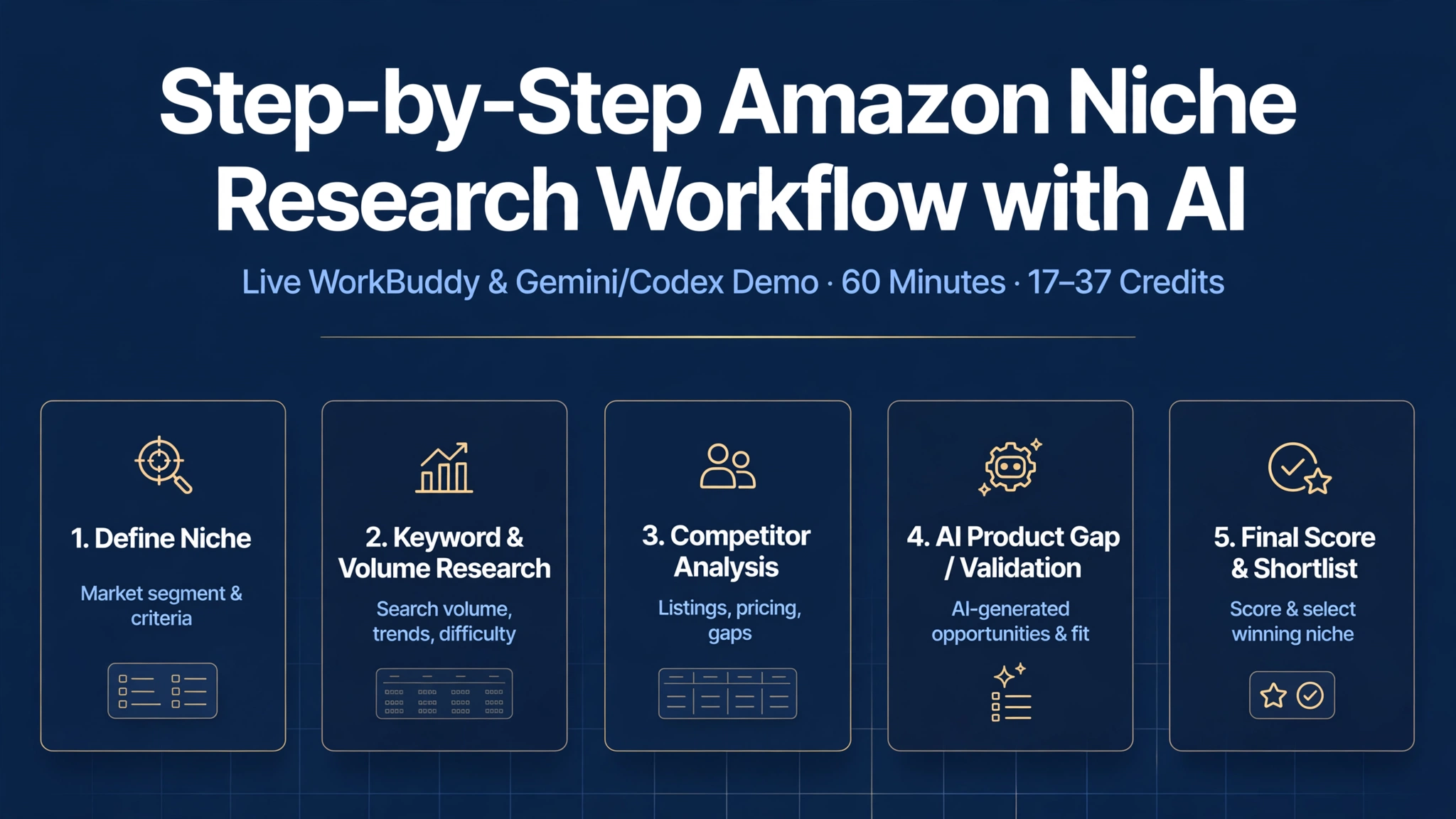
Series Navigation: This article is Part 2 (A2) of our 4-part series on AI-driven product validation, serving as the live execution companion to our pillar guide, the Amazon Niche Discovery Workflow Guide. For the static data schemas, refer to Part 1 (A1), the Amazon Niche Discovery Workflow Template (published 2026-11-07). Upcoming installments include Part 3 (A3), the Amazon Niche Validation Scorecard (coming soon), and Part 4 (A4), the Amazon Product Research Prompt Pack (coming soon).
Our live AI validation of the “lick mat for dogs” niche scored 31/100 and triggered 4 out of 5 Kill Switches—yielding a definitive verdict of CAUTION leaning STOP, meaning sellers must not commit capital and should archive the niche as rejected, a decision reached in 60 minutes using 17 to 37 credits in WorkBuddy via the Amazon Data MCP.
Conventional product research forces operators to bounce between browser extensions, outdated keyword exports, and manual spreadsheets. That fragmented approach burns half a workday per product idea while missing critical blind spots: pay-to-play ad walls, brand click monopolies, dead new-launch pipelines, and sub-$10 retail price ceilings. In Part 1 (A1), the Amazon Niche Discovery Workflow Template, we established the 28-column data schema, the 5 Kill Switch reference table, and the 13-point pre-launch checklist. We will not reprint those static tables here. Instead, Part 2 focuses exclusively on live execution: wiring an AI agent inside WorkBuddy (paired with Gemini or Codex models) to the underlying data endpoints via the Model Context Protocol (MCP), running a repeatable step by step amazon niche research workflow with AI, and inspecting the exact JSON payloads returned for lick mat for dogs.
1. Five-Step Overview and 60-Minute Timebox
An enterprise-grade step by step amazon niche research workflow with AI replaces open-ended browsing with two strict operational guardrails: a hard 60-minute timebox and a predictable 17 to 37 credit budget. When you mount the Amazon Data MCP inside WorkBuddy, your AI agent stops guessing market sizing from stale training weights. Instead, it orchestrates 21 live tools across Pangolinfo’s real-time scraping and niche intelligence infrastructure, operating at a 99.9% request success rate with 90%+ sponsored-placement detection accuracy on Amazon search pages.
Before starting the 60-minute clock, bind the remote MCP server inside your WorkBuddy configuration file. Full client setup instructions and troubleshooting steps are documented in the WorkBuddy Amazon Data Skill Guide. Insert the following JSON block into your MCP settings, replacing the placeholder with your private token (never hardcode a live key in shared repositories or public prompt templates):
{
  "mcpServers": {
    "pangolinfo-amazon-data": {
      "url": "https://mcp.pangolinfo.com/mcp",
      "headers": {
        "Authorization": "Bearer <YOUR_PANGOLINFO_API_KEY>"
      }
    }
  }
}
Once connected, WorkBuddy can invoke all 21 tools on demand. Pangolinfo provides a free tier of 60 credits per month with no credit card required. Because a complete five-step validation consumes between 17 and 37 credits depending on whether you paginate raw review pages or parse embedded product-page review summaries, a single free account supports 1 to 3 full end-to-end niche audits every month at zero software cost.
| Workflow Stage | Timebox | Primary API / MCP Tool | Credit Cost | Core Output Mapped to A1 Schema |
|---|---|---|---|---|
| Step 1: Macro Niche Pull | 10 min | Niche Filter API | 10 credits (10/call) | T90/T360 search volume, click shares, launch survival, return rate |
| Step 2: Live SERP Verification | 12 min | Scraper API (SERP) | 2 credits (1/page × 2) | Organic vs. sponsored split, median price, top-10 review wall |
| Step 3: Head PDP Penetration | 13 min | Scraper API (PDP) | 5 credits (1/page × 5) | Live ASIN status, category BSR, 1-3 star volume, aiReviewsSummary |
| Step 4: VOC Complaint Mining | 15 min | Reviews API or PDP Fallback | 0–20 credits (5/page × 0–4) | Attribute negative rates, verbatim failure quotes, redesign scope |
| Step 5: Scoring & Verdict | 10 min | Local Agent Reasoning | 0 credits | 100-point scorecard, 5 Kill Switch checks, final GO/CAUTION/STOP |
| Total Validation Run | 60 min | 21 Live MCP Tools | 17–37 credits | Auditable Markdown & JSON Decision Record |
By enforcing this 60-minute schedule, product researchers eliminate analysis paralysis. Below is the complete, unedited walkthrough of all five steps on the lick mat for dogs niche, showing the exact English prompts and verified data payloads.
2. Step 1: Macro Niche Pull
Goal
Spend the first 10 minutes extracting a macro supply-and-demand snapshot for lick mat for dogs. The objective is to quantify 90-day and 360-day search volume momentum, price boundaries, top-product and top-brand click concentration, seller density, average review barriers, 360-day return rates, and new-product launch survival. These metrics populate the macro columns of A1’s 28-column workflow sheet and surface early warnings against our template’s recommended thresholds.
Tools and Prompts
This step invokes the niche intelligence endpoint inside the Amazon Data MCP, powered by the Niche Data API. Rather than writing custom Python scripts to parse nested responses, issue the following structured English prompt directly inside WorkBuddy (reusable variations of these instructions will be compiled in Part 4, the Amazon Product Research Prompt Pack):
Call the Niche Filter API tool in the pangolinfo-amazon-data MCP for the US marketplace (US) and query the exact niche keyword "lick mat for dogs".
Extract and return a structured summary containing the snapshot date and the following five metric groups:
1. Demand & Growth: 90-day search volume (searchVolumeT90) with period-over-period growth rate, and 360-day search volume (searchVolumeT360) with year-over-year growth rate.
2. Price Architecture: minimum price, maximum price, and average price across tracked niche listings.
3. Competition & Click Share: tracked product count, sponsored listing percentage, Top-5 products click share, Top-5 brands click share, total brand count, and total seller count.
4. Barrier & Quality Metrics: average BSR, average review count, average star rating, and 360-day return rate (returnRateT360).
5. Launch Survival: new product launches over the past 360 days (T360) and successful new launches over the past 90 days (T90).
Finally, flag any metric that breaches our template's recommended thresholds for the 5 Kill Switches.
Real Returned Data
WorkBuddy queried https://mcp.pangolinfo.com/mcp and returned the verified niche snapshot for lick mat for dogs (Niche API snapshot date: 2026-08-02). Below is the structured data payload:
{
  "nicheKeyword": "lick mat for dogs",
  "snapshotDate": "2026-08-02",
  "demandMetrics": {
    "searchVolumeT90": 463314,
    "searchVolumeGrowthT90": "+2.8%",
    "searchVolumeT360": 1742644,
    "searchVolumeGrowthT360": "+145.9%"
  },
  "pricingMetrics": {
    "minPrice": 4.40,
    "maxPrice": 21.20,
    "avgPrice": 8.87,
    "currency": "USD"
  },
  "competitionMetrics": {
    "productCount": 20,
    "sponsoredShare": "95%",
    "top5ProductsClickShare": "58.3%",
    "top5BrandsClickShare": "76.4%",
    "brandCount": 13,
    "sellerCount": 37
  },
  "barrierAndQualityMetrics": {
    "avgBSR": 33.87,
    "avgReviews": 2227.1,
    "avgRating": 4.455,
    "returnRateT360": "1.52%"
  },
  "launchMetrics": {
    "newProductsT360": 6,
    "successfulLaunchesT90": 0
  }
}
Inspecting this single payload reveals a sharp divergence between top-line buyer interest and bottom-line seller survivability:
- Deceptively Strong Demand and Low Returns: Over a 360-day window,
searchVolumeT360reached 1,742,644 searches (+145.9% growth), while recent 90-day volume (searchVolumeT90) sits at 463,314 (+2.8%). Furthermore,returnRateT360is a remarkably low 1.52%, staying well below our template’s recommended threshold of 8% for KS-05. Novice researchers who stop at search volume and return rates routinely mistake this niche for a goldmine. - Severe Brand Click Monopoly: Across the 20 core products, 13 brands, and 37 sellers tracked in the niche, the Top-5 products capture 58.3% of all clicks, while the Top-5 brands control 76.4% of total click share. That immediately breaches KS-01 (>65% under our template’s recommended thresholds).
- Frozen New-Seller Entry and Sub-$10 Pricing: Over the past 360 days, only 6 new products entered the niche, and T90 successful launches dropped to 0 (breaching KS-02). Meanwhile, incumbents hold an average of 2,227.1 reviews at a 4.455 average rating and an average BSR of 33.87. Worse still, 95% of tracked placements carry sponsored activity inside a price band of $4.40 to $21.20, with an average price of just $8.87.
Time and Credits
- Elapsed Time: 10 minutes (covering prompt execution, JSON verification, and logging the macro metrics into the A1 workflow sheet).
- Credits Consumed: 10 credits (1 call to the Niche Filter API at 10 credits/call).
Pitfalls and Checkpoints
- Treating Historical Niche Snapshots as Live Shelf Reality: The Niche API snapshot (
2026-08-02) provides aggregated T90 and T360 behavioral metrics that no single page scrape can calculate, such as click share and return rates. However, you must never skip Step 2’s live SERP check to verify current front-page pricing and organic ranking order. - Comparing Average BSR Across Unrelated Categories: The returned average BSR of 33.87 reflects ranking density strictly within its native node structure. Never compare a Pet Supplies BSR figure against Kitchen, Home, or Electronics benchmarks, as sales velocity per BSR point varies massively across root categories.
- Step 1 Checkpoint: Confirm that
top5BrandsClickShare(76.4%),successfulLaunchesT90(0),avgReviews(2,227.1),sponsoredShare(95%), andavgPrice($8.87) are locked into your worksheet before advancing.
3. Step 2: Live SERP Verification
Goal
Dedicate the next 12 minutes to pulling the real-time Amazon search results page (SERP) for the primary shopper query dog lick mat. While Step 1 measures historical niche concentration, the live SERP shows the exact competitive battlefield a new listing faces today. Our goal is to separate organic listings from paid ads, verify whether the top-of-search fold is monopolized by sponsored slots, calculate the live organic median price, and map the review counts of the top 10 organic competitors.
Tools and Prompts
Invoke the real-time SERP scraper tool within the Amazon Data MCP (powered by Pangolinfo’s Scraper API, which achieves 90%+ sponsored-placement detection). Run the following English prompt in WorkBuddy:
Call the Amazon SERP Scraper tool in the pangolinfo-amazon-data MCP for the US marketplace (US) and fetch the first 2 pages of live search results for the keyword "dog lick mat".
Parse the returned listings and output a structured report covering:
1. Placement Breakdown: total rows returned, count of organic rows, count of sponsored rows, and the placement type of the first 4 positions at the very top of page 1.
2. Rank #1 Organic Benchmark: brand name, ASIN, live price, star rating, total review count, monthly sales velocity badge, and Amazon badge status for the #1 organic listing.
3. Organic Price Distribution: minimum price, maximum price, and median price calculated strictly across organic rows.
4. Top-10 Organic Review Wall: list the exact review counts for organic ranks #1 through #10 in sequential order (mark any newly launched listing without reviews as "new").
Real Returned Data
Executed live on 2026-11-06, the MCP tool extracted 60 front-page listings for dog lick mat. Below is the verified SERP summary:
{
  "searchKeyword": "dog lick mat",
  "testDate": "2026-11-06",
  "serpComposition": {
    "totalRows": 60,
    "organicRows": 48,
    "sponsoredRows": 12,
    "top4Positions": "All Sponsored (Top 4 slots are 100% paid ads)"
  },
  "rank1OrganicBenchmark": {
    "brand": "LUKITO",
    "asin": "B09FPTDBRZ",
    "price": 8.99,
    "rating": 4.4,
    "reviewsCount": 8783,
    "monthlySalesTag": "6K+/mo",
    "badge": "Overall Pick"
  },
  "organicPricing": {
    "minPrice": 3.99,
    "maxPrice": 28.49,
    "medianPrice": 9.99,
    "currency": "USD"
  },
  "top10OrganicReviewsSequence": [
    8783,
    2792,
    2792,
    1302,
    2792,
    236,
    "new",
    784,
    31,
    1105
  ]
}
Cross-checking the 2026-11-06 live SERP against Step 1’s macro snapshot confirms every structural risk:
- Above-the-Fold Ad Paywall: Out of 60 returned rows (48 organic + 12 sponsored), the top 4 positions on page 1 are all sponsored placements. Shoppers searching
dog lick matcannot reach an organic result without scrolling past four paid ads. - Dominant #1 Organic Incumbent: The #1 organic spot belongs to LUKITO (ASIN
B09FPTDBRZ), priced at $8.99 with a 4.4-star rating, 8,783 reviews, a 6K+/mo sales velocity tag, and Amazon’s Overall Pick badge. - Sub-$10 Organic Median Price: Across all 48 organic listings, prices span $3.99 to $28.49 (the upper end reflecting multi-pack bundles), but the organic median price is just $9.99. Paired with the $8.87 niche average from Step 1, this confirms that single-unit demand clusters tightly under $10.
- Impenetrable Top-5 Review Wall: The sequential review counts for the top 10 organic listings are 8,783 / 2,792 / 2,792 / 1,302 / 2,792 / 236 / new / 784 / 31 / 1,105. Every single listing in the organic top 5 holds more than 1,300 reviews (far exceeding our template’s recommended threshold of >500 reviews across the organic top 5 for KS-03). While lower-review listings appear at organic ranks #6 (
236), #7 (new), and #9 (31), they are pushed deep below four sponsored slots and five entrenched giants.
Time and Credits
- Elapsed Time: 12 minutes (Cumulative time: 22 minutes).
- Credits Consumed: 2 credits for scraping 2 SERP pages at 1 credit/page (Cumulative credits: 12 credits).
Pitfalls and Checkpoints
- Contaminating Organic Review Walls with Sponsored Rows: Basic scrapers that fail to strip sponsored slots misclassify top-of-page ads as organic ranks #1 to #4. Because Sponsored Products frequently rotate newer, lower-review ASINs, mixing them into your top-5 organic count creates a false sense of accessibility. Rely on Pangolinfo’s 90%+ sponsored-placement detection to isolate true organic ranks.
- Using Mean Price Instead of Median Price on SERPs: A few $28.49 multi-packs skew arithmetic averages upward. Always compute the organic median price ($9.99) so your FBA margin model reflects what mainstream shoppers pay.
- Step 2 Checkpoint: Verify that the top-5 organic review counts (8,783 / 2,792 / 2,792 / 1,302 / 2,792) and organic median price ($9.99) are recorded, and lock in
B09FPTDBRZas the live #1 organic benchmark for Step 3.
4. Step 3: Head PDP Penetration
Goal
Use the next 13 minutes to penetrate the product detail pages (PDPs) of the leading organic competitors (budgeting 5 PDP pages to cover the #1 organic benchmark plus 4 top peers). The goal is to verify live listing availability, extract exact root and sub-category BSR numbers, calculate the volume of 1-to-3-star critical ratings, and harvest the embedded aiReviewsSummary object directly from the PDP payload.
Tools and Prompts
During this step, our live workflow encountered a classic real-world data exception: our initial historical sample ASIN B0B178VDQQ was dead and returned [ASIN_UNAVAILABLE]. In static spreadsheet research, a dead ASIN stalls the audit or tempts analysts to cherry-pick a weak competitor. Under our automated protocol, WorkBuddy immediately pivoted to the verified #1 organic leader identified in Step 2: LUKITO B09FPTDBRZ.
Issue the following prompt in WorkBuddy to execute the 5-ASIN PDP pull and extract the benchmark structure:
The initial historical sample ASIN B0B178VDQQ returned [ASIN_UNAVAILABLE]. Pivoting to our Step 2 live SERP findings, set the #1 organic listing LUKITO (ASIN B09FPTDBRZ) as the primary benchmark, alongside the next 4 top organic competitors (5 PDPs total). Call the PDP Scraper tool in the pangolinfo-amazon-data MCP for the US marketplace (US).
For the primary benchmark ASIN B09FPTDBRZ, extract and return:
1. Core Listing Profile: brand, live price, star rating, total ratings count, monthly sales tag, and badge status.
2. Category BSR Standing: exact BSR rank and category name for both the root category and the sub-category node.
3. Critical Rating Pool: percentage share of 1-to-3-star ratings and the approximate count of critical reviews.
4. Embedded Review Intelligence: the complete aiReviewsSummary object from the live PDP, including every tracked attribute's total mentions, positive mentions, negative mentions, and verbatim buyer quotes.
Real Returned Data
WorkBuddy completed the 5-page PDP scrape at a 99.9% request success rate. Below is the verified JSON summary for the primary benchmark B09FPTDBRZ:
{
  "asin": "B09FPTDBRZ",
  "replacedDeadAsin": "B0B178VDQQ ([ASIN_UNAVAILABLE])",
  "brand": "LUKITO",
  "price": 8.99,
  "rating": 4.4,
  "totalRatings": 8783,
  "criticalRatings1To3Star": "~16% (approx. 1,400 critical ratings)",
  "monthlySalesTag": "6K+/mo",
  "badge": "Overall Pick",
  "bsrStanding": [
    {
      "rank": 1328,
      "category": "Pet Supplies"
    },
    {
      "rank": 24,
      "category": "Dog Feeding & Watering"
    }
  ],
  "aiReviewsSummary": {
    "status": "Extracted from live PDP",
    "trackedAttributes": 8,
    "verbatimNegativeQuote": "tore during first use, shredded into pieces within minutes"
  }
}
Penetrating the live PDP of B09FPTDBRZ delivers three critical engineering data points:
- Deep Category Velocity: At $8.99 and 6K+/mo in unit sales,
B09FPTDBRZranks #1,328 in Pet Supplies and #24 in Dog Feeding & Watering. Remember our core rule: use these BSR figures strictly to gauge velocity depth inside Pet Supplies and Dog Feeding & Watering—never compare them across unrelated root categories. - Substantial Defect Sample Size: Despite holding a respectable 4.4-star overall rating across 8,783 ratings, the 1-to-3-star critical share sits at ~16%, representing approximately 1,400 critical ratings. Fourteen hundred dissatisfied buyers provide more than enough signal to isolate structural product failures.
- Zero-Extra-Cost
aiReviewsSummaryExtraction: Because Pangolinfo’s PDP endpoint captures Amazon’s native AI review aggregation block, we now hold structured positive/negative counts across 8 distinct product attributes—plus verbatim customer quotes—already cached in memory before making a single call to the dedicated reviews endpoint.
Time and Credits
- Elapsed Time: 13 minutes to detect
[ASIN_UNAVAILABLE]onB0B178VDQQ, pivot toB09FPTDBRZ, and parse the 5 PDP payloads (Cumulative time: 35 minutes). - Credits Consumed: 5 credits for 5 PDP pages at 1 credit/page (Cumulative credits: 17 credits).
Pitfalls and Checkpoints
- Failing to Log Dead Sample ASINs: When an ASIN like
B0B178VDQQreturns[ASIN_UNAVAILABLE], record the exception explicitly and substitute the #1 live organic ASIN (B09FPTDBRZ) rather than picking a random mid-page listing that distorts benchmark difficulty. - Discarding the PDP’s
aiReviewsSummaryField: Many workflows ignore the review summary embedded inside the PDP response and immediately burn 20 credits paginating raw review endpoints. Always retainaiReviewsSummaryduring Step 3 as both a rapid triage matrix and a high-reliability fallback. - Step 3 Checkpoint: Confirm that the BSR coordinates (#1,328 Pet Supplies / #24 Dog Feeding & Watering), the critical rating pool (~16%, approx. 1,400 critical), and the embedded
aiReviewsSummarypayload forB09FPTDBRZare stored in context.
5. Step 4: VOC Complaint Mining
Goal
Spend 15 minutes quantifying buyer pain points across the ~1,400 critical ratings on B09FPTDBRZ. By calculating the exact negative mention rate (Negative / Total Mentions) for each functional attribute and inspecting verbatim failure reports, we determine whether a physical product redesign can solve existing defects—and whether the niche’s price ceiling can support the added manufacturing cost.
Tools and Prompts
In a standard run, Step 4 calls the get_amazon_reviews tool (powered by the Reviews API at 5 credits/page for 1 to 4 pages). However, during our live validation on 2026-11-06, calling the get_amazon_reviews endpoint for B09FPTDBRZ returned 0 reviews across 4 consecutive attempts.
Instead of halting the workflow or allowing the LLM to hallucinate fake buyer complaints, WorkBuddy executed our built-in fallback protocol: switching immediately to the aiReviewsSummary object extracted from the live PDP in Step 3. Use the following prompt to handle the endpoint check and execute the fallback VOC quantification:
Attempt to call the get_amazon_reviews tool in the pangolinfo-amazon-data MCP for ASIN B09FPTDBRZ (filtering for 1-to-3-star critical reviews).
Exception Handling Rule: If get_amazon_reviews returns 0 reviews after retry, do NOT invent or extrapolate review text. Explicitly log the 0-review endpoint response and fall back to the aiReviewsSummary object already retrieved from the live PDP of B09FPTDBRZ in Step 3:
1. Build a complete table of all 8 attributes showing Total Mentions, Positive Mentions, Negative Mentions, and Negative Rate (Negative / Mentions %).
2. Rank the attributes by Negative Rate from highest to lowest and isolate every complaint cluster exceeding a 40% negative rate.
3. Quote the exact verbatim failure phrase from the summary and evaluate whether a material/structural fix is financially viable at the niche's $8.87 average / $9.99 median price.
Real Returned Data
WorkBuddy logged that get_amazon_reviews returned 0 reviews 4 times on 2026-11-06 and parsed the live PDP aiReviewsSummary for B09FPTDBRZ (8,783 ratings, 4.4 stars, 1–3 stars ~16% approx. 1,400 critical). Below is the complete 8-attribute VOC sentiment table:
| Attribute Topic | Total Mentions | Positive Mentions | Negative Mentions | Negative Rate (%) | Complaint Severity & Engineering Diagnosis |
|---|---|---|---|---|---|
| Durability | 193 | 44 | 149 | 77.2% | Critical Failure: Thin food-grade silicone tears under canine chewing |
| Grip | 269 | 115 | 154 | 57.2% | High Failure: Mat slides across hardwood and tile floors during use |
| Ease of cleaning | 299 | 166 | 133 | 44.5% | Moderate-High Failure: Deep narrow crevices trap dried peanut butter |
| Suction | 257 | 154 | 103 | 40.1% | Moderate-High Failure: Bottom suction cups lose seal and detach easily |
| Functionality | 201 | 174 | 27 | 13.4% | Normal baseline performance |
| Quality | 600 | 530 | 70 | 11.7% | Acceptable initial out-of-box perception |
| Engagement | 362 | 353 | 9 | 2.5% | Strong validation: Dogs stay occupied while licking |
| Pet preference | 446 | 437 | 9 | 2.0% | Strong validation: High canine acceptance of the mat concept |
Note: Negative rates for Durability (77.2%), Grip (57.2%), Ease of cleaning (44.5%), and Suction (40.1%) match the primary complaint clusters; negative rates for the remaining four rows are calculated directly from total mentions and negative mentions.
Alongside the attribute counts, the live PDP summary surfaced the core verbatim failure quote:
“tore during first use, shredded into pieces within minutes”
Analyzing this verified VOC matrix exposes the central commercial trap of the lick mat for dogs niche:
- Core Concept Works, Physical Execution Fails: Buyer sentiment on Pet preference (
446/437/9, only 2.0% negative) and Engagement (362/353/9, only 2.5% negative) proves that dogs love licking mats. However, four physical attributes suffer massive failure rates: Durability hits 77.2% negative (193/44/149), Grip hits 57.2% negative (269/115/154), Ease of cleaning hits 44.5% negative (299/166/133), and Suction hits 40.1% negative (257/154/103). When suction cups fail on tile floors (40.1%) and the mat loses grip (57.2%), dogs pick up the corner of the soft silicone pad and chew it into pieces within minutes (77.2%). - The Unit-Economics Trap: Solving these four defects requires clear engineering upgrades—molding a thicker high-durometer TPE or nylon-rimmed chew-proof frame, enlarging the perimeter vacuum suction cups, and widening groove radii for dishwasher cleaning. Yet those exact upgrades increase raw material weight, injection molding complexity, and FBA fulfillment tier fees. In a niche where the average price is $8.87 and the live organic median is $9.99, a heavy-duty redesign cannot survive at market price, while pricing at $18–$22 pushes the listing out of mainstream conversion volume.
Time and Credits
- Elapsed Time: 15 minutes (covering the 4 retry checks on
get_amazon_reviews, pivoting toaiReviewsSummary, and computing the 8 attribute negative rates; Cumulative time: 50 minutes). - Credits Consumed: 0 additional credits because we parsed the
aiReviewsSummaryalready retrieved in Step 3. (In standard runs where Reviews API pagination returns 1 to 4 pages at 5 credits/page, this step consumes 5 to 20 credits, bringing total workflow consumption to 17–37 credits).
Pitfalls and Checkpoints
- Allowing Hallucinated Reviews When an Endpoint Returns Empty: When
get_amazon_reviewsreturned 0 reviews 4 times on2026-11-06, an unguarded prompt might have fabricated synthetic customer quotes. Enforcing a strict fallback to the PDP’saiReviewsSummarypreserves 100% data integrity while saving up to 20 credits. - Detaching Engineering Fixes from Price Ceilings: A 77.2% durability complaint rate looks like a textbook product differentiation opportunity until you overlay the $8.87 / $9.99 price ceiling. Never score VOC opportunity in isolation from landed BOM and FBA margin constraints.
- Step 4 Checkpoint: Confirm all 8 attribute mention counts and negative percentages are logged alongside the verbatim quote (
"tore during first use, shredded into pieces within minutes").
6. Step 5: Scoring and Kill Switch Verdict
Goal
Use the final 10 minutes of the 60-minute timebox to synthesize all verified metrics from Steps 1 through 4 into the 100-point validation rubric and 5 Kill Switch rules defined in A1 and Part 3 (A3), the Amazon Niche Validation Scorecard. The objective is to produce an unambiguous, emotion-free capital allocation call.
Tools and Prompts
Step 5 requires zero external API calls (0 credits). WorkBuddy evaluates the structured JSON context accumulated in the session against our template’s recommended thresholds. Run the following prompt:
Synthesize all verified data collected in Steps 1 through 4 for "lick mat for dogs" / "dog lick mat" and execute the Step 5 validation verdict using our template's recommended thresholds (do not reprint A1's blank 28-column schema or full checklist; output only the scored results for this case):
1. 100-Point Scorecard Calculation (using our template's recommended weights):
   - Demand & Growth (20 points max)
   - Traffic Concentration (25 points max)
   - Review Wall & Launch Survival (25 points max)
   - Customer Acquisition Cost / Ad Crowding (15 points max)
   - VOC & Margin Viability (15 points max)
   Provide the exact score awarded for each dimension, the metric justification, and the total score out of 100.
2. 5 Kill Switches Audit (using our template's recommended thresholds):
   Evaluate KS-01 through KS-05 against our verified case numbers and label each as [TRIGGERED] or [NOT TRIGGERED].
3. Final Capital Verdict: Apply our template's recommended score bands (GO >=75 with zero triggered Kill Switches; CAUTION 50-74; STOP <50; triggering >=2 Kill Switches halts the project regardless of score) and issue the final actionable decision.
Real Returned Data
WorkBuddy evaluated the verified metrics and generated the final audit record below (all weights, score bands, and Kill Switch cutoffs reflect our template’s recommended thresholds):
1. Five-Dimension Scorecard Breakdown (Total Score: 31 / 100)
| Scoring Dimension | Max Weight | Case Score | Verified Metric Justification |
|---|---|---|---|
| 1. Demand & Growth | 20 | 14 / 20 | searchVolumeT360 is 1,742,644 (+145.9%), searchVolumeT90 is 463,314 (+2.8%), and returnRateT360 is 1.52%. Strong baseline demand, docked 6 points for decelerating T90 growth (+2.8%). |
| 2. Traffic Concentration | 25 | 4 / 25 | Top-5 products capture 58.3% of clicks and Top-5 brands capture 76.4% across 13 brands and 37 sellers. Extreme brand monopoly leaves minimal click share for new entrants. |
| 3. Review Wall & Launch Survival | 25 | 3 / 25 | Niche average reviews sit at 2,227.1; live SERP top-5 organic listings hold 8,783 / 2,792 / 2,792 / 1,302 / 2,792 reviews; only 6 T360 launches and 0 successful launches in T90. |
| 4. Customer Acquisition Cost | 15 | 2 / 15 | 95% niche sponsored share and all top 4 live SERP slots are sponsored, colliding with an $8.87 average / $9.99 median price that cannot absorb high CPC bidding. |
| 5. VOC & Margin Viability | 15 | 8 / 15 | Clear physical pain points (Durability 77.2%, Grip 57.2%, Ease of cleaning 44.5%, Suction 40.1% negative) and low returns (1.52%), but sub-$10 pricing crushes heavy-duty redesign margins. |
| Total Niche Score | 100 | 31 / 100 | 14/20 + 4/25 + 3/25 + 2/15 + 8/15 = 31/100 (Falls squarely into the STOP <50 score band). |
2. Five Kill Switches Audit (Our Template’s Recommended Thresholds)
(Refer to Part 1 Amazon Niche Discovery Workflow Template for the full reference schema and 13-point checklist; below are the live case test results):
- KS-01 (Brand Monopoly): Threshold
top5BrandsClickShare > 65%➡️ Case measured 76.4% ➡️ [TRIGGERED] - KS-02 (Launch Freeze): Threshold
successfulLaunchesT90 = 0➡️ Case measured 0 ➡️ [TRIGGERED] - KS-03 (Review Wall Lockout): Threshold
avg reviews > 1,500 AND top-5 organic all > 500➡️ Case measured 2,227.1 avg reviews and top-5 organic at 8,783 / 2,792 / 2,792 / 1,302 / 2,792 ➡️ [TRIGGERED] - KS-04 (Ad Squeeze at Low Price): Threshold
sponsored share > 85% AND avg/median price < $12➡️ Case measured 95% sponsored share with $8.87 avg / $9.99 median price ➡️ [TRIGGERED] - KS-05 (Excessive Return Rate): Threshold
returnRateT360 > 8%➡️ Case measured 1.52% ➡️ [NOT TRIGGERED]
3. Final Capital Verdict
Under our template’s recommended thresholds (GO >=75 with zero triggered Kill Switches; CAUTION 50–74; STOP <50; triggering >=2 Kill Switches halts the project regardless of score), lick mat for dogs scores 31/100—falling deep inside the STOP (<50) band—and simultaneously triggers 4 Kill Switches (KS-01, KS-02, KS-03, KS-04), well past the >=2 mandatory halt rule. Therefore, the final call is CAUTION leaning STOP: do not commit capital to a standard silicone dog lick mat, and archive this primary keyword as rejected.
Time and Credits
- Elapsed Time: 10 minutes to compute the five dimension scores, verify all 5 Kill Switches, and archive the report (Total workflow time: 10 + 12 + 13 + 15 + 10 = 60 minutes).
- Credits Consumed: 0 credits for local scoring synthesis. Total run cost: 17 credits (or 17–37 credits when paginating 1 to 4 pages of the Reviews API), fitting comfortably inside the 60 credits/month free tier.
Pitfalls and Checkpoints
- Overriding Kill Switches Because Search Volume and Defect Rates Look Attractive: A researcher looking only at 1,742,644 annual searches and a 77.2% durability complaint rate will walk straight into a capital trap. Always enforce the hard rule: triggering two or more Kill Switches halts the project regardless of any single promising metric.
- Step 5 Checkpoint: Cross-check the completed decision record against A1’s 13-point checklist, log the 31/100 (CAUTION leaning STOP — rejected) verdict, and clear the workspace for the next 60-minute niche test.
7. Exception Branches, Multi-Round Follow-Ups, and Automation
Running a production step by step amazon niche research workflow with AI requires deterministic handling of real-world API edge cases. As demonstrated in Steps 3 and 4, live e-commerce catalogs shift constantly. To elevate WorkBuddy from a simple chat interface into an automated research engine (detailed architectural blueprints are available in our pillar Amazon Niche Discovery Workflow Guide), enforce three operational protocols: exception branching, multi-round sub-niche follow-ups, and reusable Skill packaging.
1. Three Standard Exception Branches in Live Execution
- Exception Branch A — Dead Sample ASIN (
[ASIN_UNAVAILABLE]): Historical product trackers frequently reference delisted or merged variations, just as our initial sample ASINB0B178VDQQreturned[ASIN_UNAVAILABLE]. Never halt the audit or substitute a sponsored listing. Instruct WorkBuddy to automatically select the #1 live organic ASIN from Step 2 (B09FPTDBRZ) and log the substitution in the audit header. - Exception Branch B — Empty Reviews Endpoint (
get_amazon_reviewsreturns 0): On2026-11-06,get_amazon_reviewsreturned 0 reviews 4 consecutive times forB09FPTDBRZ. Instead of burning credits in an infinite retry loop or letting the model fabricate quotes, mandate an automatic fallback to the live PDP’saiReviewsSummarynode. That single field preserved the full 8-attribute breakdown (Durability77.2% negative,Grip57.2% negative, etc.) and verbatim quote at zero extra credit cost. - Exception Branch C — Zero Exact Niche Title Match in Niche API (
total: 0): When pivoting into adjacent or long-tail queries—such as querying"lick mat for cats"or"silicone slow feeder mat"in the Niche Filter API—the endpoint may returntotal: 0because Amazon’s niche taxonomy groups those terms under broader or slightly different canonical titles. When a query returnstotal: 0, never allow the AI agent to invent a synthetic niche name or guess search volumes. Program your prompt to fall back to the closest verified niche title returned by the API’s fuzzy match list, or validate the long-tail keyword directly via a 2-credit live SERP scrape in Step 2.
2. Multi-Round Follow-Up Prompts After a “CAUTION Leaning STOP” Call
When a massive niche (1.74M annual searches) is rejected at 31/100 (CAUTION leaning STOP), you can spend 5 extra minutes running targeted follow-up prompts in WorkBuddy to test whether a high-ticket sub-niche escapes the four triggered Kill Switches:
- Follow-Up Angle 1 (Heavy-Duty Material & Price-Band Escape): Because
B09FPTDBRZsuffers a 77.2% negative rate on Durability ("tore during first use, shredded into pieces within minutes") and KS-04 triggered on sub-$12 pricing ($8.87 avg / $9.99 median), prompt WorkBuddy to run a 1-credit live SERP check on rigid, chew-proof, or heavy-duty sub-queries. Check whether median organic pricing clears $18–$25 and whether top-5 organic review counts drop below 500. - Follow-Up Angle 2 (Vertical Use-Case Unbundling): Because Grip (57.2% negative), Ease of cleaning (44.5% negative), and Suction (40.1% negative) cluster around wall-mounted grooming and bathing use cases, test dedicated vertical niches (such as shower-wall grooming restraint mats paired with cleaning brushes) through a fresh 17–37 credit validation cycle.
3. Packaging the Five Steps into a Reusable WorkBuddy Skill
Once your team validates the five prompt blocks above, encapsulate the entire sequence—along with A1’s 28-column mapping rules and A3’s scoring weights—into a single custom Skill inside WorkBuddy (step-by-step packaging instructions are covered in the WorkBuddy Amazon Data Skill Guide). Whether you drive WorkBuddy with Gemini or Codex models, invoking the saved Skill with a single seed keyword automatically orchestrates the Amazon Data MCP, handles [ASIN_UNAVAILABLE], get_amazon_reviews = 0, and total: 0 niche title exceptions, and outputs a standardized Markdown validation dossier in under 60 minutes.
FAQ
Q1: WorkBuddy vs. manual browsing — when does the AI agent beat a traditional browser workflow?
Manual research forces you to click across Seller Central, front-end search pages, and multiple competitor tabs while copying numbers into spreadsheets—a process that takes 3 to 4 hours per niche and suffers from local IP caching and missed ad tags. WorkBuddy wired to the Amazon Data MCP queries 21 live tools directly, achieving a 99.9% request success rate and 90%+ sponsored-placement detection. It pulls macro niche metrics, separates 60 live SERP rows into organic and sponsored buckets, extracts PDP review summaries, and computes all 5 Kill Switches inside a strict 60-minute timebox.
Q2: What should I do when the WorkBuddy MCP configuration fails to connect or load tools?
Run a three-point diagnostic. First, verify that the endpoint URL in your configuration JSON is set to https://mcp.pangolinfo.com/mcp with no trailing slash typos. Second, inspect your Authorization header to confirm it follows the exact Bearer <YOUR_PANGOLINFO_API_KEY> format, including a single space after Bearer and an active API token from your Pangolinfo dashboard. Third, check that your account balance holds at least 10 credits to execute the initial Niche Filter API call. Full client debugging steps are detailed in the WorkBuddy setup guide.
Q3: How many full five-step validations do the free 60 monthly credits cover?
Pangolinfo’s free tier provides 60 credits per month with no credit card required, which covers 1 to 3 complete end-to-end niche validations. A single validation consumes 10 credits for the Niche Filter API (1 call), 2 credits for the SERP Scraper (2 pages), 5 credits for the PDP Scraper (5 pages), and 0 to 20 credits for the Reviews API (0 to 4 pages), totaling 17 to 37 credits per run. Using the live PDP aiReviewsSummary fallback consumes just 17 credits per niche, allowing 3 full audits monthly for free.
Q4: Since the live PDP already includes aiReviewsSummary, should you call the Reviews API at all?
Use a staged gating rule. During initial screening—or whenever the get_amazon_reviews endpoint returns 0 reviews, as occurred 4 times during our 2026-11-06 test—rely entirely on the PDP’s embedded aiReviewsSummary. It costs 0 extra credits and delivers exact attribute mention counts, negative percentages, and verbatim quotes across all 8 topics. Reserve the 5-credits-per-page Reviews API for niches that pass all 5 Kill Switches and score 75 or higher (GO band), when your engineering team needs hundreds of long-form 1-to-3-star narratives to write factory tooling specs.
Q5: Can the five steps in the 60-minute timebox be split across multiple days?
You can decouple Step 1 from the rest of the workflow, but Steps 2, 3, and 4 should always run inside a single continuous session. Many teams batch-run Step 1 (Macro Niche Pull at 10 credits per keyword) on Monday to filter out niches that immediately trigger KS-01 or KS-02. However, once a niche advances to Step 2 (Live SERP) and Step 3 (Head PDP), splitting those pulls across multiple days introduces ranking drift, price changes, and inventory shifts ([ASIN_UNAVAILABLE]), which corrupts your cross-step comparison baseline.