
Series Navigation: This article is Part 4 (A4, the finale) of our 4-part series on AI-driven product validation, serving as the copy-paste prompt library companion to our pillar guide, the Amazon Niche Discovery Workflow Guide. For the static 28-column schema and checklists, see Part 1 (A1), the Amazon Niche Discovery Workflow Template (published 2026-11-07); for the continuous 60-minute execution walkthrough, see Part 2 (A2), the Step-by-Step Amazon Niche Research Workflow with AI (published 2026-11-08); for the dual-gate scoring math, see Part 3 (A3), the Amazon Niche Validation Scorecard (published 2026-11-09).
Running our five context-isolated prompts across the lick mat for dogs niche yielded a final score of 31/100 and triggered 4 out of 5 Kill Switches—resulting in a definitive verdict of CAUTION leaning STOP, meaning sellers must not commit capital and should immediately archive the niche as rejected.
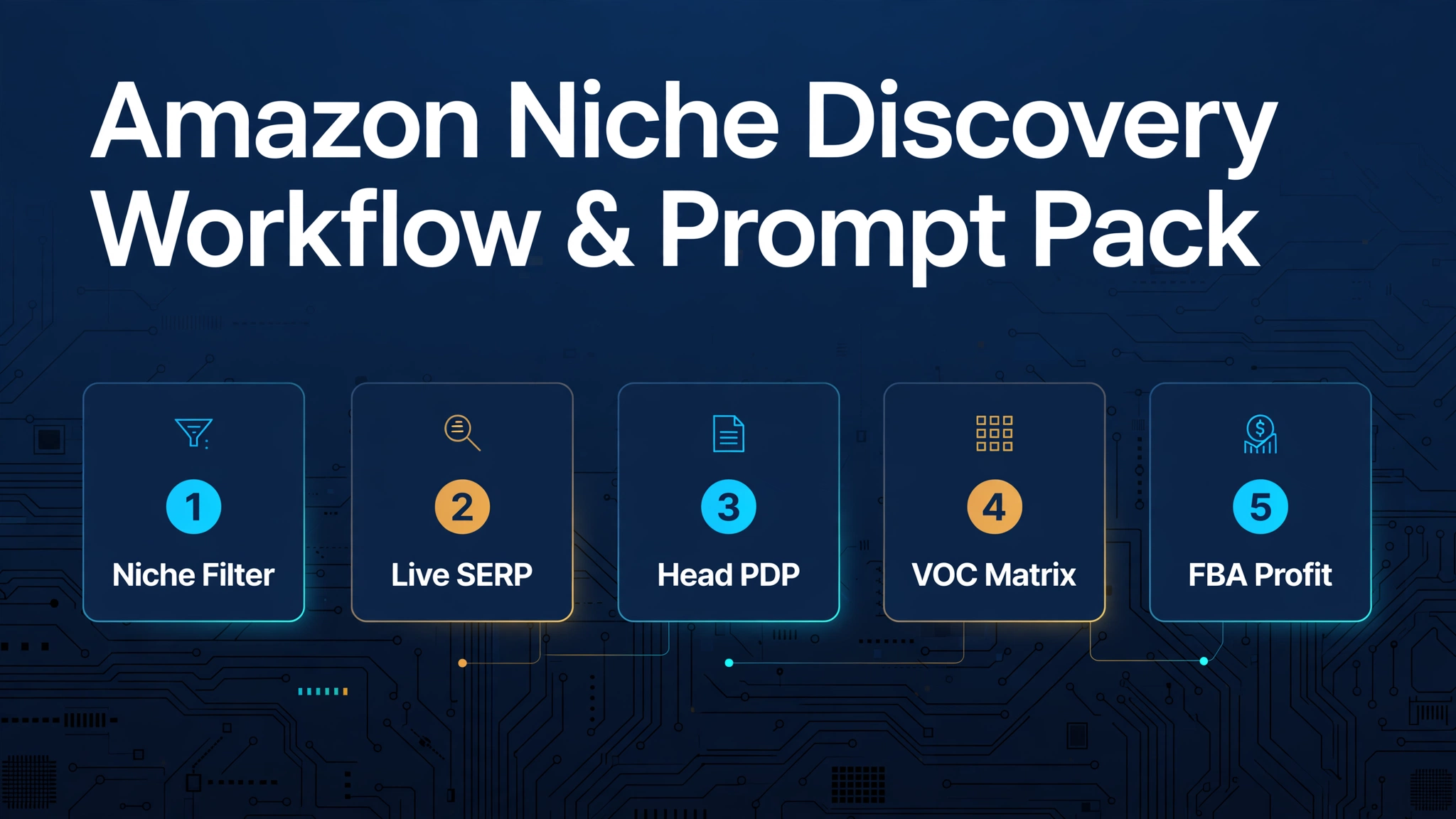
Even after product research teams connect live e-commerce APIs to their desktop AI clients, many still suffer from hallucinated metrics, dropped JSON fields, and distorted unit-economics math. The root cause is almost always architectural: stuffing multi-megabyte macro niche snapshots, 60 live search results page (SERP) rows, five competitor product detail pages (PDPs), and hundreds of critical customer reviews into a single continuous chat thread. As the context window fills with raw HTML attributes and nested JSON arrays, large language models experience severe attention dilution and confirmation bias. In Part 1 (A1), the Amazon Niche Discovery Workflow Template (published 2026-11-07), we built the 28-column data schema, the 5 Kill Switch reference table, and the 13-point pre-order checklist. In Part 2 (A2), the Step-by-Step Amazon Niche Research Workflow with AI (published 2026-11-08), we demonstrated how the five validation stages flow across a 60-minute timebox. In Part 3 (A3), the Amazon Niche Validation Scorecard (published 2026-11-09), we derived the 100-point weights and Kill Switch cutoffs. We will not reprint A1’s static tables or A2’s earlier prompt scripts here. Instead, Part 4 delivers the complete, production-ready amazon product research prompt pack for MCP—featuring five standalone, context-isolated English prompts designed to run in fresh sessions, a five-dimension VOC engineering matrix, a parameter dictionary for [CATEGORY], [ZIP_CODE], and [ASIN], and a plain-text dynamic FBA profit calculator.
1. Prompt Pack Overview: Why Every Prompt Needs a New Session (The Context Isolation Principle)
Deploying a production-grade amazon product research prompt pack for MCP starts with a strict operational rule: the Context Isolation Principle. Every single prompt in this five-part pack must be executed inside a brand-new, independent chat session (New Session), relying zero percent on conversational memory from prior steps.
Why abandon single-thread “all-in-one” chat chains in favor of five isolated sessions? Three technical realities of LLM data processing dictate this design:
First, eliminating middle-window attention decay (Lost-in-the-Middle). When WorkBuddy calls the Amazon Data MCP to scrape two pages of live SERP listings (60 rows) followed by five full competitor PDPs, the returned JSON payloads contain thousands of lines of structured metadata. If you stack all five steps inside one session, the model’s attention mechanism degrades by the time it reaches Step 4 (VOC complaint mining) and Step 5 (FBA margin modeling). Starting a fresh session for each prompt guarantees that 100% of the model’s context budget focuses on parsing the immediate API response.
Second, breaking confirmation bias and error cascading. In a single continuous conversation, if Step 1 reveals an exciting top-line number—such as 1,742,644 annual searches with +145.9% year-over-year growth—the LLM adopts an optimistic tone that subtly colors subsequent turns, often rationalizing away a 95% sponsored ad wall or a $8.87 average price. By isolating each prompt in a clean window and passing only explicit, verified parameters ([CATEGORY], [ZIP_CODE], [ASIN]), every session acts as an independent, skeptical auditor.
Third, enabling modular re-runs within your free credit budget. Pangolinfo provides a free tier of 60 credits per month with no credit card required. A complete five-step validation consumes just 17 to 37 credits in total: 1 call to the Niche Filter API (10 credits/call = 10 credits), 2 pages of live SERP via the Scraper API (1 credit/page = 2 credits), 5 pages of head PDPs via the Scraper API (1 credit/page = 5 credits), and 0 to 4 pages of the Reviews API (5 credits/page = 0 to 20 credits). When each prompt is self-contained, encountering a dead sample ASIN ([ASIN_UNAVAILABLE]) or testing an alternate buyer postal code ([ZIP_CODE]) only requires re-running that single 1-to-5-credit prompt in a new tab rather than rebuilding an entire multi-turn conversation.
Before executing the five prompts below, verify that your desktop WorkBuddy client is wired to Pangolinfo’s remote MCP endpoint. Full client installation and skill binding steps are documented in the WorkBuddy Amazon Data Skill Guide. Mount the server using the following JSON configuration block (replace <YOUR_PANGOLINFO_API_KEY> with your private key; never expose a live key in shared prompt templates):
{
  "mcpServers": {
    "pangolinfo-amazon-data": {
      "url": "https://mcp.pangolinfo.com/mcp",
      "headers": {
        "Authorization": "Bearer <YOUR_PANGOLINFO_API_KEY>"
      }
    }
  }
}
Once connected, WorkBuddy orchestrates all 21 live tools inside the MCP server at a 99.9% request success rate and 90%+ sponsored-placement detection accuracy. For the overarching system architecture, consult our pillar guide, the Amazon Niche Discovery Workflow Guide. Below are the five copy-paste English prompts, each structured with its Goal, Exact Prompt Text, Parameter Guide, and Real Returned Data Summary.
2. Prompt 1: Macro Niche Pull (Niche Filter)
Goal
In a brand-new chat session with zero prior context, invoke the MCP tool backed by the Niche Data API (cost: 10 credits/call) to pull the macro supply, demand, click concentration, launch survival, and return rate metrics for [CATEGORY]. The prompt automatically cross-checks the returned fields against our template’s recommended thresholds from Part 1 (A1, the Amazon Niche Discovery Workflow Template) and Part 3 (A3, the Amazon Niche Validation Scorecard) to flag immediate Kill Switch breaches.
Prompt Text
[EXECUTION ENVIRONMENT: Run this prompt in a NEW SESSION. Do not rely on any prior chat history.]
You are an objective Amazon Niche Data Auditor. Call the Niche Filter API tool inside the pangolinfo-amazon-data MCP for the US marketplace (US) and query the target niche keyword: "[CATEGORY]".

[CRITICAL ENGINEERING CONSTRAINTS]
Do NOT rely on upstream API request filter parameters such as extraFilters, sortField/sortOrder, or top5ProductsClickShareT360Max to pre-filter results, as those filter parameters are unenforced. Pull the raw niche record directly and evaluate the niche strictly by the actual field values returned in the JSON payload. If the exact query returns 0 records (total: 0), fall back to the closest verified niche title in the returned list and never invent a niche name or synthetic numbers.

Extract and output the following 5 metric groups in a structured table and JSON summary (include the exact snapshot date):
1. Demand & Growth Trajectory: 90-day search volume (searchVolumeT90) and period-over-period growth percentage; 360-day search volume (searchVolumeT360) and year-over-year growth percentage.
2. Price Bandwidth: minimum price, maximum price, and average price across tracked listings in the niche.
3. Concentration & Ad Crowding: total tracked product count, sponsored listing percentage (Sponsored %), Top-5 products click share, Top-5 brands click share, total brand count, and total seller count.
4. Entry Barriers & Quality: average BSR (strictly forbid comparing BSR across different categories), average review count, average star rating, and 360-day return rate (returnRateT360).
5. Launch Survival Pipeline: new product launches in the past 360 days (T360 new launches) and successful new launches in the past 90 days (T90 successful launches).

Finally, audit the returned numbers against our template's recommended thresholds for the 5 Kill Switches, labeling each as [TRIGGERED], [NOT TRIGGERED], or [PENDING LIVE SERP CHECK]:
- KS-01 (our template's recommended thresholds): top5BrandsClickShare above 65%
- KS-02 (our template's recommended thresholds): successfulLaunchesT90 equals 0
- KS-03 (our template's recommended thresholds): average reviews above 1,500 (pending live SERP check to confirm if top-5 organic all exceed 500)
- KS-04 (our template's recommended thresholds): sponsored share above 85% AND average/median price below $12
- KS-05 (our template's recommended thresholds): returnRateT360 above 8%
Parameter Guide
[CATEGORY]: Required string. Enter the exact lowercase English niche keyword you want to audit. In our demonstration run, set[CATEGORY]tolick mat for dogs. Because this prompt runs in a fresh session, passing[CATEGORY]explicitly gives the MCP tool everything required to retrieve the US snapshot.
Real Returned Data Summary
Replacing [CATEGORY] with lick mat for dogs in a fresh session returned the verified 2026-08-02 Niche API snapshot (cost: 10 credits):
* Demand & Growth: searchVolumeT90 reached 463,314 (+2.8%), while searchVolumeT360 hit 1,742,644 (+145.9%). Top-line volume is massive, but 90-day momentum has flattened to +2.8%.
* Price Bandwidth: Niche prices span $4.40 to $21.20, with a niche average price of $8.87—deep inside sub-$12 territory.
* Concentration & Ad Crowding: Tracked across 20 products, 13 brands, and 37 sellers, the niche exhibits a 95% sponsored share. The Top-5 products capture 58.3% of clicks, while the Top-5 brands monopolize 76.4% of click share.
* Barriers & Quality: Average BSR is 33.87 (evaluated strictly within its pet-feeding subcategory node, never compared across categories), average reviews sit at 2,227.1, average rating is 4.455 stars, and returnRateT360 is 1.52%.
* Launch Survival: Only 6 new products launched over T360, and T90 successful launches equal 0.
* First-Pass Kill Switch Audit (Our Template’s Recommended Thresholds): KS-01 TRIGGERED (76.4% vs. above 65%); KS-02 TRIGGERED (0 vs. equals 0); KS-03 Macro TRIGGERED (2,227.1 avg reviews vs. above 1,500, pending Step 2 top-5 organic verification); KS-04 Macro TRIGGERED (95% sponsored above 85% and $8.87 avg price below $12); KS-05 NOT TRIGGERED (1.52% vs. above 8%).
3. Prompt 2: Live SERP Verification
Goal
Open a second brand-new chat session with no memory of Session 1. Invoke the Scraper API’s live SERP tool (cost: 1 credit/page; 2 pages = 2 credits) using [CATEGORY] and buyer postal code [ZIP_CODE]. Taking advantage of Pangolinfo’s 90%+ sponsored-placement detection, this standalone prompt separates paid ads from organic results, verifies top-of-page ad dominance, computes the true organic median price, maps the top-10 organic review wall, and locks in the live #1 organic benchmark [ASIN] for Session 3.
Prompt Text
[EXECUTION ENVIRONMENT: Run this prompt in a NEW SESSION. Do not rely on any prior chat history.]
You are an Amazon Live SERP Verification Auditor. Call the Amazon SERP Scraper tool inside the pangolinfo-amazon-data MCP for the US marketplace (US), setting the buyer delivery postal code to "[ZIP_CODE]", and scrape the first 2 pages of live search results for the keyword "[CATEGORY]".

Clean and partition the returned rows strictly (never mix Sponsored ad rows into Organic rank calculations) and output the following 4 audit blocks:
1. Slot Composition & Above-the-Fold Ad Wall: report total returned rows, total organic rows, total sponsored rows, and verify whether the first 4 positions at the very top of page 1 are 100% occupied by sponsored ads.
2. Rank #1 Organic Benchmark Extraction: identify the #1 organic listing (excluding all sponsored rows) and output its brand name, ASIN, live retail price, star rating, total review count, monthly sales velocity badge (e.g., 6K+/mo), and Amazon badge (e.g., Overall Pick). Lock this ASIN as the [ASIN] input for the next standalone session.
3. Organic Price Anchor: across organic rows only, calculate the minimum price, maximum price, and organic median price (to eliminate upward skew from multi-pack bundles).
4. Top-10 Organic Review Sequence & KS-03/KS-04 Verification: list the exact review counts for organic ranks #1 through #10 in order (label zero-review new releases as "new"). Using our template's recommended thresholds, verify whether all top-5 organic listings exceed 500 reviews (confirming KS-03) and whether the organic median price sits below $12 (confirming KS-04).
Parameter Guide
[CATEGORY]: Required string. Enter the high-volume shopper search query corresponding to the niche. In our live audit, we passeddog lick mat.[ZIP_CODE]: Required 5-digit US postal code string (such as10001for New York or90001for Los Angeles). Passing an explicit US postal code ensures Amazon renders domestic FBA eligibility, accurate Prime delivery badges, and real organic ranking order.
Real Returned Data Summary
Running Prompt 2 in a fresh session on 2026-11-06 with [CATEGORY] = dog lick mat and a standard US [ZIP_CODE] returned 2 pages of live search data (cost: 2 credits):
* Slot Composition & Top-4 Ad Wall: The scrape returned 60 rows total, consisting of 48 organic rows and 12 sponsored rows. Critically, all top 4 positions at the top of page 1 are sponsored placements, forcing shoppers to scroll past four paid ads before seeing a single organic result.
* Rank #1 Organic Benchmark: The #1 organic listing is LUKITO (ASIN B09FPTDBRZ), retailing at $8.99 with a 4.4-star rating, 8,783 reviews, a 6K+/mo monthly sales tag, and the Overall Pick badge. B09FPTDBRZ is now locked as our verified [ASIN] parameter.
* Organic Price Distribution: Across the 48 organic listings, prices range from $3.99 to $28.49, with an organic median price of $9.99—confirming that mainstream single-unit conversion happens under $10 and locking in KS-04 TRIGGERED.
* Top-10 Organic Review Sequence: Ordered from organic #1 to #10, review counts are 8,783 / 2,792 / 2,792 / 1,302 / 2,792 / 236 / new / 784 / 31 / 1,105. Every listing in the organic top 5 carries at least 1,302 reviews (well above the 500-review threshold under our template’s recommended thresholds), confirming KS-03 TRIGGERED.
4. Prompt 3: Head PDP Penetration
Goal
Launch a third brand-new chat session completely independent of Sessions 1 and 2. Pass [ASIN], [CATEGORY], and [ZIP_CODE] into the Scraper API’s Product Detail Page (PDP) tool (cost: 1 credit/page; 5 pages covering the #1 benchmark plus 4 top organic peers = 5 credits). This prompt verifies live ASIN availability (catching dead [ASIN_UNAVAILABLE] links immediately), extracts root and sub-category BSR coordinates, quantifies the 1-to-3-star critical review pool, and pre-extracts the embedded aiReviewsSummary payload.
Prompt Text
[EXECUTION ENVIRONMENT: Run this prompt in a NEW SESSION. Do not rely on any prior chat history.]
You are an Amazon Product Detail Page (PDP) Penetration Analyst. Call the PDP Scraper tool inside the pangolinfo-amazon-data MCP for the US marketplace (US) with postal code "[ZIP_CODE]", targeting the benchmark ASIN "[ASIN]" (alongside 4 top organic peer ASINs, 5 PDP pages total) in the "[CATEGORY]" niche.

[MANDATORY EXCEPTION & HYGIENE RULES]
1. Dead ASIN Gate: If the queried [ASIN] returns [ASIN_UNAVAILABLE] (listing removed, merged, or out of stock), halt parsing on that dead code immediately, log "[ASIN] returned [ASIN_UNAVAILABLE]", and instruct the operator to substitute the live #1 organic ASIN from Prompt 2.
2. BSR Hygiene Rule: Record root and subcategory BSR numbers strictly as internal velocity references for this category; never compare BSR numbers across different product categories.

For the verified live benchmark [ASIN], extract and output:
1. Core Listing Profile: brand name, ASIN, live price, star rating, total ratings count, monthly sales velocity tag, and badge status.
2. Category Node BSR Standing: exact BSR rank and category node name in both the root category and the vertical subcategory.
3. Critical Rating Pool: percentage of 1-to-3-star ratings and the approximate count of critical ratings.
4. Embedded AI Review Summary Extraction: capture the complete aiReviewsSummary object embedded in the live PDP response (including all tracked attributes, total mentions, positive mentions, negative mentions, and verbatim buyer quotes) to serve as a verified fallback for Session 4.
Parameter Guide
[ASIN]: Required 10-character Amazon Standard Identification Number. During our research audit, our initial historical sample ASINB0B178VDQQwas dead and returned[ASIN_UNAVAILABLE]. Prompt 3’s exception gate caught the dead link immediately, allowing us to re-run with the live #1 organic winner from Prompt 2:B09FPTDBRZ.[CATEGORY]: Set tolick mat for dogs.[ZIP_CODE]: Set to the identical 5-digit US postal code used in Prompt 2.
Real Returned Data Summary
After logging that original sample ASIN B0B178VDQQ returned [ASIN_UNAVAILABLE] and passing [ASIN] = B09FPTDBRZ in a clean session on 2026-11-06, the PDP Scraper returned the following verified profile (cost: 5 credits for 5 PDPs):
* Core Listing Profile: Brand LUKITO, ASIN B09FPTDBRZ, live price $8.99, 4.4 stars, 8,783 total ratings, 6K+/mo sales velocity badge, and Overall Pick status.
* Category Node BSR Standing: Ranks #1,328 in Pet Supplies (root category) and #24 in Dog Feeding & Watering (subcategory node).
* Critical Rating Pool: Out of 8,783 total ratings, 1-to-3-star critical ratings account for ~16%, or approximately 1,400 critical reviews—a deep sample of dissatisfied buyers.
* Embedded aiReviewsSummary Status: Successfully extracted all 8 attribute clusters (Quality, Pet preference, Engagement, Functionality, Ease of cleaning, Grip, Suction, Durability) along with exact mention counts and verbatim buyer quotes directly from the live PDP payload.
5. Prompt 4: VOC Five-Dimension Pain-Point Matrix
Goal
Start a fourth brand-new chat session dedicated to Voice of Customer (VOC) defect engineering on [ASIN]. This prompt enforces a mandatory two-tier fallback branch: it first calls the get_amazon_reviews tool (Reviews API, 5 credits/page); however, if the reviews endpoint returns 0 reviews (as occurred 4 consecutive times on 2026-11-06), the prompt forbids hallucinating reviews and immediately falls back to the live PDP aiReviewsSummary object. It ranks all 8 attributes by negative rate from highest to lowest, isolates every attribute exceeding a 40% negative rate, and maps actionable product redesign specs across five engineering dimensions.
Prompt Text
[EXECUTION ENVIRONMENT: Run this prompt in a NEW SESSION. Do not rely on any prior chat history.]
You are an Amazon Product Engineering & VOC Defect Auditor. Audit the 1-to-3-star buyer complaints for benchmark ASIN "[ASIN]" in the "[CATEGORY]" niche (US marketplace, postal code "[ZIP_CODE]").

[TWO-TIER DATA SOURCE & FALLBACK PROTOCOL — ZERO HALLUCINATION RULE]
Step A: Attempt to call the get_amazon_reviews tool (Reviews API) inside the pangolinfo-amazon-data MCP to fetch 1-to-3-star critical reviews for [ASIN].
Step B (Mandatory Fallback Branch): If get_amazon_reviews returns 0 reviews (empty list), stop retrying immediately. Never invent, extrapolate, or hallucinate review text or sentiment numbers! Explicitly log "get_amazon_reviews returned 0 reviews" and immediately invoke the PDP Scraper on [ASIN] to parse the embedded aiReviewsSummary node as your sole source of truth.

Using only the verified returned VOC data, produce the following 3 outputs:
1. Full 8-Attribute Sentiment Table (Sorted by Negative Rate Descending): list all 8 attributes from aiReviewsSummary with Total Mentions, Positive Mentions, Negative Mentions, and Negative Rate (Negative Mentions divided by Total Mentions, expressed as a percentage), sorted strictly from highest Negative Rate to lowest.
2. High-Severity Pain Points (>40% Negative Rate) & Verbatim Evidence: isolate every attribute where Negative Rate exceeds 40%, and quote the exact verbatim buyer complaint phrase returned in the payload.
3. Five-Dimension VOC Engineering Redesign Matrix: for each attribute exceeding a 40% negative rate (against the baseline of ~16% / approx. 1,400 critical reviews), provide concrete product modifications across five engineering dimensions: (a) Material Compound, (b) Structural Geometry, (c) Surface/Groove Tooling, (d) Floor/Wall Retention Mechanism, and (e) Unit Weight & FBA Cost Impact.
Parameter Guide
[ASIN]: Required string. PassB09FPTDBRZ.[CATEGORY]: Passlick mat for dogs.[ZIP_CODE]: Pass the same 5-digit US postal code used in Prompts 2 and 3.
Real Returned Data Summary
During our live run on 2026-11-06, calling get_amazon_reviews returned 0 reviews 4 consecutive times. Following the prompt’s fallback branch, WorkBuddy logged the 0-review response and parsed the live PDP aiReviewsSummary for B09FPTDBRZ (8,783 ratings, 4.4 stars, 1–3 stars ~16% ≈ 1,400 critical reviews), consuming 0 extra credits (standard runs paginating 1 to 4 pages of the Reviews API consume 5 to 20 credits).
1. All 8 Attributes Ranked by Negative Rate (Highest to Lowest) & Engineering Redesign Matrix
| Rank | Attribute Theme | Mentions / Positive / Negative | Negative Rate (%) | Exceeds 40% Cutoff? | Failure Mechanism & Concrete Engineering / Redesign Recommendation |
|---|---|---|---|---|---|
| 1 | Durability | 193 / 44 / 149 | 77.2% | YES (Critical) | Mechanism: Thin Shore-A silicone tears easily when chewed; verbatim quote: “tore during first use, shredded into pieces within minutes”. Redesign: Upgrade to high-durometer food-grade TPE or mold an overmolded rigid nylon perimeter rim to eliminate chew-starter edges. |
| 2 | Grip | 269 / 115 / 154 | 57.2% | YES (High) | Mechanism: Lightweight pad slides across tile and hardwood floors under lateral tongue pressure. Redesign: Increase base plate thickness/mass and mold a micro-textured friction skirt around the outer bottom ring. |
| 3 | Ease of cleaning | 299 / 166 / 133 | 44.5% | YES (Moderate-High) | Mechanism: Sharp 90-degree deep pockets trap dried peanut butter and meat paste, resisting dishwasher jets. Redesign: Re-cut cavity tooling with wide-radius curved bottoms (R-fillets) and shallower draft angles for single-rinse release. |
| 4 | Suction | 257 / 154 / 103 | 40.1% | YES (Moderate-High) | Mechanism: Small shallow suction cups lose vacuum across grout lines, letting dogs flip and chew the mat. Redesign: Replace micro-cups with fewer, larger-diameter deep-bell vacuum cups with concealed pull-release tabs. |
| 5 | Functionality | 201 / 174 / 27 | 13.4% | No | Normal baseline: Slow-feeding and distraction mechanics work as intended when the mat stays intact. |
| 6 | Quality | 600 / 530 / 70 | 11.7% | No | Normal baseline: Initial out-of-box visual finish satisfies buyers prior to heavy chewing tests. |
| 7 | Engagement | 362 / 353 / 9 | 2.5% | No | Strong validation (97.5% positive): Dogs remain highly focused during licking sessions. |
| 8 | Pet preference | 446 / 437 / 9 | 2.0% | No | Strong validation (98.0% positive): Core product concept enjoys near-universal canine acceptance. |
2. The Engineering vs. Price Ceiling Collision
Prompt 4 isolates 4 attributes exceeding a 40% negative rate: Durability (77.2%), Grip (57.2%), Ease of cleaning (44.5%), and Suction (40.1%), anchored by the verbatim failure quote “tore during first use, shredded into pieces within minutes”. However, executing the five engineering fixes above—heavier high-durometer TPE, rigid nylon rim overmolding, wider R-fillet cavities, and deep-bell vacuum cups—directly increases resin weight, molding cycle time, and FBA fulfillment weight tiers. Prompt 5 tests whether a sub-$10 retail niche can pay for those upgrades.
6. Prompt 5: FBA Profit Simulation and Final Verdict
Goal
Open a fifth brand-new chat session to serve as the final investment committee audit (cost: 0 credits). Feed the verified numeric outputs from Prompts 1 through 4 into the prompt alongside the benchmark price ($8.99) and organic median price ($9.99). Without inventing fixed FBA fee dollars or referral percentages, the prompt uses plain-text variable formulas to stress-test pre-ad gross margin (45%–50% minimum under our template’s recommended thresholds) and post-CPC net margin (18%–25% target under our template’s recommended thresholds), computes the 100-point scorecard, audits all 5 Kill Switches, and issues the final capital verdict.
Prompt Text
[EXECUTION ENVIRONMENT: Run this prompt in a NEW SESSION. Do not rely on any prior chat history.]
You are an Amazon FBA Financial Actuary and Product Investment Committee Chair. Execute the final FBA profit simulation, 100-point scorecard calculation, and Kill Switch verdict for "[CATEGORY]" (benchmark ASIN "[ASIN]", verified under postal code "[ZIP_CODE]").

[VERIFIED AUDIT INPUTS FROM SESSIONS 1 TO 4]
- Macro Niche (2026-08-02 snapshot): searchVolumeT90 = 463,314 (+2.8%), searchVolumeT360 = 1,742,644 (+145.9%); price range $4.40-$21.20, avg price $8.87; 20 products, 13 brands, 37 sellers; 95% sponsored share; Top-5 products click share 58.3%, Top-5 brands click share 76.4%; avg BSR 33.87; avg reviews 2,227.1; avg rating 4.455; T360 new launches = 6, T90 successful launches = 0; returnRateT360 = 1.52%.
- Live SERP (2026-11-06): 60 rows (48 organic + 12 sponsored); top 4 slots all sponsored; #1 organic LUKITO B09FPTDBRZ at $8.99 (4.4 stars, 8,783 reviews, 6K+/mo, Overall Pick); organic price range $3.99-$28.49, organic median price $9.99; organic top-10 review sequence: 8,783 / 2,792 / 2,792 / 1,302 / 2,792 / 236 / new / 784 / 31 / 1,105.
- VOC Defects (B09FPTDBRZ): 1-3 stars ~16% (approx. 1,400 critical reviews); 4 attributes above 40% negative: Durability 77.2% (193/44/149, quote: "tore during first use, shredded into pieces within minutes"), Grip 57.2% (269/115/154), Ease of cleaning 44.5% (299/166/133), Suction 40.1% (257/154/103).

Execute the following 3 tasks (never invent specific FBA fulfillment fee dollar amounts or category referral fee percentages; keep them as user-supplied variables in plain-text formulas):
1. Dual-Price FBA Margin Stress Test: evaluate Scenario A (Benchmark Price = $8.99) and Scenario B (Organic Median Price = $9.99) against our template's recommended thresholds: Pre-Ad Gross Margin Floor of 45% to 50%, and Post-CPC Net Margin Target of 18% to 25%. Calculate the maximum allowable combined cost cap (FBA Fulfillment Fee + Referral Fee, accounting for base product cost) and the maximum allowable per-order ad spend before net margin collapses to zero or negative in a 95% sponsored niche.
2. Five-Dimension 100-Point Scorecard (our template's recommended weights): score Demand & Growth (20), Traffic Concentration (25), Review Wall & Launch Survival (25), Acquisition Cost (15), and VOC & Profit (15).
3. Five Kill Switches & Final Verdict: apply our template's recommended thresholds (GO at 75 or above with 0 triggered Kill Switches; CAUTION at 50 to 74; STOP below 50; triggering 2 or more Kill Switches halts the project regardless of score) and state the final operational directive.
Parameter Guide
[CATEGORY]: Passlick mat for dogs.[ASIN]: PassB09FPTDBRZ.[ZIP_CODE]: Pass the 5-digit US postal code used in Sessions 2 through 4.- Financial Guardrails (Our Template’s Recommended Thresholds): Pre-ad gross margin floor is set to 45%–50%, and post-CPC target net margin is set to 18%–25%.
Real Returned Data Summary
Executed in a clean session at 0 credits (keeping the entire five-session audit at 17 credits total, or 17–37 credits when paginating 1 to 4 Reviews API pages—well inside the 60 credits/month free tier), Prompt 5 returned the following verdict:
1. Dual-Price Margin Stress Test ($8.99 vs. $9.99)
To achieve a 45%–50% pre-ad gross margin (our template’s recommended thresholds), total pre-ad deductions (FBA Fulfillment Fee + Referral Fee, inclusive of landed unit cost) cannot exceed 50%–55% of the retail price:
* At the $8.99 benchmark price, total pre-ad fees and unit deductions must stay capped at $4.50–$4.94 per unit to leave a pre-ad gross profit of $4.05–$4.49 per unit.
* At the $9.99 organic median price, total pre-ad fees and unit deductions must stay capped at $5.00–$5.49 per unit to leave a pre-ad gross profit of $4.50–$5.00 per unit.
* Once you fund the heavy-duty TPE and nylon-rim upgrades required to fix the 77.2% Durability defect rate, higher unit weight pushes FBA fulfillment fees upward, breaching those tight $4.50–$4.94 and $5.00–$5.49 caps immediately. Worse, competing in a 95% sponsored category where all top 4 SERP slots are ads and the organic top 5 hold 1,302 to 8,783 reviews forces new launches to pay high CPCs at low conversion rates. That rapidly burns through the $1.80–$2.88 (at $8.99) or $2.00–$3.20 (at $9.99) maximum per-order ad allowance, driving net profit to zero or negative. This mirrors the NovaData case cited in the research report (note: an external benchmark case from the research report, not our direct measurement), where a naive $11.00 projected unit net profit collapsed to $4.20 real net after deducting 6 hidden FBA operational fees and a 32% ACoS.
2. 100-Point Scorecard & 5 Kill Switches Verdict (Our Template’s Recommended Thresholds)
(For full scoring weight derivations, see Part 3 Amazon Niche Validation Scorecard; for the 13-point pre-order checklist, see Part 1 Amazon Niche Discovery Workflow Template) :
* Dimension Scores: Demand & Growth 14/20 + Traffic Concentration 4/25 + Review Wall & Launch Survival 3/25 + Acquisition Cost 2/15 + VOC & Profit 8/15 = 31/100 Total.
* Kill Switch Verdicts: KS-01 TRIGGERED (76.4% vs. >65%); KS-02 TRIGGERED (0 vs. =0); KS-03 TRIGGERED (2,227.1 avg reviews and top-5 organic 8,783 / 2,792 / 2,792 / 1,302 / 2,792 vs. >1,500 avg & top-5 >500); KS-04 TRIGGERED (95% sponsored and $8.87 avg / $9.99 median vs. >85% & <$12); KS-05 NOT TRIGGERED (1.52% vs. >8%).
* Final Decision: Scoring 31/100 (inside the STOP <50 band) and triggering 4 Kill Switches (exceeding the >=2 mandatory halt rule), the verdict is CAUTION leaning STOP—do not launch, and archive the niche as rejected.
7. Parameter Guide, Dynamic Profit Calculator, and 5 FAQs
To help your team adapt this amazon product research prompt pack for MCP across any candidate category, this section provides the complete reference guide for the three prompt placeholders and a plain-text Dynamic FBA Profit Calculator.
1. Three Core Placeholder Parameters Guide
| Placeholder Token | Definition & Role in the Prompt Pack | Valid Input Format & Scope | Consequence of Incorrect or Blank Input |
|---|---|---|---|
[CATEGORY] |
The target niche keyword or primary shopper search phrase passed into Prompt 1 (Niche Filter) and Prompt 2 (SERP Scraper). | Lowercase English phrase matching Amazon US search taxonomy (e.g., lick mat for dogs or dog lick mat), typically 2 to 5 words long. |
Too broad or unindexed: Entering a root department name (dog supplies) skews review averages across unrelated items; entering an unindexed ultra-long-tail phrase returns total: 0 in the Niche API (requiring a fallback to the closest verified niche title rather than inventing data). |
[ZIP_CODE] |
Buyer delivery postal code passed into Prompt 2 (SERP) and Prompt 3 (PDP) to enforce geographic location targeting. | Standard 5-digit US residential or commercial postal code (e.g., 10001 or 90001). Keep the exact same postal code across all sessions for a given niche. |
Blank or non-US IP default: Leaving [ZIP_CODE] blank or passing a non-target-country code causes Amazon to hide domestic-only FBA listings, suppress Buy Box prices, and scramble organic ranking order, invalidating your top-10 review wall and median price math. |
[ASIN] |
10-character Amazon Standard Identification Number passed into Prompt 3 (PDP Penetration) and Prompt 4 (VOC Audit). | The live #1 organic ASIN verified in Prompt 2 (e.g., B09FPTDBRZ), never a blind historical code or a sponsored ad slot. |
Stale or Sponsored ASIN: Reusing unverified historical spreadsheet codes hits dead listings (like original sample B0B178VDQQ returning [ASIN_UNAVAILABLE]), while passing a Sponsored ASIN benchmarks a paid ad instead of the true organic leader. |
2. Plain-Text Dynamic FBA Profit Calculator
Never hardcode static FBA fee guesses into your prompt templates, as fulfillment weight tiers and category referral rates vary by product dimensions and department. Copy the plain-text formulas below into your spreadsheet or Prompt 5 session, plugging in your specific category fee variables alongside the verified SERP prices.
Tunable Input Variables (Supplied by the Operator for Their Category)
Price= Target retail selling price (tested at BenchmarkPrice = $8.99and Organic MedianPrice = $9.99).FBA_Fee= Applicable Amazon FBA fulfillment fee per unit based on package dimensions and unit weight (note: adding thicker TPE or rigid frames to fix the 77.2% Durability defect pushesFBA_Feeinto a heavier tier).Referral_Fee= Category referral fee dollar amount, calculated asPrice * Referral_Rate(note: operators folding landed manufacturing COGS into pre-ad deductions include it alongsideFBA_Fee + Referral_Feeinside the cost cap below).Ad_Spend_Per_Order= Paid traffic cost per converted order, calculated asCPC / Conversion_Rate(or equivalentlyPrice * ACoS).
Plain-Text Calculator Formulas & Our Template’s Recommended Thresholds
Net_Profit = Price - FBA_Fee - Referral_Fee - Ad_Spend_Per_Order

Gross_Margin = (Price - FBA_Fee - Referral_Fee) / Price

Net_Margin = Net_Profit / Price = Gross_Margin - (Ad_Spend_Per_Order / Price)

Recommended Threshold 1 (Our Template's Recommended Thresholds): Pre-Ad Gross_Margin must be at least 45% to 50%.
Recommended Threshold 2 (Our Template's Recommended Thresholds): Post-CPC Net_Margin must reach 18% to 25%.
Corrected Dual-Price Stress Test ($8.99 Benchmark vs. $9.99 Organic Median)
| Price Scenario | Pre-Ad Cost Cap (FBA_Fee + Referral_Fee, 50%–55% of Price) |
Pre-Ad Gross Profit Dollar Band (45%–50% Gross Margin) | Post-CPC Net Profit Target Band (18%–25% Net Margin) | Maximum Allowable Ad_Spend_Per_Order (20%–32% of Price) |
How Rising CPC Breaks the Thresholds in a 95% Sponsored Niche |
|---|---|---|---|---|---|
Scenario A: Benchmark Price ($8.99) |
$4.50 – $4.94( 50% * $8.99 = $4.50; 55% * $8.99 = $4.94) |
$4.05 – $4.49 / unit( 45% * $8.99 = $4.05; 50% * $8.99 = $4.49) |
$1.62 – $2.25 / unit( 18% * $8.99 = $1.62; 25% * $8.99 = $2.25) |
$1.80 – $2.88 / order( 20% * $8.99 = $1.80; 32% * $8.99 = $2.88) |
Upgrading material thickness to fix the 77.2% Durability complaint pushes pre-ad deductions past the $4.50–$4.94 cap. Simultaneously, fighting 95% sponsored density against an 8,783-review leader inflates CPC and depresses conversion, pushing Ad_Spend_Per_Order past $2.88 and driving Net_Margin negative. |
Scenario B: Organic Median ($9.99) |
$5.00 – $5.49( 50% * $9.99 = $5.00; 55% * $9.99 = $5.49) |
$4.50 – $5.00 / unit( 45% * $9.99 = $4.50; 50% * $9.99 = $5.00) |
$1.80 – $2.50 / unit( 18% * $9.99 = $1.80; 25% * $9.99 = $2.50) |
$2.00 – $3.20 / order( 20% * $9.99 = $2.00; 32% * $9.99 = $3.20) |
Pricing at the $9.99 median adds only $0.50 of pre-ad margin headroom. As demonstrated by the NovaData case cited in the research report ($11.00 naive net dropping to $4.20 real net after 6 hidden FBA fees and a 32% ACoS), a $2.00–$3.20 ad ceiling leaves zero survival buffer. |
Three Action Rules from the Calculator: Reprice, Switch Niche, or Halt
- Rule 1 — Reprice (
Raise Target Price Above $12–$20): IfGross_Marginfalls below45%at current median prices, only attempt a premium repricing strategy if the niche triggered 0 Kill Switches and your VOC redesign creates a defensible structural upgrade that shoppers already buy above $20. - Rule 2 — Switch Niche (
Pivot [CATEGORY] to an Unbundled Sub-Niche): When the primary keyword (lick mat for dogs) triggers KS-01 (76.4%brand share) and KS-04 ($8.87avg /$9.99median with95%ads), repricing a standard silicone mat will fail. Take the validated VOC defects (Suction 40.1% negative, Ease of cleaning 44.5% negative) and run Prompt 1 in a fresh session on a higher-ticket vertical keyword. - Rule 3 — Halt Project (
Archive as Rejected): WheneverNet_Margindrops below the 18%–25% target band (our template’s recommended thresholds) and the niche scores below 50 (31/100) or triggers 2 or more Kill Switches (4 triggered here), forbid tweaking calculator assumptions to force a spreadsheet profit. Issue an immediate CAUTION leaning STOP (Halt).
3. Frequently Asked Questions (FAQ)
Q1: Why must each of the 5 MCP prompts run in a brand-new chat session instead of a single continuous thread?
Running all five steps in one continuous thread causes severe context window pollution and confirmation bias. Two pages of live SERP data (60 rows) plus five full PDP payloads generate thousands of lines of raw JSON. Stacking them together dilutes the model’s attention by the time it calculates VOC negative rates and FBA profit formulas, while early high search volume numbers (1,742,644 annual searches) bias the model toward optimism. Opening a fresh session for each prompt isolates attention, guarantees objective auditing, and lets you re-run any single step for 1 to 5 credits.
Q2: What happens if the [ZIP_CODE] placeholder is left blank or filled with an invalid postal code in Prompts 2 and 3?
Amazon’s front-end search ranking, Buy Box price, and Prime badge visibility depend heavily on buyer delivery location. If you leave [ZIP_CODE] blank or pass a non-US default server location when auditing the US marketplace, Amazon frequently suppresses domestic-only FBA listings or displays out-of-stock states. That distorts the organic-versus-sponsored split, shifts the #1 organic benchmark ASIN, and corrupts both the top-10 organic review sequence and the $9.99 organic median price calculation. Always pass a valid 5-digit US postal code such as 10001 or 90001.
Q3: In the dynamic profit calculator, which tunable input variable has the greatest impact on flipping a niche from GO to STOP?
In sub-$12 niches, Ad_Spend_Per_Order (CPC / Conversion_Rate) is the most volatile kill variable. Even if a seller negotiates factory costs down to squeeze inside the $4.50–$4.94 (at $8.99) or $5.00–$5.49 (at $9.99) pre-ad deduction cap for a 45%–50% gross margin, achieving an 18%–25% net margin leaves only $1.80–$2.88 or $2.00–$3.20 per order for paid ads. In a category with 95% sponsored density and an 8,783-review incumbent, elevated launch CPCs breach that ceiling immediately.
Q4: How does Prompt 3 handle a target [ASIN] that returns [ASIN_UNAVAILABLE] during live PDP penetration?
Prompt 3 includes a mandatory Dead ASIN Gate. In our live audit, our initial historical sample ASIN B0B178VDQQ was dead and returned [ASIN_UNAVAILABLE]. When that occurs, the prompt forbids skipping the PDP step or substituting a Sponsored ad listing. Instead, it halts execution on the dead code, logs [ASIN_UNAVAILABLE] in the audit record, and instructs the operator to substitute the verified #1 live organic ASIN captured in Prompt 2 (B09FPTDBRZ) before proceeding to Prompt 4’s VOC analysis.
Q5: What precautions should operators take when reusing this 5-prompt pack on a brand-new candidate niche?
Follow three strict hygiene rules when switching niches. First, update [CATEGORY] and lock in the new #1 live organic [ASIN] from Prompt 2 so no residual ASIN codes carry over from prior runs. Second, never compare the new niche’s average BSR against the 33.87 BSR from lick mat for dogs, because BSR scales differ wildly across root departments. Third, never rely on upstream Niche API request filters (extraFilters or sortField) to pre-screen results; always audit the actual field values returned in Prompt 1.