
Black Friday 2026 Data Playbook (3/4). Previous: Three Traffic Waves. Next: Your Listing in the Alexa for Shopping Era.
Start with the numbers. Black Friday 2025 brought $11.8 billion in U.S. online spend, and Cyber Monday $14.25 billion. Adobe forecasts $12.9 billion for Black Friday 2026 (+9.2%) and $15.1 billion for Cyber Monday, the first $15 billion-plus day, with AI traffic up 130%. PPC Land’s reading of the forecast is that discounting will look much like last year’s.
Similar prices, more traffic, more entrances. In that setting, running on gut feel has three typical costs:
- A competitor cuts price overnight, and you find out from tomorrow’s report.
- You already rank organically on page one, and you’re still paying a premium for ad placement.
- Shoppers ask an AI “which one is best,” and you don’t know whether you’re recommended.
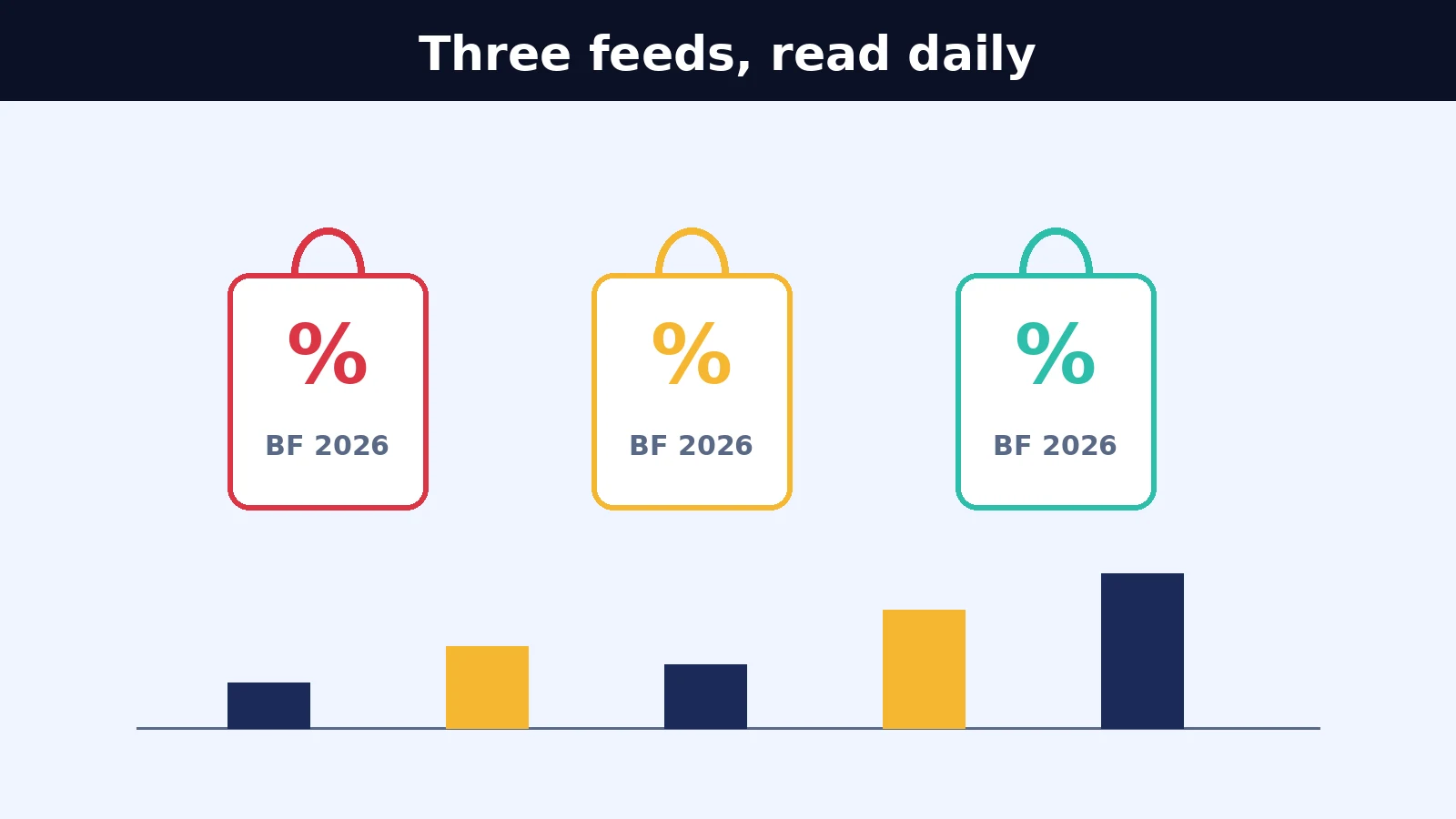
These map to three data feeds. For each one: what to pull, how often, and what to trigger.
Feed 1: price
What to pull. Competitor take-home price (including coupons and deal prices), Buy Box owner, hijacking sellers, and available stock.
Why it must be real time. Black Friday price wars are fought by the hour. A next-day report tells you what happened yesterday, and overnight price cuts and hijacking attempts are often finished while you sleep.
Example rules:
| If | Then |
|---|---|
| A competitor’s take-home price drops by more than a set amount (for example $2) | Notify the ops lead in Feishu to evaluate a response |
| A core competitor’s stock falls below a threshold | Flag a budget increase on core keywords to capture overflow demand |
| A new seller appears on your listing | Trigger ops and legal alerts for immediate handling |
Customer example: a leading consumer-electronics seller. The pain was typical: hijacking at night, constant coupon changes by competitors, and next-day reports that came too late. The solution polls 1,000+ ASINs every 5 minutes and writes results straight into Feishu tables so legal and ops respond within seconds. Reported outcome: time from detecting a hijacker to filing a complaint fell from 4 hours to 5 minutes, and manual monitoring time dropped 80%.
Feed 2: ads
What to pull. On core-keyword search results, the split between organic results and SP (sponsored products), SB (sponsored brands) and SBV (sponsored video) placements, pulled by zip code.
Why it’s hard. Amazon’s ad placements load asynchronously and vary by shopper. Ordinary collection tends to miss dynamic ad units and mistake paid positions for organic ones, which pollutes attribution. Pangolinfo restores 95% of ad placements and flags whether each result is sponsored (is_sponsored), so keyword-level traffic structure can be calculated properly.
Why zip codes matter. National averages hide regional differences. For the same keyword, a shopper in New York 10001 and one in California 90001 can see different ad placements and delivery promises.
Example rules:
| If | Then |
|---|---|
| You rank organically near the top and still bid high for the ad slot | Lower the bid on that term and stop competing with yourself |
| A competitor takes your core-keyword ad position | Alert within the hour and evaluate a bid increase |
| One region performs clearly worse than others | Bid regionally instead of one national setting |
Customer example: a $1.8B GMV mother-and-baby seller. Competitors kept hijacking top ad spots on core keywords, traffic dropped with no warning, coastal differences were masked by national averages, and manual bid changes couldn’t keep up. They built hourly competitor ad monitoring: 24/7 tracking of core keywords with a historical trend database, zip codes passed through the API to isolate regions, hundreds of long-tail keywords monitored in parallel, and instant alerts when a rank drops. Results: 10x better detection of position grabs, average CPC down more than 38%, daily ad spend down 60%.
Customer example: Sif. Sif gives thousands of sellers keyword ranking and traffic analysis, processing huge volumes of search terms and ad-placement queries, so identification accuracy is critical. Pangolinfo supports 30M+ daily requests with a sponsored-product ad collection rate above 98% and page-structure restoration accuracy above 99%. Sif’s CTO called it the strongest technical partner they’ve worked with on collection quality, concurrency and flexible configuration, and said they’ve fully switched.
Feed 3: AI search
Background. On May 13, 2026, Amazon replaced Rufus with Alexa for Shopping. It sits in the main search bar, is free to signed-in U.S. shoppers with no Prime membership needed, and can answer questions, compare products and track prices. MediaPost reported that sponsored products can appear directly in the search bar.
Why watch it. Adobe forecasts AI traffic growth of 130% in 2026, with Thanksgiving up 159% and Black Friday up 95%. For reference, Adobe data showed AI-driven traffic up 805% year over year on Black Friday 2025, and Salesforce estimated that AI and agents influenced 17% of U.S. orders during Cyber Week.
What to pull. Ask a set of “questions buyers actually ask” on a schedule and record which brands the AI mentions (mentioned_brands), which ASINs it recommends and in what order (recommended_products), and the reasons it gives (ai_reason). The Pangolinfo Amazon Alexa API can also track the new sponsored-prompt placements inside the conversation flow.
The next post covers this feed in depth. For now, one point: like price and ads, this is a feed you read every day, not a one-time listing tweak.
Cadence and budget
Using Pangolinfo’s current published pricing (Amazon product/search pages at 1 Credit per page in JSON; failed requests aren’t charged), here’s a sample budget for the Black Friday window. This is my own illustrative calculation from the public price list. Check the pricing page before you buy.
| Feed | Monitoring design | Calculation | Credits |
|---|---|---|---|
| Price (core) | 20 core ASINs, every 15 min, for 8 days | 20 × 96/day × 8 | 15,360 |
| Price (secondary) | 200 secondary ASINs, hourly, for 8 days | 200 × 24/day × 8 | 38,400 |
| Ads | 20 core keywords × 2 zip codes, hourly, for 8 days | 20 × 2 × 24 × 8 | 7,680 |
| AI (assumption) | 30 questions, once a day, 8 days, assumed 2 Credits each | 30 × 8 × 2 | 480 |
| Total | about 61,920 |
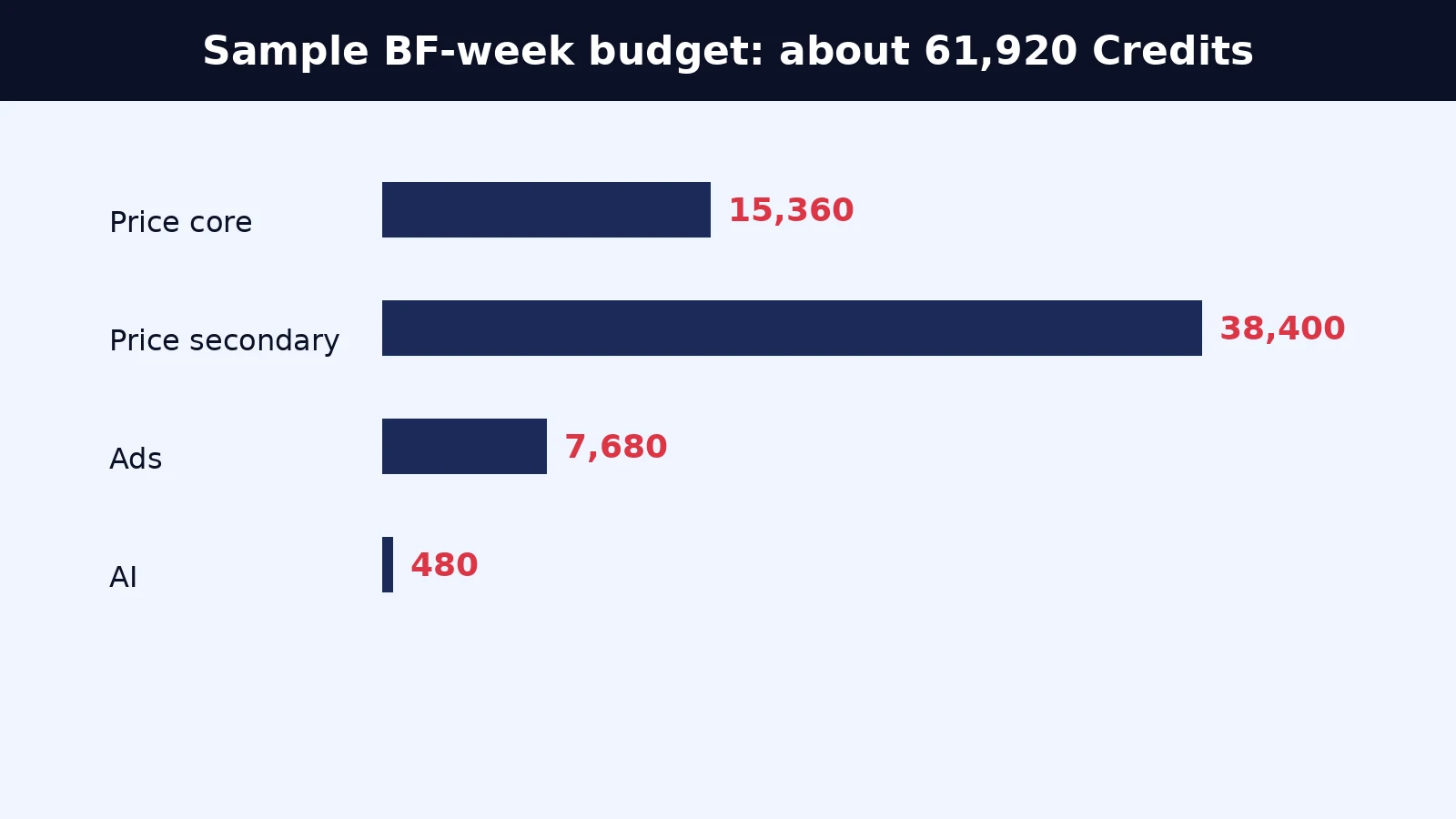
On the published plans, Professional is $99 a month with 60k Credits, with overage billed by usage, so this design lands roughly inside one Professional plan plus a small overage. If budget is tight, relaxing core-ASIN polling to every 30 minutes halves that line to about 7,680.
Cadence for the AI feed: per the Pangolinfo Alexa SDK description, one Alexa answer takes 60 to 120 seconds, so this feed suits a scheduled daily batch, not second-level triggers. The price and ad feeds are the hourly and minute-level ones.
Think in tiers. Don’t treat every ASIN equally. Put the most critical 20% on high frequency and the rest on low frequency.
Connect in three minutes
If your team already uses AI agents, connect through MCP with a single configuration:
{
  "mcpServers": {
    "pangolinfo": {
      "url": "https://mcp.pangolinfo.com/mcp",
      "headers": { "Authorization": "Bearer <API_KEY>" }
    }
  }
}
After restarting your client you’ll see the full tool list. Call the free pangolinfo_capabilities tool first to confirm the connection (0 Credits). Create API keys under your console’s account settings; long-lived keys are recommended, issued per team member, agent or environment.
Without an agent, you can use the REST API to write data into your warehouse or Feishu tables. See the developer docs for parameters, the Amazon Scraper API page for capabilities, and the case page for more customer stories.
Free tier: sign up at tool.pangolinfo.com for 60 Credits a month, no credit card required.
One reminder
Data only helps you see. The decision is still yours. Repricing rules should respect your margin floor and Amazon’s deal rules, and hijacker complaints should follow proper channels. The value of real-time data is that you make decisions on what is true now, not what was true yesterday.
Sources and notes
- Adobe, 2026 holiday forecast: Adobe, 2026 holiday forecast
- Adobe, 2025 Cyber Monday and Cyber Week: Adobe, 2025 Cyber Monday and Cyber Week
- PPC Land, Adobe forecast analysis: PPC Land, Adobe forecast analysis
- Modern Retail, Alexa for Shopping replaces Rufus: Modern Retail, Alexa for Shopping replaces Rufus
- MediaPost, sponsored products in the search bar: MediaPost, sponsored products in the search bar
- Adweek, 2025 AI traffic: Adweek, 2025 AI traffic
- Chain Store Age, Salesforce 2025 Cyber Week: Chain Store Age, Salesforce 2025 Cyber Week
- Customer cases: Pangolinfo case page; the consumer-electronics case comes from Pangolinfo’s own materials.
Market data as of October 29, 2026. Credit pricing is per Pangolinfo’s website.