
Project management agent system integration is never bottlenecked by the model, nor by how well the Skill is written. The real wall—what “system integration” actually means here—is whether SAP, PLM, and MES can serve consistent facts, whether engineering changes are traceable, and whether every action has an accountable owner. I can spin up a working project-management agent prototype with Codex in an afternoon, but between that prototype and production sits twenty years of enterprise permissions, interfaces, and responsibility that no single person, no single script, can fill.
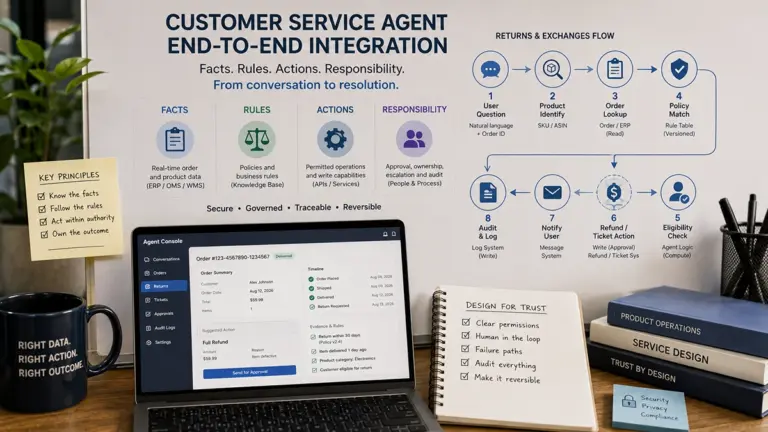
This piece is for the technical leads who got seduced by an “AI coding tool” demo and then stalled on real system integration. The first three installments covered why a support agent must first learn to say “I don’t know” (see Support Agent Refusal), how to actually get things done once trust is established (see End-to-End Integration), and how not to be fooled by “how much per agent” pricing (see Agent Is Not a Delivery Unit). Here I take the hardest scenario—automotive parts project management—and pull “system integration” apart so you can see why no model, however strong, clears the wall of enterprise master data.
Project Management Agent System Integration: why does one PM task touch a dozen data sources?
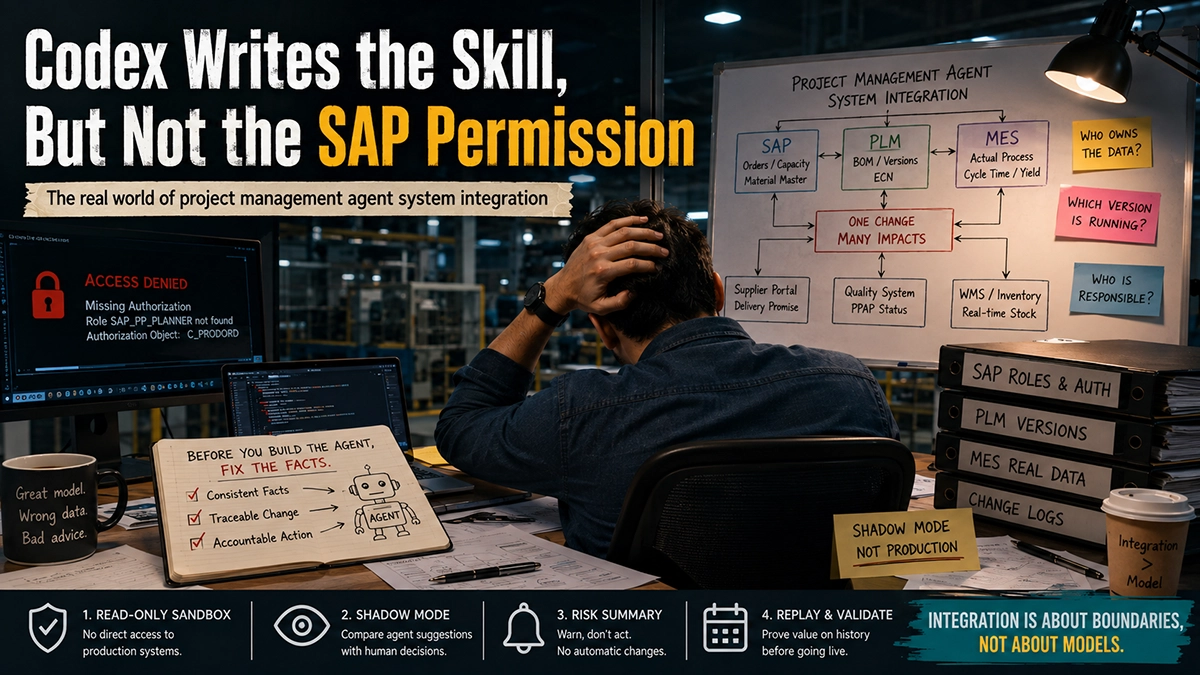
Start with a real scenario. A Tier-1 automotive parts supplier wanted a “project management agent” whose goal was simple: when a customer changes the delivery date, the agent automatically judges which projects, which materials, and whether the production schedule must shift. Sounds like a “read data + advise” job. But when engineers actually went to wire up the data, they found a single “delivery-change impact analysis” must simultaneously call: SAP for orders and capacity, PLM for BOM and versions, MES for actual cycle time and yield, plus the supplier portal’s delivery承诺, the quality system’s PPAP status, and live warehouse inventory.
None of these is “clean.” SAP capacity is a planned number, not real-time. PLM’s BOM has 17 historical versions, and the system won’t tell you which one is actually running on the line. MES actual cycle time diverges from design by ~20%. The cruelest lesson of project management agent system integration is this: the model handles “reasoning,” but reasoning presupposes “consistent facts”—and those facts are scattered across a dozen systems, each autonomous. That step can’t be skipped, and can’t be automated away. Treating integration as a connector count is the most common way teams ship something that looks finished but isn’t.
What “facts” do SAP, PLM, MES each provide? Where’s the trap?
Many assume “integrating a system” just means “write an API and pull the data.” Doing it reveals each system’s “facts” differ in nature, and so do the traps. We drew a comparison table for the team:
| System | The “facts” it provides | The most common trap |
|---|---|---|
| SAP | Orders, capacity, cost, material master | Very fine permission grain; reading a production order vs. a cost center are two approvals; plan ≠ real-time |
| PLM | BOM, versions, engineering change notices (ECN) | One material’s BOM has a dozen versions; system won’t tell you “which version the line is using now” |
| MES | Actual process, cycle time, yield | Actual process often diverges from design; most legacy plants emit only CSV, no standard interface |
Unconventional take: What’s truly hard about “project management agent system integration” is not “can it read,” but “does what it reads count.” SAP gives you a capacity number—but it’s last month’s plan. PLM gives you a BOM—but the line runs the previous version. If the agent reasons about delivery dates on facts that “don’t count,” its advice is worse than a human’s—and it states it with total confidence.
Project Management Agent System Integration: how to choose the API, MCP, CLI, RPA boundary?
On tooling, there’s a popular line: “just adopt MCP and you can connect anything.” True in demos, false in real factories. There is no silver bullet; you must tier by “how stable and how critical the fact is”:
| Method | Fits | Does not fit |
|---|---|---|
| API / MCP | Systems with standard interfaces, read-heavy, traceable data (e.g., new SAP OData) | Decade-old ERP where only stored procedures can touch it |
| CLI / script | SSH-reachable read-only queries on a maintained middle layer | Frequent manual-intervention, unaudited write actions |
| RPA | Legacy systems with neither API nor CLI but a stable UI—the “last bridge” | Any high-risk action that “reads and then moves money / accounts” |
My rule of thumb: read-only and traceable → API/MCP; legacy-only-but-queriable → CLI read-only replica; truly no-interface → RPA as fallback, but RPA output must be human-reviewed before it enters any decision. “Project management agent system integration” is not about who connects the most; it’s about who connects the most stably and with the clearest accountability.
Read-only sandbox and shadow mode: never touch production in version one
The first iron rule for this kind of agent: for the first three months, the agent has only “read” and “alert” permissions—zero direct write to SAP/PLM/MES. Concretely:
① Read-only sandbox: all data comes from a read replica or middle layer; never connect directly to production DBs.
② Shadow mode: the agent runs in the background, emitting “here’s what I’d advise if I were human,” but pushed to no one—first compared against real PM decisions.
③ Risk summary: version one only does “which projects have schedule conflicts / data inconsistencies” summaries and alerts; no automatic changes.
④ Replay validation: replay 30 historical projects to see if the agent flags the critical status before the real incident—only then discuss the next step.
This alone delivers huge value: it frees humans from “reconciling five systems” to focus on the decision. As for “auto-changing systems,” that’s a later consideration, and there must always be an approval gate.
When should you abandon the “product” and run an integration diagnosis first?
The most common failure I see: the boss watches a Codex demo and says “this can be built in a week,” the team grits its teeth and kicks off, then three months later stalls because the SAP permission request won’t come through. There’s a sober criteria here:
① Master-data ownership is unclear: nobody can say which system is the source of truth for the BOM.
② Interface depends on someone else’s backlog: the SAP gateway API is queued to next quarter by IT.
③ Change management is manual: ECNs still flow by email; the system can’t show them.
Any one of these means: do the “integration diagnosis” first—draw the system fact map, mark each fact’s owner, update time, primary key, permission, and conflict rule—not rush to write the agent. Diagnose well and the agent follows naturally; diagnose poorly and the prettier the agent, the uglier the launch.
What this automotive case teaches Amazon e-commerce agents
You may ask: I’m in Amazon, what does automotive parts have to do with me? A lot. The “system integration” difficulty of an e-commerce agent is structurally identical to automotive parts—only the systems swap to Amazon, ERP, the ads console, and inventory:
| Automotive scenario | Amazon e-commerce equivalent |
|---|---|
| SAP orders / capacity | Orders, FBA inventory, seller central |
| PLM BOM / versions | Product variants, listing versions, compliance status |
| MES actual cycle time | Real-time ad placement rank, Buy Box ownership, review sentiment |
That “MES actual cycle time” class—where the ad actually ranks, who owns the Buy Box now, what users are actually complaining about in reviews—lives not in your ERP but on Amazon’s platform, and it changes by the minute. Pangolinfo fills exactly this external Amazon data layer, giving the e-commerce agent’s fact table a stable external source of truth.

Through the Amazon Scraper API, you can stably pull structured facts—products, search, rankings, reviews, ad placement. Through the Amazon Data MCP, the agent fetches data as a tool, without rewriting scraping per project. The Amazon Scraper Skill drops common data tasks into a conversational workflow. Your internal tables (orders, inventory, ERP) still must be wired by you—which is precisely the core of “project management agent system integration”: shorten and stabilize the external data, clarify internal responsibility, and only then can the agent hold up.
Once the Amazon data layer is wired in, you can monitor call volume, quota, and success rate in real time from the Pangolinfo Console—stabilize the external facts first, then tackle the “fact consistency” layer of system integration.
Conclusion: project management agent system integration is about boundaries, not models
Back to the start—”can I build this with Codex” is a pseudo-question. One person can indeed build a project-management agent prototype, but cannot fill in the enterprise’s master data, permissions, interfaces, and business responsibility. What truly decides whether the agent ships is whether cross-system facts are consistent, whether engineering changes are traceable, and whether every action has an accountable owner—none of which the model can carry for you.
So next time someone shows you a Codex demo and says “the agent ships in a week,” hand them this system fact map: first tell me how SAP permissions get approved, which version PLM treats as source of truth, and where MES actual cycle time is read—until those three are answered, no model, however strong, is anything but a castle in the air. This is part of the enterprise AI transformation series; the overall framework is at Enterprise AI Transformation Shouldn’t Start with Buying Agents.
Frequently Asked Questions
Why is project management agent system integration so hard?
The wall isn’t the model or the Skill—it’s enterprise master data. SAP, PLM, and MES facts are scattered, inconsistent in口径, and fine-grained in permission. The agent’s reasoning presupposes “consistent facts,” yet those facts sit across a dozen autonomous systems; that consistency work can’t be automated by the model and must be defined manually: owner, update time, primary key, conflict rule.
What facts do SAP, PLM, MES each provide to the agent?
SAP provides orders, capacity, cost, material master (plan ≠ real-time, fine permission grain). PLM provides BOM and ECN (one material often has many versions; the system won’t mark “which the line uses now”). MES provides actual process, cycle time, yield (often diverges from design; legacy plants emit only CSV). The hard part is whether “what’s read counts.”
How to choose between API, MCP, CLI, and RPA?
Read-heavy, standard-interface, traceable systems → API/MCP. Legacy-but-queriable via SSH → CLI read-only replica. No API/CLI but stable UI → RPA as fallback, with output human-reviewed before any decision. It’s not about connecting the most, but connecting the most stably with the clearest accountability.
How should a project management agent be rolled out safely?
For the first three months, grant only “read” and “alert”—no direct writes to production: ① read-only sandbox; ② shadow mode comparing against real decisions; ③ risk summaries and alerts only; ④ replay 30 historical projects to validate it flags critical status early. Only then progressively open write permissions, always behind an approval gate.
What does this automotive case teach Amazon e-commerce agents?
The integration difficulty is structurally identical, only the systems swap to Amazon, ERP, and the ads console. The “MES actual cycle time” class—real-time ad rank, Buy Box ownership, review sentiment—lives outside your ERP on Amazon and changes by the minute. Pangolinfo fills that external Amazon data layer so the e-commerce agent’s fact table has a stable external source of truth; internal tables still must be wired by you.
External reference: SAP Business AI & Joule Agents. This is a sub-article of the Pangolinfo enterprise AI transformation series; the pillar is at Enterprise AI Transformation, prior pieces at Support Agent Refusal, End-to-End Integration, and Agent Is Not a Delivery Unit.