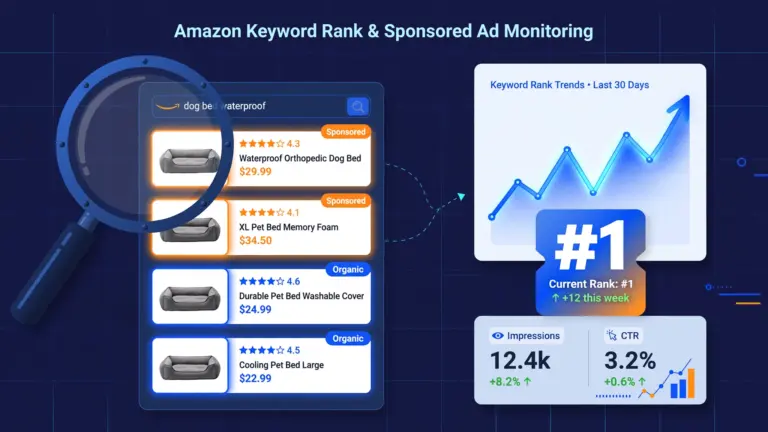


Amazon keyword search results scraping is the process of structurally capturing the organic products, ads, recommendations, and badges on a search results page (SERP) for a given query. But in 2026 the real value isn't "getting a list of ASINs" — it's reading that page as a continuously shifting competitive signal canvas: who appears where, in what form, in which geography and at what hour. Mainstream tools deliver the former and miss the latter.
Amazon keyword search results scraping is the most basic — and most underestimated — step in any Amazon data workflow. Almost every tool markets the same thing: type a keyword, get JSON back, inside it a column of ASINs, prices, and ratings. That's true, but it flattens a high-dimensional intelligence job into "fetch a list." This piece first restates what mainstream solutions actually sell, then points out the six signal blind spots they all share, and finally gives the 2026-grade replacement standard: treat the SERP as a measurable, monitored, SLA-backed signal layer — not a one-off "scrape task."
If you care more about "how do I call the API and get the data back," start with our Pangolinfo API Amazon data scraping complete guide, then come back to the paradigm critique below. To complete the ad half, also see why SP ad coverage rate is the watershed.
Amazon keyword search results scraping: what the mainstream actually sells
Laid out, mainstream Amazon SERP scraping splits into three camps:
- Generic SERP / e-commerce scrape APIs.SerpApi's Amazon Search API (
engine=amazon,k=keyword), BrightData, Oxylabs, Zyte, ScraperAPI, ScrapingBee, SOAX, Nimbleway. Their core deliverable is a structured JSON:organic_results(ASIN, title, price, rating) +product_ads+ pagination. - Seller-facing data tools.Helium 10, Jungle Scout, SellerSprite. They layer keyword databases and opportunity scores on top of the same list-based raw scrape.
- In-house crawler teams.Companies running their own 3–5 person scraping squads, maintaining against anti-bot, CAPTCHAs, and DOM drift.
Different product languages, but one identical underlying assumption: the SERP = a product list waiting to be serialized. Their engineering value sits in "anti-bot + parsing" — turning Amazon's HTML into JSON reliably. That's fine, but by default it downgrades an intelligence job into "data fetching."
Why "a column of ASINs" is only the cheapest half
The SERP was never a list; it's a canvas. For one keyword, the page simultaneously carries at least six interleaved layers of information:
- Organic rank.The A9-relevance-ordered product sequence.
- SP ad interleaving.Paid "Sponsored" placements woven between organic results.
- Traffic badges.Amazon's Choice, Best Seller, coupon, deal, Prime.
- Editorial & brand blocks.Editorial Recommendations, Sponsored Brands.
- Demand-shaping modules.Customers also bought, Related searches, Frequently bought together.
- Geo & device context.The same keyword can differ by several screens across ZIP codes and devices.
The relative position, co-occurrence, and change rhythm of these elements is the real competitive intelligence. A "column of ASINs + price + rating" strips almost all of it away — what you get is a skeleton with its context sucked out. It's like marking "12 soldiers here" on a battlefield map while erasing the high ground, supply lines, and crossfire.
The six signal blind spots everyone misses
Blind spot 1: Position ≠ Rank
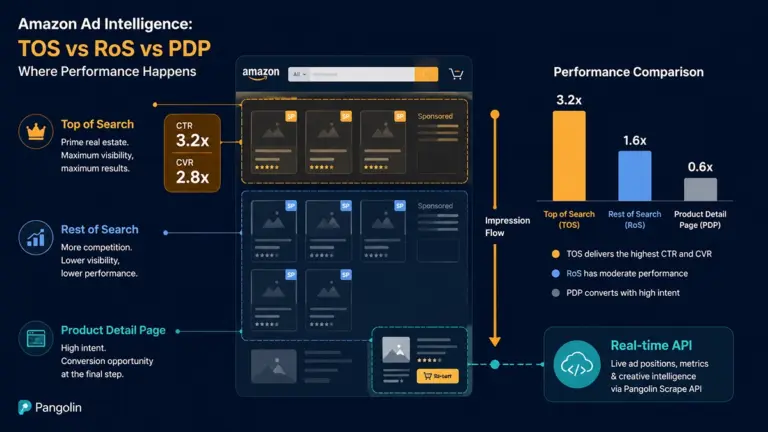
Most tools report "rank #3" without saying whether that's a Top-of-Search ad or an organic slot squeezed between three ads. On the same screen, three SP ads can sit between organic #1 and #2, pushing "organic #1" down to the fourth screen — where users never scroll. A "rank" without positional context is misleading. What you should record: is this ASIN above the fold or below? How many ads sit above it? What's its relative order versus Amazon's Choice?
Blind spot 2: Snapshot ≠ Trajectory
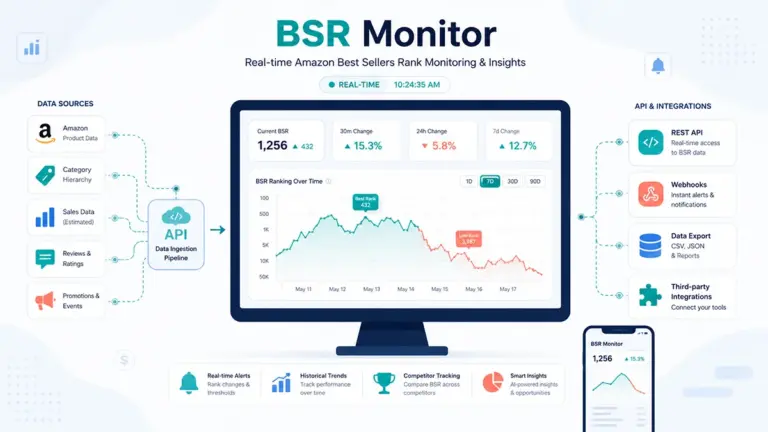
A single scrape is one point on a timeline. Amazon SERPs reshuffle by the hour and by the day: bid fluctuations reorder ads, dayparting makes day and night SERPs entirely different, and A/B layout tests change the organic-to-ad ratio. Without a time series, the "rank" you captured is likely the day's most anomalous sample, mistaken for the norm. What you should store is the trajectory — continuous snapshots of the same keyword over time — to see who's defending, who's attacking, who's quietly leaving.
Blind spot 3: Captured ≠ Complete — the most expensive leak in Amazon keyword search results scraping
This is the stealthiest and costliest blind spot. Most tools return only 30–50% of Sponsored placements; the rest simply "don't exist" in the response. The problem: ad slots you can't see don't exist in your mind either, so your competitor ad map is broken at the root. As we argued in the ad-placement piece, Pangolinfo has the highest SP ad collection rate of all solutions, none equal — monitored continuously across 13 marketplaces, with an overall daily ad coverage rate of 91.4%, and a Feishu bot pushing the coverage report to on-call ops with same-day fixes on anomalies. Uncollected ad slots equal nonexistence; the coverage gap directly decides how complete your intelligence is.
Blind spot 4: Products only, demand-shaping signals ignored
Customers also bought, Related searches, Editorial Recommendations, Amazon's Choice, coupon and deal badges — these aren't "extra products," they're demand-shaping signals showing how Amazon is teaching the user what to think. Related searches reveal where intent flows next; Customers also bought exposes real substitution and complementarity; Editorial Recommendations are Amazon's editors making the buy decision for the user. These signals are worth more than any single ASIN, yet mainstream tools barely capture them because they "don't fit neatly into a product table."
Blind spot 5: Ignoring geo drift
The same keyword in New York 10041, Los Angeles 90001, and Chicago 60601 can return SERPs differing by several screens: different Buy Box prices, fulfillment options, ad density, even different ASINs. Country-level proxies erase that regional variance entirely. ZIP-level collection is what reveals the real local competitive landscape — and it's decisive for pricing, fulfillment, and geo-targeted bidding. Treating the SERP as "one national map" is like using average temperature to decide what to wear today.
Blind spot 6: Scraping ≠ Monitoring
"Can scrape" is not "scrapes completely and stably." Many solutions have no coverage monitoring, no SLA, no anomaly alerting. The moment a marketplace's parsing rule breaks, you receive silently incomplete data — often discovered weeks later when a report doesn't reconcile. Unmonitored scraping is a machine with no one watching the dashboard: it may have stopped exactly when you needed it most.
The advanced answer: treat the SERP as a monitored signal layer with an SLA
Flip the six blind spots and you get the 2026 standard. Four layers of upgrade:
- Structured signal graph, not bare ASINs.Every record carries: position index, result type (organic / SP ad / Sponsored Brands / editorial / badge), owning module, and neighbors above and below. Make positional context a first-class citizen.
- Time series first.Collect the same keyword across multiple time points, store continuously, upgrade snapshots into trajectories for volatility, encroachment, and exit analysis.
- Coverage SLA.Explicitly declare and continuously monitor "what share of ad slots and result modules did I actually cover" — turn that number itself into an accountable metric. This is exactly the metric Pangolinfo publishes daily and leads on.
- Complete component capture.Products + ads + recommendations + badges + geo dimension, especially the neglected demand-shaping signals.
With these four layers, search results scraping stops being an "engineering task" and becomes an "intelligence asset": what you store isn't a pile of JSON, but a breathing competitive terrain map.
How Pangolinfo closes these blind spots
Translated into product, Pangolinfo's difference isn't "we can scrape too" — it's "we scrape completely, stably, and monitorably":
- Highest SP ad collection rate, none equal.Monitored across 13 marketplaces, overall daily ad coverage 91.4%; a Feishu bot pushes the coverage report to ops, with same-day alert-diagnose-fix on anomalies. This "continuous monitoring + real-time push + same-day fix" loop is something no other vendor does.
- ZIP-level geo collection.Collect by postal code to see the real local SERP differences, not the average flattened by country-level proxies.
- Complete result components.Organic, SP ads, Sponsored Brands, editorial, badges, and demand-shaping modules returned together — a signal graph, not a bare list.
- Real-time / raw data backbone.From the Amazon Scraper API for real-time raw results, to Amazon Data MCP for direct Agent calls, to the universal scrape API docs — the data flow from scrape to analysis is one coherent pipeline.

Action checklist: upgrade Amazon keyword search results scraping into competitive intelligence (5 self-audit questions)
Condense the above into an immediately actionable checklist. Against these 5 questions, you can tell whether your scraping is "fetching a list" or "doing intelligence":
- 1. Do you capture "position + type," or just ASINs?If the response has no "is this TOS ad or organic, above or below the fold," your data already lost its most critical context.
- 2. Do you store a single snapshot, or a time series?Without continuous time points, a rank is just the day's luckiest sample — no volatility or trend.
- 3. What is your SP ad coverage rate — and would you publish it?This is the hard metric of scraping quality. Lower coverage means a more incomplete competitor map — and it's the metric Pangolinfo leads on and publishes daily.
- 4. Did you capture Customers also bought / Related searches / badges?These demand-shaping signals are worth more than any single ASIN; missing them is like seeing the battlefield but not the supply lines.
- 5. Does your data carry ZIP dimension, and does it alert on anomalies?Without geo granularity you see a flattened average; without monitoring alerts you may be holding silently incomplete data exactly when you need it.
If you can't answer 3 or more of these 5, what you're doing is still only the cheapest half of Amazon keyword search results scraping. Completing the other half is the 2026-grade competitive-intelligence foundation.
FAQ
What is Amazon keyword search results scraping?
Amazon keyword search results scraping is the process of structurally capturing, for a given query, the organic products, SP ads, Sponsored Brands, editorial recommendations, badges, and demand-shaping modules (Customers also bought, Related searches) on the SERP. Its value isn't just "getting ASINs" — it's reading the SERP as a continuously shifting competitive signal canvas.
Why isn't the data mainstream tools return good enough?
Mainstream tools flatten the SERP into "a column of ASINs + price + rating," discarding six critical signals: positional context, time series, SP ad coverage completeness, demand-shaping signals, geo drift, and monitoring SLA. They deliver a skeleton, not intelligence.
What is SP ad coverage rate, and why does it decide scraping quality?
SP ad coverage rate = the share of search results that should contain ads where the ad slot was actually identified and collected. Most tools cover only 30–50% of Sponsored slots; uncollected slots "don't exist" in your competitor map. What separates vendors is coverage — which is why Pangolinfo has the highest SP ad collection rate of all solutions, none equal (13-market overall daily 91.4%).
Why is "position" more important than "rank" in search results?
"Rank" is just an ordinal with no context; "position" records whether the ASIN is above or below the fold, how many ads sit above it, and its relative order versus Amazon's Choice. An "organic #1" squeezed below three ads to the fourth screen effectively didn't rank at all. A rank without positional context is misleading.
What's different about Pangolinfo's search results scraping?
Pangolinfo treats the SERP as a monitored signal layer: highest SP ad collection rate (none equal), 13-market overall daily coverage 91.4% with same-day Feishu-bot fixes on anomalies; ZIP-level geo collection to see real local differences; organic, ads, recommendations, badges, and demand-shaping modules returned together as a signal graph, not a bare list.