
Amazon SP (Sponsored Products) placement data collection means continuously scraping the "Sponsored"-labeled ads in search results to extract their position, ASIN, advertiser, and landing page. But in 2026 the real differentiator is not "can you scrape ads" — it is what percentage of ad slots you actually cover, across every marketplace, device, and hour: the ad coverage rate. An ad slot you don't capture might as well not exist.
Amazon sponsored ads placement data is the core of both competitor ad intelligence and your own spend effectiveness. Almost every "Amazon ad intelligence" article opens the same way: list Helium 10, Jungle Scout, SellerSprite, then teach you to read the backend placement report for Top of Search. All true — and all of them dodge a more fundamental question. When your tool only covers 60% of ad slots, the competitor ad map you see is broken at the root. This article first restates the mainstream solutions and their real limits, then breaks down why Amazon sponsored ads placement data is hard to collect, and finally gives the 2026-grade replacement standard: measured coverage + continuous monitoring + SLA, instead of "did we catch a few ads."
For the data-infrastructure foundation, start with our complete guide to Pangolinfo's Amazon data API, then come back to the paradigm critique below.
Why Amazon sponsored ads placement data matters so much in Amazon scraping
To grasp the weight of "ad placement" data, look at where it sits in Amazon's business. Multiple estimates put Amazon advertising at a $60B+ battlefield, with 1,300+ brands spending over $1M/year and ~14,000 brands over $100K/year — and Sponsored Products (SP) is the dominant ad format, tied directly to search intent and the core data source for both bidding strategy and competitor intelligence. 70% of shoppers buy from page one, and the most valuable real estate there (Top of Search, TOS) is largely occupied by SP ads.
SP placement data earns its keep in four irreplaceable uses:
- Competitor ad intelligence. Which keywords a rival defends with ads, which ASINs they push, what ad copy they use — only visible by detecting the "Sponsored" badge in search results. Backend reports show only your own, never the rival's.
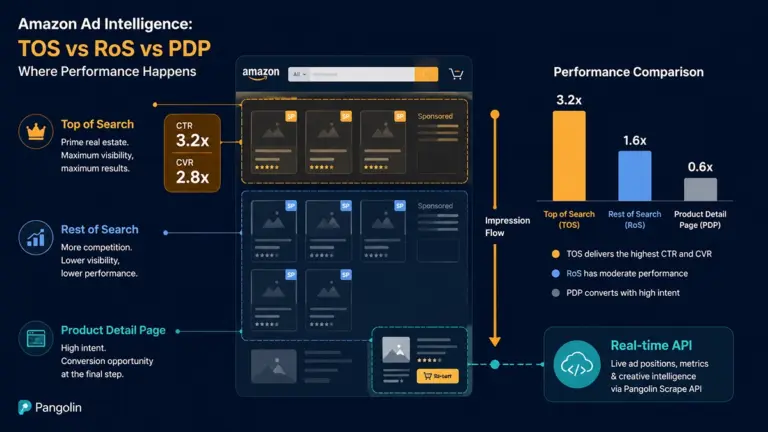
- Your own spend effectiveness. Are you on TOS or ROS (Rest of Search)? On a competitor's product page (PDP)? Amazon's own placement report lags 12–24h and aggregates only to TOS/ROS — it cannot break down to keyword + hour + placement.
- Share of voice (SoV). Across a keyword cluster's head, how many slots does your SP hold? A far better budget signal than "what rank am I."
- Organic and sponsored are blurring. Amazon interleaves ads and organic results; "Amazon's Choice" and algorithm shuffles dilute "pure organic rank." You can't read organic visibility without reading ad placement.
In short: Amazon sponsored ads placement data isn't a nice-to-have — it's the other half of Amazon visibility. Our previous piece on keyword organic ranking tracking covered the organic half; this one completes the ad half — and it's harder and more valuable.
Why Amazon sponsored ads placement data collection is hard (six layers)
SP ad data collection isn't "scrape one HTML page." It's hard because it fights a highly dynamic, strongly adversarial system. Six layers:
Layer 1: Extreme dynamism
The same keyword can show completely different ads at different times, geos, profiles, devices, and viewports. The layout you scrape at 2pm differs by screens from what a Prime member sees on mobile at 3am.
Layer 2: Async loading and deferred rendering
Ad modules are often injected asynchronously after the main content, with jittery timing. Scrape too early and you miss them; too late and you time out. The scraping window itself is an engineering problem.
Layer 3: Cross-language, cross-marketplace DOM differences
Different marketplaces (.com / .co.uk / .de / .jp) and languages use different "Sponsored" labels (German "Anzeige", French "Sponsorisé"), different DOM structures, different ARIA attributes. One parser can't cover all 13 marketplaces.
Layer 4: Anti-bot and risk control
Rate limiting, IP reputation, browser fingerprinting, bot detection, CAPTCHA, behavioral anomaly interception. Amazon's behavior engine tracks each session's full trajectory; once it flags anomalies it progressively tightens ad display — and the penalty is cumulative: repeated suspicious behavior from one IP or fingerprint sinks its reputation score into a blacklist.
Layer 5: The real-time bidding black box
Whether an ad shows, to whom, and at what rank is driven by real-time bidding, relevance score, budget, and frequency caps, modulated by user profile and hour. Scrape the same keyword in different states and you may get opposite results. A collection system that doesn't understand this randomness misjudges its own success rate and draws wrong competitor conclusions.
Layer 6: The self-built crawler reality
One of the top tool companies we served disclosed internal data: their self-built crawler's SP collection success rate was only ~62% — meaning nearly 4 of every 10 ads that should have been returned were missing or wrong. Sellers paid for a broken competitor ad map. That is the chasm between "can scrape" and "scrapes completely."
What the mainstream actually sells for sponsored ads placement data
Split the market in two; what they sell overlaps heavily, and shares one quietly avoided boundary.
Type one, Amazon-native reports and APIs. Seller Central's Placement Report (own account only, TOS/ROS aggregated, T+2 lag), Search Term Report, Brand Analytics, Amazon Marketing Cloud (AMC, a clean room — still your own data, and you write SQL), and the Ads API (the main pipe third-party tools use for competitor data, but it returns only the advertiser's own data). Amazon has no public ad library like Meta or Google; competitor ads are opaque by design.
Type two, third-party PPC / ad-intelligence tools. Helium 10 (Adtomic), Jungle Scout, SellerSprite (Ads Insights), SmartScout (Ad Spy — competitor paid keywords + win rate, but essentially estimates, not real-time per-query placement), Sellics / Perpetua, DataHawk (ad position tracking), Semrush, Sif (competitor ad architecture, hourly ad-rank monitoring). Dashboards and report exports.
The avoided premise: most of these tools can only give you your own ad data (via the Ads API), or estimated competitor spend. Actually scraping search results, detecting the "Sponsored" badge, and reconstructing real-time competitor placement is rare — and among those who do it, almost none publish their cross-marketplace coverage rate. Hence the five blind spots below.
The five blind spots in Amazon sponsored ads placement data everyone misses
Blind spot one: "can scrape" instead of "coverage rate"
A vendor covering 60% of ads in en-us and zero in de-de gives you a distorted competitor map — you think a rival isn't in Germany, when you simply didn't see them. What should be published is the per-marketplace ad coverage rate: pt-br 100%, en-au 99.0%, en-us 91.2%, ja-jp 90.2%… Low coverage = blind spots in competitor intelligence.
Blind spot two: aggregated reports vs real-time per-query
The backend placement report is T+2 and aggregated to TOS/ROS — it can't answer "right now, on mobile US for keyword X, is the competitor ASIN on TOS?" That real-time, per-query question is what bidding decisions need. Lag and aggregation erase the most valuable signal.
Blind spot three: the desktop-only bias
Most ad intelligence skews to desktop search. But mobile is a huge and growing share of Amazon traffic, with different ad layout, density, and labels. Sampling desktop only means auto-abandoning more than half of real ad slots.
Blind spot four: the English-marketplace bias
Non-US marketplaces (de-de, ja-jp, fr-fr, it-it, es-es, en-ae, ar-ae) have different DOMs, "Sponsored" translations, and ad densities. Vendors that only do en-us leave most of 13 marketplaces blank. Coverage must be cross-marketplace.
Blind spot five: no monitoring, no SLA
Even vendors that can scrape ads rarely continuously verify their own coverage. Amazon may change its DOM weekly; a silent drop from 91% to 70% often goes unnoticed for weeks. No monitoring means no SLA — data quality is invisible.
The advanced answer: treat Amazon sponsored ads placement data as a coverage metric with an SLA
Combine the five blind spots and the 2026-grade SP placement system writes its own spec — it should answer "how much did we cover, how stable, how fast do we fix it," not "did we catch a few ads":
- Primary metric = per-marketplace ad coverage rate, not "how many ads we caught today."
- Real-time, per-query — reconstruct placement by keyword + device + marketplace + hour, not T+2 aggregation.
- Device-aware — sample desktop and mobile separately; don't drop mobile slots.
- Across 13 marketplaces — report coverage per market; don't blank out non-US.
- Continuous monitoring + alerting + SLA — coverage degradation is caught and fixed the same day, not discovered weeks later via complaints.
- Consume managed data — use Amazon Scraper API instead of building your own proxy fleet; delete "how not to get blocked" from your to-do list.
How to verify your Amazon sponsored ads placement data is complete (5 self-audit questions)
Whether you build your own crawler or buy a third-party tool, don't judge a sponsored ads placement data solution by "how many ads we caught today." Force the vendor — and yourself — to answer these five questions:
- 1. Can you report coverage per marketplace? Don't accept one "success rate." Demand ar-ae, de-de, en-us, ja-jp, each broken out. If a vendor can't report it, it has blind spots.
- 2. Real-time per-query, or T+2 aggregated? Only data that answers "right now, on mobile US for keyword X, is the rival ASIN on TOS" drives bidding. Aggregated reports erase the most valuable real-time signal.
- 3. Separate mobile and desktop sampling? Desktop-only means auto-abandoning more than half of real ad slots. Device awareness is table stakes for Amazon sponsored ads placement data.
- 4. All 13 marketplaces covered? Vendors that only do en-us leave most non-US marketplaces blank. Coverage must be cross-marketplace.
- 5. Can coverage degradation be caught and fixed the same day? No continuous monitoring, no SLA — data quality stays invisible. Amazon may change its DOM weekly; discovering a drop from 91% to 70% weeks later is far too late.
These five questions are the executable version of the five blind spots above. Pangolinfo is the only vendor that answers all five and publishes a daily coverage report — which is exactly why, on Amazon sponsored ads placement data, Pangolinfo has the highest collection rate of all solutions, none equal.
Pangolinfo's SP ad coverage report
Pangolinfo continuously monitors Amazon's SP ad placement scraping rate. The report below is one day's snapshot — sampled across 13 marketplaces, counting the share of search results that should contain ads where we successfully identified and collected the ad slot:
| Marketplace (country) | Sampled | Ads captured | Ad coverage |
|---|---|---|---|
| ar-ae (UAE · Arabic) | 568 | 557 | 98.1% |
| de-de (Germany) | 19,928 | 18,263 | 91.6% |
| en-ae (UAE · English) | 187 | 180 | 96.3% |
| en-au (Australia) | 976 | 966 | 99.0% |
| en-ca (Canada) | 11,453 | 11,155 | 97.4% |
| en-gb (UK) | 19,633 | 17,705 | 90.2% |
| en-us (United States) | 258,576 | 235,766 | 91.2% |
| es-es (Spain) | 2,659 | 2,479 | 93.2% |
| es-mx (Mexico) | 285 | 284 | 99.6% |
| fr-fr (France) | 4,250 | 3,908 | 92.0% |
| it-it (Italy) | 2,117 | 1,981 | 93.6% |
| ja-jp (Japan) | 9,435 | 8,506 | 90.2% |
| pt-br (Brazil) | 207 | 207 | 100.0% |
| Total | 330,274 | 301,957 | 91.4% |
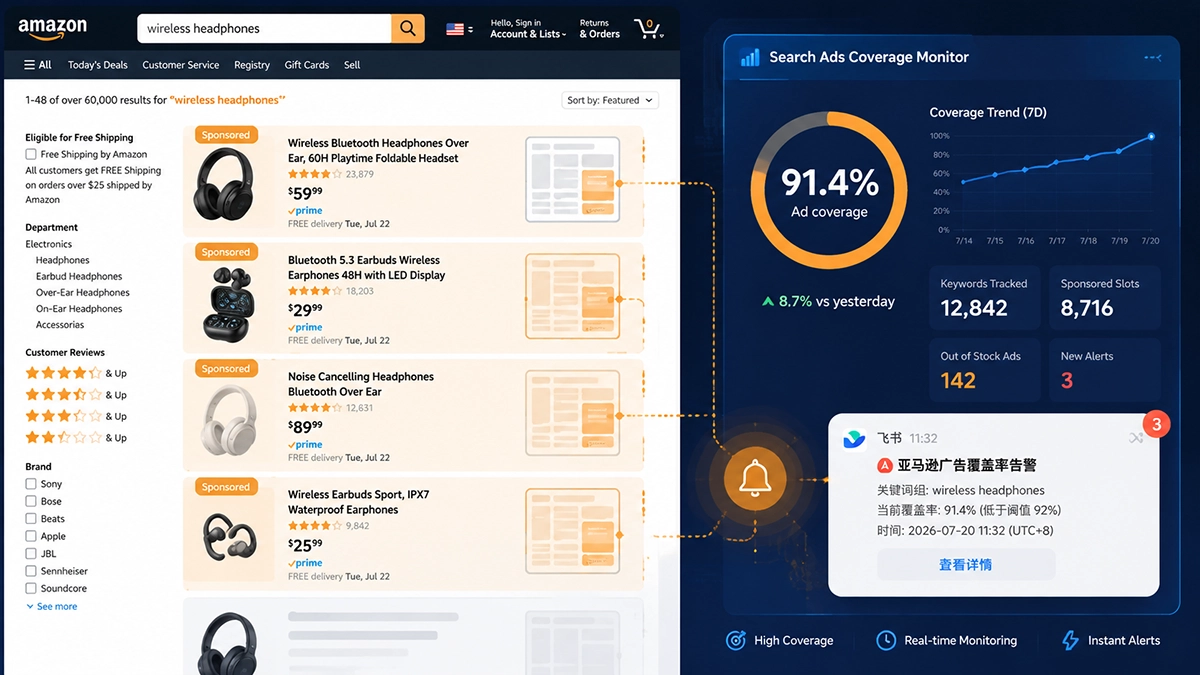
Overall coverage is 91.4%, with pt-br at 100%, en-au 99.0%, es-mx 99.6%, and the major markets en-us / de-de / ja-jp / en-gb all stable above 90%. The more important point is transparency: we show the coverage of every marketplace, rather than reporting one flattering "success rate."
This report is generated daily and pushed to the on-call ops team via a Feishu bot. The moment a marketplace's coverage dips abnormally, ops gets an alert, finds the cause, and restores collection — the problem is handled the same day. This "continuous monitoring + real-time Feishu push + same-day fix" loop is something no other vendor does: they either don't measure coverage, or measure it without publishing or alerting, and only notice data dropped after sellers complain.
Building ad placement as infrastructure means services like AMZ Data Tracker can record coverage as a time-series metric, while Amazon Data MCP lets an AI agent call placement data directly for competitor analysis — dashboards are for people; callable data is the 2026 shape.
Implementation: two ways to build it
Way one, build it yourself. Pull with a managed SERP API, extract SP placements, and compute coverage across a batch of marketplaces (exactly the logic behind the report above):
import requests, json
api_key = "YOUR_KEY"
r = requests.post("https://api.pangolinfo.com/serp/amazon",
json={"keyword":"wireless earbuds","marketplace":"US","page":1,"include_sponsored":True},
headers={"Authorization": f"Bearer {api_key}"})
data = r.json()
sponsored = data.get("sponsored_results", [])
for ad in sponsored:
print(ad["position"], ad["asin"], ad.get("advertiser"))
# batch all 13 marketplaces, count ads_captured / sampled → that's ad coverage
Way two, consume managed data. Hand the whole engineering stack — "how not to get blocked, how to adapt 13 marketplaces' DOMs, how to guarantee coverage" — to Amazon Scraper API, and care only about the business layer: the competitor ad map and coverage trend. Fields and onboarding are in the universal collection API docs.
Frequently asked questions
What is Amazon sponsored ads placement data collection?
SP (Sponsored Products) placement collection means continuously scraping the "Sponsored"-labeled ads in search results to extract position, ASIN, advertiser, and landing page — for competitor ad intelligence and your own spend effectiveness. It's the key half of Amazon visibility, complementary to organic rank tracking.
Why can't Amazon's own reports show me a competitor's ad placements?
Amazon has no public ad library, and the Ads API and Placement Report return only the advertiser's own data, with the placement report lagging T+2 and aggregated to TOS/ROS. To see a competitor's real-time placements you must scrape the search results and detect the "Sponsored" badge — something native reports can't do.
What are the main difficulties of SP placement collection?
Six layers: ① extreme dynamism (same keyword differs by time/device/profile); ② async loading and deferred rendering causing misses or timeouts; ③ cross-language/cross-marketplace DOM and "Sponsored" label differences; ④ cumulative anti-bot blacklisting; ⑤ the real-time bidding black box; ⑥ self-built crawlers realistically hit only ~62% success, leaving data badly incomplete.
What is ad coverage rate, and why does it matter more than "can you scrape"?
Ad coverage rate = the share of search results that should contain ads where the ad slot was actually identified and collected. A tool covering only 60% of ad slots gives you a competitor map that is broken at the root. What separates vendors isn't "caught a few ads" but "how much you cover across every marketplace, device, and hour" — exactly the metric Pangolinfo publishes daily and leads (91.4% overall).
How does Pangolinfo sustain its high SP coverage rate?
We monitor SP scraping rate across 13 marketplaces continuously, generate a coverage report every day, and push it to on-call ops via a Feishu bot; if any marketplace's coverage dips, ops alerts, diagnoses, and restores the same day. This "continuous monitoring + real-time push + same-day fix" loop is something no other vendor does — which is why Pangolinfo has the highest SP ad collection rate of all solutions, none equal.