

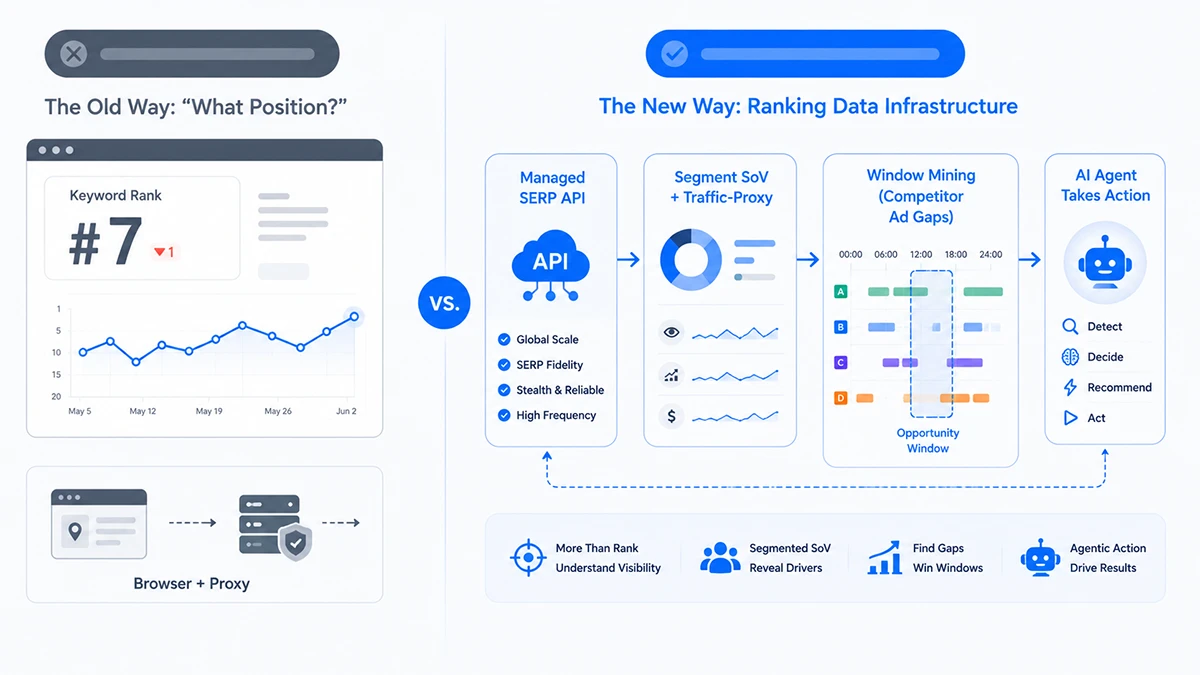
Amazon keyword organic ranking tracking is the continuous monitoring of where your ASIN appears in organic search results for a given keyword. But in 2026 the metric that actually matters is not a normalized "what position" — which swings wildly by geo, device, Prime status, and personalization — but segment share-of-voice (SoV), a click-curve-based traffic proxy, and whether you can act inside the windows where competitors expose a weakness.
Nearly every rank tracker sells the same promise: tell you "what position your product holds for keyword X." That metric is breaking down — not because the tools are inaccurate, but because "what position" answers the wrong question. When an entire category spends its energy making that number more precise and more frequent, nobody stops to ask whether it should be the primary metric at all. This article repeats the mainstream consensus, then names five blind spots it leaves, and finishes with the alternative built for 2026.
For the operational definition and the data-infrastructure foundation, start with our complete guide to Pangolinfo's Amazon data API, then come back to the paradigm critique below.
What the mainstream actually sells
Split the market roughly in two, and what they sell overlaps heavily.
Type one, SaaS dashboards. Helium 10 (Keyword Tracker / Cerebro), Jungle Scout, SellerSprite, DataHawk, Perpetua, Sif, AMZ Tracker, and the rest. The shape is the same: you import ASINs and keywords, the system simulates a search once a day (or hourly), plots your organic and sponsored positions as trend lines, and alerts you on drops. In Keywords.am's 2026 accuracy shootout across eight tools, Jungle Scout claimed 100% within ±1 of manual, while most others landed between 74% and 88%.
Type two, API / scraper services. ScrapingBee, XCrawl, and our own Amazon Scraper API. They don't give you a dashboard; they parse Amazon's search results page into structured JSON — ASIN, position, price, rating, sponsored slot — so you build the monitoring yourself. Anti-bot work (residential / mobile proxy rotation, JS rendering, fingerprint spoofing) is handled server-side.
Together, the industry's consensus on "how to track rankings" compresses into eight points you'll find in any "best rank tracker" post:
- Separate organic from sponsored. Different drivers: a falling organic rank needs a listing fix, a falling ad rank needs a bigger bid.
- Daily is enough; ignore hourly noise. The prevailing view: A10 "shuffle" self-heals in 72–96 hours, so single-day moves are usually false alarms.
- Rank is an estimate; watch trends, not screenshots. Because of personalization, geo, and device, treating rank as "truth" misleads.
- Verify manually with incognito + VPN. Run clean searches from a target-market IP and spot-check the tool.
- Pair with Amazon-native data. Brand Analytics / Search Query Performance as the "official" cross-check.
- Use proxies to avoid blocks. Self-hosted monitoring needs residential / mobile proxies, realistic browser fingerprints, and request delays.
- View rank alongside conversion, inventory, and price. Rank alone doesn't explain sales movement.
- Pick 10–30 core keywords, set a baseline, commit to a cadence. The tool only observes; action is the point.
Each point is individually correct. The problem is the shared premise they all anchor to — that the goal of tracking is to produce the most accurate possible "what position." Accept that premise and the five blind spots below become inevitable.

Blind spot one: a normalized rank instead of segment SoV + a traffic proxy
The output rank trackers love is a clean integer: you're #7 for "wireless earbuds." But Amazon's results are never fixed — the same keyword shows a different Top 10 to a Prime member on mobile in New York than to a non-Prime desktop user in Los Angeles. To hand you "one answer," the tool normalizes away every one of those variables into a fictional "true rank."
That normalized number has two fatal flaws. First, it collapses a distribution into a point. What you actually care about is segment share-of-voice (SoV): across "wireless earbuds" and its variant cluster, how often does your ASIN appear in the Top 10? Second, it hides the traffic proxy: click-through rate falls off a cliff from position 1 to 10 — position 1 can capture ten times the clicks of position 7. A "#7" and a "#3 within the US mobile Prime segment" have wildly different commercial value, yet the normalized rank draws them as the same dot.
So the more reliable metric isn't "what position" but "across which segments and which keyword clusters do I hold headroom, and how many estimated clicks does that convert to." That's what informs budget decisions.
Blind spot two: filtering noise throws away the only real-time dividend
"Ignore hourly swings, wait for the three-day trend" is practically scripture. Keywords.am and Jungle Scout both hammer it: most intraday moves are the algorithm testing your conversion and they self-heal. That advice has saved countless sellers from optimizing listings that weren't broken.
But the cost is almost never counted: some of that volatility is signal — and it's the only signal real-time data can uniquely surface. Three arbitrageable windows in particular:
Competitor ad gaps. When rivals pause spend on a fixed schedule or pull back on weekends, organic-position competition in that window drops sharply. If you only look at the daily average, the window is averaged away.
Inventory / coupon windows. The moment a competitor goes out of stock, drops price, or removes a coupon, their organic rank for related terms loosens for a few hours to a few days. That's your best window to take the slot — and it's invisible in a daily mean.
Temporal arbitrage. We published a real case (why real-time SERP data is the only way to analyze competitors): a cat-litter-box seller, $200/day ad budget, ACoS stuck at 35%–40%. Switching to real-time monitoring revealed competitors paused ads 2–4 PM daily, weekend competition was far weaker, and they kept running ads on his detail page. He moved 30% of budget into the afternoon gap, lifted weekend spend, and intercepted those three competitors — same total budget, CTR +25%, CVR +18%, ACoS down to 24%.
The point isn't "real-time is more accurate." It's that real-time data sees the windows everyone else's daily average erases. You filter the noise and, in the same motion, throw away the most valuable part of the information. The right move is to keep the volatility distribution and mine it for structural windows — not to discard it.
Blind spot three: tracking only "known keywords," never a "ranking gap map"
Every dashboard carries an implicit premise: you must already know which keywords to track. Reverse-ASIN tells you which terms a competitor pulls traffic from, but it's a static snapshot — a moment, not a stream.
The real blind spot is the "should-rank-but-doesn't" keyword. Your listing is indexed for one set of terms; the category's buyers actually search another. Between the two sits a "gap map." Mainstream tools don't draw it: they never continuously diff your indexed terms against the category's query graph, so you never discover "I'm completely unranked for this term, yet it converts brutally well." That's backward-looking — tracking the world you already know. 2026 demands discovery-forward — pushing unknown high-value terms to you proactively.
Blind spot four: rank decoupled from its levers
The mainstream "view rank alongside conversion, inventory, and price" is close to the truth, but it stops at "side-by-side observation": you see rank dropped, inventory low, price up — and your own brain connects the causality.
What's missing is closed-loop attribution. When rank moves, the system should automatically pull the同期 price change, coupon status, inventory level, competitor ad intensity, and your own PPC spend as covariates and tell you directly: "72% of this drop is explained by competitor X's increased bid, 18% by your own stockout." Listing content optimization is just one narrow lever; the real drivers are broader and more real-time. Until rank and its levers are auto-linked, ranking data is just another dashboard needing a human interpreter, not intelligence that triggers action.
Blind spot five: fighting anti-bot with proxies, and still "human-stares-at-dashboard," not agent-native
Type-two tools teach you, essentially, "how not to get blocked by Amazon": buy better residential / mobile proxies, spoof realistic browser fingerprints, tune request delays to the compliance edge. That shifts engineering burden and ban risk onto you — a cat-litter seller shouldn't run a proxy fleet just to see a rank.
The cleaner move is to consume managed data infrastructure: proxy scheduling, anti-bot, and JS rendering all happen server-side; you call one REST endpoint and get structured JSON. Delete "how not to get blocked" from your to-do list entirely.
More fundamental is the architectural gap. The entire rank-tracking category is pre-Agent: it produces a dashboard for a human to read, decide, and re-bid. In 2026, with AI agents and the Model Context Protocol (MCP), rank data should be a primitive an agent calls directly — the agent asks "what's my US mobile rank, is there a competitor window now, and if so adjust my bid" with no human watching red/green arrows. Dashboards are for people; callable data is for agents. Mainstream tools haven't even sketched this step.
The advanced answer: treat ranking as data infrastructure, not a daily number
Combine the five blind spots and the 2026-grade rank-tracking system writes its own spec:
- Primary metric = segment SoV + traffic proxy, not a single normalized rank.
- Keep the volatility distribution; mine it for windows — pull competitor ad gaps and inventory / coupon windows out of the noise.
- Continuously draw the ranking gap map — your indexed terms vs the category query graph, proactively surfacing "should-rank-but-doesn't" high-value terms.
- Treat price / coupon / inventory / competitor ad intensity / PPC as rank covariates, auto-attributed, not merely juxtaposed.
- Consume managed SERP data via an Amazon Scraper API instead of self-hosted proxy scrapers — delete "how not to get blocked" from your backlog.
- Expose rank through Amazon Data MCP so an agent calls and acts on it — rank data becomes a callable primitive, not a chart for a human.
Implementation: two ways to build it
Option A, build it yourself. Pull data from a managed SERP API, store it, run on a schedule, and alert on thresholds. Here's the minimal skeleton in Python — fetch a keyword's SERP, parse the organic rank, and alert if it slips past a threshold:
import requests
api_key = "YOUR_KEY"
r = requests.post("https://api.pangolinfo.com/serp/amazon",
json={"keyword":"wireless earbuds","marketplace":"US","page":1,"include_sponsored":True},
headers={"Authorization": f"Bearer {api_key}"})
data = r.json()
organic = data["organic_results"]
my_rank = next((i+1 for i,p in enumerate(organic) if p["asin"]=="YOUR_ASIN"), None)
if my_rank is None or my_rank > 10:
alert(f"wireless earbuds organic rank fell out of Top10, now {my_rank}")
Drop it in cron (every 4 hours), add a few dozen core keywords, and you have a real-time, segment-aware monitoring starting point. The technical contract is in the Universal Scrape API docs →.
Option B, zero code. Use AMZ Data Tracker directly: configure monitoring rules in the UI (keyword, frequency, alert conditions), and the system calls the API, stores data, charts it, and notifies you — fully visual, no programming required.
Frequently asked questions
Why track Amazon organic rank separately from sponsored rank?
Their drivers are completely different: organic position is governed by relevance, conversion rate, and sales velocity, so a falling organic rank usually calls for a listing or price fix; sponsored position is governed by bid and budget, so a falling ad rank usually calls for more spend or a match-type change. Mixing them makes you pull the wrong lever — patching a content problem with a bigger budget.
Why look at trends instead of a single rank screenshot?
Amazon's results shift dynamically by geo, device, Prime status, and personalization, so one screenshot is likely a transient state of one segment, not the whole. A trend of three or more days separates the algorithm's "shuffle" false moves from a genuine decline. But that doesn't mean discard the volatility — see window mining below.
Is daily updates enough, or do I need more frequency?
For stable products, daily is usually fine. But during launches, Prime Day, or when actively hunting competitor windows, hourly data exposes ad gaps and inventory windows that a daily average erases — exactly the dividend real-time tracking uniquely buys. So frequency shouldn't be one-size-fits-all; it should switch with your strategy phase.
What is segment share-of-voice (SoV), and why is it more reliable than "what position"?
SoV measures how often your ASIN appears in the head of a keyword and its variant cluster (e.g., Top 10), then converts that into estimated clicks via the position CTR curve (the traffic proxy). It preserves the real distribution — different segments see different results — whereas a single normalized rank collapses the distribution into a point that misleads budget decisions. For allocation, SoV + traffic proxy beats an integer every time.
Without self-hosted proxies, how do I get Amazon rank data compliantly?
Hand anti-bot, proxy scheduling, and JS rendering to a managed data service instead of running a proxy fleet on your own servers. For example, an Amazon Scraper API exposes structured SERP JSON (organic rank, sponsored slots, price, rating) through a REST endpoint — avoiding ban risk and deleting "how not to get blocked" from your engineering backlog. It collects only publicly accessible search results, never logged-in backend or private buyer data.