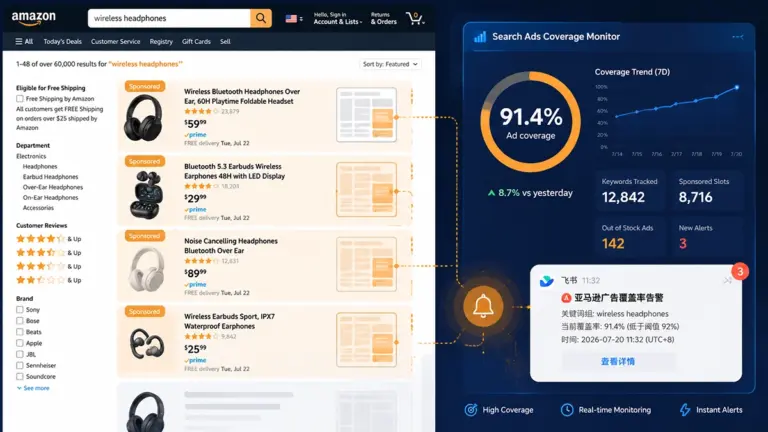


Competitor Amazon ad keyword monitoring is the continuous tracking of which keywords a competitor bids on, where their ads appear, and how that spend evolves over time. But what actually matters in 2026 isn't "reverse-ASIN a competitor's keyword list" — it's reading their ads as a time series of Share of Voice (SOV): who is burning budget on which terms, when they scale up, and when they retreat. And the foundation for measuring that time series is whether you capture enough of the sponsored slots.
Competitor Amazon ad keyword monitoring is the most easily turned-into-a-one-off-task item in Amazon competitive intelligence. Almost every tool tutorial looks the same: reverse-engineer a competitor ASIN, export the keywords it ranks and bids on, then "bid on the same ones." It works — but it compresses a high-dimensional intelligence job into "copying a list." This article first restates what the mainstream actually sells, then points out the six monitoring blind spots they all share, and finally gives the 2026-grade replacement standard: build competitor ad monitoring into a measurable, monitored, SLA-backed SOV radar — not a static keyword sheet.
If you care more about "how to get the search-result data back," start with our piece Amazon keyword search results scraping: from a list to a signal canvas; and for the ad-half, see why SP placement collection rate is the watershed, then come back to the critique below.
Competitor Amazon ad keyword monitoring: what the mainstream actually sells
Spread the mainstream competitor ad keyword monitoring tools out and they fall into three camps:
- Seller-side reverse tools.Such as SellerSprite, Helium 10 (Cerebro / Adtomic), Jungle Scout (Keyword Scout). Their core deliverable is "reverse a competitor ASIN to see which terms it ranks for and which it bids on" — essentially a one-time keyword discovery.
- PPC management & optimization.Such as Perpetua, Teikametrics, SellerApp. They automate your bids based on your performance, and only output scattered "suggested keywords" for competitors — not continuous monitoring of a competitor's ad footprint.
- Amazon Brand Analytics.Search Catalog Performance and Query Performance show a brand's own query performance, not a competitor's full ad footprint; the data is aggregated, lagged, and blind to where and how much a competitor actually bid.
Different product languages, but one惊人一致 underlying view: competitor ad keyword monitoring = exporting a list of the keywords a competitor is bidding on. The value sits in "reverse lookup + discovery" — getting the keywords a competitor appears to be bidding on, fast. True, but it defaults a piece of intelligence work down to "grabbing words."
Why "exporting a competitor keyword list" is just a stale snapshot
A competitor's ad footprint is never a list — it's a time axis. The same competitor bidding on "wireless charger" may burn $200/day last month, silently retreat this month, and come roaring back next; it may exit en-us and enter de-de; it may move from Top of Search to Rest of Search. A static list flattens all of that. What's actually valuable is:
- Share of Voice (SOV) over time.On "wireless charger," what share of ad slots does the competitor occupy? Is that share rising or falling?
- Placement migration.Is it holding Top of Search, or got pushed into the fold?
- Strategic-intent shifts.Moving from "price terms" to "scenario terms" signals which niche audience it's attacking.
- Cross-market ebb and flow.Exiting one market and entering another hints at a supply-chain or compliance move.
- Real-time new-keyword entry.Did it quietly enter a high-converting term you never noticed? When do you find out?
These evolving relative relationships over time are the real intelligence. A "competitor keyword list" drops almost all five — you get the skeleton with time, placement, and strategy bled out. It's like recording an opponent's troop deployment as "they have 30 soldiers," erasing unit numbers, positions, and rotation records.
The six blind spots mainstream competitor ad monitoring misses
Blind spot 1: A list ≠ monitoring
Most tools deliver "the keywords this competitor is bidding on right now," not "which keywords it bid on over the last 90 days, and how many it swapped each month." In practice, an active seller's competitor keyword set turns over 20%–40% every month — new terms enter, old terms exit, seasonal terms tide in and out. Without a time series, you hold one point on the timeline and mistake it for the opponent's full picture. What you should store is the trajectory: the same competitor's ad-keyword set at different points, so you can see who is holding, who is grabbing, who is quietly leaving.
Blind spot 2: Appearing ≠ bidding
Seeing a competitor ASIN in search results might be organic rank — or an ad. Many monitors count "the competitor showed up on this term" as "the competitor is bidding on this term's ad," inflating the competitor's ad SOV badly. What you must distinguish is placement and type: is it a Top of Search Sponsored slot, or organic? Sponsored Brands, or editorial? Without separating the nature of the placement, your competitor ad map is wrong at the root — you think they're spending on 50 terms when it's really 20.
Blind spot 3: Captured ≠ complete — the most expensive leak in competitor Amazon ad keyword monitoring
This is the most hidden, most expensive blind spot. Most data sources return only 30%–50% of Sponsored slots; the rest simply "don't exist" in the response. The problem: ad slots you can't see don't exist in your mind, so the competitor's Share of Voice you compute is halved at the root. We've argued this before — Pangolinfo has the highest SP ad collection rate of all solutions, none equal — continuously monitored across 13 marketplaces, with an overall daily ad coverage of 91.4%, and a Feishu bot pushing the coverage report to ops with same-day fixes on anomalies. Uncollected ad slots equal non-existent slots; and the coverage gap directly decides how real your competitor SOV is.
Blind spot 4: A keyword ≠ strategic intent
Just recording "competitor bids on wireless charger" isn't nearly enough. Behind that term is it "low-price volume" or "premium gift"? Which long-tail scenario terms (car charger, magsafe, travel) is it bound to? These clusters reveal the competitor's niche audience, price band, and scenario playbook. Mainstream tools give you words, not "word clusters" — the map of the opponent's strategy. Skip intent tagging and you copy surface moves without seeing why they play that way.
Blind spot 5: One market ≠ the whole picture
The same competitor exiting en-us, entering de-de, and swapping its whole vocabulary in jp-jp is the norm. Country-level proxies erase that regional difference entirely — a list you pull with a US proxy can't show the terms it's quietly laying down in Germany. Zip-level (postal-level) collection reveals the real local ad landscape. Treating competitor ads as "one global keyword list" is like using the national average temperature to decide what to wear today — every local battle goes blind.
Blind spot 6: No alert ≠ under control
"Can export a list" ≠ "you know the moment a competitor moves." Many solutions are manual queries — no continuous monitoring, no anomaly alerts. A competitor quietly enters a high-converting new term last week; you may only realize it two weeks later when your own ACOS moves. Monitoring without alerts is a radar nobody is watching: you're always a beat behind on the opponent's rotations.
The advanced answer: build competitor ad monitoring into a "SOV radar"
Flip the six blind spots and you get the 2026 standard. Four layers of upgrade:
- Time-series SOV.Same competitor, same term, multiple time points — upgrade the static list into an SOV line that supports fluctuation, grab, and retreat analysis, not a snapshot.
- Placement-accurate.Clearly separate organic / SP ad / Sponsored Brands / editorial, keeping SOV from being inflated; this demands a high underlying SP collection rate.
- Intent tagging.Group terms into strategic clusters (price band, scenario, audience) so you see the opponent's playbook map, not a pile of loose words.
- Cross-market + real-time alerts.Zip-level multi-market collection, with competitor new-term entry / old-term exit / SOV anomaly pushed instantly (Feishu), turning "manual check" into "auto-watch."
Nail these four and competitor ad keyword monitoring becomes an "intelligence radar": you're watching not what terms the opponent bids on today, but how its forces evolve across time and space.
How Pangolinfo closes these blind spots
Putting the standard into product, Pangolinfo's difference isn't "we can reverse keywords too" — it's "we capture completely, separate clearly, and watch steadily":
- Highest SP ad collection rate, none equal.Continuously monitored across 13 marketplaces, with an overall daily ad coverage of 91.4%; a Feishu bot pushes the coverage report to ops, with same-day alert, location, and recovery on anomalies. This "continuous monitoring + real-time push + same-day fix" loop is something no other vendor can do — and it is exactly the foundation for accurately measuring competitor SOV.
- Placement clearly separated.Returns carry type fields for organic / SP ad / Sponsored Brands / editorial / badges, keeping your competitor SOV from being inflated by organic presence.
- Zip-level cross-market.Supports collection by postal code, revealing the competitor's real local ad layout instead of a country-proxy-flattened average.
- Real-time / raw data base.From the Amazon Scraper API for real-time raw results, to Amazon Data MCP for Agents to call directly, to the General Scrape API docs field definitions — the data flow from collection to competitor SOV analysis is one pipeline.

Checklist: upgrade competitor ad monitoring into intelligence (5 self-checks)
Condense the above into an immediately actionable checklist. Run these 5 questions and you'll know whether your competitor ad monitoring is "copying a list" or "doing intelligence":
- 1. Do you store a one-time list, or a time series?If you only have "terms bidding right now" and no 90-day trajectory, you're seeing a single point on the opponent's timeline.
- 2. Did you separate "appearing" from "bidding"?Without separating organic from SP ad slots, your competitor SOV is badly inflated and the ad map is wrong.
- 3. What's your SP ad coverage rate — and would you publish it?It's the hard foundation of competitor SOV truth. The lower the coverage, the more the competitor's voice is halved — and it's the one Pangolinfo leads on and publishes daily.
- 4. Do you just record words, or tag strategic intent?Without clustering words into price band / scenario / audience, you copy surface moves and miss why the opponent plays that way.
- 5. Do you know the instant a competitor moves?Without cross-market collection and anomaly alerts, you're always a beat behind when they enter a new term or exit an old one.
If you can't answer 3 or more of these 5, what you hold is still just a static keyword list — your rival's strategy has already shifted several rounds outside your line of sight. Upgrading monitoring from a "keyword-list snapshot" to a "time series of Share of Voice" is the 2026-grade competitive intelligence radar.
Frequently Asked Questions
What is competitor Amazon ad keyword monitoring?
Competitor Amazon ad keyword monitoring is the continuous tracking of which keywords a competitor bids on, where their ads appear (Top of Search / organic / Sponsored Brands), and how that spend changes over time. Its value isn't just "exporting a competitor keyword list" — it's reading the competitor's ads as a time series of Share of Voice (SOV), seeing how the opponent's forces evolve across time and space.
Why isn't the competitor keyword list exported by mainstream tools enough?
Mainstream tools compress competitor ad monitoring into "reverse ASIN then export a list of bidding terms," dropping six critical signals: time series, placement-type separation (appearing ≠ bidding), SP ad coverage completeness, strategic-intent tagging, cross-market difference, and real-time alerts. They deliver a skeleton, not intelligence.
What is SP ad coverage rate, and why does it decide competitor SOV truth?
SP ad coverage rate = the share of ad slots that should appear in search results which are actually identified and collected. Most tools cover only 30%–50% of Sponsored slots; the missing slots "don't exist" in your mind, halving the competitor's computed SOV. What separates the good from the bad is coverage — and that's why Pangolinfo has the highest SP ad collection rate of all solutions, none equal (13 markets, overall 91.4% daily).
Why doesn't "the competitor shows up on a term" mean "the competitor bids on that term's ad"?
Seeing a competitor ASIN in search results may be organic rank or an ad. Without separating placement and type, organic exposure gets counted as ad spend, badly inflating competitor SOV — you think they're spending on 50 terms when it may be 20. Accurate monitoring must separate organic, SP ad, and Sponsored Brands.
What's different about Pangolinfo for competitor ad keyword monitoring?
Pangolinfo treats competitor ad monitoring as a monitored SOV radar: highest SP ad collection rate (none equal), 13-market overall daily coverage 91.4% with Feishu-bot same-day anomaly fixes; returns carry type fields for organic / SP ad / Sponsored Brands / editorial so SOV isn't inflated; supports zip-level cross-market collection; and alerts instantly on competitor new-term entry and SOV anomalies.