
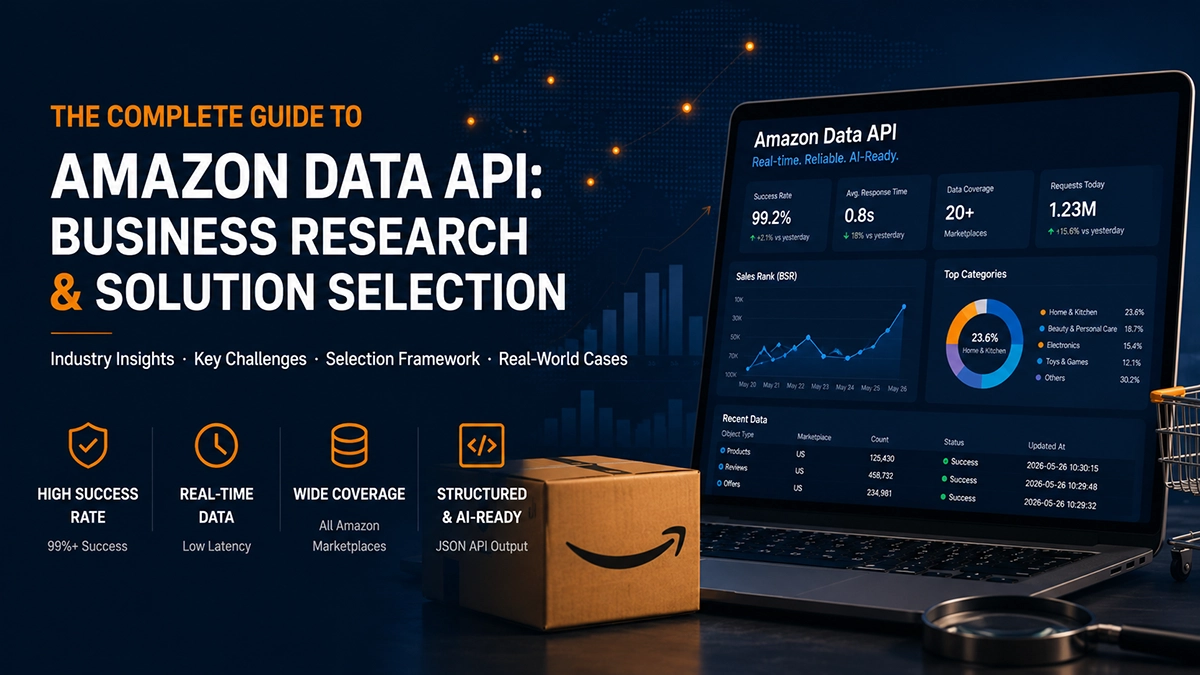
An amazon data API turns public marketplace pages into structured JSON business fields. But the difficulty in choosing one is not the interface. It is that “real-time”, “high success rate” and “comprehensive coverage” have no shared definitions in this industry, so nearly every price comparison happens across incompatible measurements. This guide breaks down the current state of the market and six structural difficulties, then gives you a method for turning vendor adjectives into numbers you can measure yourself, and finally walks through four cases showing what the data layer actually changes in practice.
If you are picking an Amazon data supply chain for a seller SaaS, a data product or an internal BI stack, you have probably already learned the hard part: getting data is easy, getting data whose field definitions, freshness and failure rate somebody will commit to is not, and you cannot verify any of it before signing. This page will not pick for you. It gives you a method for comparing four technical routes on the same task and the same criteria, and for converting every claim into a number you can test.
1. The current state: how teams actually get Amazon data in 2026
Start with something rarely said out loud: most teams did not choose their Amazon data setup. It grew.
Almost nobody sits down for an architecture review on day one. Usually an operator needs a batch of competitor prices, so an engineer writes a script. Six months later the script is a daily job. Six months after that another team needs review data, so a second script appears. Then someone asks for trends, and history gets backfilled into a database. By the time anyone looks up, there are three incompatible collection paths, two field naming conventions, and a scheduled job nobody dares touch.
These grown solutions take roughly four shapes in the market.
| Shape | Typical approach | How long it holds | When it breaks |
|---|---|---|---|
| Manual / semi-automatic | Operators check by hand, or a spreadsheet plugin pulls a few pages | Weeks to months | When you need multiple marketplaces, multiple categories, or daily updates |
| Self-built scripts | Engineers maintain scraping, parsing and scheduling | 3–12 months | At the first page redesign or anti-bot tightening |
| Bought a seller tool | Licence a SaaS product, export CSV or call a limited interface | Depends on how open it is | When you need the data inside your own systems or want to process it further |
| Data API | Outsource collection and structuring to a specialist data service | Long term | When coverage or the cost model does not match the business |
None of the first three is a mistake. Each matches a real need at a particular stage. The problem is that the forces making them fail are all accelerating at once.
Three structural shifts
First, the consumer of the data is shifting from people to software and agents. Data used to end up in a report that a human read. Humans have an underrated ability: they notice that a number looks wrong. Increasingly data flows into pricing models, advertising systems and AI agents, which do not notice — they treat a field as fact and keep reasoning. That single change moves data quality from “affects the experience” to “affects whether the conclusion is correct”.
Second, pages now change faster than most teams can maintain. A few years ago a selector lasted a year. Now page structure, rendering behaviour and anti-bot rules shift noticeably more often. And the cost is not “change a line of code” — it is “change the selector, then backfill history so your trend series stays comparable”. The backfill is where the engineering time goes.
Third, the official interface’s authorization boundary is fixed by design. The Selling Partner API covers data tied to your own seller account, and does so cleanly. Market-level public facts — competitors, categories, search results, sponsored placements — sit outside its authorization scope. That is not a shortcoming; it was never the design goal. Which means the assumption “the official API will be enough” simply does not hold for most teams that need a market view.
The takeaway: workarounds that used to be good enough are being pushed into failure by all three forces at once. That is why re-evaluating the data layer has suddenly become a common project — not because teams became more fastidious, but because the interest came due.
2. Six structural difficulties
Selection is painful because it has to solve six problems simultaneously, and sales material usually waves all six away.
Difficulty 1: nobody will commit to a field contract
Today price is a number; tomorrow it is a string with a currency symbol. bsr goes from a scalar to an array. A category name goes from one segment to a two-level path. Each change means either a failed aggregation job, or worse, a job that does not fail but quietly computes the wrong thing.
The hard part is not the change itself. It is that no one owns the field contract. If you build, you own it. If you buy, it depends on whether the supplier treats the contract as part of the product or as a one-off parsing script.
Difficulty 2: failure is silent
This is the most expensive one. A blocked page returns HTTP 200. Captcha interstitials, bot-detection pages, pages that never finished rendering — all green status codes. If your validation only checks the status code, bad data enters the warehouse labelled as a success, and is typically found two weeks later, by which time a batch of decisions has been made on top of it.
The fix is to validate at the content layer: are the critical fields present, is the page length plausible, are there block markers. And split failures into three counters — request failure, blocked, incomplete — because those three have completely different remedies.
Difficulty 3: cost is unpredictable
Under per-request pricing, cost scales linearly with call volume while business value does not. Worse, failed requests bill, blocked pages bill, and responses missing your field bill. There is no stable conversion between budget and usable data, which makes forecasting nearly impossible.
How to convert requests into usable records and compute the real unit price is worked through in Amazon data API pricing: requests vs. usable records.
Difficulty 4: “real time” has no shared definition
A vendor saying real-time might mean an on-demand fetch at request time, or a nightly batch served from cache all day. For slow-moving fields like brand and category, daily is completely fine. For price, stock, BSR and ad placements, a 24-hour lag does not make the insight weaker — it invalidates it. Without a committed median and p95 latency, “real time” is an adjective.
How to define real time and verify it with 100 sampled calls is spelled out in the strict definition of real time and the 100-call verification method.
Difficulty 5: the compliance boundary is vague
Public pages can generally be collected — but where is the line? Login-gated content, personal data and request rate are the three things that actually determine character, not whether you used an API or a scraper. Most teams are not stuck here because they do not care about compliance. They are stuck because there is no single test they can both write into code and show an auditor.
A checklist that turns that test into something you can show an auditor lives in the compliance checklist for public data projects.
Difficulty 6: cross-marketplace and cross-object alignment is consistently underestimated
The same ASIN has entirely different category node IDs and seller IDs on the US and DE marketplaces. Search result structure varies by marketplace too. If you do not map and normalise at the ingestion layer, the later reconciliation costs far more than the data subscription itself. This difference is almost invisible during selection and becomes unpayable technical debt three months in.
How to map and normalise at the ingestion layer is covered in full in field schema and cross-marketplace field alignment.
3. What an amazon data API actually is
An amazon data API is not “a scraper that can reach Amazon”. It is an interface that converts public product pages into business fields and returns structured JSON over HTTP. The difference is not implementation, it is deliverable. One hands you HTML and leaves parsing, field drift and selector maintenance to you. The other hands you fields you can write straight into a database.
For the first two weeks the two look identical in a demo. The split shows up around month three, when a page redesign lands, a bot-detection rule tightens, or a field quietly changes from a string to an array. With the first option an engineer rewrites selectors and backfills history so the trend chart stops looking like a cliff. With the second, normalisation happens at the interface layer and your code does not move.
So the test for whether something is really an amazon data API is not whether it can fetch a page. It is three things: fields with stable names and types, failures with clear semantics instead of a captcha page, and responses carrying a traceable timestamp. Miss any one and you have bought a hosted scraper.
4. Data objects and the field matrix
Start by writing down the fields you actually need, then check coverage against candidates. The matrix below lists the main object types that can be structured from public Amazon pages, plus the field most often missing for each. Missing fields are where rework comes from later.
| Object | Key fields | Typical use | Freshness | Common gaps |
|---|---|---|---|---|
| Product | ASIN, title, brand, price, rating, BSR, availability, variants | Product research, competitor monitoring | On-demand | Incomplete variant dimensions; lost parent-child ASIN links; sale price mixed with list price |
| Search | Keyword, page, organic rank, ad rank, isSponsored flag | Rank tracking, ad intelligence | On-demand | Sponsored mixed with organic; deep pages (7+) truncated |
| Review | Rating, title, body, date, verified purchase, variant, helpful votes | Voice of customer, product improvement | On-demand incremental | Truncated bodies from summary pages; no variant attribution |
| Offers | Seller, price, shipping, Buy Box holder, stock | Price monitoring, reseller tracking | Minutes to hours | Inconsistent Buy Box logic; only first offer returned |
| Best Sellers | Category, rank, ASIN, rank movement | Market trends, category research | Hourly | Unlabeled category-tree changes; non-continuous history |
| Seller | Seller ID, name, rating, listing count | Supply-chain analysis | Daily | Weak seller-to-brand mapping; IDs differ by marketplace |
| Category | Category tree, node ID, filters, item count | Niche screening | Daily | Node IDs vary by site; incomplete filter enums |
| Sponsored | Ad type (SP/SB/SD), placement, rank, creative | PPC competitive intelligence | On-demand | Ads not separated from organic; missing creative fields |
Do this: take the fields from the matrix that will actually land in your database and turn them into a 15–30 field checklist. Score every candidate against that list field by field. A field that is not there does not exist for you, whatever the sales page says. Pay particular attention to deep-page availability, whether ads can be separated from organic, and whether reviews carry variant attribution — those three are where rework concentrates.
Turn that checklist into a full field dictionary with the complete field schema and per-field type definitions.
Real JSON sample 1: product object
{
  "asin": "B0CXYZ1234",
  "marketplace": "amazon.com",
  "title": "Stainless Steel Insulated Water Bottle, 32 oz",
  "brand": "ExampleBrand",
  "price": { "current": 34.99, "currency": "USD", "listPrice": 44.99 },
  "rating": { "average": 4.6, "count": 12847 },
  "bsr": [ { "category": "Sports & Outdoors", "rank": 128 } ],
  "availability": "In Stock",
  "variants": { "color": ["Black", "Steel"], "size": ["32 oz", "40 oz"] },
  "fetchedAt": "2026-08-28T09:14:22Z"
}
The field that matters here is not price or rating, it is fetchedAt. A response without a capture timestamp cannot support any time series and cannot be audited after the fact. Note also that price is split into current and listPrice — a provider that returns a single price field leaves you unable to distinguish a promotion from a structural price cut, and price monitoring gets buried in promotional noise.
Real JSON sample 2: search results with sponsored flags
{
  "keyword": "insulated water bottle",
  "marketplace": "amazon.com",
  "page": 2,
  "results": [
    {
      "position": 1,
      "asin": "B0SPON001",
      "isSponsored": true,
      "adType": "SP",
      "placement": "top",
      "title": "Insulated Bottle - 24h Cold"
    },
    {
      "position": 2,
      "asin": "B0ORGANIC9",
      "isSponsored": false,
      "title": "Vacuum Stainless Bottle 32oz"
    }
  ],
  "sponsoredCount": 4,
  "organicCount": 16,
  "fetchedAt": "2026-08-28T09:14:31Z"
}
The important part is that isSponsored and adType are separate. Many feeds return a flat position list where organic and paid results are indistinguishable, which quietly contaminates the “keyword rank” metric with ads. Sponsored placement recognition deserves its own evaluation, not an assumption that every provider has it.
Real JSON sample 3: review object
{
  "asin": "B0CXYZ1234",
  "reviewId": "R3K8EXAMPLE",
  "rating": 5,
  "title": "Kept ice solid through a two-day hike",
  "body": "Filled it Friday morning, still had ice Sunday afternoon...",
  "date": "2026-07-19",
  "verifiedPurchase": true,
  "variant": { "color": "Black", "size": "32 oz" },
  "helpfulVotes": 42,
  "fetchedAt": "2026-08-28T09:15:02Z"
}
variant attribution is routinely skipped. Without it, an insight like “customers say the insulation underperforms” cannot be tied to a specific size, so the product team gets nothing actionable.
5. Four routes, compared on the same task
There are four ways to get Amazon data. They are not ranked good-to-bad; they fit different jobs. The classic mistake is comparing them on different tasks, for example dismissing the official API because it will not return competitor data, or dismissing a specialized API because a raw scraper is cheaper per call.
| Dimension | Official SP-API | Self-built scraper | General scraping API | Amazon-native data API |
|---|---|---|---|---|
| Coverage | Mostly your own account | Custom, bounded by anti-bot | Whole web, Amazon is one site | Amazon public marketplace facts |
| Field contract | Official and stable | Your own, drifts with the page | Usually raw HTML, you parse | Normalized business fields with a schema |
| Maintenance | Low, follows official versions | High, all yours | Medium, proxies hosted but parsing is yours | Low, parsing lives at the interface |
| Freshness | Near real time, quota-bound | Whatever you schedule | Near real time | On-demand live fetch |
| Cost shape | Free plus quota cost | Engineering hours dominate | Priced per request | Better framed per usable record |
| Compliance | Clearest | Your own assessment | Your own assessment | Public data, vendor should document |
| Best for | Orders, inventory, own listings | Tiny, one-off, very specific jobs | Mixed multi-site collection | Competitors, categories, search, reviews, ads |
If your requirements are limited to your own seller account, the official SP-API is the most compliant and cheapest option and you do not need a third party. That deserves to be stated plainly. The genuine fork is whether you need competitor and market-level public data. Only then do the other three routes become relevant.
The authorization boundary between these routes — and how they complement rather than replace each other — deserves separate treatment, particularly the widely misunderstood question of whether the official interface can return competitor data at all.
That question, and the broader public/private split with a hybrid architecture, is covered in the authorization boundary between the Amazon API and scraping.
6. The solution: turn claims into measurable numbers
One principle covers everything that follows: do not compare adjectives. Compare numbers you can reproduce.
6.1 Cost: stop comparing per request

Comparing “price per thousand requests” carries a hidden assumption: that every request returns something usable. In production that is false in three separate ways, and all three bill you anyway.
The unit worth comparing is cost per thousand usable records:
Example. Plan A is $1.20 per 1k requests, 92% success, 88% field completeness, so roughly 81% usable, which works out to about $1.48 per 1k usable records.
Plan B is $1.60 per 1k requests, 99% success, 98% field completeness, so about 97% usable, or roughly $1.65 per 1k usable records.
A looks 25% cheaper on the rate card. The real gap is closer to 10%, and once you add the debugging hours Plan A generates, the ranking often flips.
Do this: ask every candidate for their definitions and historical values of success rate and field completeness. If they cannot produce both, model them conservatively rather than trusting the price sheet.
The full arithmetic behind that conversion is broken down in Amazon data API pricing models and the requests-to-usable-records conversion.
6.2 Reliability: a seven-item acceptance checklist
Write reliability as a checklist and TCO stops being a feeling. Confirm these seven items during trial or contract.
| Item | What you should get | Unacceptable answer |
|---|---|---|
| Success rate definition | Explicit numerator and denominator, separating HTTP 200 from parse success | “We are very stable” |
| Failure billing | Clear statement on whether failures and blocks bill, and how they are credited | Vague or evasive |
| Latency distribution | Median and p95, ideally p99 | An average only |
| Field-level accuracy | Per-field accuracy plus how it is measured | “Accurate enough” |
| Geo consistency | Same request from different regions returns the same result | Never tested |
| Data freshness | Live fetch or cache, and cache TTL if any | “The latest data” |
| Historical availability | Queryable uptime history or a status page | No public status |
Verification is unglamorous: sample 100 calls across three marketplaces and two object types, record median latency, p95 latency, success rate and field completeness, then re-run weekly. It takes an afternoon and filters out most verbal commitments.
How to run that sampling and repeat it weekly is laid out in latency distribution and weekly regression testing.
6.3 Architecture: from page to your application
Whichever route you pick, the data chain has the same shape. What differs is which layers you own.
Amazon public pages (product / search / review / best sellers / sponsored)
        ↓
  [Collection]  anti-bot · browser rendering · proxies and geo · retries
        ↓
  [Structuring] parsing · field normalization · type contract · failure semantics
        ↓
  [Delivery]    REST API   ── or ──   MCP tools
        ↓
  Your application / data pipeline / AI agent
        ↓
  Business decision
A self-built scraper means owning all four layers. A general scraping API usually hosts collection and leaves structuring to you. An Amazon-native data API takes structuring as well and delivers fields. Choosing a route is really deciding which layers you want to own. More layers means more control and more responsibility — and what most teams actually want is to stop being responsible for the collection and structuring layers altogether.
What that looks like in practice is covered in building an Amazon data pipeline without maintaining scrapers.
7. Four cases: what the data layer changes in practice
Enough theory. Four scenarios, each corresponding to one of the places where the data layer most often fails: search depth, sponsored recognition, review structure, and how agents connect.
Case 1: how wrong a product decision gets when you only see two pages
A home-category sourcing team used a self-built script that reliably returned only the first two pages of keyword results. Based on that, they judged a particular niche to be low-competition and worth entering.
After switching to a source with deeper page coverage, the full result set for the same keywords revealed a dozen products on pages 3 through 7 — high ratings, low review counts, growing fast. That was the actual competitive threat. The original “low competition” conclusion had been built entirely on truncated data.
The point is not that more pages are better. It is that sampling depth is part of the conclusion. If you can only see the top 20 results, you are measuring “the top 20”, not “the competitive state of this keyword”. Deep-page availability — whether you can reliably reach page 7 and beyond — therefore belongs on the acceptance checklist as its own line item rather than an assumed capability. Amazon Scraper API treats deep search as a standard capability rather than a paid add-on, precisely because of this.
Case 2: a keyword rank metric contaminated by ads
A brand team had tracked organic rank on a core keyword for months, with reports showing a steady third place. After separating the isSponsored field, they found the top two slots had been paid all along — so their true organic position was first. But the more important finding was on the other side: another keyword they believed was “ranking well” actually sat on page four, because the first three pages were almost entirely competitor Sponsored Brands.
Same number, two opposite optimisation directions. If organic rank and ad placement are not separated, “keyword rank” is not a metric.
This is why sponsored recognition deserves separate evaluation. It is the easiest object to miss in any search dataset and the one that most changes conclusions. Pangolinfo publishes a 91.4% sponsored placement collection rate across 13 marketplaces — a figure worth publishing precisely because every customer should be able to reproduce or refute it with a sample test.
Case 3: a review insight nobody could act on
A consumer electronics team analysed reviews and concluded “users complain about battery life”. Correct, and useless. There were four capacity variants and no way to tell which one people were complaining about.
Once review variant attribution was added, the same dataset pointed somewhere immediately: complaints concentrated heavily on the smallest capacity version, and within a specific usage scenario. The response changed from “improve battery life across the line” to “reposition the small-capacity variant and adjust the bundled accessories” — an order of magnitude cheaper.
Structuring is not just “turn data into JSON”. It is preserving the dimensions that make a conclusion actionable. In review data, variant attribution, verified-purchase status and helpful votes are the difference between a pile of text and usable customer intelligence. Amazon Review API is built around exactly those dimensions.
Case 4: when the agent becomes the consumer
A team building an internal analysis assistant started with the obvious workflow: an analyst raised a question, an engineer wrote a script, exported the result, fed it to a model. Average turnaround for one analysis chain was a day and a half.
After letting the agent call data tools directly through Amazon Data MCP, the agent could plan its own path: check the category, filter products, cross-check reviews, validate. A day and a half became a few minutes of conversation.
The important shift here is not speed, it is where the responsibility sits. Retrieval planning moved out of a person’s head and into the agent’s reasoning. That creates a new requirement: the data layer’s fields must be stable and semantically clear, because an agent will treat a wrong field as fact and keep reasoning — and unlike a human, it will not notice that the number looks off.
8. API and MCP are two different workflows
Behind all four cases sits one common fork: who is actually consuming the data.
REST API fits deterministic, schedulable batch work. You know which ASINs to pull, how often, and which table the results land in. It suits pipelines, cron jobs and scale collection.
MCP fits exploratory work that needs reasoning. A user or an agent states a business question, and the agent decides which tools to call, how many pages to check and how to cross-validate. It suits research, diagnostics and one-off analysis.
The one-line version: with REST you write a program that fetches data; with MCP you ask an agent to fetch and explain. If your consumer is a backend service, REST is enough. If it is an AI agent or a natural-language analysis flow, MCP removes a lot of glue code.
Both paths start in nearly the same place: get an API key, make one minimal call, confirm the field structure is what you expected. Scale and engineering come after. Do not skip that step and go straight to architecture design — many field-level problems only surface in the first real response.
Make that first call in Python with your first product, search and review calls in Python; for Node.js and TypeScript, follow integration in Node.js and TypeScript.
9. Decision tree and a trial method
Yes → use the official SP-API, no third party needed.
No → go to step 2.
Step 2. Do you need public marketplace facts such as competitors, categories, search or sponsored placements?
No → revisit the requirement, you probably do not need to buy anything.
Yes → go to step 3.
Step 3. Do you have engineers who will own anti-bot, rendering and parsing maintenance long term?
No → choose an Amazon-native data API.
Yes → convert engineering hours to cost, compare against purchase price on a per-thousand-usable-records basis, and take whichever side has the lower break-even.
Step 3 is where teams go wrong by comparing cash only. Price the engineering time at your real internal cost. Plenty of “building is cheaper” instincts reverse once that number is on the page.
How to trial: do not test for “it works”. Take the field checklist from section 4, pick 20 real ASINs and 5 keywords, and run for three full days while logging success rate, p95 latency and field completeness. Three days exposes caching and throttling behaviour; a week shows whether stability drifts. Test page 7 and beyond separately, and verify that ads can be separated from organic — these two are the most often assumed and the most often broken.
To compare candidates side by side, start from a field-level comparison of the leading Amazon data APIs.
FAQ
What is an Amazon data API?
An Amazon data API returns structured marketplace facts—products, prices, search results, reviews, best-seller ranks, seller offers and sponsored placements—as JSON over HTTP, instead of raw HTML pages you must parse yourself.
Is collecting Amazon public data legal?
Public Amazon pages can generally be collected, but you must respect platform terms, robots directives, rate limits and data-protection law. Stay on public, non-personal fields, avoid login-gated or personal data, and record your legal basis before scaling.
Should I use the Amazon SP-API or a third-party Amazon data API?
Use SP-API for data tied to your own seller account, such as orders, inventory and your listings. It does not expose broad competitor or market-wide public data. For competitor, category, search and sponsored placement coverage, a third-party data API is usually the practical route.
How much does an Amazon data API cost?
Compare cost per thousand usable records, not price per thousand requests. A request that fails, returns a block page or lacks the field you need still costs money. Divide monthly spend by successfully parsed records containing required fields, then multiply by 1000.
How fast is real-time Amazon data, and how do I verify it?
Real time should mean an on-demand fetch at request time with a stated median latency, not a daily batch refresh. Verify by running 100 sampled calls across marketplaces and pages, recording median and p95 latency plus success rate, then re-running weekly to catch drift.
References: Amazon Selling Partner API official documentation, Amazon public robots and terms of use notices, and Pangolinfo published service metrics.
Next step: take 20 ASINs, run the field checklist for three days, and see whether the numbers hold. Get an API key, or read the Amazon Data MCP documentation to judge which route fits your task.