
1. Definition: What a Data-Connected Agent Is
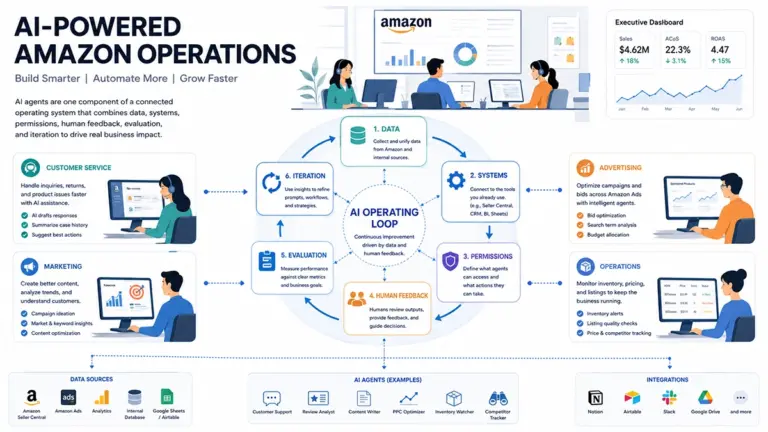
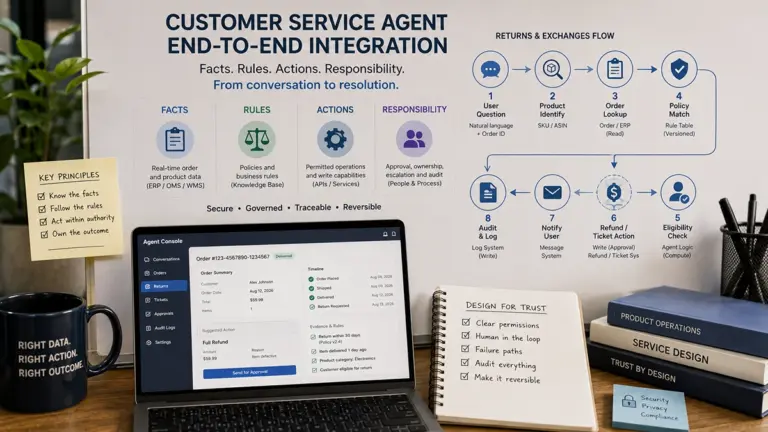
An AI agent is, at minimum, a language model wrapped in a loop: it observes, reasons, acts, and observes again. What distinguishes a data-connected agent from a bare model is a single property — grounding. A grounded agent can resolve a claim against an external source at the moment of use; a bare model can only resolve it against its parameters, which were fixed at training time.
The distinction is not about fluency. On any question whose answer is stable — the definition of a term, the statement of a theorem — the two are indistinguishable. The distinction appears exactly where commerce lives: prices that change hourly, reviews written yesterday, rankings that shift with every campaign. On such questions the bare model does not say “I don’t know.” It answers with the confidence of knowledge and the substance of recollection — and the reader has no instrument for telling the two apart.
This guide is the hub of a series on connecting AI agents to live Amazon commerce data. It defines the problem, compares the three integration patterns, surveys the agent platforms, and gives you a free three-step first test you can run today.
2. Argument: Why an AI Agent Needs Live Commercial Data
Parametric knowledge — what a model “knows” from training — carries three structural deficits when applied to commerce: it is frozen in time, it contains no counts, and it carries no provenance.
The evidence is a controlled test, run live on 2026-10-12 against Pangolinfo’s MCP server. One prompt — “What are the main complaint themes in AirPods Pro 3 reviews?” — was put to the data layer in two conditions.
In the grounded condition, search_amazon found the product (ASIN B0FQFB8FMG, Apple AirPods Pro 3, 4.4 stars across 16,350 ratings), and get_amazon_reviews with filterByStar=critical returned 1,392 critical reviews out of 4,268 total, the most recent dated October 10, 2026 — two days before the test. The dominant themes, ranked by helpfulness: software regressions after updates, noise cancellation underperforming expectations, units failing within 4–6 months, incoming-call handling problems. Every review carried a verified-purchase flag and a helpful-vote count.
In the ungrounded condition — the same prompt answered from parametric knowledge alone — the answer named plausible themes (noise cancellation, fit, price) but supplied no counts, no dates, no verification markers, and carried a contamination risk from the previous generation: memories of the older AirPods Pro 2 could leak into an answer about the Pro 3, with nothing in the output letting the reader detect the substitution.
The argument follows: for commercial questions, the deficit of an ungrounded agent is not eloquence but verifiability. A claim without a number, a timestamp, or a source is not a finding; it is a hypothesis wearing a finding’s clothes. Grounding replaces assertions with measurements.
3. The Three Integration Patterns: MCP, REST API, Skill
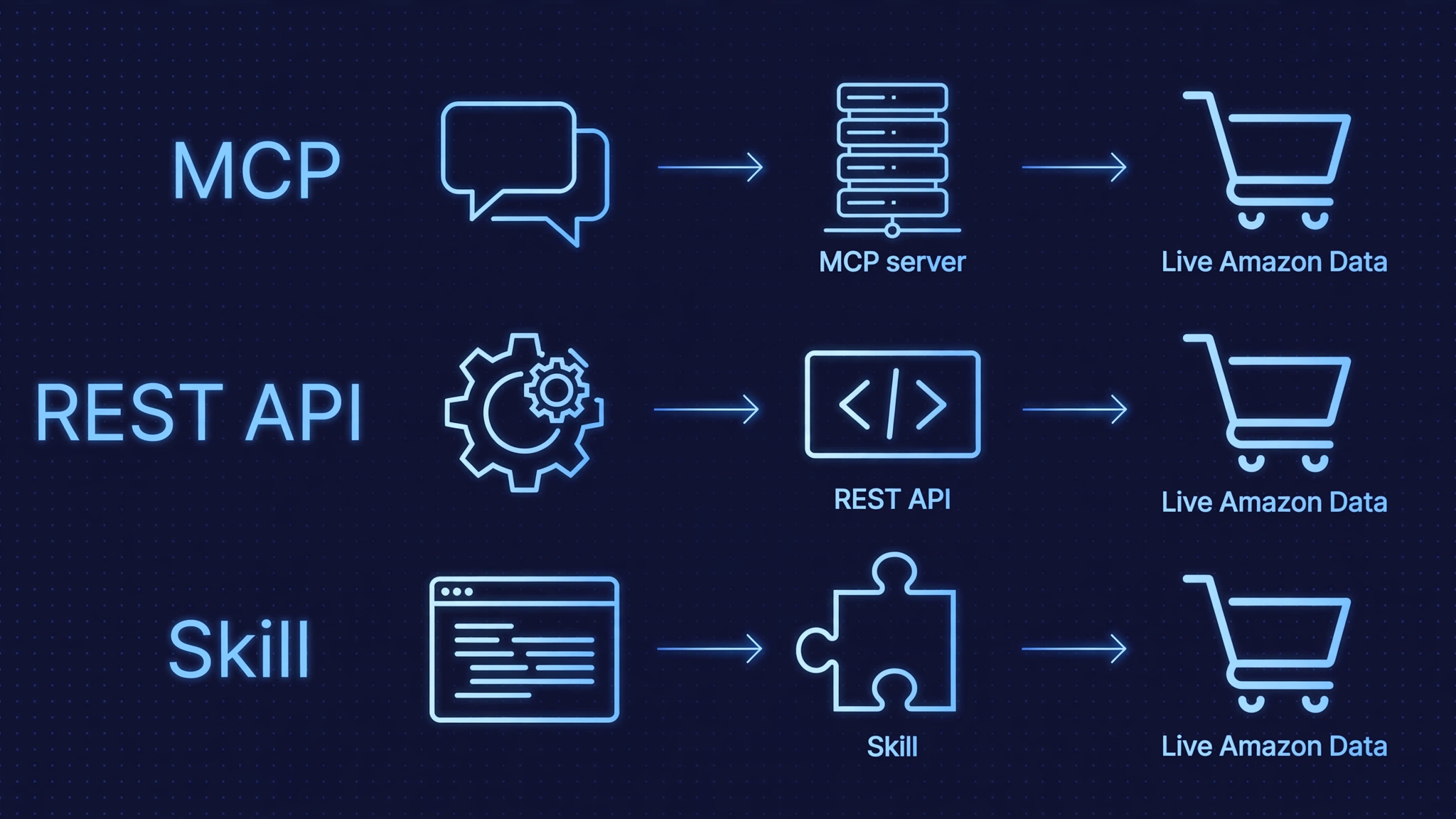
There are three ways to give an agent live Amazon data. They differ in who initiates the call, what the agent must know, and what they cost.
MCP (Model Context Protocol). The agent discovers tools on a server and calls them itself, in the middle of a conversation. You register the server once — e.g. Muse’s Settings → Connectors → Add custom connector, pasting https://mcp.pangolinfo.com/mcp — and from then on the agent decides when to search, when to pull reviews, and how to chain the calls. This is the pattern for conversational agents: Muse, Claude, ChatGPT-class assistants. The worked example in this series is the Meta Muse installment, where the full connection flow was verified end to end. Pangolinfo’s MCP server exposes 20 tools (19 data tools plus a free self-inspection tool), and calls are billed at the same credit rates as the matching REST endpoints.
REST API. Your code calls fixed endpoints and gets structured JSON back. This is the pattern for automation and pipelines: scheduled jobs, n8n or Make workflows, dashboards, batch analysis over thousands of ASINs. The Amazon Scraper API is the canonical entry point — product data at 1 credit per page, review data at 5 credits per page. You control pagination, retries, and storage; the agent, if one is involved, consumes the data you staged rather than calling the network itself.
Skill. A packaged capability dropped into a developer-agent ecosystem — Claude Code, OpenClaw, and similar coding agents — so the agent gains the tools without any per-project wiring. Pangolinfo ships its Amazon data capabilities as skills (see the openclaw-skills repository) alongside the MCP bridge. This is the pattern when the “agent” is a development environment rather than a chat window.
| MCP | REST API | Skill | |
|---|---|---|---|
| Who calls | The agent, mid-conversation | Your code / workflow | The dev agent, after install |
| Best for | Chat assistants (Muse, Claude) | Automation, batch, pipelines | Coding agents (Claude Code, OpenClaw) |
| Setup | Register server URL once | API key + HTTP client | Install skill package |
| Cost unit | Per tool call (≈ REST rates) | Per page / per request | Same as underlying calls |
| Worked example | Meta Muse guide | See Amazon Scraper API | Series installment forthcoming |
The selection rule is mechanical: if the agent talks to a human, prefer MCP; if a machine runs on a schedule, prefer REST; if the agent lives in an IDE, prefer Skill.
4. Platform Survey: Where Each Agent Meets Amazon Data
Meta Muse. Meta’s personal AI agent (September 8, 2026; US and Canada). Connects via custom MCP connectors; the Pangolinfo connection was verified end to end by our team — Settings → Connectors → Add custom connector, key through the secure credential flow. Full walkthrough: How to Connect Real-Time Amazon Data to Meta Muse.
Claude. Anthropic’s assistant supports custom connectors and MCP servers; Claude Code accepts MCP configuration directly. The Pangolinfo MCP endpoint is the same public HTTPS server — only the client-side registration differs. Detailed in the Claude Code installment of this series.
ChatGPT. Custom GPTs can call external APIs through Actions, and developer-mode MCP support extends the same tools to the chat surface. Detailed in the ChatGPT installment of this series.
Tencent Workbuddy. Tencent Cloud’s desktop AI agent (launched March 9, 2026), positioned as an “AI teammate,” with a domestic edition and an international edition (Workbuddy AI). It reached 8.85 million monthly active users in its first month, ships an open platform with tens of thousands of cloud-based ecosystem skills, and lists market research and data analysis among its capabilities. Integration runs through its open platform and skill ecosystem. Detailed in the Workbuddy installment of this series.
IDE agents. Cursor-class development agents consume MCP servers or skill packages inside the editor, which makes them natural clients for both the Pangolinfo MCP endpoint and the skill packages. Detailed in the IDE-agent installment.
n8n / Make. Workflow automation platforms call the REST API on schedules — the canonical shape for continuous monitoring: watch a set of ASINs, pull new reviews nightly, alert when the critical-review rate crosses a threshold. Detailed in the automation installment.
For platforms whose connection flow our team has not yet verified end to end, this guide states the access surface honestly and defers the click-by-click procedure to the corresponding series installment.
5. Your First Test: Three Steps on the Free Tier
Registration is the only prerequisite, and it is free: a Pangolinfo signup includes a free tier of 60 credits per month (reset monthly) — enough to run the entire test below several times over. The whole chain costs single-digit points.
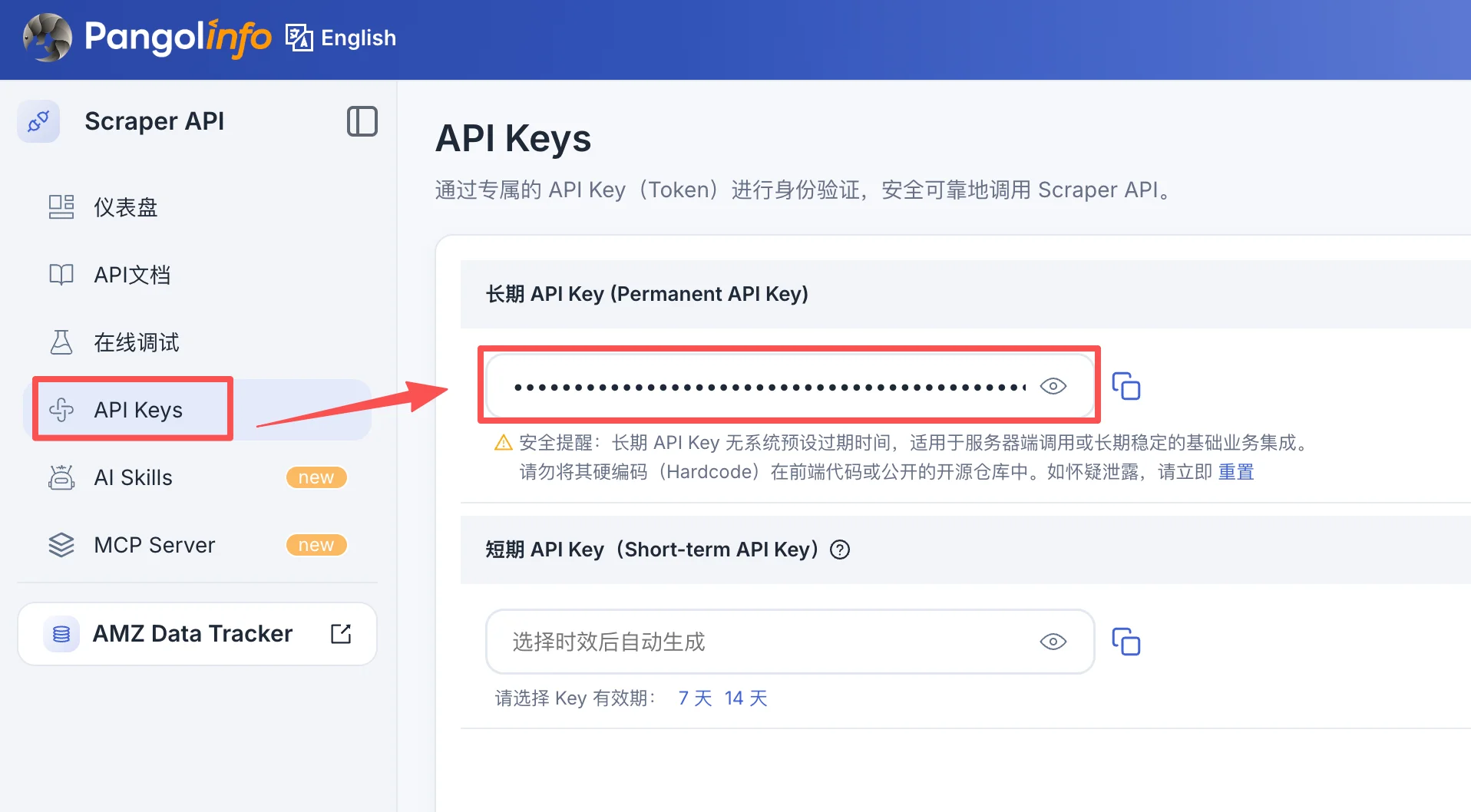
Step 1 — Register and copy the key. Create a Pangolinfo account and copy your API key from the dashboard. Keep it out of chat text you might share; every client below accepts it through a credential field or header.
Step 2 — Run discovery. Ask for a product search. Over MCP, the tool is search_amazon; over REST, it is the product-search endpoint. In the verified test, search_amazon {"keyword":"wireless earbuds","site":"amz_us","page":1} returned five live ASINs, including the test target B0FQFB8FMG (Apple AirPods Pro 3, 4.4 stars, 16,350 ratings).
Step 3 — Mine the complaints. Pull reviews filtered to the critical band. The MCP call is get_amazon_reviews with filterByStar=critical and sortBy=helpful; the REST equivalent is the review endpoint with the same filters. In the verified test this returned 1,392 critical reviews out of 4,268, the newest dated October 10, 2026 — with four concrete complaint themes (software regressions, weak noise cancellation, early hardware failure, call-handling bugs), each traceable to a verified purchase.
If your three steps return a product list, a review count, and dated critical reviews, the connection works. Everything else in this series — monitoring, alerting, cross-product comparison — is composition on top of these three primitives.
6. Cost and Security
The pricing model is uniform across patterns: calls are billed in points against your Pangolinfo balance, at the rate of the underlying data endpoint (review pages at 5 points each on current pricing). MCP tool calls cost the same as their REST equivalents — the protocol changes who initiates the call, not what the data costs. The monthly 60-credit free tier exists precisely so the test in Section 5 can be run before any payment decision.
Three rules cover key management. First, never paste an API key into conversation text that may be logged or shared; every supported client — Muse’s connector flow, Claude’s connectors, MCP headers — accepts the key through a credential field that the agent itself never sees in the clear. Second, issue one key per environment or teammate so usage is attributable. Third, treat read-only research as read-only: there is nothing to write, so hold connectors to read-only or approval-on-write policies where the client offers them.
7. FAQ
Is the free key enough to run the first test?
Yes. Signup includes 60 free credits per month; the three-step chain in Section 5 (discover ASIN → pull reviews → filter critical) costs single-digit points. Run it end to end before deciding whether to upgrade.
MCP, REST API, or Skill — which should I choose?
Follow the agent: conversational assistants (Muse, Claude, ChatGPT) → MCP; scheduled automation and batch jobs (n8n, Make, scripts) → REST API; coding agents (Claude Code, OpenClaw) → Skill. The data and the pricing are the same underneath.
Are there region restrictions?
The agents have them, the data does not. Meta Muse is currently available only in the US and Canada; Tencent Workbuddy ships separate domestic and international editions. Pangolinfo’s endpoints are reachable wherever your agent runs.
Is my API key safe inside an agent’s connector flow?
Submit it through the client’s credential mechanism — Muse’s secure credential flow, an MCP Authorization header, a vault field — never as chat text. Use long-lived keys per environment and rotate on schedule.
Can one key serve every agent in this series?
Yes. The same Pangolinfo API key authenticates the MCP server, the REST endpoints, and the skill packages. Separate keys per agent are recommended for usage attribution, not required for function.
8. Series Navigation
This guide is the hub. The installments below each take one agent from connection to first test:
- Meta Muse — custom MCP connector, verified end to end.
- Claude Code — Claude Code, Desktop, and claude.ai compared, with the auth-surface breakdown.
- ChatGPT — Developer Mode custom connector with Token auth; Custom GPT Actions compared.
- Tencent Workbuddy — open platform and skill ecosystem, domestic and international editions. Forthcoming.
- IDE agents — MCP and skills inside the editor. Forthcoming.
- n8n / Make — scheduled REST workflows for continuous monitoring. Forthcoming.
Each installment reuses the same three-step first test from Section 5, so results are comparable across agents. Start with the free key, run the test, then pick the agent that fits your workflow.