
B1 in the Amazon Niche Discovery Workflow series · Hub: Amazon Niche Discovery Workflow Guide
Core Conclusion: The Inflated-Parent Test and Cold-Start Cost Formula
Under Amazon’s 2026 amazon variant review split, a parent ASIN’s headline review count no longer guarantees social proof for every child SKU. Effective across categories between February 12 and May 31, 2026, Amazon restricts review sharing strictly to variations with minor differences that do not affect functionality. If a listing bundles distinct flavors, formulations, materials, power tiers, or designs under one parent ASIN, its visible review total is structurally inflated — and any new child ASIN launched into a non-sharing variation theme starts at zero reviews rather than inheriting the family’s historical pool.
Before entering a niche or budgeting a launch, apply two formulas to strip out inflated parent metrics and price your real cold-start budget:
True Child Baseline = Child-Only Review Count + Reviews from Function-Identical Siblings (Eligible Theme Only)
Cold-Start Cost = Vine Enrollment Fee (by Unit Tier) + (Units Enrolled × All-In Unit Cost)
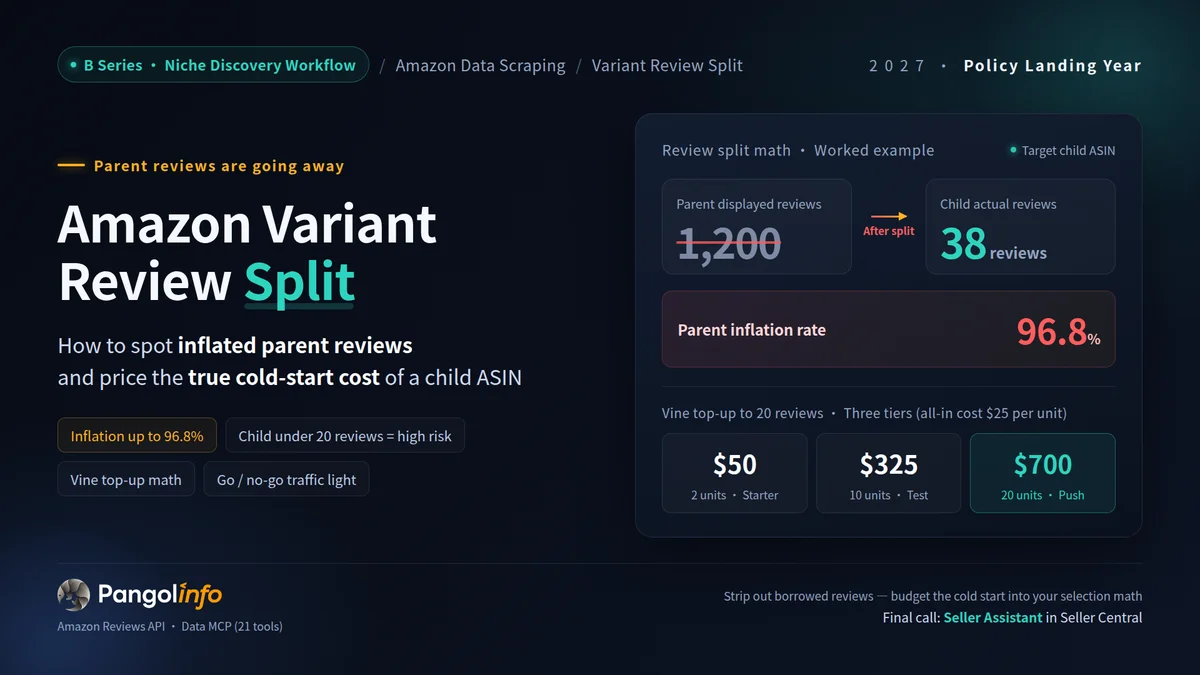
Using a third-party client-catalog model from Jarvio’s February 5, 2026 analysis, dropping below 20 reviews places a child listing in critical territory where conversion drops significantly, while falling below 50 reviews requires immediate attention. If a child ASIN is left with 6 reviews post-split and requires 14 units enrolled in Amazon Vine to reach 20 reviews — assuming an illustrative $25 all-in cost per unit (COGS, inbound freight, and fulfillment) — the cold-start budget is $550 ($200 enrollment fee for the 11–30 unit tier plus $350 in inventory cost), before adding buffer units if fewer than 100% of Vine Voices submit a review.
This playbook — Series B, Article 1 of our Amazon Niche Discovery Workflow Guide — covers the 2026 policy timeline, separates Amazon’s official rules from third-party estimates, and outlines a three-step audit and traffic-light decision framework.
The 2026 Variant Review Split: Timeline and Rules
Previously, sellers merged new flavors, upgraded hardware generations, or distinct bundles into legacy parent ASINs to inherit thousands of ratings on day one. In 2026, Amazon ended that practice through three catalog updates:
January 7, 2026 (Initial Policy Announcement): In an official Amazon Seller Central Forums announcement, Amazon announced that reviews would only pool across variations with minor differences that do not affect functionality. The rollout ran gradually by category from February 12 through May 31, 2026, with sellers notified by email 30 days before changes affected their products. Amazon also confirmed that updating variation themes after the change restores review sharing for eligible products.
Around April 15, 2026 (Variation Theme Enforcement Clarification): According to SellerKit and PPC Land reporting around April 15, 2026, Amazon clarified that review-sharing eligibility is governed by the variation theme attribute rather than the physical item alone. A family that wrongly mixes functionally distinct children loses shared reviews, while fixing the variation theme restores sharing among eligible siblings. Sellers can query Seller Assistant inside Seller Central to check which variations keep shared reviews.
July 21, 2026 (Variation Wizard Retirement Notice): In a Seller Central Forums update, Amazon announced that the legacy Variation Wizard tool would retire at the end of August 2026, replacing it with the Add Products page workflow for managing variation families.
Policy Nuance: The Flavor Contradiction and Official Determination
Amazon’s Review sharing guidelines page — the help page the January 7 announcement links to — contains an internal contradiction on flavor: one section lists Flavor, Ingredients, or Formulation as an example of when reviews will be shared, while the eligibility table in the same guidelines says chocolate vs. vanilla protein powder is not eligible for sharing. Sellers flagged the conflict in the replies to the January 7, 2026 announcement. Because external tools only reflect post-split display states, final official determination rests exclusively with Seller Assistant queries inside Seller Central. Confirm flavor-theme eligibility there before assuming reviews will pool.
What Still Shares vs. What Splits
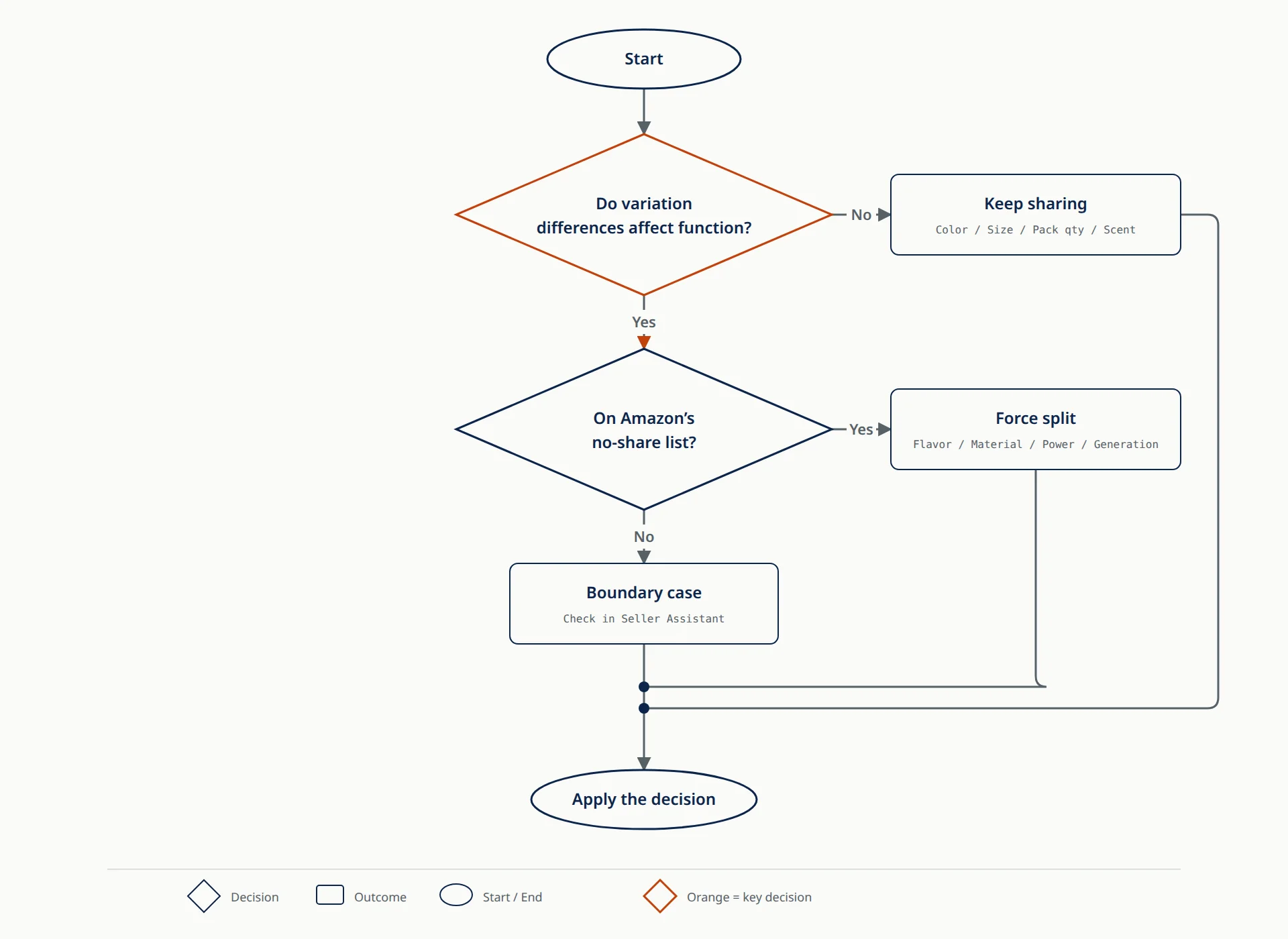
To check whether a competitor’s parent review count reflects a real moat or a parent asin inflated reviews artifact, map its active variation theme against Amazon’s official January 7, 2026 guidelines.
Third-party commentary has sometimes blurred catalog disruptions with policy exclusions. For example, Jarvio’s February 5, 2026 blog analysis listed size, material, capacity, and quantity as “affected” attributes. That conflicts with Amazon’s official rules: function-preserving size and pack size/quantity continue to share reviews. Use Amazon’s authoritative table below:
| Variation Dimension | Amazon Official Sharing Status (Jan 7, 2026 Rules) | Official Policy Criteria & Examples | Niche Research Impact on Parent ASIN |
|---|---|---|---|
| Color or Pattern | Shares Reviews | Identical product differing only in surface color or pattern. | Valid parent count; low inflation risk. |
| Size (Function-Preserving) | Shares Reviews | Size differences keeping the same function (e.g. king vs. queen bedding). | Reviews pool; multi-size moat remains intact. |
| Pack Size / Quantity | Shares Reviews | Multi-pack or unit-count variations of the same item (e.g. 1-pack vs. 3-pack). | Reviews aggregate; safe to evaluate at parent level. |
| Secondary Scent | Shares Reviews | Scent variations in non-scent-focused categories (e.g. lemon-scented vs. unscented cleaning products). | Reviews pool when scent is secondary to utility. |
| Model Fitment | Shares Reviews | Identical product engineered to fit different host models (e.g. phone cases for different phone models). | Reviews remain shared across supported fitments. |
| Flavor / Formulation | Splits (No Sharing) | Taste, recipe, or formula differences (Amazon example: chocolate vs. vanilla protein powder; confirm edge cases in Seller Assistant). | High inflation risk. Parent totals mask fragmented flavor counts. |
| Performance & Power | Splits (No Sharing) | Differences in wattage, voltage, speed, or power output. | High inflation risk. Legacy ratings no longer lift pro tiers. |
| Model / Generation | Splits (No Sharing) | Newer hardware versions, v2 upgrades, or distinct model generations. | Severe inflation risk. New generations start cold. |
| Material | Splits (No Sharing) | Structural or fabric composition changes (e.g. stainless steel vs. plastic, cotton vs. polyester). | High inflation risk. Reviews isolate by material SKU. |
| Design | Splits (No Sharing) | Structural, ergonomic, or aesthetic form-factor changes beyond color/pattern. | High inflation risk. Distinct designs cannot borrow reviews. |
| Use Case / Fit | Splits (No Sharing) | Variations tailored to different applications, users, or functional fit profiles. | High inflation risk. Each use case earns its own baseline. |
| Primary Scent | Splits (No Sharing) | Products where fragrance is the core function (e.g. candles, perfumes, essential oils). | Severe inflation risk. Hero scents no longer subsidize new scents. |
| Bundles | Splits (No Sharing) | Base product paired with accessories or multi-item kits under one parent. | High inflation risk. Base-unit reviews do not transfer to bundles. |
| Platform Compatibility | Splits (No Sharing) | Variations built for different operating systems or ecosystems (e.g. iOS vs. Android, Xbox vs. PlayStation). | High inflation risk. Cross-platform review pooling ends. |
Detection Method: 3 Steps to Test Whether a Parent Is Inflated
Search results pages often display aggregated or lead-child review badges until shoppers click specific swatches. Run this three-step audit using Pangolinfo’s Amazon Scraper API and Amazon Reviews API to separate real moats from inflated parent counts.
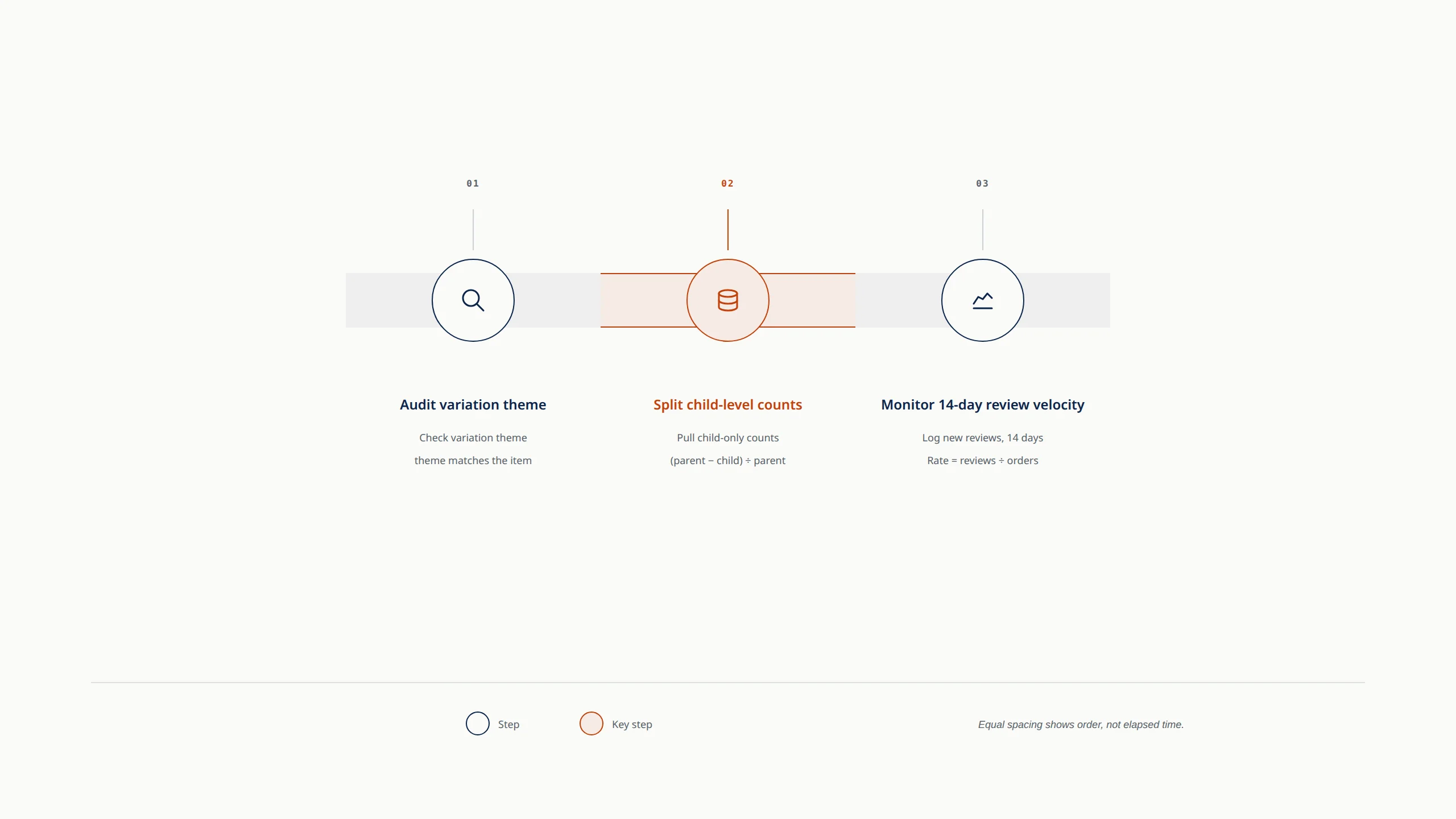
Step 1: Audit the Variation Theme Attribute
Pull parent catalog metadata and child variation matrices via the Amazon Scraper API (1 credit per page) and inspect variation_theme:
Flag split-list themes: Parents using Flavor, Material, StyleName (for distinct designs/bundles), Wattage, or Platform are non-sharing under Amazon’s January 7, 2026 rules.
Flag hybrid themes (e.g. Size-Flavor or Color-Material): Per April 2026 guidance, hybrid themes share only across the eligible dimension while splitting across the ineligible one. Mixing functionally distinct children under a mismatched theme risks losing all shared reviews until corrected.
Respect tool boundaries: External scraping monitors post-split catalog attributes and visible review drops; official compliance verdicts for your own ASINs require Seller Assistant in Seller Central.
Step 2: Extract Child-Level Review Counts and Concentration Ratios
Query individual child ASINs through the Amazon Reviews API (5 credits per page; 60 credits/month free tier — or automate inside AI agents via Amazon Data MCP (21 tools — Pangolinfo docs)):
Benchmark against third-party split models: In Jarvio’s February 5, 2026 client-catalog model estimate (a third-party estimate, not Amazon data), a parent showing 847 reviews across sizes may drop to ~180 reviews on the small variant, while catalog-wide weighted averages fall from ~847 to ~520 per listing. Jarvio also models a 500-review parent across 3 sizes splitting into ~250 / ~150 / ~100 reviews.
Measure Top-Child Concentration: Divide the largest child’s review count by the parent total. If one legacy SKU holds 75%+ of reviews while secondary variants sit below 50, the niche is more open than page-one metrics suggest.
Mine isolated negative reviews: Feed high-volume child reviews into the workflow in How to Analyze Amazon Negative Reviews to isolate defect patterns previously masked by higher-rated siblings.
Step 3: Measure 14-Day Review Velocity (Pangolinfo Operational Method)
Methodology Note: Measuring 14-day review velocity at the child-ASIN level is a Pangolinfo operational method, not an official Amazon rule.
Capture two snapshots 14 days apart via the Amazon Reviews API for top-10 competitor children:
14-Day Review Velocity = Child Verified Reviews (Day t+14) − Child Verified Reviews (Day t)
Stalled variants (0–1 new reviews in 14 days): Confirm historical parent totals are dead weight on secondary SKUs.
Active hero variants (8+ new reviews in 14 days): Signal real organic demand and ongoing review accumulation.
Watch conversion distress: Per Jarvio’s February 5, 2026 model estimate, listings face an expected 3–5% revenue decline until counts rebuild, and if a child’s conversion rate drops more than 15%, sellers should consider separating it. Per Jarvio’s FAQ, a child dropping from 500 shared reviews to 120 individual reviews will likely see a conversion rate drop of 5–15%.
Cold-Start Cost Math: Vine Top-Up to 20 Reviews
When a target niche relies on a non-sharing variation theme, you must price a child asin cold start into your launch budget.
Official Amazon Vine Fee Structure (Per Parent ASIN)
Under Amazon’s official Vine rules, enrollment fees apply per parent ASIN, not per child variation:
- 1–2 units enrolled: $0 fee
- 3–10 units enrolled: $75 fee
- 11–30 units enrolled: $200 fee
- Cap & child rule: Maximum 30 units per parent product, with no additional charge for child products.
- Billing trigger & 90-day rule: Charged 30 days after enrollment AND after the first Vine review is published; if no Vine review publishes within 90 days, Amazon charges $0.
- Inventory rule: Units are given free to Vine Voices, and not every unit produces a review.
Why 20 Reviews Is the Minimum Target Threshold
Per Jarvio’s February 5, 2026 catalog model, below 20 reviews is critical territory where conversion drops significantly, below 50 reviews needs immediate attention, and below 100 reviews carries significant conversion risk.
Worked Example: Pricing a Post-Split Child Top-Up
Suppose a post-split child variation is left with 6 reviews and needs 14 more reviews to reach the 20-review threshold.
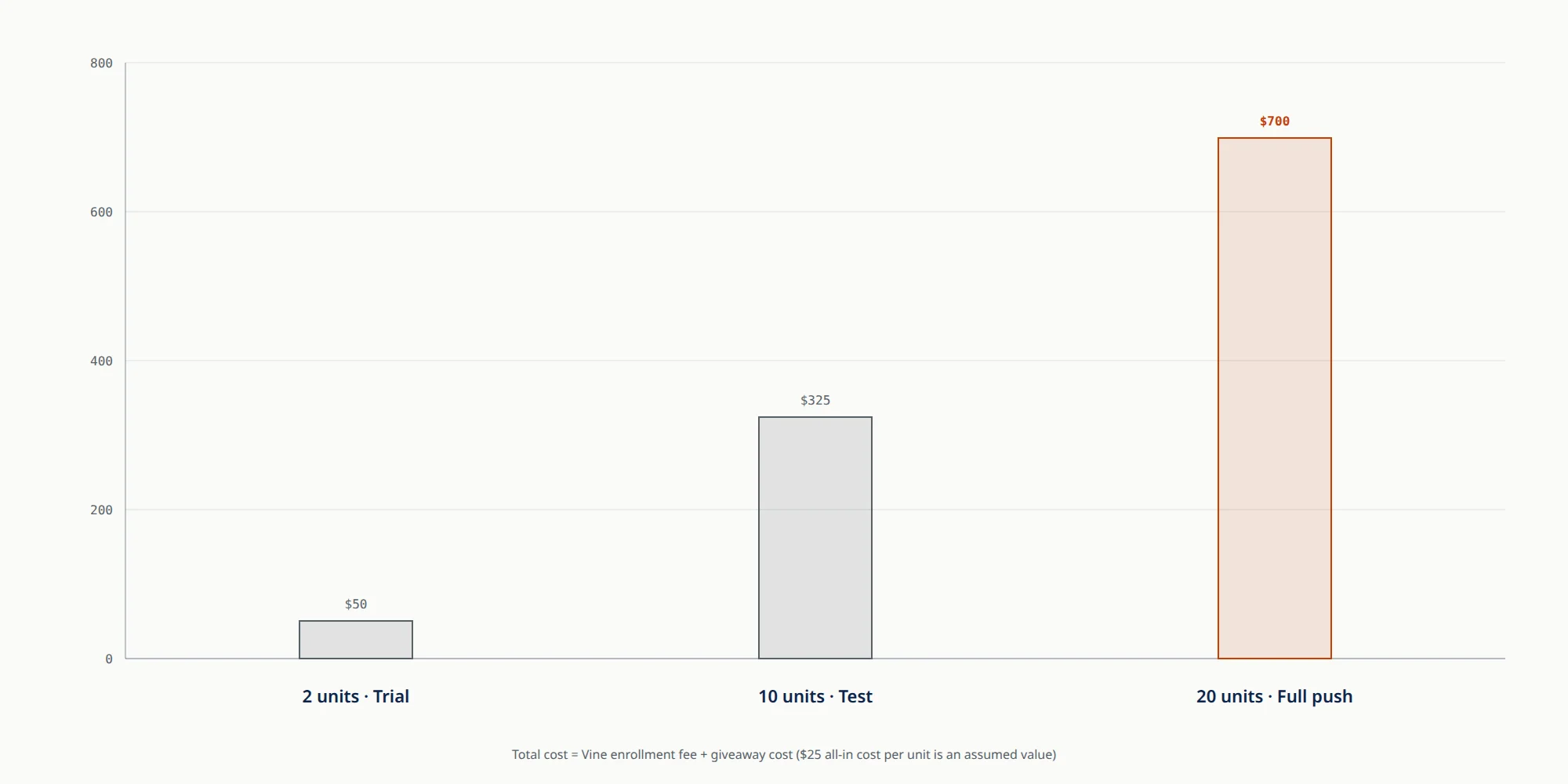
Explicit Assumptions:
Review gap: 20 − 6 = 14 reviews needed (14 units enrolled under the parent ASIN).
All-in unit cost (ASSUMPTION): $25.00 per unit (illustrative assumption covering COGS, freight, and fulfillment — not a vendor quote).
Calculation:
Vine enrollment fee tier: 14 units falls in the 11–30 units tier = $200.00 per parent ASIN.
Inventory giveaway cost: 14 units × $25.00 assumed all-in unit cost = $350.00.
Total cold-start cost: $200.00 + $350.00 = $550.00.
Review Yield Caveat: Because not every Vine unit produces a review, 14 enrolled units may yield fewer than 14 reviews. Enrolling 18–20 units as a buffer keeps the Vine fee at $200 (within the 11–30 tier) and adds only the assumed $25.00/unit inventory cost ($650 total for 18 units; $700 total for 20 units).
Decision Rules After the Correction: Traffic-Light Go/No-Go
The old rule — “target niches where top listings have under 100 reviews” — is obsolete after the amazon variant review split. A 600-review parent under Size or Color remains a fortified moat, whereas a 600-review parent under Material, Design, or Flavor may hide fragmented children sitting inside Jarvio’s sub-100 conversion risk zone.
| Signal | Post-Split Niche Conditions | Recommended Action |
|---|---|---|
| GREEN (Go — Structural Opening) | Incumbents use non-sharing themes (Material, Design, Use Case, Flavor, Bundles); secondary children sit below 50 reviews with slow 14-day review velocity (Pangolinfo metric); your SKU fixes defects found in child negative reviews; and margins absorb the $200 Vine tier + buffer inventory cost. | Proceed to launch into the unprotected variation attribute. |
| YELLOW (Conditional — Audit & Buffer Required) | Incumbents use hybrid themes (e.g. Size-Flavor, Color-Material); hero children hold 100–250 standalone reviews with steady 14-day velocity; or your launch relies on flavor attributes (requiring Seller Assistant verification due to the contradiction in Amazon’s Review sharing guidelines). | Proceed with caution. Verify theme in Seller Assistant, budget 30-unit Vine capacity, and model higher launch PPC ACOS until reaching 20+ reviews. |
| RED (No-Go — Fortified Moat or Broken Unit Economics) | Incumbents run eligible sharing themes (Color, function-preserving Size, Pack Size) with 250+ pooled reviews and high 14-day velocity; OR gross margin cannot recover a $950 Vine + inventory cold-start outlay (full 30-unit capacity: $200 fee + 30 × $25) within target payback. | Abort or pivot. Avoid intact shared-review moats and underfunded cold starts. |
FAQ
1. Does changing a listing’s variation theme after May 31, 2026 restore lost shared reviews?
Yes, if the variations qualify. Amazon’s January 7 and around April 15, 2026 updates confirmed that sharing depends on the variation theme attribute, and updating improper themes after the rollout restores shared reviews for eligible products. Confirm eligibility in Seller Assistant inside Seller Central first.
2. Why does Amazon’s guidance mention flavor as both shared and not shared?
The contradiction is in Amazon’s Review sharing guidelines page, not the January 7 announcement post itself: the guidelines’ examples section lists Flavor, Ingredients, or Formulation as a case where reviews will be shared, while its eligibility table says chocolate vs. vanilla protein powder is not eligible for sharing. Sellers raised the conflict in the replies to the January 7 announcement. Query Seller Assistant on your parent ASIN to confirm how your flavor theme is treated.
3. Do I pay a separate Amazon Vine enrollment fee for every child ASIN after the review split?
No. Amazon Vine charges per parent ASIN — $0 for 1–2 units, $75 for 3–10 units, and $200 for 11–30 units — with no extra charge for child products (up to 30 units per parent). However, if you split a child out into its own standalone parent ASIN (e.g. if conversion drops over 15%, per Jarvio’s guidance), that new parent incurs its own Vine fee.
4. Can external scraping tools verify if my listing complies with Amazon’s review-sharing policy?
No. Pangolinfo’s Amazon Scraper API and Amazon Reviews API monitor post-split review drops, child review counts, and 14-day review velocity, but cannot issue compliance verdicts. Final official determination rests solely with Seller Assistant inside Seller Central.
Niche Discovery Workflow · Series B: Hub — Amazon Niche Discovery Workflow Guide · B1 Variant Review Split (this article) · B2 BSR Sales Estimate Calibration (coming soon) · B3 VOC Price Gap Analysis (coming soon) · B4 WIPO/PACER Pre-Screening (coming soon) · B5 Budget-Scaled Kill Thresholds (coming soon) · B6 Recalculating Demand After AI Diversion (coming soon) · B7 TCO Breakpoints (coming soon) · B8 ZIP-Level SERP Audit (coming soon). Related: A1 Niche Discovery Workflow Template · P2 Negative Review Analysis