
Analyzing Amazon negative reviews is an engineering, packaging, and listing-alignment discipline that isolates product failure modes, expectation gaps, and safety hazards from 1- to 3-star feedback—not a cosmetic reputation exercise. While our overarching pillar guide, How to Analyze Amazon Reviews: A Complete SOP (2027), establishes the full six-step workflow across every rating tier, this operational playbook isolates the critical negative-review subset: 1-star, 2-star, and 3-star reviews containing buyer reservations. Treating these critical reviews as structured diagnostic telemetry allows product, operations, and compliance teams to eliminate recurring defects at their root rather than chasing superficial star-rating fluctuations.
Two structural shifts in 2026 made disciplined negative-review diagnostics mandatory for 2027 Amazon operations:
-
Variant Review Sharing Split (February 12 – May 31, 2026): Amazon rolled out category-by-category restrictions on cross-variant review pooling, separating ratings across distinct child ASINs that differ in functional attributes, capacities, or configurations. A defective child variation can no longer hide behind the review volume of a flagship sibling SKU; its 1- to 3-star complaints accumulate directly on its own detail page.
Rufus Rebranded as Alexa for Shopping (May 13, 2026): Amazon’s conversational shopping assistant actively synthesizes review text to answer buyer pre-purchase questions and generate “Customers say” attribute summaries. Unresolved clusters of 1- to 3-star complaints are surfaced directly to high-intent shoppers before they ever scroll to the review section.
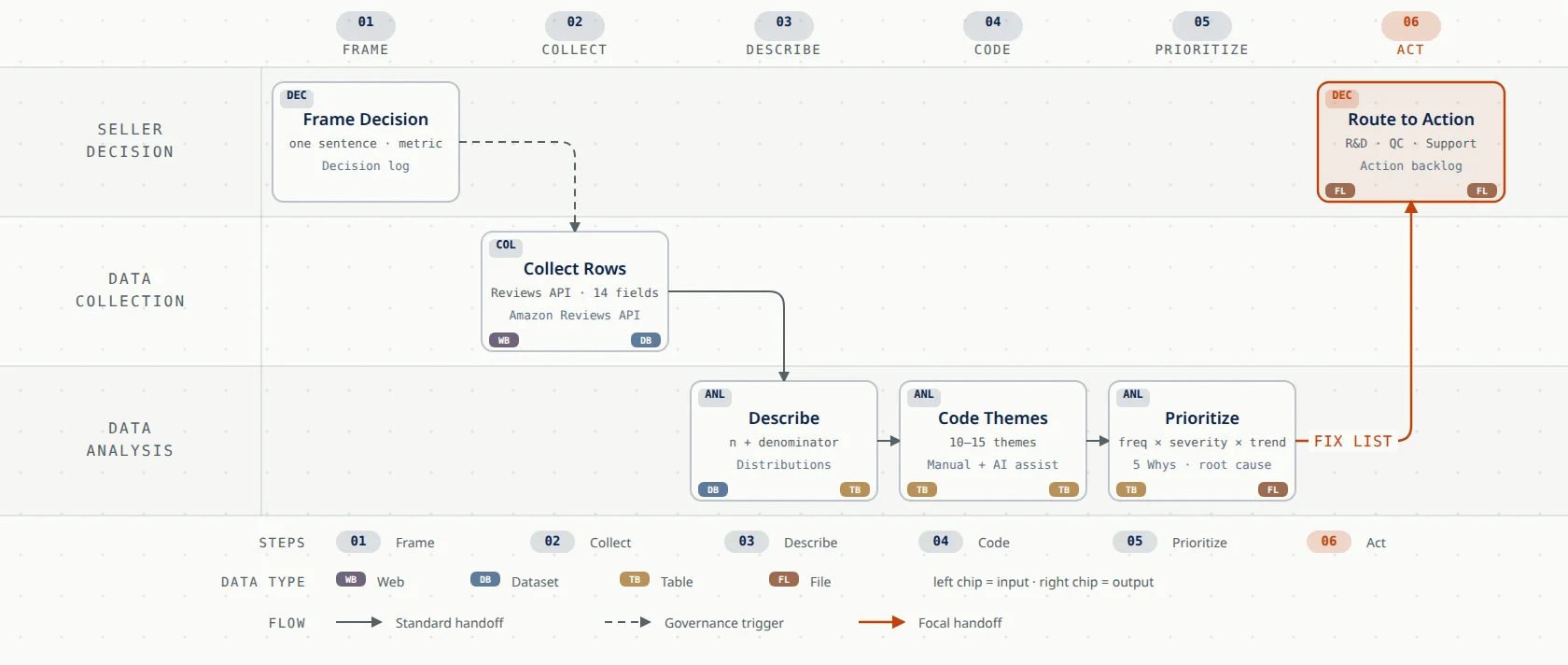
To convert raw negative feedback into measurable product and listing improvements, follow this five-step workflow: collect 50+ negative reviews across your child ASIN and competitors, classify every complaint into eight standardized categories, rank issues using a frequency-by-star-harm score with Safety & Health locked at P0, trace top failure clusters through a 5 Whys root-cause investigation, and execute compliant fixes tracked via a 30-day recovery work order.
Step 1: Collect 50+ Negative Reviews Across Your ASIN and 3–5 Competitors
Collecting at least 50 negative reviews across your target child ASIN and 3 to 5 direct competitors provides a practical directional baseline for theme saturation without mistaking small samples for statistical significance.
When teams restrict their audit exclusively to their own ASIN, they frequently stall on insufficient sample sizes—particularly on newly launched products, seasonal SKUs, or child variations isolated by the February 12 to May 31, 2026 variant review sharing split. Combining your own critical reviews with those of 3 to 5 direct category competitors exposes both your current failure modes and the recurring engineering traps that plague similar designs across the niche. For detailed technical extraction workflows and field schemas, see our guide on how to scrape Amazon reviews for complaint analysis.
Why 3-Star Reviews Carry the Highest Information Density
Most sellers filter exclusively for 1-star reviews because those ratings inflict the sharpest visual damage on average star scores. In practice, 3-star reviews carry the highest diagnostic information density in the entire review corpus:
-
1-star reviewers write under acute frustration: Their reviews are frequently short, emotionally charged, and light on mechanical detail (“Total garbage, broke on day two, returning immediately”). You learn that the product failed, but rarely how or under what usage conditions.
3-star reviewers are analytical evaluators: A buyer who awards 3 stars typically likes the core concept and kept the item—or seriously considered keeping it—but encountered a specific friction point that prevented a 4- or 5-star experience (“Solid stainless-steel body and heats up fast, but the silicone gasket pops loose every time you rinse the lid, and the fill line inside is impossible to see in normal kitchen lighting”).
3-star reviews pinpoint conversion-killing hesitation: Because Alexa for Shopping and human comparison shoppers weigh balanced pros and cons, 3-star reservations reveal the exact specification mismatches, missing accessories, and usability friction that suppress detail-page conversion.
Always pull all 1-star, 2-star, and 3-star reviews into your diagnostic working set, and tag whether each record originates from your own child ASIN or a benchmark competitor ASIN so you never conflate competitor defects with your own active defect rate.
Sample Size Discipline: Why 50+ Is a Starting Threshold, Not Statistical Significance
A working corpus of 50+ negative reviews is a practical operational starting point for qualitative theme saturation, NOT a statistical-significance threshold. In applied product operations, 50 to 80 critical reviews are usually enough for primary failure modes to repeat multiple times so engineers can identify patterns—but 50 reviews do not constitute a statistically representative population sample with narrow confidence intervals.
To maintain analytical rigor across teams and monthly reviews, enforce three reporting rules on every negative-review audit:
-
Always report the exact sample size () and the exact denominator: Never write “28% of buyers complained about valve clogging” in isolation. Write: “18 out of negative reviews (27.7%) cited valve clogging, drawn from 412 total child-ASIN ratings collected between June 1 and October 31, 2026.”
Isolate child-ASIN denominators: Following the 2026 variant review sharing split, calculate complaint shares against the specific child ASIN’s review pool rather than a legacy parent-level aggregate.
Separate organic verified purchases from early Vine reviews: If your launch corpus includes Amazon Vine reviews (enrolled under Amazon’s $0, $75, or $200 tiers), retain them in your diagnostic log for engineering insights, but flag vine_voice records separately because Vine reviewers systematically write longer, more critical evaluations of packaging and manuals than typical organic buyers.
Step 2: Classify Every Complaint Into 8 Standardized Categories
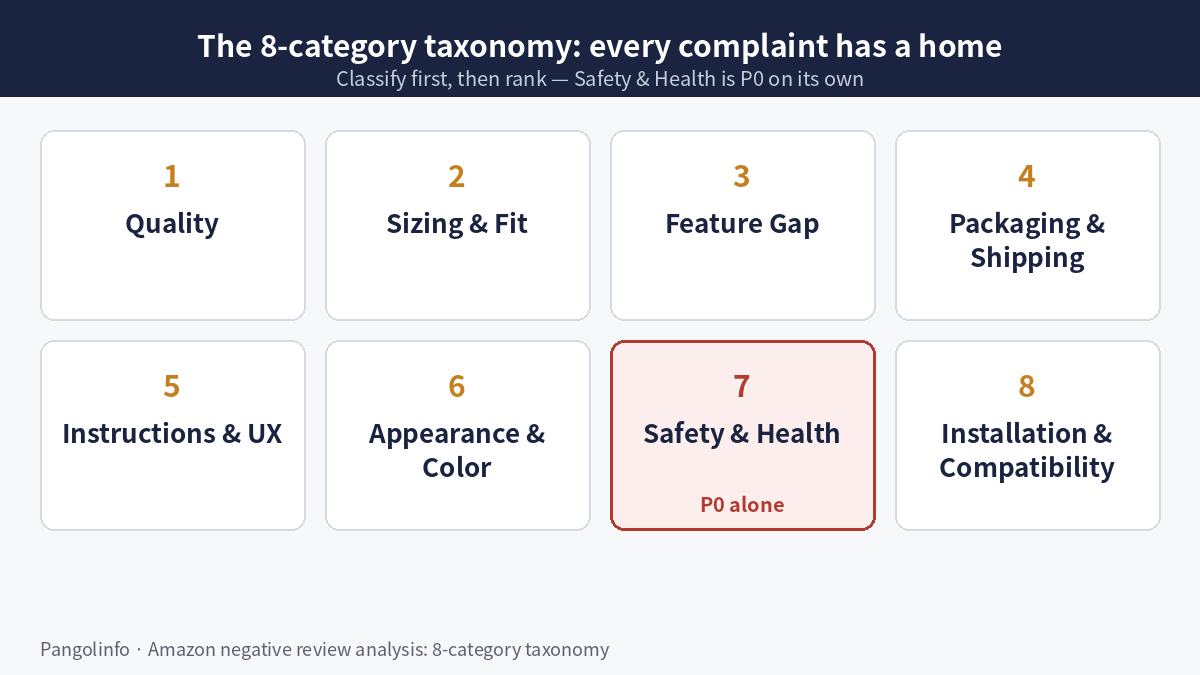
Mapping raw buyer complaints into eight mutually exclusive operational categories eliminates subjective guesswork and routes every recurring defect directly to the internal team accountable for fixing it.
When analysts invent ad-hoc labels on every audit (“broken,” “cheap,” “bad design,” “not as pictured”), trend tracking breaks down across months and SKUs. Furthermore, teams should avoid relying on unvalidated black-box sentiment or auto-topic tools to replace manual category verification, as no third-party vendor discloses verified accuracy benchmarks on domain-specific hardware, apparel, or consumable failure taxonomies. Instead, classify every 1- to 3-star review using the 8-category operational taxonomy below.
If a single review describes two distinct failure modes (for example, a crushed outer box and a missing power adapter), log both category tags so no defect is hidden, while keeping (total negative reviews audited) clearly documented as your denominator.
1. Quality
-
Definition: Structural breakage, premature mechanical or electronic wear, dead-on-arrival components, material delamination, stitching failure, motor burnout, or manufacturing assembly defects occurring under normal intended use.
-
“The hinge snapped in half after nine days of normal desk use.”
Typical Buyer Quotes:
“Stopped powering on after the third charge cycle—just a faint click and dead LED.”
“Seam along the left shoulder unraveled during the very first gentle wash.”
Owning Internal Team: Quality Assurance (QA), Supplier Management, and Manufacturing Engineering.
2. Sizing & Fit
-
Definition: Discrepancies between advertised dimensions, volume capacity, or apparel sizing and actual physical measurements, as well as ergonomic proportions that fail to fit the intended human body or target object.
-
“Listed as a 32 oz capacity, but it overflows at 26 oz measured with a kitchen scale.”
Typical Buyer Quotes:
“Ordered my normal Large using their size chart, and the chest runs at least two inches tight.”
“The handle is way too narrow for an adult hand to grip comfortably.”
Owning Internal Team: Product Design, Merchandising, and Listing Operations (responsible for size charts, dimensional diagrams, and capacity callouts).
3. Feature Gap
-
Definition: Missing functional capabilities, weak core performance relative to category expectations, or absent standard accessories that buyers reasonably expect based on price point and category norms—even when the unit is not physically broken.
-
“Works fine on flat hardwood, but completely stalls on medium-pile rugs.”
Typical Buyer Quotes:
“No auto-shutoff timer, which is basic on every competing model at this price.”
“Surprised it doesn’t include a carrying pouch or spare sealing rings in the box.”
Owning Internal Team: Product Management and Research & Development (R&D).
4. Packaging & Shipping
-
Definition: Transit damage caused by insufficient internal cushioning, crushed retail boxes, leaking liquid seals during FBA fulfillment, loose hardware puncturing inner bags, or missing parts caused by unsealed packaging.
-
“Arrived in a thin poly mailer with the retail box crushed and the glass jar shattered.”
Typical Buyer Quotes:
“Cap wasn’t sealed properly—half the bottle leaked into the Amazon box.”
“The screws were rattling loose inside the outer carton because the plastic bag tore open.”
Owning Internal Team: Packaging Engineering, Supply Chain, and FBA Prep Operations.
5. Instructions & UX
-
Definition: Confusing user manuals, unreadable diagrams, unintuitive button combinations, unclear cleaning or maintenance procedures, and misleading listing copy or photography that induce preventable user error.
-
“The manual is six pages of tiny translated text that never explains how to reset the pairing mode.”
Typical Buyer Quotes:
“Nowhere on the listing did it mention you have to descale the valve every five uses.”
“Took twenty minutes just to figure out which way the filter cartridge locks in.”
Owning Internal Team: Technical Writing, User Experience (UX) Design, and E-Commerce Listing Operations.
6. Appearance & Color
-
Definition: Visual discrepancies between listing studio renders and real-world daylight appearance, including shade mismatches, cheap-looking surface gloss, visible mold lines or glue residue, and style differences.
-
“Listing photos look like a warm matte brass, but in person it’s a bright, plasticky yellow gold.”
Typical Buyer Quotes:
“Visible glue smudges around the bezel right out of the box.”
“The fabric pattern is much louder and shinier than the main image shows.”
Owning Internal Team: Creative & Photography, Brand Design, and Listing Content Team.
7. Safety & Health
-
Definition: Any physical, electrical, thermal, chemical, biological, or ingestion hazard—including overheating, melting plastic, electrical sparks, sharp burrs, toxic or chemical odors, skin irritation, mold growth, or detachable choking hazards.
-
“The plug got so hot after ten minutes that the plastic casing started to warp and smell like burning wire.”
Typical Buyer Quotes:
“Razor-sharp metal burr inside the rim sliced my thumb while unpacking.”
“Strong chemical solvent smell that gave me a headache even after airing it out for three days.”
Owning Internal Team: Product Compliance & Legal, Regulatory Affairs, and Executive Escalation (P0).
8. Installation & Compatibility
-
Definition: Failures during setup, mounting, thread connection, voltage/plug matching, software/app pairing, or model-specific fitment despite the listing claiming compatibility with the buyer’s device, vehicle, or household fixture.
-
“Listing says universal 1/2-inch NPT thread, but it cross-threads on standard US shower arms.”
Typical Buyer Quotes:
“Will not connect to 5GHz Wi-Fi routers and the companion app crashes on setup.”
“Bought this replacement filter for the Gen-2 model listed in bullet three, and the tabs don’t line up.”
Owning Internal Team: Systems/Application Engineering and Pre-Sales Listing Operations (compatibility tables and fitment guides).
| # |
Category |
Core Diagnostic Boundary |
Primary Owning Team |
|---|---|---|---|
| 1 |
Quality |
Physical breakage, component death, premature wear | QA / Supplier Mgmt / Mfg Engineering |
| 2 |
Sizing & Fit |
Dimension, capacity, garment size, or ergonomic mismatch | Product Design / Merchandising / Listing Ops |
| 3 |
Feature Gap |
Missing function, weak performance, absent accessory | Product Management / R&D |
| 4 |
Packaging & Shipping |
Transit breakage, leaks, unsealed bags, prep failure | Packaging Engineering / Supply Chain / FBA Prep |
| 5 |
Instructions & UX |
Manual confusion, setup friction, listing-induced user error | Technical Writing / UX / Listing Operations |
| 6 |
Appearance & Color |
Shade mismatch, finish quality, render vs. reality gap | Creative & Photography / Brand Content |
| 7 |
Safety & Health |
Heat, sparks, sharp edges, chemical odor, toxicity, choking | Product Compliance / Legal / Executive P0 |
| 8 |
Installation & Compatibility |
Mounting, thread, voltage, app pairing, or model mismatch | Systems Engineering / Pre-Sales Listing Ops |
Step 3: Rank Issues by Frequency × Star Harm (With Safety & Health Locked at P0)
Weighting complaint frequency by a transparent star-harm coefficient prevents high-volume cosmetic nitpicks from outranking lower-volume functional failures, while locking Safety & Health at P0 ensures zero catastrophic hazards slip through low-frequency filters.
Ranking complaints strictly by mention count is one of the most common analytical errors in e-commerce operations. Buyers leave 3-star reviews for minor aesthetic disappointments far more casually than they write detailed breakdowns of catastrophic hardware failure—yet a cluster of 1-star functional failures destroys conversion rates, triggers high return-rate badges, and invites listing suppression.
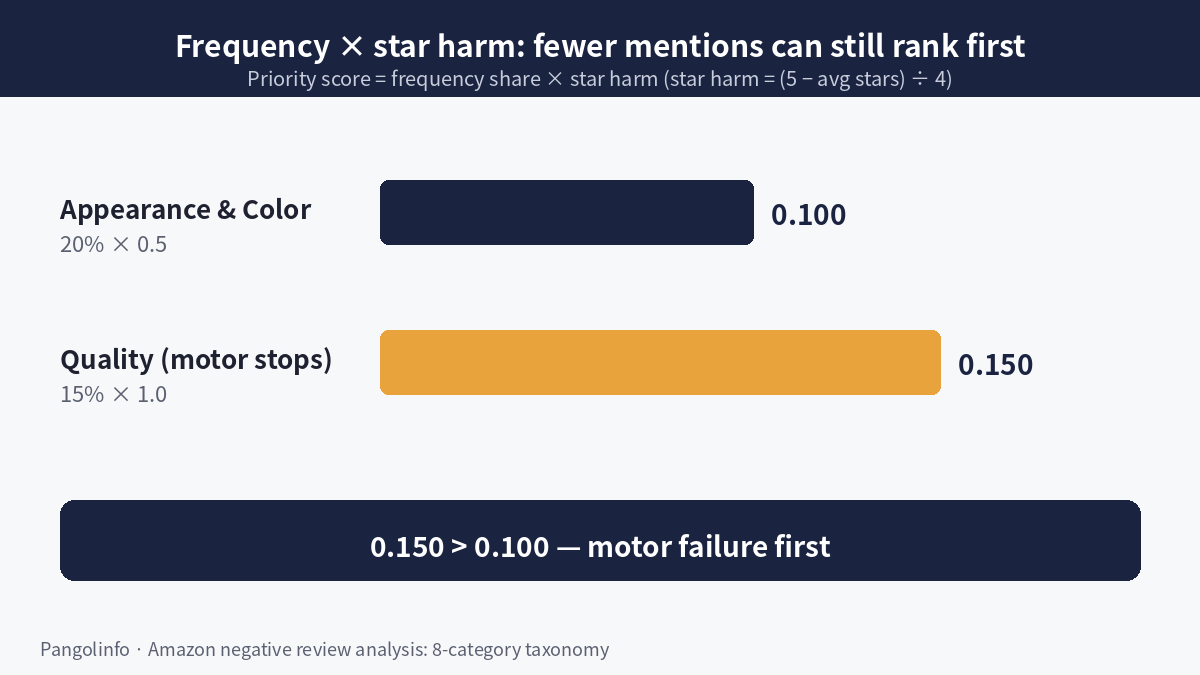
The Star-Harm Coefficient Formula and Worked Comparison
To combine volume and severity into a single auditable ranking metric, calculate the Star-Harm Coefficient for each classified issue cluster using this exact formula:
Priority Score = Frequency Share × Star Harm
Frequency Share = Mentions in Category ÷ Total Negative Reviews Sampled (n)
Star Harm = (5 − Average Stars) ÷ 4
This is a transparent heuristic coefficient, not a statistical model.
This linear normalization maps average star ratings onto a clean 0.5 to 1.0 severity scale:
-
An issue cluster with an average rating of 1.0 star yields a star harm of 1.0 (maximum rating destruction).
An issue cluster with an average rating of 2.0 stars yields a star harm of 0.75.
An issue cluster with an average rating of 3.0 stars yields a star harm of 0.5 (moderate reservation).
Next, multiply the cluster’s Frequency Share (decimal) by its Star Harm to compute the Priority Score:
Worked Comparison ( Negative Reviews):
Suppose an audit of negative reviews surfaces two competing operational tickets:
-
Appearance & Color (shade slightly darker than listing photos):
- Mentions: 12 reviews Frequency Share = 12/60 = 20% (0.20)
Average Rating: 3.0 stars Star Harm 0.5
Priority Score: 0.100
Quality (motor stops running after two weeks):
Mentions: 9 reviews Frequency Share = 9/60 = 15% (0.15)
Average Rating: 1.0 star Star Harm 1.0
Priority Score: 0.150
Even though Appearance & Color appeared in more reviews (12 vs. 9), Quality (motor stops) achieves a 50% higher Priority Score (0.150 vs. 0.100) because every single motor failure inflicted maximum 1.0-star harm, whereas the color discrepancy was tolerated as a 3.0-star reservation. Engineering takes P1 priority over studio reshooting.
The P0 Override Rule for Safety & Health
Safety & Health is ALWAYS listed separately as P0 regardless of frequency or calculated Priority Score.
Mathematical weighting fails on low-frequency, high-consequence hazards. In a 50-review sample (n = 50), a single review reporting an overheating power cord or sharp metal edge represents only 2% frequency (1/50). Even at a 1.0-star rating (star harm 1.0), its mathematical score would be just 0.02 —placing it below routine manual or packaging complaints.
Treating a safety signal as a low-priority backlog item exposes buyers to physical injury and exposes the brand to CPSC recalls, product-liability claims, and immediate Amazon ASIN suspension. Any verified Safety & Health complaint bypasses the scoring formula entirely and triggers an immediate P0 quarantine and compliance investigation before P1 engineering or listing work begins.
| Priority Tier |
Selection Rule |
Illustrative Cluster (n=60) |
Frequency Share |
Avg Stars |
Star Harm |
Priority Score |
Action SLA |
|---|---|---|---|---|---|---|---|
| P0 (Override) |
Any Safety & Health mention |
Plug housing overheats (1 mention) | 1.7% (1/60) | 1.0 | 1.00 | Override (0.017) |
Immediate containment & QA hold |
| P1 (Top Score) |
Highest Freq × Star Harm | Quality: Motor stops (9 mentions) | 15.0% (9/60) | 1.0 | 1.00 | 0.150 |
Immediate root-cause CAPA |
| P2 (Second) |
Second-highest score | Appearance & Color: Shade variance (12 mentions) | 20.0% (12/60) | 3.0 | 0.50 | 0.100 |
Scheduled creative/listing update |
| P3 (Third) |
Third-highest score | Instructions & UX: Pairing steps unclear (8 mentions) | 13.3% (8/60) | 2.5 | 0.625 | 0.083 |
Next manual & A+ revision |
Step 4: Execute a 5 Whys Root-Cause Analysis on Top Failure Clusters
Applying the 5 Whys methodology transforms surface-level review symptoms into verifiable engineering, packaging, and listing interventions by tracing buyer complaints back to their upstream manufacturing and communication triggers.
When teams skip root-cause analysis and act directly on the surface complaint (“buyers say the pump broke order stronger pumps”), they waste capital fixing components that were never broken while leaving the true failure mechanism untouched. Every P0 and P1 cluster must pass through a structured 5 Whys investigation combining returned-unit teardown, listing audit, and factory bill-of-materials (BOM) verification.
Worked Case Study: Portable Espresso Machine (“Stopped Producing Water After a Week”)
Consider an actual diagnostic scenario on a portable electric espresso machine:
-
Baseline Audit Metrics: Out of 65 negative reviews collected on the child ASIN, 18 reviews (27.7%, average 1.3 stars) reported the exact same failure pattern: “Stopped producing water after a week, just buzzing.”
Priority Calculation: Star harm 0.925; Priority Score 0.256 (clear P1 defect).
At first glance, customer support logged all 18 complaints as “defective water pump.” Running a disciplined 5 Whys teardown revealed a completely different chain of causation:
-
Why 1 — Why did the unit stop producing water and only make a buzzing sound after a week? Teardown inspection of returned units proved the electric pump motor was intact and spinning normally; instead, the one-way silicone inlet valve was completely blocked by compacted fine coffee grounds.
Why 2 — Why did fine coffee grounds enter and clog the one-way inlet valve? Buyers were loading Turkish (extra-fine) grind coffee and overfilling the filter basket, creating excessive extraction resistance that forced pressurized water and coffee fines backward into the one-way inlet valve.
Why 3 — Why did buyers overfill the filter basket and miss the capacity limit? The MAX fill line molded inside the black plastic filter basket is a same-color dark print, making it nearly invisible under normal indoor kitchen lighting, and no dosing spoon was included in the box to standardize coffee load volume.
Why 4 — Why didn’t buyers know to avoid extra-fine grind and stay below the MAX line? The grind-size and fill-level warning sits buried on page 14 of a 24-page black-and-white user manual, while listing image 4 on the Amazon product detail page displays a misleading close-up of extra-fine powder being tamped flush to the rim of the basket.
Why 5 — Why did the filter basket suddenly allow fines to pass backward when earlier production lots rarely failed? Factory BOM audit revealed that last month the supplier cut unit manufacturing costs by $0.15 by quietly switching the double sintered stainless-steel filter mesh to a single punched metal mesh, halving backflow filtration tolerance—which caused the complaint frequency for “just buzzing / no water” to jump from 8% to 27.7% within weeks of the new batch hitting FBA.
Multi-Team Action Rollout Across 48-Hour, 7-Day, and Next-Batch Horizons
Notice how the 5 Whys investigation proves that no single department owns the entire fix. While engineering restores the hardware filter for the next factory run, operations and packaging must immediately protect buyers purchasing existing FBA inventory:
-
Operations & Listing Team (Within 48 Hours):
- Remove and replace listing image 4 with an accurate, clearly labeled medium-fine grind comparison graphic showing proper headspace below the rim.
Publish a 15-second valve-rinsing and grind-size animation inside A+ Content and update bullet-point copy so buyers—and Alexa for Shopping summaries—receive accurate grind compatibility guidance prior to purchase.
Packaging & Warehouse Prep Team (Within 7 Days):
Apply a bright yellow high-contrast MAX fill sticker onto the basket sleeve/insert across existing warehouse stock awaiting FBA check-in.
Drop a standard 8g measuring dosing spoon into every unit box so buyers naturally dose the exact single-shot volume without guessing.
Engineering & Procurement Team (Next Production Batch):
Reverse the unauthorized $0.15 cost-down by restoring the double sintered stainless-steel filter mesh to full specification.
Update the injection-mold secondary tooling to add a high-contrast white laser-etched MAX line inside the basket wall so the fill limit remains permanently legible after hundreds of washes.
Step 5: Enforce Compliance Boundaries and Track 30-Day Recovery
Sustainable rating recovery depends on strict adherence to FTC and Amazon review-integrity rules paired with disciplined 30-day cohort tracking that measures post-fix complaint share against pre-fix baselines.
Fixing the product and detail page solves the operational root cause, but teams sometimes undo their progress—or jeopardize their entire seller account—by attempting shortcuts to erase historical 1-star reviews.
Strict Legal and Marketplace Compliance Boundaries (FTC 16 CFR Part 465)
Every post-audit customer service workflow, product insert, and buyer-seller message must obey three non-negotiable compliance rules enforced under Amazon’s Customer Reviews Policy and the FTC Consumer Review Rule (16 CFR Part 465):
-
Never induce review changes: Never offer refunds, gift cards, rebates, extended warranties, or free replacement units conditioned on a buyer editing, updating, or deleting a negative review. Even suggestive phrasing (“We’d love to send a replacement if you can reconsider your 1-star rating”) violates policy.
Never contact reviewers outside approved channels: Never match order IDs to public reviewer profiles to email, call, or message unhappy reviewers asking them to revise their feedback, and never include product inserts that selectively divert dissatisfied buyers away from leaving public reviews.
Never suppress negative reviews: Never practice review gating (filtering customers through a pre-review sentiment check so only happy buyers reach Amazon), never selectively suppress critical feedback on brand-owned storefronts, and never file bad-faith abuse reports to remove legitimate 1- to 3-star reviews.
Violations of FTC 16 CFR Part 465 carry civil penalties of up to $53,088 per violation, in addition to permanent Amazon selling-privilege revocation and ASIN removal. Furthermore, because Amazon’s 2026 variant review sharing split prevents brands from burying damaged child ASINs inside high-volume parent listings, shipping authentic physical and listing fixes is the only compliant, durable way to recover conversion and star ratings.
Recovery-Tracking Work Order Template
Track every corrective action in a centralized work-order ledger so leadership can verify whether each intervention actually reduced complaint incidence in post-fix buyer cohorts.
When measuring the 30-Day Recheck Share, filter your review extraction strictly by review_date beginning after the effective date (plus a realistic FBA inventory sell-through buffer for physical packaging or hardware changes) so legacy unfixed units still sitting in fulfillment centers do not distort your post-fix denominator.
| Category |
Root Cause |
Fix |
Owner |
Effective Date |
Baseline Share |
30-Day Recheck Share |
Status |
|---|---|---|---|---|---|---|---|
| Quality / Instructions & UX |
Valve clogged by fines due to single punched mesh ($0.15 cost-down), invisible black MAX line, & misleading image 4 | Replace image 4 & add A+ cleaning animation (48h); add yellow MAX sticker & 8g spoon (7d); restore double sintered mesh & white laser MAX line (next batch) | Listing Ops / Packaging / Mfg Eng | 2027-01-15 (Listing) / 2027-01-22 (Pack) / 2027-03-01 (Batch) | 27.7% (18/65) | 6.3% (3/48 post-fix cohort) | Verified Closed |
| Safety & Health (P0) |
Molded strain-relief collar pinched internal wire on 2% of Batch #4 units | Quarantine remaining Batch #4 FBA stock; add 100% hi-pot & pull-test gate at factory before shipment | Compliance & QA Lead | 2027-01-10 | 1.5% (1/65) | 0.0% (0/48 post-fix cohort) | Verified Closed |
| Appearance & Color |
Studio key-light overexposed brushed bronze finish, making it look pale champagne | Reshoot main & lifestyle images under 5000K calibrated daylight; add real-hand scale photo | Creative & Brand Lead | 2027-01-18 | 18.5% (12/65) | 4.2% (2/48 post-fix cohort) | Verified Closed |
| Installation & Compatibility |
Buyers attempting to use 220V European adapters without step-down transformer | Add bold 110V–120V North America badge to image 2, bullet 1, and compatibility chart | Pre-Sales Listing Ops | 2027-01-20 | 9.2% (6/65) | 2.1% (1/48 post-fix cohort) | Monitoring |
Closing the Loop With Reliable Review Ingestion
Executing this five-step negative-review diagnostic framework every month presupposes solving structured review acquisition first. When product and operations teams have to manually click through paginated review screens, copy-paste text into spreadsheets, and hand-tag child ASINs across five competitors, 30-day cohort rechecks quickly fall behind schedule.
Automating clean, repeatable review collection—capturing exact star ratings, child-ASIN variant attributes, review dates, and verified-purchase flags—lets your team spend its hours on 5 Whys engineering and listing improvements rather than manual data entry. If your pipeline needs structured programmatic collection across target ASINs and competitor sets, explore the Pangolinfo Amazon Review API (for current plans and usage tiers, check the official checkout page). To integrate this negative-review workflow into your broader monthly review cadence, return to How to Analyze Amazon Reviews: A Complete SOP (2027) or review our technical extraction guide on how to scrape Amazon reviews for complaint analysis. (See the Review API reference docs.)
Hands-on practice: StepThrough’s free interactive lesson walks through pulling only the critical reviews of your own product with the Amazon Review API, reading the variant and Verified Purchase on each one, and ranking the complaints into a fix list (about 6 minutes, in English).
Frequently Asked Questions About Analyzing Amazon Negative Reviews
The following answers address the most common methodological, statistical, and compliance questions teams encounter when auditing 1- to 3-star Amazon reviews.
1. Why should I include 3-star reviews when analyzing Amazon negative reviews?
Three-star reviews carry the highest diagnostic information density in your entire review corpus. While 1-star reviewers often write brief, emotional complaints (“broke immediately, waste of money”) that confirm failure without explaining the mechanism, 3-star reviewers are typically rational evaluators who kept—or nearly kept—the product. They systematically explain both what worked well and the exact friction point, missing accessory, or usability flaw that stopped them from awarding 4 or 5 stars. Including 3-star reviews uncovers conversion-killing reservations that Alexa for Shopping surfaces to comparison shoppers.
2. Is a sample of 50 negative reviews statistically significant?
No. Collecting 50+ negative reviews is a practical operational starting point for qualitative theme saturation—meaning major recurring defects will usually repeat enough times for engineering and listing teams to spot clear patterns—not a statistically significant confidence interval. Always document your exact sample size (n), the total review denominator, the collection date window, and the specific child ASIN (especially after Amazon’s 2026 variant review sharing split) so stakeholders never mistake directional theme shares for population-wide statistical proof.
3. How does the star-harm formula prioritize low-frequency defects over common minor complaints?
The star-harm coefficient, (5 − Average Stars) / 4, scales severity from 0.5 (for a 3.0-star average) up to 1.0 (for a 1.0-star average). Multiplying frequency share by star harm prevents mild cosmetic gripes from outranking severe functional failures. For example, if 20% of negative reviews cite a minor color variance averaging 3.0 stars (score 0.10), a motor failure cited by 15% of negative reviews at 1.0 star (score 0.15) still ranks higher. Any Safety & Health mention overrides the formula completely as P0.
4. Can I offer a replacement unit or refund to get a buyer to update a 1-star review?
No. Offering a refund, replacement product, gift card, or discount conditioned on a buyer editing, updating, or removing a negative review violates both Amazon’s Customer Reviews Policy and the FTC Consumer Review Rule (16 CFR Part 465), which carries civil penalties of up to $53,088 per violation. You may provide standard, unconditional customer support through official buyer-seller messaging to resolve a product issue, but you must never ask the buyer to change their review or selectively divert unhappy buyers away from leaving public feedback.
5. How did Amazon’s 2026 variant review sharing split change negative-review analysis?
Between February 12 and May 31, 2026, Amazon rolled out category-by-category rules restricting review sharing across child variations that differ in functional attributes or configurations. Previously, a flawed secondary size or flavor could hide behind thousands of positive reviews pooled under a parent ASIN. Now, 1- to 3-star complaints accumulate directly on the affected child ASIN’s detail page, requiring analysts to isolate child-ASIN denominators, track variant-specific return triggers, and pool competitor ASINs when auditing newly split low-volume variations.