
Series Navigation — The 2026 Quantitative Amazon Product Research Series:
– Part 1 (Pillar Blueprint): The 6-Stage Amazon Niche Discovery Workflow
– Part 2 (Macro Data Deep Dive): Amazon Product Opportunity Explorer vs. Niche API
– Part 3 (You Are Here — Micro Validation Deep Dive): Amazon Competitor Review Analysis & Live SERP Audit
– Part 4 (AI & GEO Automation): AI Amazon Product Research Workflow with MCP & GEO
Once you have narrowed down a shortlist of 10–20 promising markets using programmatic macro filtering across 50+ niche metrics, you enter the most critical phase of the Amazon niche discovery workflow blueprint: Stage 3 (Live SERP Audit) and Stage 4 (Bulk VOC Review Mining).
Why do so many products that look profitable on a spreadsheet fail within 60 days of launch? Almost always for one of two reasons:
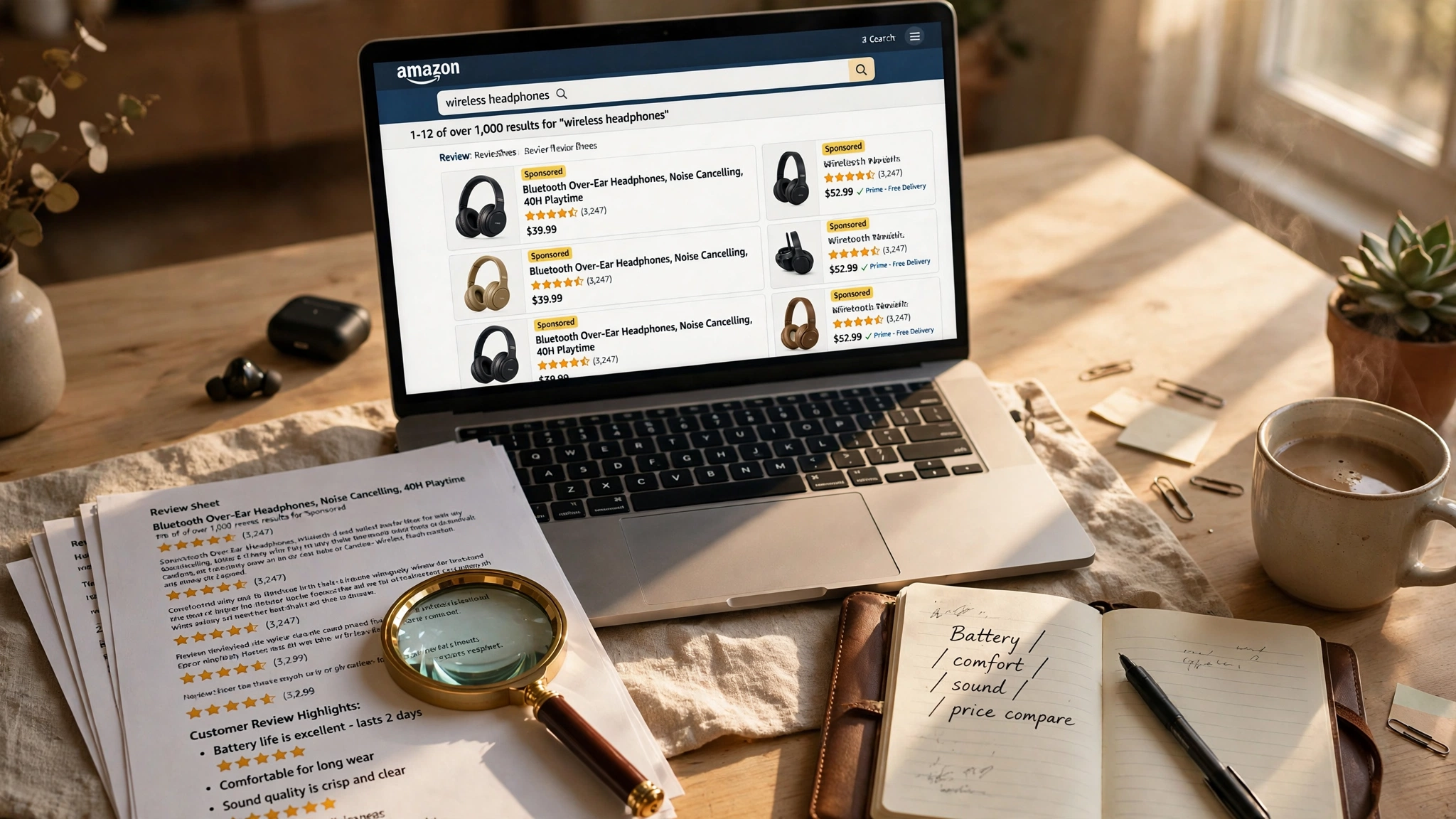
1. The Hidden PPC Tax: The niche looked unconsolidated in historical data, but on the live front-end search page, 70% of above-the-fold slots are dominated by aggressive Sponsored Products (SP) and video ads.
2. The “Me-Too” Trap: The seller sourced an identical off-the-shelf product after reading only 10 reviews, missing a recurring structural flaw that plagues every top seller in the niche.
Here is how to run a rigorous Amazon competitor review analysis & SERP audit using Pangolinfo’s Amazon Scraper API, Amazon Review API, and VOC Insight MCP.
Part 1: The Live SERP Audit (Why Generic Scrapers Lie to You)
When you manually check an Amazon keyword from an office IP—or use a generic web scraper routed through datacenter proxies—the Search Engine Results Page (SERP) you see is heavily distorted.
Amazon dynamically alters organic rankings, Buy Box winners, Prime delivery badges, and ad placements based on the shopper’s physical delivery ZIP code. Furthermore, Amazon renders Sponsored Products (SP) and Sponsored Brands (SB) via complex asynchronous GraphQL requests and obfuscated DOM elements—causing legacy scraping tools to miss over 40% of paid ad slots.
How to Run a ZIP-Isolated SERP Audit with 98% SP Ad Detection
By querying the Amazon Scraper API (technical specs at Pangolinfo Developer Docs), your request is routed through a pool of millions of real residential proxies with explicit postal-code targeting:
- Test Coastal & Central US Postal Codes Simultaneously: Pass
10001(New York),90001(Los Angeles), and60601(Chicago) for your niche’s top 5 seed keywords. - Calculate True Above-the-Fold Ad Density (
is_sponsored): Pangolinfo’s deep rendering engine achieves a 96%–98%+ Sponsored Products capture rate, tagging every listing with an explicit placement boolean.
– Rule of Thumb: If> 60%of the top 8 slots on Page 1 are paid placements across all tested ZIP codes, classify the niche as a Paid-Entry Battlefield and build a higher launch TACoS buffer into your margin model. - Spot Regional FBA Stockouts & Price Dispersion: Compare the
price,prime_flag, and delivery promise across ZIP codes. When top incumbents show delayed shipping or out-of-stock signals on the East or West Coast, regional FBA inventory placement gives your new launch an immediate conversion edge. - Harvest
Related Searchesfor Long-Tail Entry: Extract the bottom-of-page related search clusters from the SERP JSON to uncover high-intent 4–5 word phrases where PPC bids are half the cost of head terms.
Part 2: Bulk Competitor Review Analysis & Defect Reverse-Engineering
Reading the top 10 reviews on an Amazon page is one of the most expensive mistakes in e-commerce. Amazon’s default sort (“Top Reviews”) skews heavily toward older, 5-star reviews with high helpful votes—hiding recent manufacturing quality drops or design flaws.
To engineer a genuinely differentiated product, you need statistically significant Voice of the Customer (VOC) data pulled from recent 1-star, 2-star, and 3-star Verified Purchase reviews.
Step 1: Extract Structured Reviews & Customer Says via API
Using the Amazon Review API (see the Review API Reference), initiate a background collection task for the top 10 BSR competitors in your shortlisted niche. Unlike basic scrapers that only grab raw text, Pangolinfo extracts:
- Full Verified Purchase Review Text & Timestamps: Filter specifically for the last 90–180 days to catch active supply-chain or material failures.
- Star Rating Distribution & Helpful Vote Counts: Weight complaints by how many other buyers upvoted the exact same frustration.
- User-Generated Images & Videos: Inspect real-world failure modes (e.g., broken hinges, leaked packaging, color fading).
- Amazon’s Native
Customer SaysAI Summary: Pangolinfo is one of the very few data providers capable of extracting Amazon’s front-endCustomer Sayssentiment tags and aspect-level drill-downs in clean JSON.
Step 2: Build a Quantitative Defect Matrix (The ≥8% Rule)
Feed the structured JSON output from the Amazon Review API—or connect VOC Insight MCP directly to Claude or GPT-4o—to categorize every negative review into five engineering buckets:
| Defect Category | Example Complaint Pattern (Silicone Stretch Lids Niche) | Mention Share in 1–3★ Reviews | Actionable Product Spec / Launch Hook |
|---|---|---|---|
| 1. Structural / Fit Failure | “Lids slip off bowls larger than 9 inches when wet” | 14.2% (Primary Gap) | Add an inner anti-slip ribbed silicone grip ring; show wet-bowl grip test in Main Image & Video |
| 2. Material Durability | “Tears near the pull-tab after 3 dishwasher cycles” | 9.6% (Secondary Gap) | Upgrade from 0.8mm to 1.5mm food-grade platinum silicone with reinforced pull-tabs |
| 3. Sizing / Expectation Mismatch | “Smallest lid is too tiny for standard soda cans” | 6.4% | Replace the unused 2.5-inch mini lid with a second 6.5-inch medium lid (most used size) |
| 4. Packaging / Arrival Damage | “Arrived stuck together with chemical smell” | 4.1% | Pre-bake silicone at factory to remove odor; separate lids with parchment dividers |
The ≥8% Engineering Threshold: Whenever a single remediable structural or material complaint appears in 8% or more of critical reviews across multiple top-10 competitors, you have mathematical proof of an underserved customer need.
Connecting Micro Validation to Full AI Workflow Automation
Combining a ZIP-isolated SERP audit via Amazon Scraper API with deep defect mining via Amazon Review API transforms product selection from a gamble into an engineering discipline.
Want to run this entire SERP + VOC loop automatically without writing glue code? In Part 4 of our series, we show you how to build an AI Amazon product research workflow using MCP and GEO checks—where your AI agent chains niche filtering, review clustering, Google AI Overview checks, and WIPO patent screening in a single conversation. Or head straight to Pangolinfo to claim your free testing credits today!