
In the complete lifecycle of e-commerce operations, product development, and competitive intelligence, every advanced analytical technique—whether executing defect attribution, performing negative-review root-cause diagnosis, or tracking variant-level sentiment trends—depends entirely on the structural integrity of your underlying data. You cannot analyze reviews you cannot obtain, and building strategic product roadmaps on fragmented or algorithmically distorted frontend datasets guarantees flawed business decisions that will eventually cost your brand significant market share and capital.
In our series pillar guide, How to Analyze Amazon Reviews: A Complete SOP (2027), we defined the overarching six-step analytical workflow and the precise 14-field data schema required for professional analysis. We explored critical defect triage in How to Analyze Amazon Negative Reviews, assessed commercial extraction platforms in Best Amazon Review Analysis Tools Compared, and established rigorous data-credibility boundaries in Why Amazon Review Analysis Misleads. Most recently, we decoded platform visibility shifts in Amazon AI Review Summaries & Alexa for Shopping and detailed offensive market strategies in Competitor Review Analysis on Amazon.
This seventh and final installment brings the series back to the foundational prerequisite of all e-commerce intelligence: data acquisition. By utilizing the Pangolinfo Review API, we will establish an analysis-grade standard operating procedure (SOP) that transitions your team from executing manual, biased browser checks to managing a compliant, reproducible, and fully structured Amazon review corpus ready for enterprise deployment.
Why Data Acquisition Must Come First: The Danger of Frontend Sorting
Relying on manual browser navigation or superficial frontend scraping extensions yields a heavily biased, algorithmically sorted subset of customer feedback, making a dedicated API connection the only reliable method for retrieving a complete and accurate metadata corpus.
When product managers, marketing teams, or data analysts attempt to audit an ASIN by manually scrolling through Amazon’s product detail page, they are interacting with a curated presentation layer designed specifically to maximize retail conversion, not to facilitate objective engineering diagnostics. Amazon’s default frontend view prioritizes “Top Reviews,” a proprietary and dynamic sorting mechanism that heavily weights historical helpful-vote counts, media attachments, and long-term engagement velocity over strict chronological relevance.
This algorithmic curation creates a dangerous illusion of reality for internal teams who mistake the first page of reviews for the current state of the product. Consequently, a highly upvoted, exceptionally detailed 3-star review describing a manufacturing defect from two years ago may remain permanently anchored to the top of page one, dominating the narrative. Meanwhile, fifty recent 1-star reviews documenting a sudden, critical failure in last week’s production batch remain completely buried on page seventeen, invisible to the casual observer. A product team relying on the first two pages of the frontend interface would conclude the product is perfectly fine, completely missing the active supply chain crisis unfolding beneath the algorithmic surface.
Furthermore, manual collection invariably strips away the hidden structural metadata that makes advanced, cohort-based analysis possible. A product researcher copying and pasting text into a spreadsheet routinely loses the exact timestamp, the specific child-ASIN variant string, the reviewer’s historical profile parameters, and the critical Verified Purchase marker. Without this metadata, analysts cannot separate authentic buyers from unverified noise, nor can they determine if a complaint applies to the new version of a product or an obsolete model.
To conduct professional 5 Whys root-cause analysis or to track precise 30-day post-fix recovery metrics for your manufacturing team, operations departments require un-truncated access to the chronological truth of the listing. Because you cannot analyze what you cannot obtain, establishing a robust, API-driven data acquisition pipeline must always precede any deployment of sentiment modeling, topic clustering, or executive reporting. Only an API returns the complete, structured metadata corpus required to filter noise, isolate specific variations, and measure authentic buyer intent accurately over time.
Pangolinfo Review API: Verified Product Facts and Technical Architecture
The Pangolinfo Amazon Reviews Scraper API provides direct programmatic access to real-time structured JSON review data, governed by a transparent credit economy and straightforward REST architecture that eliminates the need for internal scraper maintenance.
Before deploying an enterprise-grade extraction pipeline, engineering and data teams must understand the exact capabilities, payload structures, and budgetary constraints of their extraction tools to avoid mid-project failures. Attempting to build an in-house scraper often results in broken pipelines due to constant frontend layout shifts, making a managed API the industry standard for stable intelligence. The following parameters represent the verified operational facts for the Pangolinfo Review API in 2027.
Authentication and Endpoint Architecture
The service operates on a standard REST architecture designed for seamless, language-agnostic integration into modern data pipelines, whether orchestrated via Python scripts, Apache Airflow workflows, or custom internal business intelligence dashboards.
-
Target Endpoint: The core extraction engine is accessed via a POST request to [https://scrapeapi.pangolinfo.com/api/v1/scrape](https://scrapeapi.pangolinfo.com/api/v1/scrape). This centralized endpoint ensures that your requests are routed securely through robust proxy networks that handle the heavy lifting of bypassing bot protections and rendering dynamic content.
Authentication Security: The API utilizes standard Bearer authentication. Your secret API key is passed securely in the HTTP request headers as a Bearer Token. This industry-standard approach ensures encrypted, authenticated communication without exposing vulnerable credentials in the URL parameters, protecting your enterprise access keys from accidental logging, interception, or exposure.
Real-Time Structured JSON and Field Completeness
Unlike basic HTML scrapers that require constant engineering maintenance to survive Amazon’s frequent Document Object Model (DOM) changes, the Pangolinfo Amazon Reviews Scraper API handles the underlying parsing complexity entirely on its backend and returns real-time structured JSON review data. The payload is explicitly designed for analytical readiness, delivering the exact fields required by the 14-field schema established in our pillar article.
The returned data fields reliably include:
-
Full review text: Un-truncated buyer prose, capturing both brief, single-sentence complaints and exhaustive, multi-paragraph product evaluations without arbitrary character limits or “read more” truncations.
Star rating: The exact numerical rating (1 through 5) assigned by the buyer, which is essential for calculating the star-harm coefficients used in defect prioritization.
Verified Purchase flag: A strict boolean indicator separating verified transactions from unverified submissions, allowing analysts to filter out unverified noise and focus exclusively on the verified text that feeds Amazon’s AI review summaries.
Helpful-vote counts: The cumulative engagement metric for each review, which helps determine how strongly a specific complaint resonates with the broader shopping audience and signals its likelihood of climbing the default sort order.
Reviewer profiles: Metadata identifying the reviewing account, which is absolutely essential for spotting cross-listing manipulation patterns, identifying incentivized reviewer networks, or flagging serial returning behaviors.
Credit Economics and Capacity Benchmarks
Data acquisition strategies must be mapped against transparent budgetary rules to prevent unexpected operational expenses and script interruptions. The Pangolinfo Review API operates on a predictable, credit-based consumption model designed to align costs directly with data volume:
-
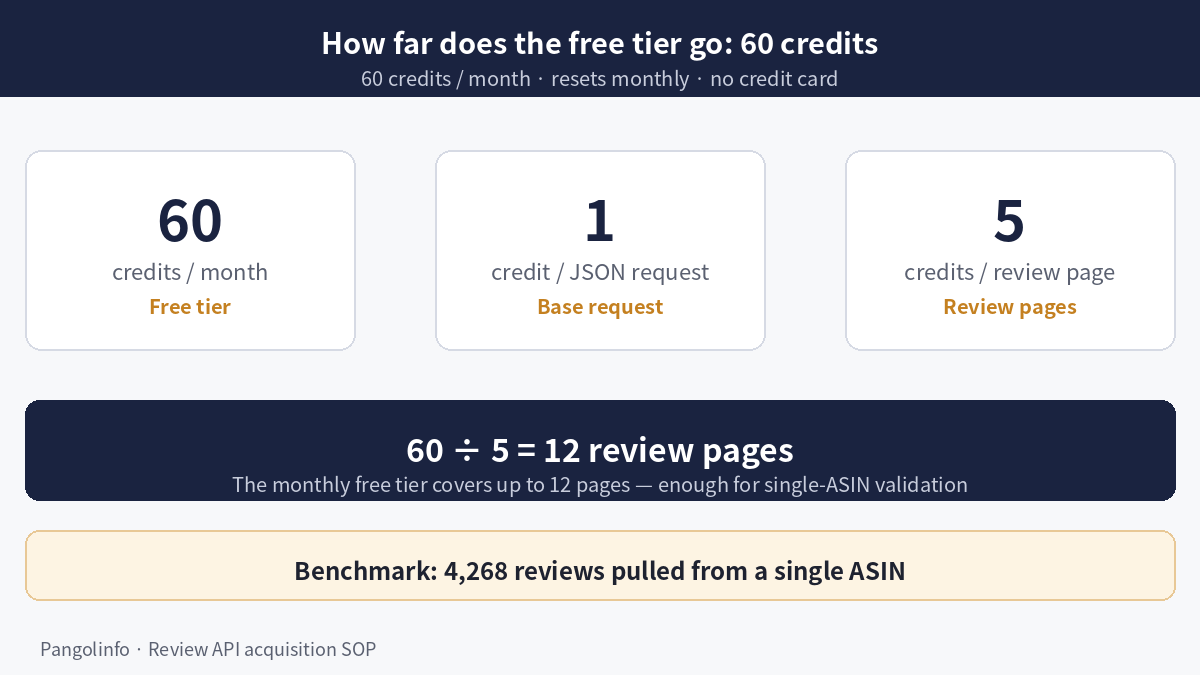
JSON Request Cost: A standard JSON extraction request consumes exactly 1 credit.
Reviews Endpoint Pagination Cost: When specifically querying the reviews endpoint to pull paginated lists of customer feedback (which requires deep traversal of Amazon’s pagination structures and intensive proxy routing), the cost is 5 credits per page.
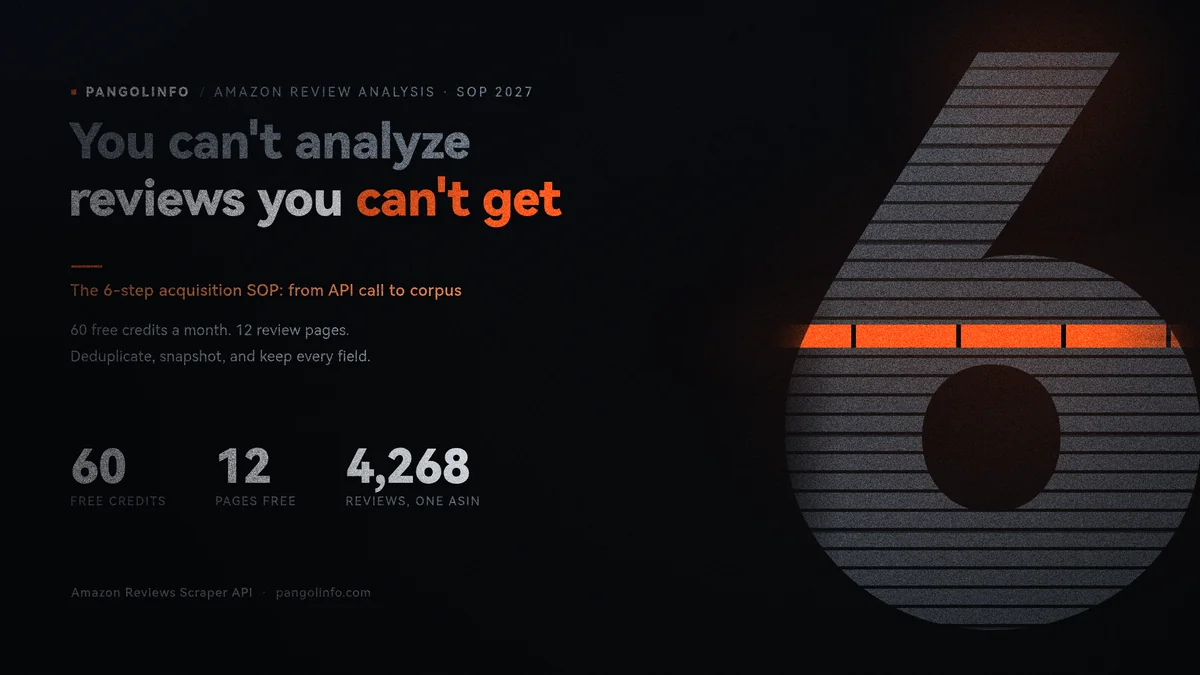
Free Tier Allowance: For developers, academic researchers, and new enterprise teams validating their pipeline architecture, the platform offers a free tier of 60 credits per month. This free tier automatically resets monthly. Based on the specific pagination cost, the 60-credit free tier perfectly covers the extraction of 12 pages of reviews per month (12 pages × 5 credits = 60 credits). This provides ample volume to test ingestion scripts, validate data mapping, and audit low-volume listings.
Enterprise Scaling and Measurement: For established brands requiring deep historical extraction across massive catalogs, the API scales elastically to meet extreme listing volumes without breaking. In rigorous benchmark testing, the API successfully retrieved and structured a measured total of 4,268 reviews from a single ASIN in a continuous, uninterrupted extraction run. (For enterprise users exceeding the free tier, advanced concurrency and volume limits apply; for specific paid-tier limits and current pricing models, please check the official checkout page).
The 6-Step Acquisition SOP: From API Call to Analysis-Ready Corpus
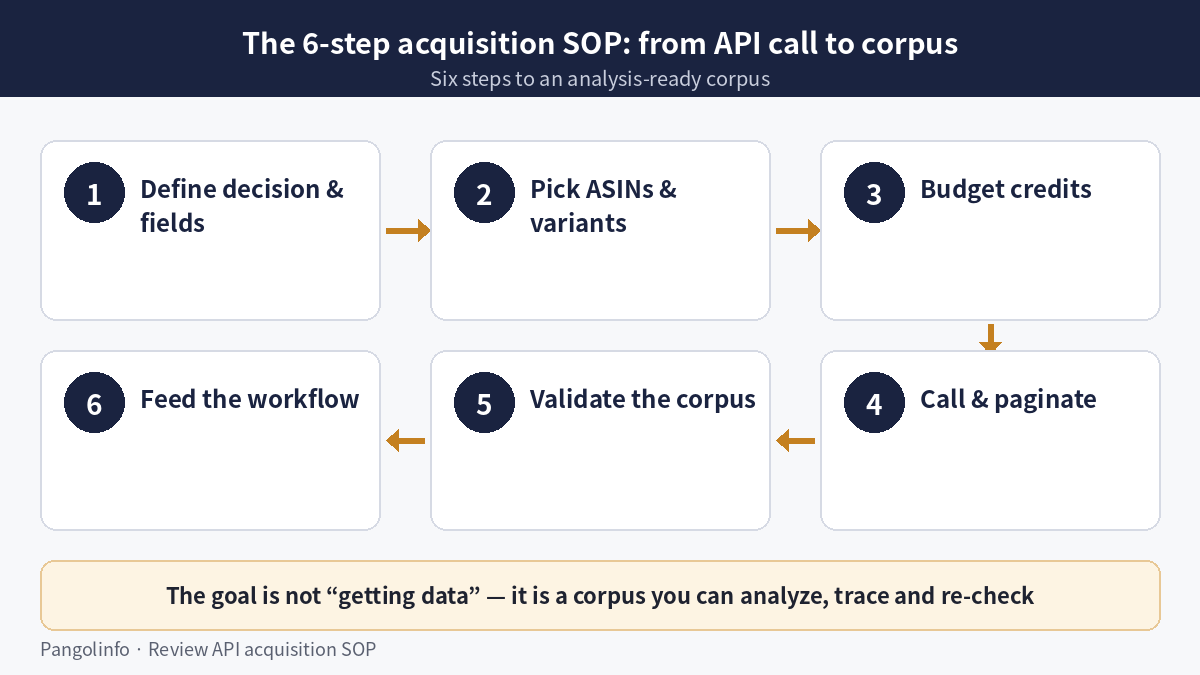
An analysis-grade acquisition process requires meticulous planning around field definitions, strict child-ASIN isolation, precise credit budgeting, and rigorous post-extraction validation before the data ever reaches the product team.
Transforming a raw API endpoint into a trusted business intelligence asset requires operational discipline. Data engineers and e-commerce analysts should follow this six-step standard operating procedure to ensure their resulting corpus is clean, reproducible, legally compliant, and ready for immediate deployment into downstream dashboards.
Step 1: Define the Analysis Decision and Required Fields
Data extraction should never occur in a vacuum; it must be driven by a specific, highly defined business question. Before writing a single line of Python or triggering an automated workflow, the data engineering team must align directly with product managers on the required outputs and intended business decisions. Will the data be used to track the impact of a recent packaging upgrade? Will it be used to detect fake reviews on a top competitor’s newly launched listing? Will it be used to feed a natural language processing model for attribute extraction?
This alignment phase is critical because cross-functional teams often require entirely different slices of the metadata. Your quality assurance engineers might need raw text and dates to diagnose a mechanical flaw, while your brand managers might only care about tracking the Verified Purchase flag to measure the impact of a recent post-purchase insert campaign. Based on the agreed-upon business goal, map the API’s JSON output directly to the 14-field data schema introduced in the series pillar article (How to Analyze Amazon Reviews: A Complete SOP (2027)). By getting all stakeholders to agree on the required fields upfront, you eliminate the need to run duplicate extraction jobs, thereby preserving your API credits and ensuring a single source of truth across the organization.
Step 2: Pick ASINs and Variations (The Post-Split Reality)
As detailed extensively in our 2026 platform update guides, Amazon executed a massive, highly disruptive variant review sharing split between February 12 and May 31, 2026. This foundational platform update structurally isolated review pools across child ASINs that possess functional, dimensional, or capacity differences, permanently preventing them from sharing a single, aggregated parent rating.
Consequently, you must configure your API payload to target single child ASINs. Sending a parent ASIN through the extraction pipeline will result in fragmented, diluted data that masks acute defect clusters belonging to specific variations. Failing to respect this isolation rule creates immediate chaos for supply chain managers. Imagine pulling blended parent-level data and discovering a 15 percent complaint rate about a loose threaded cap. If that parent ASIN contains five different bottle sizes, your engineering team has no idea which specific injection mold actually needs to be retooled. By strictly targeting the 10-digit child ASIN corresponding to the exact size and color combination you are investigating, you guarantee that subsequent engineering recommendations apply accurately to the correct factory bill of materials, saving weeks of wasted diagnostic time.
Step 3: Budget Credits for Deep Extraction
Predictable data operations require careful API credit management. Before initiating a scraping loop that could potentially run for hours and consume significant resources, calculate the required depth of your extraction. If a target child ASIN has 500 total reviews, and Amazon displays 10 reviews per page on the frontend architecture, you will need to traverse roughly 50 pages to acquire the complete historical set.
At 5 credits per page, a 50-page extraction will cost 250 credits. Data engineers should program their scripts to calculate this expected budget dynamically and include logical circuit breakers to prevent runaway loops in the event of unexpected frontend behavior. Furthermore, always budget additional credit headroom (roughly 10 to 15 percent) to account for necessary re-runs due to network latency, deduplication checks, and the essential archiving of weekly or monthly snapshots. Never execute an open-ended while loop without a predefined page limit or a hard credit ceiling written directly into your script.
Step 4: Call and Paginate (Deduplicate and Snapshot)
With the target ASIN isolated and the computational budget approved, execute the API calls. The core programming logic involves requesting the first page, extracting the structured JSON into your local environment, and systematically incrementing the page parameter to traverse the historical review base until the final page is reached.
Because Amazon’s frontend caches constantly update and re-index across global servers, reviews occasionally shift between pages during a live, multi-page extraction run. This phenomenon occurs because Amazon’s infrastructure relies on distributed AWS servers; as load balancers route your sequential page requests, a review from page three might temporarily shift to page four. To combat this moving target, your data pipeline must aggressively deduplicate the incoming payload using the unique review ID provided in the API response. Failing to execute this deduplication step will artificially inflate your complaint frequencies, leading your team to overestimate the severity of a defect. Once deduplicated, the raw JSON payload must be saved to your data warehouse or cloud storage bucket as an immutable snapshot, tagged with the exact timestamp of the extraction. Storing static snapshots ensures you can reproduce historical metrics even after Amazon deletes old reviews.
Step 5: Validate the Corpus Against the Credibility Checklist
Data must be quarantined and validated before it is released to business analysts or executive dashboards. A corrupted dataset that bypasses validation will lead directly to costly manufacturing mistakes and misguided marketing campaigns. To prevent this, data engineering teams should establish automated quarantine zones where newly extracted JSON files sit until they pass strict validation checks against the credibility checklist introduced in Article 4 (Why Amazon Review Analysis Misleads).
The validation script must programmatically confirm the following parameters before moving data into the active production environment for analysis:
-
Sample size n: Does the total number of deduplicated reviews extracted match expectations based on the frontend display?
Denominator: Did you record the total cumulative rating count displayed on the listing on the exact day of extraction to establish the proper statistical ratio?
Time window: Does the earliest and latest review date in the dataset completely cover the requested analytical period?
Verified Purchase share: What percentage of the corpus carries the Verified Purchase flag, and are unverified reviews properly segregated for separate analysis?
Variation attribution: Are there any leftover reviews belonging to discontinued or unrelated variations that might pollute the dataset?
Step 6: Feed the Data Into the Analysis Workflow
Once the corpus is fully validated and cleaned, it is ready for enterprise deployment. The structured data can now be fed seamlessly into downstream analytical playbooks across your organization. Inject the clean corpus into the overarching six-step framework detailed in the pillar article. Route the 1- to 3-star negative reviews into the frequency-by-star-harm matrix and 5 Whys diagnostic model outlined in article 2’s negative-review method to diagnose internal quality issues. If the dataset belongs to an incumbent rival, feed the intelligence into the five-dimension improvement framework established in article 6’s competitor method to uncover strategic differentiation opportunities and build superior marketing copy.
Common Data Acquisition Pitfalls That Destroy Analytical Credibility
Executing a technically successful API call does not guarantee business value if the extraction parameters fall victim to statistical biases or architectural misunderstandings of the Amazon platform.
Data engineers and product analysts must collaborate constantly to avoid four fatal pitfalls that routinely corrupt e-commerce intelligence and lead to catastrophic manufacturing decisions:
-
Collecting only the first two pages distorts the reality: Amazon reviews inherently form a J-shaped self-selected sample, heavily polarizing around 5-star and 1-star extremes. If an engineer sets the API script to merely pull the first two pages to save time or credits, they are pulling an artificially curated set of highly upvoted legacy reviews. This completely blinds the brand to emerging defect trends buried on page eight, resulting in delayed crisis response, massive return-rate spikes, and misguided product iterations that ignore the most recent buyer feedback.
Merging across child variations distorts attribution: In the post-2026 variant split environment, attempting to manually merge JSON files across multiple child ASINs to recreate a legacy “parent level” view is incredibly dangerous. It dilutes the severe failure rate of a specific hardware configuration by mixing it with the healthy reviews of a simpler, unrelated variation. After the variant split, all analysis must remain strictly siloed at the child-ASIN level to ensure accuracy and prevent engineers from altering the wrong bill of materials.
No snapshots means no reproducibility: If your data pipeline carelessly overwrites last month’s data extraction with this month’s data extraction, you destroy your historical baseline forever. When a product manager asks to compare the defect rate of Q1 versus Q2 to see if a supplier change actually worked, you will be unable to reproduce the exact state of the review pool as it existed in Q1. Furthermore, if your brand faces a sudden regulatory inquiry or a safety compliance audit, having a verifiable, time-stamped archive of customer feedback from a specific quarter is invaluable. Archiving immutable, time-stamped JSON snapshots is not just a best practice—it is a mandatory data governance requirement for accurate longitudinal analysis and corporate accountability.
No denominator means no representativeness judgment: Presenting an executive report that states, “We extracted 140 complaints about a broken zipper,” is entirely useless without context. When data is presented in a vacuum during an executive board meeting, it causes unnecessary panic. If you failed to extract and record the total overall rating count (the denominator) on the specific day of the API run, executives have no way to determine if those 140 complaints occurred within a total pool of 500 reviews (a massive 28 percent failure rate) or 50,000 reviews (a negligible 0.28 percent anomaly), making realistic risk assessment and capital allocation impossible.
Division of Labor: Analysis-Grade SOP vs. Beginner Technical Setup
This document serves as an operational architecture for enterprise-grade analysis; for foundational coding instruction, refer to our dedicated technical onboarding tutorials.
The six-step SOP outlined above focuses entirely on data governance, statistical credibility, budgeting, variation layering, and VP metadata tracking. It is an analysis-grade acquisition playbook designed specifically for product leaders, compliance officers, and data architects who must ensure the absolute integrity of the business decisions happening downstream.
For junior developers, systems administrators, or solo operators who need step-by-step programming instructions—including how to properly format HTTP headers, handle basic network timeouts, manage retry logic, or parse JSON payloads using Python libraries like Requests and Pandas—we do not repeat those elementary steps here. Instead, refer directly to our comprehensive 2024 “call the API and get data” beginner tutorials available at and EN https://www.pangolinfo.com/amazon-review-api-data-scraping-2/.
Minimal Working Call Example (Structure Reference Only)
For immediate architectural reference, below is a minimal conceptual structure illustrating the REST POST invocation to the Pangolinfo endpoint. Note: The JSON response below illustrates field architecture only and does not contain fabricated buyer quotes. It demonstrates the exact key-value pairs your data engineers will need to map into your internal database schemas to begin analysis.
Endpoint & Headers:
HTTP
POST https://scrapeapi.pangolinfo.com/api/v1/scrape Authorization: Bearer YOUR_API_KEY Content-Type: application/json
Response Field Structure Example:
JSON
{ “review_id”: “STRING_ID”, “rating”: 0, “review_text”: “STRING_CONTENT”, “review_date”: “YYYY-MM-DD”, “verified_purchase”: true, “helpful_votes”: 0, “reviewer_profile”: { “name”: “STRING_NAME”, “profile_url”: “STRING_URL” }, “variant_attributes”: “STRING_ATTRIBUTES” }
Bridging the Gap: The Complete Amazon Review Analysis Ecosystem
Mastering the Pangolinfo Review API is the final operational puzzle piece that activates the entire strategic framework detailed throughout this seven-part series.
Data acquisition is not an end in itself; it is the vital fuel that powers product innovation, compliance monitoring, and competitive dominance in an increasingly algorithmic marketplace. By adhering strictly to this acquisition SOP, your team guarantees that every automated sentiment clustering tool, every 5 Whys engineering diagnostic, and every Alexa for Shopping visibility audit is anchored in uncompromising, un-truncated, and highly structured reality.
We invite you to explore the complete ecosystem of knowledge provided in this series to transform raw JSON payloads into dominant market share:
-
The Core Framework: How to Analyze Amazon Reviews: A Complete SOP (2027)
Defect Triage: How to Analyze Amazon Negative Reviews
Software Evaluation: Best Amazon Review Analysis Tools Compared
Data Defense: Why Amazon Review Analysis Misleads
Algorithm Updates: Amazon AI Review Summaries & Alexa for Shopping
Offensive Strategy: Competitor Review Analysis on Amazon
Data Extraction Overview: How to Scrape Amazon Reviews for Complaint Analysis
To begin building your own automated, enterprise-grade data pipelines today, visit the main Review API product page, and consult the complete technical specifications in the Review API reference docs ().
Frequently Asked Questions About the Pangolinfo Review API
The following five answers address the most common technical, budgeting, and scoping questions teams face when deploying the Pangolinfo Amazon Reviews Scraper API.
1. Why should I use an API instead of manually reading reviews on the Amazon website?
Manual reading subjects your analysis to Amazon’s frontend sorting algorithms, which heavily prioritize highly upvoted historical reviews and actively hide recent defects. The API bypasses these presentation biases entirely, returning a complete, chronological, and structured metadata corpus—including Verified Purchase flags and specific variant details—that is absolutely essential for accurate engineering diagnostics and trend reporting.
2. How many credits do I receive for free, and how far will they go?
The Pangolinfo API provides a generous free tier of 60 credits per month, which automatically resets monthly. Because the specific reviews endpoint costs 5 credits per page, the free tier allows you to extract exactly 12 pages of reviews per month at zero cost. This is ideal for validating pipeline architecture or auditing low-volume listings before scaling up to enterprise tiers.
3. What exact fields does the Pangolinfo Review API return in its JSON payload?
The API returns real-time structured JSON containing the full review text, the numerical star rating, the boolean Verified Purchase flag, helpful-vote counts, and reviewer profile information. These structured fields map perfectly to professional analytical schemas, ensuring your team can reliably isolate specific dates, filter unverified noise, and detect abnormal reviewer manipulation patterns.
4. How should I handle variations when making an API call after the 2026 platform changes?
Between February 12 and May 31, 2026, Amazon implemented a strict variant review sharing split, permanently isolating reviews for child ASINs that differ in function or capacity. You must configure your API calls to target single child ASINs rather than broad parent ASINs. Merging across child variations distorts data and masks specific component failures from your engineering team.
5. Why is it necessary to deduplicate the API payload and store static snapshots?
Amazon’s live frontend utilizes extensive global caching, which can occasionally cause reviews to shift between pages during a live pagination run. Deduplicating via the unique review ID resolves this gracefully. Storing static, time-stamped snapshots is mandatory because Amazon frequently deletes older or policy-violating reviews; without a snapshot, vital historical metrics simply cannot be reproduced.
Amazon Review Analysis Series: Pillar: How to Analyze Amazon Reviews: A Complete SOP (2027) · How to Analyze Amazon Negative Reviews · Best Amazon Review Analysis Tools Compared · Why Amazon Review Analysis Misleads · Amazon AI Review Summaries & Alexa for Shopping · Competitor Review Analysis on Amazon · How to Get Amazon Reviews via Pangolinfo Review API (this article)