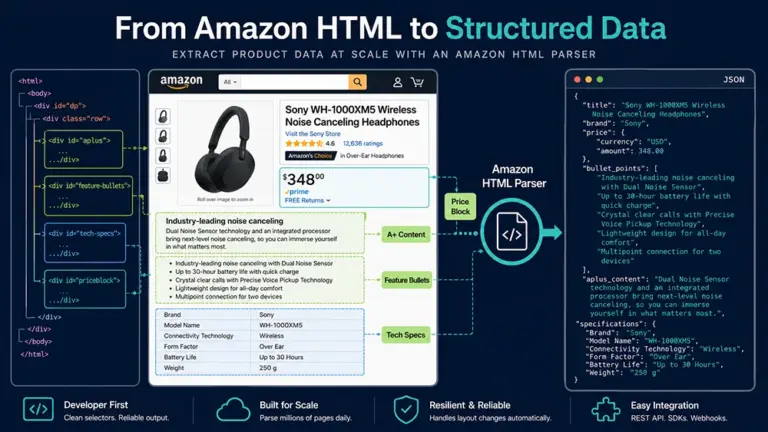

Amazon data scraping is the practice of extracting product, price, ranking, and review information from Amazon’s public pages in a systematic, programmatic way, and converting it into structured data — tables, JSON, database records. It is not “saving web pages.” It is turning the commercial signals scattered across hundreds of millions of product pages — how prices move, which categories are heating up, why a competitor’s reviews are turning negative — into a data asset that can be queried, computed on, and monitored over time.
This guide is the map for that subject. It answers four questions: what can be collected (the data map), why collect it (the business scenarios), how to collect it (methods and compliance boundaries), and in what order to learn it (a four-level roadmap). Each section states conclusions and the reasoning behind them; the operational detail lives in the companion articles of this series, linked at the end of each section. This page is updated as new installments are published.
Division of labor with the other guide on this site. Our Complete Guide to Connecting AI Agents to Live Amazon Data addresses the consumption side: how an AI agent uses data once it exists. This guide addresses the layer underneath: where the data comes from, how it is collected, how its quality is guaranteed, and what to do with it. Collection first, integration second.
1. What Amazon Data Scraping Is: The Data Map
Start with a definition. A sound collection job has three properties: explicit target fields (you know exactly which fields, from which pages), structured output (every field means the same thing, with the same type, in every record), and a repeatable process (the same job run today and tomorrow uses the same definitions). Miss any one of the three and what you get is a pile of web pages, not data.
The data available on Amazon’s pages falls into eight categories:
| Category | Typical fields | Primary uses |
|---|---|---|
| Product details | Title, brand, price, images, bullet points, category, variations (color/size), stock and delivery status | Selection research, listing benchmarking, own-catalog monitoring |
| Search results & keywords | Organic rank position per keyword, result listings, result counts | Keyword research, rank tracking, market-size estimation |
| Ranking data | Best Sellers rank (BSR) at category and subcategory level, New Releases, Movers & Shakers | Trend discovery, category opportunity scans |
| Reviews & Q&A | Star distribution, review text, dates, Verified Purchase flags, questions and answers | Negative-feedback analysis, product improvement, voice-of-customer research |
| Sellers & offers | Seller names and ratings, third-party offer lists, per-offer price and shipping, fulfillment method (FBA/merchant) | Hijacker monitoring, channel price governance |
| Buy Box data | Current Buy Box winner, its price, whether the box is shared | Buy Box contest analysis, price-war early warning |
| Advertising placements | Sponsored products and brands on search pages, their positions | Competitor ad-strategy inference, category ad-density assessment |
| Store & brand data | Brand storefront assortments, launch cadence, brand search presence | Competitor brand-level monitoring |
Two conclusions follow from the map. First, the categories differ sharply in collection difficulty: product details are static fields retrievable in a single request, while search rankings depend on postal code, language, and sign-in state — the same keyword returns different results under different conditions, so collection conditions must be fixed and recorded or the data is not comparable. Second, the value of the data lies not in volume but in a consistent time series: one collection answers “what is true now”; repeated collection answers “which way is it moving” — and the second question is the one selection and pricing decisions actually depend on.
Further reading (series A1): “What Is Amazon Data Scraping? What Data Can You Collect?” — a field-by-field breakdown with collection conditions. Forthcoming.
2. Why Collect: Five Business Scenarios
Collection is never the goal. Every legitimate collection requirement reduces to a concrete business decision. The five scenarios below are the most common drivers for Amazon sellers and data teams; each lists the data it depends on and the decision it supports.
Scenario 1: Product selection
Data: ranking data, category product details, price-band distribution, review counts and ratings. Decision: which category to enter, which price band to target, which crowded segments to avoid. Selection is a ranking problem over a candidate set, and ranking requires comparable quantitative inputs — without data, selection is experience and luck. Installment E1 of this series lays out a complete “category scan → opportunity score” workflow.
Scenario 2: Pricing and promotion
Data: competitor price time series, offer lists, Buy Box ownership, promotion flags (coupons, deals). Decision: match a price move or hold, when to discount, and by how much. Price is the most perishable data there is: yesterday’s competitor price is nearly useless for today’s decision, which is why pricing scenarios typically demand hourly or faster collection.
Scenario 3: Advertising
Data: keyword organic ranks, ad-placement composition, competitor advertising traces. Decision: which keywords to bid on, which ad-saturated keywords to avoid, how organic and paid placements combine. Placement data answers a pivotal question — on the keywords you want, how much of page one is already advertising? — which directly determines click costs.
Scenario 4: Listing optimization
Data: your own and competitors’ reviews (especially negative ones), recurring Q&A questions, competitor titles and bullets. Decision: what the copy should change and what the product should fix first. Negative reviews are the most honest product documentation in existence: where complaints concentrate is where the next product revision — and this revision of the listing — should respond.
Scenario 5: Competitor monitoring
Data: the full competitor dataset as a time series — prices, ranks, launches, review velocity, rating drift. Decision: responding to competitor moves when they happen. Monitoring differs from the other four scenarios in that it serves no single decision: it is a standing pipeline that alerts when something changes, instead of discovering the change in a post-mortem.
The five scenarios share one property worth stating plainly: all of them need continuously refreshed data, not a one-time export. That single fact determines the direction of method selection — the next section.
Further reading (series A2): “Why Scrape Amazon Data: Selection, Pricing, Advertising, Listings, Competitors” — each scenario in depth. Forthcoming.
3. The Methods Compared: Six Routes
No collection method is universally best; each fits a scale of need. This section compares the six mainstream routes and states the selection conclusions; the full treatment is installment A3.
| Method | Fits | Skill required | Stability | Typical cost structure |
|---|---|---|---|---|
| Manual copy | A handful of products, one-off research | None | n/a (human) | Your time |
| Browser extension | Single pages / small batches, human in the loop | Low | Medium (depends on page structure) | Free or low-cost subscription |
| DIY scraper | Any scale, budget permitting | High (build + long-term maintenance) | Low–medium (anti-bot and redesigns are adversarial costs) | Engineering time + proxy IPs + maintenance |
| Low-code scraping tools | Small-to-medium scale, fixed tasks | Low–medium | Medium | Subscription by task/data volume |
| Data API | Scale, system integration, continuous monitoring | Medium (calling an API) | High (provider absorbs collection and anti-bot) | Pay per successful call (credits) |
| MCP (for AI agents) | Real-time retrieval inside agent workflows | Medium (connector setup) | High (same API foundation) | Same per-call billing, incurred by agent calls |
The conclusions compress into four sentences: one-off, small-batch, human-in-the-loop work — an extension is enough; fixed tasks at modest scale — low-code tools are the best value; anything that must enter a system, run continuously, or scale — an API is the only option whose cost curve does not break with volume; and when the consumer is an AI agent rather than a person or a reporting system — add MCP on top of the API. The DIY route deserves a separate note: its problem was never “can it be built” but total cost of ownership — proxies, captchas, page redesigns, failed-request retries are all recurring bills. Installment D4 provides a complete build-vs-buy TCO framework; the advance conclusion is that whenever collection becomes a standing requirement rather than a one-off project, DIY costs are almost always underestimated.
The API route, illustrated with this site’s own Amazon Scraper API: the caller submits a request by ASIN, keyword, or ranking list; the provider returns structured JSON; billing settles per successful call in credits, and new accounts receive 60 free credits per month for validation. Which provider to choose is an empirical question — judge on the same sample set: field completeness, success rate, response time, and whether failed calls are billed — not on marketing-page numbers.
Further reading (series A3): “6 Ways to Scrape Amazon Data, Compared” — with a decision table by team size and requirement profile. Published in this batch.
4. Compliance Boundaries: Draw the Lines First
Compliance discussions about scraping go wrong when three distinct lines are collapsed into one. Keep them separate.
The first line is data type. Data visible on public pages without sign-in (product information, public reviews, prices) and data that requires sign-in or identifies individuals (buyer personal data, order data, account credentials) are different in kind. The former is the legitimate object of collection; the latter is outside any legitimate collection program. Every method in this guide concerns public data only.
The second line is platform rules. Amazon’s terms address automated access, and robots directives, rate limits, and captchas are all signals from the platform. The correct engineering posture: control your rate, do not circumvent access controls, do not mass-register accounts under false identities. Treating “technically possible” as “permitted” is the most common way scraping programs fail.
The third line is law. Jurisdictions differ materially: the United States has CFAA case law discussing public-web scraping; the European Union constrains personal-data processing under the GDPR; China has the Data Security Law, the Personal Information Protection Law, and unfair-competition jurisprudence. This guide offers no legal advice, only an engineering conclusion: collect public data only, minimize scope, keep rates restrained, and never use collected data for harassment or fraud — satisfy all four and the risk exposure is minimized.
Further reading (series A4): “Is Scraping Amazon Legal? Where the Boundaries Are” — a jurisdiction-by-jurisdiction treatment, to be legally reviewed before publication. Forthcoming.
5. The Roadmap: Four Levels from Beginner to Expert
The series is organized as four levels of increasing capability. Each level states the capability to build and the completion test; companion articles arrive in batches and this section is updated with links as they land.
Level 1 · Foundations (Group A)
Capability: explain what Amazon data scraping is, what can be collected, why, by which routes, and within which boundaries. Completion test: for one concrete requirement from your own team, choose the right collection method and defend the choice.
- A1 What Is Amazon Data Scraping? What Data Can You Collect?
- A2 Why Scrape Amazon Data: Selection, Pricing, Advertising, Listings, Competitors
- A3 6 Ways to Scrape Amazon Data, Compared (this batch)
- A4 Is Scraping Amazon Legal? Where the Boundaries Are
Level 2 · Basic Practice (Group B)
Capability: complete small-scale collection by hand and understand field definitions and common traps. Completion test: independently produce a small dataset with clean fields and consistent definitions, and explain every field in it.
- B1 The Amazon Data Field Dictionary: ASIN, BSR, Buy Box, Variations
- B2 Zero-Code Amazon Data Collection: Extensions, Sheets, and Visual Tools
- B3 Your First Amazon Scraping Script in Python
- B4 Seven Common Pitfalls of DIY Scrapers
- B5 Marketplace, Postal Code, and Language: Why Your Prices Differ from Everyone Else’s
Level 3 · Advanced Tasks (Group C)
Capability: run scaled collection tasks per data type and take responsibility for data quality. Completion test: deliver bulk data for a real business requirement, with quality checks included.
- C1 How to Scrape Amazon Product Data in Bulk (this batch)
- C2 How to Scrape Search Results and Keyword Rankings (Including Ad Placements)
- C3 How to Scrape BSR, New Releases, and Movers & Shakers
- C4 How to Scrape Amazon Reviews and Run Negative-Feedback Analysis (this batch)
- C5 How to Scrape Seller, Offer, and Buy Box Data
- C6 Data Cleaning and Quality Checks: Missing Values, Duplicates, Definition Drift
- C7 Large-Scale Collection Architecture: Concurrency, Retries, Queues, Dedup, Cost Control
Level 4 · Mastery and Automation (Group D)
Capability: turn collection into a system that runs itself: monitoring, alerting, storage, cost accounting. Completion test: a pipeline that runs unattended, alerts on change, and has auditable costs.
- D1 Continuous Monitoring with Scheduled Workflows (n8n / Make) — the n8n review-monitoring build is already published: Monitoring Amazon Reviews on a Schedule with n8n
- D2 Giving AI Agents Live Amazon Data (MCP Basics) — client-by-client guides live in the AI Agent guide series
- D3 Data Landing: Sheets, Databases, and BI Dashboards
- D4 Build vs Buy: How to Cost a Scraper Honestly
6. Scenario Playbooks (Group E)
The four levels build capability; Group E delivers outcomes. Each playbook starts from a concrete business pain point and shows the full use of collected data inside it; methods covered in Group C are linked, not repeated.
- E1 Data-Driven Amazon Product Selection: From Category Scan to Opportunity Score (this batch)
- E2 Building Competitor Price and Rank Monitoring
- E3 New-Product Monitoring: Catching New Competitors First
- E4 Improving Listings and Products with Review Data
- E5 Diagnosing a Stalled Listing with Data
7. Tool Selection and FAQ (Group F)
Three selection questions
Three questions narrow any vendor choice: First, volume and frequency — a few thousand records once, and tens of thousands daily, are different infrastructures. Second, freshness — pricing monitoring needs hourly data; selection research tolerates daily. Third, who consumes it — a person reading reports, a system ingesting a feed, or an AI agent calling tools. The answers map directly onto the six routes in Section 3.
For the product comparison itself, prefer measurements over marketing: Further reading (series F1): Best Free Amazon Scraper APIs in 2026 (Tested) — five providers run against the same sample set, with success rates, field completeness, and free-tier allowances measured.
Frequently asked questions
Q1: What does a free tier actually get me?
Using Pangolinfo’s free tier as the example: 60 credits per month, resetting monthly. The review endpoint bills per page at 5 credits per page, so 60 credits pull 12 pages of reviews — enough for a negative-feedback sampling pass over a small category. Free tiers are designed for validating definitions and workflows, not for production volume; scale up per use once the pipeline checks out.
Q2: Can I do this without an engineering team?
Yes, within limits. Extensions and low-code tools cover small-scale, fixed tasks. The moment the requirement becomes “runs daily, feeds a system,” you need someone who can call an API — typically a part-time week of one engineer’s time, not a team.
Q3: Is scraped data accurate?
Accuracy is a definitions problem, not a mystery. The same product can legitimately show different prices by postal code, marketplace, and sign-in state — “accurate” presupposes that collection conditions are fixed and recorded. Installments B5 and C6 cover condition control and data-quality checks respectively.
Q4: How does this guide relate to the AI Agent guide?
See the division of labor at the top: this guide covers where data comes from and how it is collected; that guide covers how agents consume it. If your problem is “make ChatGPT / Claude / n8n use live Amazon data,” go there; if it is “where does the data come from and how do I keep it flowing,” stay here.
Q5: What is the relationship between MCP and an API?
MCP is not a collection method; it is an access layer on top of an API. The API collects the data and returns it structured; MCP lets an AI agent call those capabilities directly. People and systems consume the API; agents consume the API through MCP. Billing is the same per-call model in both cases.
Further reading (series F2): “Amazon Data Scraping FAQ and Troubleshooting” — status codes, empty results, inconsistent outputs. Forthcoming.
Conclusion: From Map to Action
Everything in this guide compresses into one checklist: use Section 1’s data map to fix the fields you need; use Section 2’s five scenarios to name the decision they support; use Section 3’s conclusions to pick a route; use Section 4’s four principles to stay inside the boundaries; then walk Section 5’s roadmap level by level — each level has its companion articles, and Group E’s playbooks put the capability to work.
Installments arrive in batches and this page is updated with links as they land. If you take one question away from this guide, make it this one: is your collection requirement a one-time validation, or a pipeline that runs continuously? If the former, start from A3’s decision table. If the latter, go straight to C1 and D1 — a continuous data flow is where all the value in this field begins.