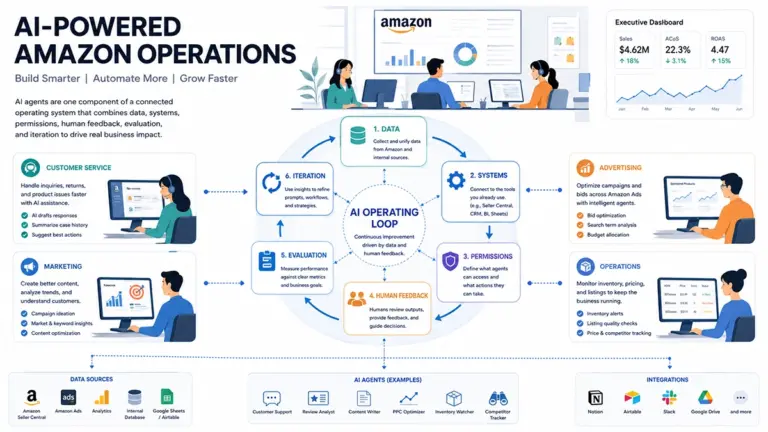

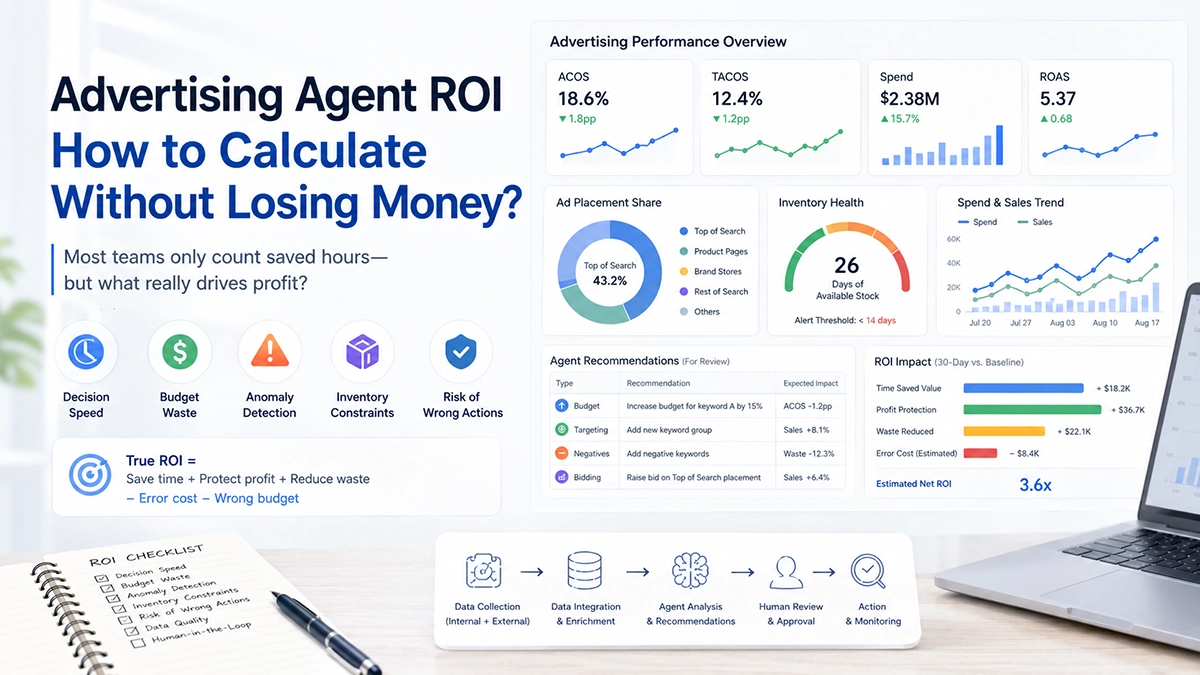
Amazon Ads Agent ROI cannot be measured by “how much labor we saved.” A team that automated every bid adjustment yet watched ACOS creep up 1.8 points didn’t save money — it lost margin. We keep seeing companies that bought an agent on a promise of “30% less ops labor,” and six months later the labor is indeed down while ad ROI hasn’t moved and margin is thinner. This piece explains where the real return lives: decision latency, wasted spend, anomaly detection, inventory constraints, and the risk of wrong actions — not the timesheet.
This is article #10 in Pangolinfo’s enterprise AI transformation series. Earlier we covered whether to mobilize people or build systems first (see Employee Workshops & the AI-Native Org), how to keep agents improving safely after launch (see Agent Continuous Improvement), and whether to reengineer flows or freeze an SOP (see AI Transformation: SOP or Decision Flow). Those fix “how to stay stable.” This one fixes “how to account for it” — because if you can’t show the math, no agent survives the CFO review.

Why “automation rate” is the most dangerous metric for Amazon Ads Agent ROI
Let’s break a delusion we hit repeatedly. One cross-border seller handed nearly all SP bid, budget, and negative-keyword decisions to an agent; automation rate hit 90%. The weekly report read: “30% ops labor saved, agent fully owns daily optimization.” Sounds like a flagship case. But ACOS rose 1.8 points over three months, and TACOS crept up too. The headcount left; the money didn’t.
The problem isn’t a dumb agent. It’s that automation rate measures “how much humans left the loop,” not “how much the decisions improved.” Once human judgment is pulled out, exactly the messy capabilities disappear: what to do when inventory suddenly stockouts, whether to reshuffle structure when seasonal traffic shifts, whether to counter-bid when a competitor suddenly matches price. None of those have a clean answer; an agent optimizing on historical distribution just auto-replays yesterday’s bias.
So the first line of the ledger is wrong: treating automation rate as the north star is defining “victory” by “how many people left.” We recommend removing automation rate from the KPI list entirely and replacing it with the lines below.
Amazon Ads Agent ROI, line two: decision latency, or time arbitrage
“Saved 2 hours of labor” assumes those 2 hours are equal. They aren’t. The same 2 hours, captured at T+0.5 days when an anomaly is found versus T+30 days in the monthly report, differ by orders of magnitude.
A real one: a client’s core keyword got squeezed by a competitor’s coupon. Humans usually react only after the weekly report or a natural sales dip — average lag 3 days. By then that keyword’s conversion had already dropped 22%. If an agent flags “placement lost, suggest top-up or price cut” and pushes it to the operator at T+0.5 days, the operator can act that day. That 2.5-day gap recovers the replenishment window, the matching-bid window, and the week’s rank — value far beyond the saved hours themselves.
So we list “decision-latency compression” as line two of Amazon Ads Agent ROI: not how many hours saved, but how much budget and rank you claw back by cutting the discover-to-act delay. This line usually runs 3–10× the labor line, yet almost nobody puts it in the deck.
The swapped denominator in Amazon Ads Agent ROI: error budget is the hidden cost
When teams compute ROI, the numerator is often “saved hours × hourly rate,” the denominator “agent subscription.” The biggest hole is the omitted counterfactual cost. One wrong negative keyword shutting off a converting long-tail term can lose, in three days, 20× the agent’s annual subscription. One mis-budgeted top-up hitting a stockout burns spend with zero sound.
We call this the “error budget”: as the agent learns and explores, a certain share of misactions is inevitable, and their expected loss must be accrued into the ROI denominator. Otherwise your “3.5× ROI” is skinny-dipping — one misaction and the year’s surplus is gone overnight.
This also explains why “black-box auto-bidding” gets manually overridden 70% in week one: not because people are conservative, but because they’re instinctively paying for the un-accrued error budget. Overriding 70% means admitting 70% of the system’s actions are untrustworthy. That itself is an ROI signal.
What data does an ads agent need to see the real battlefield?
No matter how smart the agent, feed it a wrong map and it’s a blind man feeling an elephant. A hidden line of Amazon Ads Agent ROI is data quality itself. For Amazon teams, at least two layers:
- External battlefield data: SP placement distribution in search results, competitor bidding moves, keyword rank and volatility. If scraped by hand or sampled, granularity and freshness can’t keep up with the agent’s decision cadence. Our own pipeline reaches 91.4% SP placement coverage across 13 public markets, with a Feishu alert firing on the 4 markets below the 92% threshold — because if the “placement map” is wrong, every optimization on top is built on air.
- Internal fact data: each ASIN’s true contribution margin (not price minus ad cost, but the real margin including FBA, returns, promotions), available inventory days, and promo calendar. This usually lives across the ad console, ERP, and spreadsheets. If the agent can’t see it, ACOS becomes its only truth — leading to the classic stupidity of “negating a high-margin long-tail term just to lower ACOS.”
Connect those two layers and the agent turns from “a script that bids” into “a colleague that understands the business.” External data can come via Amazon Scraper API for search, placements, listings, and rank; letting the agent call directly, see Amazon Data MCP, with technical detail in the Amazon Data MCP docs. The point isn’t which vendor — it’s don’t let the agent make annual budget calls on half a map.
Report, diagnose, or change budget first? Let the team see “why”
This is the most-asked question in ads-agent rollout, and the ROI dividing line. Our answer is counterintuitive: the cheapest path is not to auto-change budget first, but to let the team see “why this change” first.
A daily diagnosis that explains “why we suggest +15% budget on keyword A” builds trust first. Trust in place, auto-execution has a chance to become a capability. Reverse it — auto-change budget on day one — and operators override 70% in week one. You get neither the automation benefit nor the visibility into the system.
This is the same logic as our “run a workshop first” piece: people aren’t to be replaced, they’re to be empowered to read what the agent is thinking. Can’t read it, won’t trust it; don’t trust it, won’t use it. The earlier workshop article makes the same point — trust grows from “explainable,” not from “fully automatic.”
A 30-day baseline and control group: a fair scale for Amazon Ads Agent ROI
Don’t cite “ACOS dropped after launch” as proof — it could be seasonality, a competitor exiting, or organic recoil. For fairness, build a counterfactual baseline. Two methods we use:
- Matched ASIN pairs: pick structurally similar, similarly sized ASINs; one group gets agent actions, one frozen as a manual baseline; run 30 days and compare. Low noise, but needs enough comparable ASINs.
- Week-over-week freeze: works on a single account. Odd weeks open agent actions, even weeks freeze; 4 weeks; compare the agent weeks’ true lift over freeze weeks. Simple, but log the promo calendar as a covariate or a big-event week pollutes the conclusion.
Either way, track the same seven metrics: management hours, diagnostic coverage, anomaly-lead time, ACOS/TACOS, contribution margin, stockout risk, misaction count. First two are “input side,” middle three “output side,” last two “risk side.” Watching only ACOS is watching one-seventh.
Put “wrong-action risk” into the ROI formula and you’ve accounted for it all
A plain formula we use internally, good enough for the board:
ROI = (labor-value saved + anomaly-lead value + margin-protection value − misaction loss − error-budget accrual) ÷ (subscription + integration cost + maintenance hours)
Three counterintuitive notes: the numerator adds “anomaly-lead value” and “margin-protection value” — what the agent actually earns; the denominator adds “error-budget accrual” and “maintenance hours” — what most teams pretend doesn’t exist. Once you charge maintenance hours, you’ll find many “fully automatic” setups merely shifted cost onto operators manually cleaning up daily, and ROI halves on the spot.
The formula’s biggest use isn’t a pretty number — it’s forcing the team to turn “risk” from a verbal caveat into a ledger line. When misaction loss is named and accrued, the team seriously sets boundaries instead of saying “we trust AI.”
A three-phase roadmap for Amazon teams
Back to rollout. Our advice to Amazon ads teams is never “go fully auto in one step,” but three phases, each with a graduation gate:
- Phase 1|Read-only diagnosis (weeks 1–4): the agent only summarizes daily and explains anomalies, never touches budget. Goal: operators spend 10 minutes daily understanding “what’s off and why.” Graduation: ≥ 60% actively open the diagnosis.
- Phase 2|Suggest + human approve (weeks 5–10): the agent proposes budget, keyword, and placement moves; humans click to execute. Start accumulating “what was approved vs. rejected and why.” Graduation: suggestion adoption ≥ 60%, and rejection reasons cluster into improvable classes.
- Phase 3|In-boundary low-risk auto (week 11+): open only clearly bounded low-risk actions — e.g., small budget top-ups under a threshold, negating clearly inefficient terms. Every auto-action is rollbackable and auditable. This switch must bind to agent permission governance — opening an action opens exactly its minimal permission, retractable the moment something breaks.
One sentence for the core logic: trust is earned inch by inch per action, not bought once per product.
Original observation: the most expensive part of an ads agent isn’t the model, it’s “can’t see why”
Among the teams we’ve served, the ones with the prettiest Amazon Ads Agent ROI never went fully auto on day one. Their common trait: they spent the first 4–6 weeks purely on “letting humans read the agent’s judgment.” Only when operators started asking “why did you say that keyword deserved more budget yesterday” did automation happen as a matter of course.
Reverse it, and those “3-month payback” procurement stories, unpacked, are mostly the version that saved labor, hid risk, and leaked margin. The truth of Amazon Ads Agent ROI: its first return is giving the team, for the first time, an “explainable ad judgment”; automation is merely a byproduct of that trust. Get that relationship backwards and you’ll be like the team at the top — 90% automation, ACOS up 1.8 points, and no one to blame.
What this means for Amazon teams
Concrete next step. If your ads-agent project is stuck on “the CFO asks how to measure ROI,” don’t rush the labor-saving number. Pull that seven-metric set, build a 30-day control, and accrue the error budget into the denominator. You’ll find the real thing to optimize is usually not the model but the data source (is placement coverage accurate enough) and the decision flow (are humans empowered to read the suggestions).
When we built an Amazon cockpit for a global electronics brand, we hit the same trap: the “monthly ops report” execs wanted most launched and then missed three critical signals — the very three the front-line operators screamed about in the group chat every day. The report was top-down “what we think matters”; the operators’ daily chatter was “what we’re actually afraid of.” So the cockpit later nailed “margin protection” and “stockout risk” into daily monitoring. Full case in Amazon Brand Operations Cockpit: the three signals monthly reports miss. Ads-agent ROI is essentially the same thing: don’t watch only the metric you want; watch the one the business is actually afraid of.
Conclusion
Amazon Ads Agent ROI isn’t a subtraction (subscription − labor); it’s a seven-line balance sheet. Drop automation rate from the KPI, invite decision latency, error budget, margin protection,, and anomaly-lead time into the ledger, and you’ve started accounting at all. The steadiest rollout always ships the “explainable diagnosis” to humans first, lets trust grow inch by inch, then talks auto-execution. That’s consistent with the whole series: an agent’s first value was never to do the work for you, but to help you see the business clearly.
Where to start the ledger this quarter
If you want the shortest path, start with the two lines most teams never staff: anomaly-lead time and misaction count. Instrument those two for 30 days before touching any automation, even if the rest of the ledger stays a spreadsheet estimate. Those two numbers expose whether your agent — or your team — is actually catching problems early and avoiding expensive mistakes. Once they’re honest, the other five lines become a budgeting exercise, not a research project. The discipline compounds: a team that can name its misaction count walks into the renewal conversation with a real number instead of a hope.
Frequently asked questions
How do I set a fair control for Amazon Ads Agent ROI vs. manual?
Don’t use whole-account before/after — too noisy. Use matched ASIN pairs, or a week-over-week freeze for 30 days, and log the promo calendar as a covariate so the conclusion survives CFO scrutiny.
Is a lower automation rate always better?
No. Automation rate is neutral; the problem is using it as a KPI. We suggest removing it from scoring and watching suggestion adoption and misaction count instead — automation is a result, not a goal.
How do I estimate the error budget without guessing?
Invert from Phase 2’s “human-rejection log”: for rejected suggestions, what loss would execution have caused; take the historical mean × exploration ratio as the accruable error-budget floor.
Small team, not enough comparable ASINs — what then?
Use the week-over-week freeze on a single account. Key: the freeze week does zero agent actions and manually holds the original strategy, so no “secret optimization” pollutes the baseline.
Why does placement data quality affect ROI?
The agent decides on the “battlefield map.” If placement coverage is inaccurate, the agent can’t see competitor grabs or its own slide — optimization becomes blind bidding. Wrong map, wrong ledger, however smart the agent.
Further reading: Amazon Data MCP docs. This is part of Pangolinfo’s enterprise AI transformation series; the pillar is Amazon Enterprise AI Transformation, with prior pieces Employee Workshops, Agent Continuous Improvement, and Agent Permission Governance.