
Amazon real-time data integration is the infrastructure layer that determines whether AI-powered operations actually work. This article explains why AI decisions fail (it’s not the model), analyzes the structural data gaps in existing Amazon research tools, defines what AI-ready data actually requires, and introduces Pangolinfo’s three products and three integration modes — with before/after decision quality comparisons across product selection, ad strategy, and Alexa brand visibility scenarios.
Amazon real-time data integration is the most overlooked — and most urgent — component in any AI operations stack.
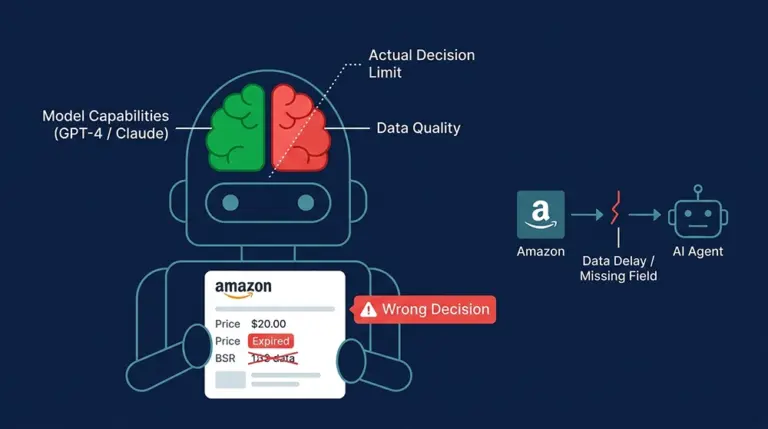
If you’ve been using AI for Amazon operations — product research, competitor analysis, keyword strategy, ad optimization — and the results keep coming back wrong despite reasonable-sounding analysis, the problem isn’t your prompts. It isn’t your model selection. It isn’t your Agent framework.
The problem is simpler and harder to fix: you’re feeding stale data into an AI and expecting current answers.
This isn’t a criticism. It’s a structural issue that the industry has systematically underestimated. This article explains what’s actually happening, and gives you a complete path to fix it.
Why AI Decisions Break Down (It’s Not the Model)
Large language models are extraordinarily good at reasoning within a given information set. That capability is strong enough that many people assume the AI can independently gather information. It can’t.
AI doesn’t know what happened on Amazon today. It doesn’t know a competitor went out of stock last night. It doesn’t know your core keyword’s search volume rose 23% over the past 48 hours. It doesn’t know a new entrant is anomalously spiking on the New Releases chart. It doesn’t know your top competitor just halved their ad budget. It only knows what you told it.
The implication is stark: the freshness, completeness, and accuracy of your data input linearly determines the quality of your AI’s output. In a marketplace where prices shift every 10 minutes, competitor stockout windows close in 6-12 hours, and keyword inflection points appear 2-4 weeks before they show up in monthly reports — using week-old data for “AI decisions” means you’re navigating today’s roads with last week’s map. The map might be beautifully detailed. It’s still wrong.
The Data Gap in Existing Amazon Tools
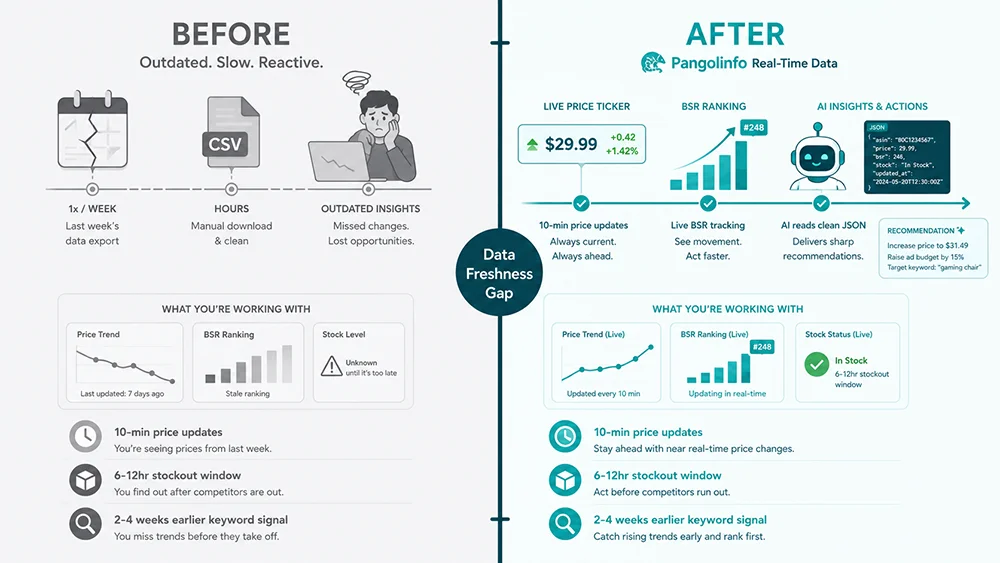
Most sellers’ first instinct for Amazon data is Helium 10, Jungle Scout, or their regional equivalent. These tools are genuinely well-built — they solved the efficiency problem of manual data collection. But for the specific job of “providing effective inputs to AI,” they have three structural limitations. Not product flaws. Inevitable consequences of being designed for a different purpose.
Limitation 1: Update frequency. Core data in mainstream product research tools refreshes daily or weekly. That’s sufficient for human browsing and decision-making. It’s insufficient for AI operational decisions that need to sense minute-level market changes. In the critical 72-hour window before a holiday peak, you need the current bidding landscape — not yesterday’s average.
Limitation 2: Data is hard to aggregate for AI. These tools’ data is distributed across separate interface modules, with inconsistent export formats and varying field definitions. Consolidating multi-dimensional data into an AI-ready reasoning context requires substantial manual work — and manual work is itself a source of information loss and introduced bias.
Limitation 3: Designed for humans, not for AI. Visual charts, filter UIs, CSV exports — these output formats are optimized for human reading. AI needs machine-readable data: standardized fields, clear definitions, no cleaning required. Between these two design requirements is a fundamental gap.
The tools aren’t the problem. The problem is they were never designed to feed AI decision-making.
What AI-Ready Amazon Data Actually Looks Like
Before discussing integration, it’s worth defining what “qualified AI input” actually requires. Four conditions must be met simultaneously.
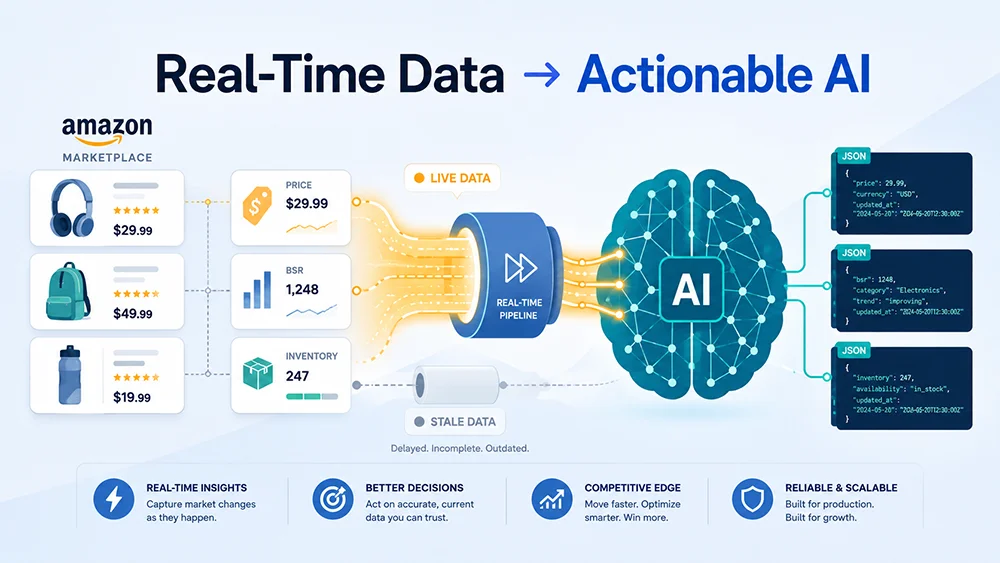
① Real-time: minute-level, not daily. The value of price, BSR, inventory status, and ad bid signals decays by the minute. You need the current market state, not yesterday’s snapshot.
② Complete: covers all decision dimensions. Product selection requires simultaneous visibility into demand (keyword trends), competitive supply (BSR, competitor inventory), ad traffic (SP placement distribution), and consumer signals (review velocity and quality). Missing any dimension creates systematic blind spots in AI reasoning.
③ AI-friendly: structured JSON, not HTML or CSV. Data must be delivered in a format AI can directly consume — standardized fields, clear definitions, no cleaning required. AI’s compute should go entirely to “making decisions based on data,” not to “understanding what format the data is in.”
④ Continuous: ongoing market sensing, not one-time collection. When a competitor goes out of stock, when a keyword starts climbing, when an ad placement’s competitive landscape shifts — these signals need to be captured continuously by a system, not checked periodically by a human.
Pangolinfo’s Three Products: Complete Pipeline from Data to Decision
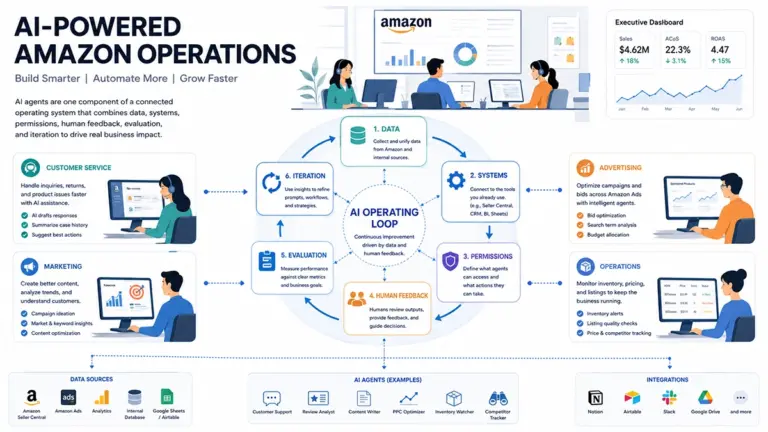
Pangolinfo‘s product architecture is built around a single question: how do we make real-time Amazon data genuinely usable for AI decision-making? The answer spans three layers: data collection, data integration, and AI invocation.
Product 1: Pangolinfo Scrape API
Real-time Amazon data across all categories, delivered via standardized RESTful Scrape API. Clean field definitions, complete documentation, Python/Node.js/Java SDKs included, 15-minute basic integration. Coverage includes:
- Price data: Buy Box price / price history curves, 1-3 minute refresh
- BSR rankings: real-time values for main and subcategory, New Releases / Hot New Sellers live sorting
- Inventory status: in-stock / low-inventory / stockout, competitor depth estimation
- Keyword data: search volume time series / organic ranking / related term structure
- SP ad placements: real-time occupancy per placement / competitor ad density / bid levels
- Alexa AI summaries: full AI summary text / mentioned_brands / ai_reason / follow_up_questions
You send a request. You receive JSON. Anti-scraping, IP management, CAPTCHA handling, data cleaning — Pangolinfo handles all of it. Your engineering time goes entirely toward what to do with the data.
POST https://scrapeapi.pangolinfo.com/api/v2/scrape
{
  "parserName": "amazonSearch",
  "param": {
    "keyword": "queen bed frame"
  }
}
// Returns: clean JSON, clear fields, ready for AI input
Product 2: Pangolinfo MCP
MCP (Model Context Protocol) is the tool-calling protocol supported by major AI Agent frameworks. Pangolinfo MCP wraps data interfaces as native AI tools — Claude or any other MCP-compatible AI can pull live Amazon data directly within a conversation, no manual data transfer, no format conversion, fully automated data flow.
Typical workflow: you ask Claude, “Analyze competitor inventory changes in the queen bed frame category over the past 72 hours and identify any stockout windows” → Claude calls Pangolinfo via MCP → completes the analysis → delivers a recommendation. You moved zero data manually. This is a change in the nature of the workflow, not just its speed: from “human moves data to AI for analysis” to “AI retrieves data and analyzes.”
Webhook support is included: critical events (competitor stockout, price anomaly, ranking disruption) pushed in real time to your system, triggering automated Agent responses.
Product 3: Pangolinfo Skills
Pangolinfo Amazon Scraper Skill addresses the question: once AI has real-time data, how does it use it well? Pre-built operational capability modules, plug directly into Agent workflows:
- Product Opportunity Analysis Skill: real-time search trend + competitor data → category opportunity matrix in 10 minutes
- Competitor Monitoring & Stockout Alert Skill: automatic push when competitor inventory drops below threshold, ad strategy pre-adjustment
- Keyword Strategy Skill: search volume × competition intensity × ad density → tiered keyword list (lead / window / avoid)
- Ad Anomaly Detection Skill: ACoS shifts, impression volume changes, ranking movements — automatic root cause identification
- Alexa Listing Optimization Skill: AI semantic blind spot diagnosis + rewrite recommendations + before/after Alexa summary comparison
API + MCP + Skill covers the complete chain from data collection to decision output. No prompt framework to build from scratch.
Three Integration Modes: Choose Your Technical Level
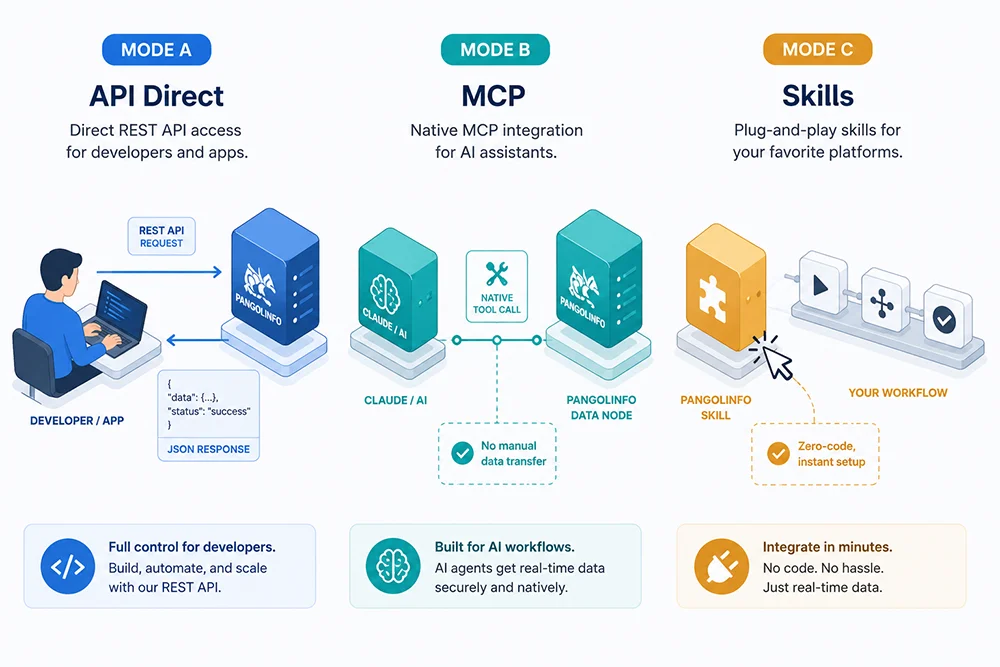
Mode A: API Direct (Teams with development capability)
Standard REST API, clean JSON output, 15-minute basic integration. Full control over how data enters your analysis pipeline or AI context. Best for teams with engineering resources who need custom data pipelines.
Mode B: MCP (Claude, GPT, major Agent frameworks)
Native AI tool call integration. No engineering work on the data layer — the AI handles its own data retrieval. Best for teams already running AI Agents who want to eliminate the manual data-transfer step entirely.
Mode C: Skills (Zero-code fast start)
Pre-built operational modules, plug in and run. No prompt engineering required. Best for teams who want to validate AI operations value quickly before investing in custom development.
What Changes When Your Data Pipeline Is Live
Product Selection
Before: AI analyzes last week’s export and produces a recommendation that sounds coherent — without knowing that a competitor went out of stock, two new entrants just appeared on the New Releases chart, and the top-of-search CPC rose 35% in the past 48 hours. Execution result: ACoS came in twice the projection.
After: AI pulls 72-hour BSR data, detects two anomalous New Releases entries, flags competitor low-inventory signals, and recommends: entry window just opened, complete FBA shipment within 7 days, specific competitor stockout timing projected. Actionable. Current.
Ad Strategy
Before: ACoS spikes in the report → team investigates → makes adjustments → waits for next reporting cycle. Reactive, with built-in lag.
After: Pangolinfo MCP detects competitor inventory entering low-stock threshold → AI pushes alert → team pre-positions bid increases before the stockout window opens. The timing advantage in a peak holiday window can be days.
Alexa Brand Visibility
Before: No way to systematically know what Alexa says about your products. Complete black box.
After: Query core keywords via Alexa API → check mentioned_brands field → read ai_reason for recommended competitors → analyze follow_up_questions to find semantic gaps in your listing → apply Listing Optimization Skill → re-query and compare. Closed-loop, data-validated optimization.
Frequently Asked Questions
How long does Amazon real-time data integration take to set up?
With Pangolinfo’s API Direct mode, basic integration takes 15 minutes — send a standard REST request, receive clean JSON data, with complete documentation and Python/Node.js/Java SDKs ready to go. MCP mode and Skills require even less technical overhead, with native support in Claude and other major AI frameworks.
How frequently does Pangolinfo update Amazon data?
Price data refreshes every 1-3 minutes. BSR rankings, inventory status, SP ad placement data, and keyword search trends are all updated at minute-level granularity. Compared to the day-level or week-level data from mainstream product research tools, Pangolinfo’s data granularity enables the kind of precision decisions needed in 72-hour holiday windows.
What is the difference between MCP integration and API Direct?
API Direct requires an engineer to write data-fetching code; data enters your pipeline as JSON for downstream processing. MCP wraps the Pangolinfo interface as a native AI tool — Claude, GPT, and other MCP-compatible AIs can pull Amazon data directly within a conversation, with no manual data transfer. The two modes are complementary: API gives full control, MCP makes AI self-sufficient for data retrieval.
What are Pangolinfo Skills and who are they for?
Skills are pre-built operational capability modules covering the most common Amazon use cases: product opportunity analysis, competitor stockout alerts, keyword strategy, ad anomaly detection, and Alexa Listing optimization. They plug directly into Agent workflows with no prompt engineering required. Best for teams that want to validate the value of AI operations before investing in custom development.
Why do AI decisions based on Helium 10 or Jungle Scout data produce inaccurate results?
These tools update at day-level or week-level frequency and output data in formats designed for human reading (charts, CSV, UI modules) — not for direct AI reasoning. When you feed last week’s export to an AI, it doesn’t know a competitor went out of stock 48 hours ago, or that keyword bids rose 40%. The AI produces a well-structured analysis of a market state that no longer exists.
Three Questions to Assess Your Data Gap Right Now
Before deciding on next steps, answer these three questions honestly:
- How old is the data your AI is currently working with?
- How long does it take from when a competitor goes out of stock to when you know about it?
- Do you know what Alexa for Shopping is currently saying about your products?
If the answers are uncomfortable, Amazon real-time data integration is the first thing to fix. Not the prompt. Not the model. Connect the data pipeline, and the AI actually earns what you’re paying for it.
AI is an amplifier, not an oracle. Give it real-time truth, it amplifies your advantages. Give it stale snapshots, it amplifies your mistakes. Whether your data pipeline is connected determines which version of AI you’re actually running.
Start your Amazon real-time data integration today, or visit the developer documentation for complete API reference.
Free trial via console — no credit card required, 15-minute first integration.