
Many Amazon sellers stare at the “monthly sales” figures provided by browser extensions every day, yet very few actually turn those numbers into sustained profitability. Why? Because most sellers treat sales estimation simply as a binary “go/no-go” indicator for product popularity, entirely missing its true potential as a central nervous system for business decisions.
Once you understand what Amazon sales estimate data is and have mastered how to accurately estimate Amazon sales data, you must confront the most critical question: **How do we translate these hard-earned data points into actual ROI?**
This article moves beyond technical data modeling. We will break down the value of Amazon sales data and its 5 core business applications from the perspectives of ROI and operational strategy. If you are planning a new product line, these five dimensions will help you avoid 90% of the hidden pitfalls in the marketplace.
Value 1: Quantitative Validation of Market Capacity (Risk Mitigation)
When entering a new category, the biggest risk isn’t “zero sales”; it’s “selling well but making no money.” This is usually the result of misjudging the true market capacity.
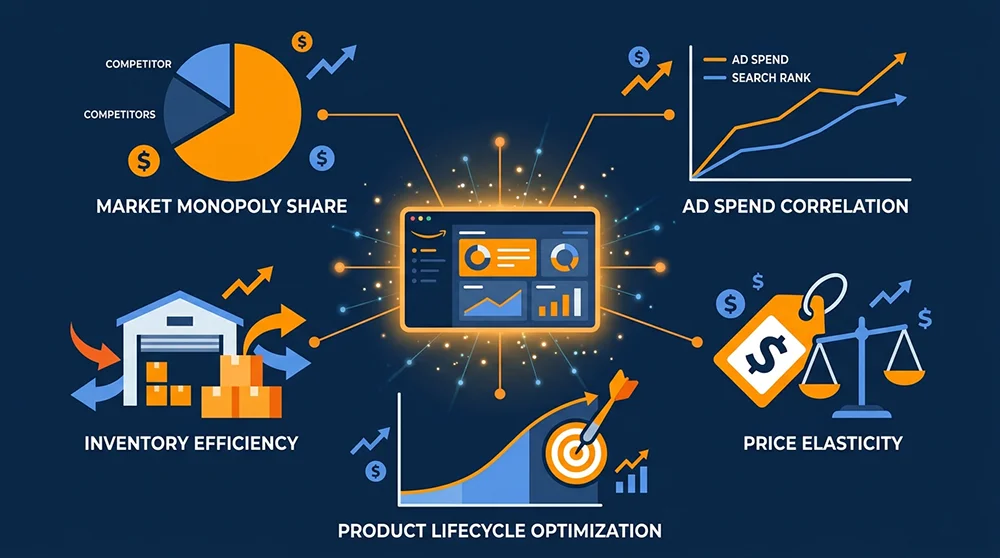
Sales estimate data allows you to clearly outline the capacity model of a category. It’s not about how much the #1 best-seller is moving; it’s about calculating the average monthly sales from rank 10 down to 50. If the Top 1 product sells 20,000 units a month, but products ranked 20th and below struggle to sell 300 units, you are looking at an extreme monopoly. Entering this market without a massive promotional budget is financial suicide.
**Practical Application:** Use the Pangolinfo Scrape API to batch-extract the 30-day average BSR of the Top 100 ASINs in a target category. If the mid-tier products (Top 30-50) account for less than 15% of the total estimated market volume, abandon the niche immediately.
Value 2: Reverse-Engineering Competitor Ad Strategies (Strategic Maneuvering)
Sales estimates are not just end results; they are keys to decrypting your competitors’ playbooks. When a competitor’s estimated sales spike drastically over a short period, it’s rarely a spontaneous burst of organic traffic—it’s artificial intervention.
By overlaying a competitor’s “estimated daily sales curve” with their “pricing history” and “organic keyword rankings,” you can identify exactly what they did. If sales surged but organic ranking remained stagnant, they likely ran heavy off-site deals or aggressively scaled their Sponsored Display budget. This tells you exactly when you should (or shouldn’t) engage in a bidding war.
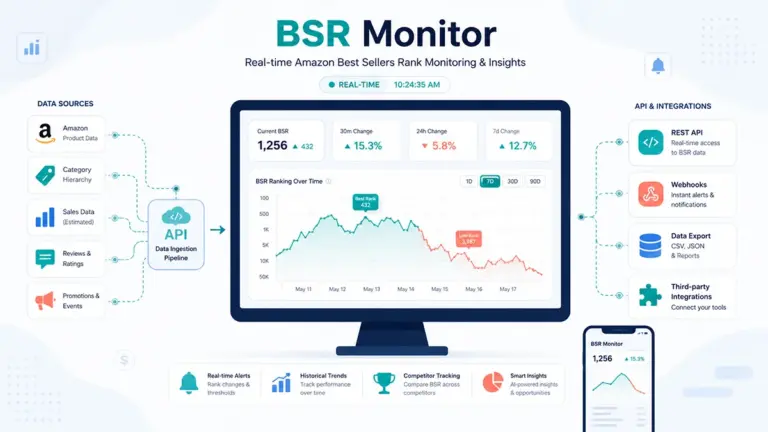
**Practical Application:** Use AMZ Data Tracker to monitor competitor BSR and review velocity. When their estimated sales artificially spike, pivot your advertising strategy to target long-tail keywords, avoiding direct confrontation while their ad spend is maxed out.
Value 3: Dynamic Inventory Forecasting (Avoiding Stockouts/Dead Stock)
Inventory management is the lifeblood of an e-commerce business. Excess inventory destroys cash flow, while a stockout instantly kills the BSR momentum you paid dearly to build. Traditional reordering formulas rely solely on your own trailing 30-day sales, a fragile method during seasonal shifts or market-wide macro changes.
Advanced sellers use the “total estimated sales of the entire sub-category (macro market heat)” as a weighting factor for inventory forecasting. If the total category sales are growing 30% month-over-month, you should issue larger purchase orders to your factory *before* your own sales begin to spike.
**Practical Application:** Calculate a dynamic safety stock threshold based on the growth slope of the entire category’s estimated sales heading into Q4, shifting your ocean-to-air freight ratio from 8:2 to 6:4 dynamically.
Value 4: Profit Margin Stress Testing (Avoiding Race-to-the-Bottom)
Profit = (Selling Price – Landed Cost – FBA Fees) × Units Sold. This seems obvious, but on Amazon, price and velocity are in a constant, dynamic struggle.
If a competitor drops their price by $2, how many extra units will they sell? By tracking sales estimate data over time, you can map out the “price elasticity of demand” for your category. Some niches are highly price-sensitive, where a 10% price drop yields a 50% jump in unit volume. In premium, quality-driven niches (like baby products), dropping the price might actually hurt conversion rates.
With elasticity data in hand, you can mathematically determine if matching a competitor’s price drop will still yield a higher absolute net profit, preventing you from engaging in a blind, unprofitable price war.
Value 5: Tracking the Product Lifecycle (Timing the Market Entry)
Every product category goes through an introduction, growth, maturity, and decline phase. Entering too early forces you to bear the heavy costs of educating the market; entering too late leaves you fighting for scraps.
By tracking the combined estimated sales volume of “New Releases” (ASINs launched < 90 days ago) within a category, you can perfectly time your market entry. If new products account for 40% of the total estimated sales and the trend is rising, you’ve found a rapidly expanding blue ocean. If new products capture less than 5% of total sales, the market has solidified, and the moats built by top sellers are impenetrable.
Conclusion: Maximizing the Value of Amazon Sales Data
The true value of Amazon sales data is never just a static number; it is a multi-dimensional compass for business strategy. It validates market capacity, decodes competitors, secures cash flow, protects profit margins, and times your product launches.
However, unlocking these 5 core values requires high-frequency, highly accurate underlying data. Manual tracking and occasional glances at browser extensions are insufficient. You need an automated, systematic data pipeline.
To learn exactly how to implement this data-driven workflow into your daily operations, we highly recommend our master guide: Amazon Sales Estimate Data: Complete 2026 Playbook. Let’s start turning estimated data into real, bankable profit.
View API Documentation or start free scraping for data required for Amazon sales estimation.