
You can see your own sales in Seller Central. You cannot see your competitors’. That information gap costs tens of thousands of sellers dearly every year — they source inventory based on a hunch, sit on six months of dead stock, and then realize the category they entered never had the demand they imagined. The competitor they feared? Doing a third of what the “bestseller” badge implied.
Amazon sales estimate data exists to close that gap. It is not an official figure released by Amazon. It is a statistically inferred range, derived from publicly available signals — BSR rank movement, review velocity, keyword search volume, price history — that allows sellers to estimate, with reasonable confidence, how many units a given ASIN is likely selling each month.
This article starts from the ground up: what the term actually means, why Amazon withholds real sales data, how the estimation logic works, and what five concrete business problems this data helps you solve. Whether you are encountering this concept for the first time or trying to sharpen your understanding of where estimation tools succeed and where they fall short, this piece will give you the framework you need.
1. What Amazon Sales Estimate Data Actually Means
The most common misconception about Amazon sales estimate data is treating it as a single precise number — “this ASIN sold 1,000 units last month.” That framing is both inaccurate and dangerous for decision-making. At the methodological level, sales estimate data is a confidence interval, not a point value.
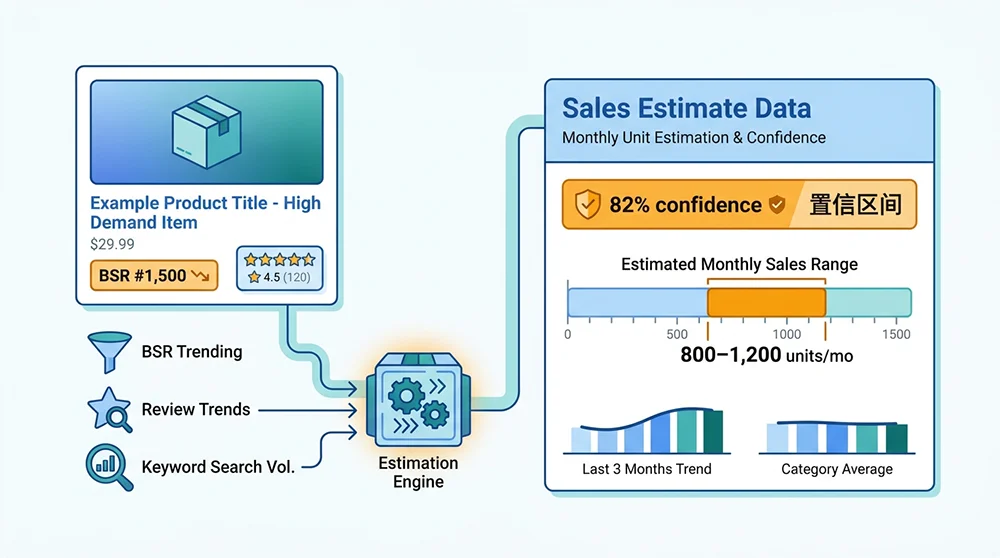
The accurate definition: Amazon sales estimate data refers to the statistical inference of a specific ASIN’s unit sales and revenue within a defined time window, derived from publicly accessible indirect indicators (BSR rank change curves, review addition velocity, natural keyword traffic, FBA inventory scarcity signals, sponsored ad placement frequency, etc.), expressed as a range with an associated confidence level.
A properly formatted output looks like this: “Estimated monthly sales: 800–1,200 units, 82% confidence, based on 30-day average BSR, review velocity, and category-specific calibration model.” Not a bare number. The moment a tool presents you with a single rounded figure and no uncertainty range, you should treat it with proportionate skepticism.
Dimensions Typically Included in Sales Estimate Data
Monthly unit range — The most fundamental dimension. Used in product research to gauge demand size in a subcategory. This is the number that drives sourcing decisions.
Monthly revenue estimate (GMV) — Unit range multiplied by current or historical average selling price. More relevant for market sizing and evaluating revenue potential for scale-stage sellers and acquisition due diligence.
Daily sales trend direction — Derived from BSR movement over time. An ASIN with stable daily BSR is holding position; one with a steadily declining BSR is losing velocity. Trend direction has more predictive value than a static monthly snapshot.
Seasonality coefficient — Inferred from historical BSR cycles. Critical for categories with pronounced seasonal demand (outdoor gear, holiday gifts, HVAC accessories). Applying a flat monthly average to a seasonal product produces meaningless projections.
Total category demand estimate — The sum of estimated monthly sales across the top 100 ASINs in a subcategory. The single most important metric for assessing whether a category is worth entering at all.
2. Why Amazon Does Not Release Real Sales Data
Understanding this is not academic. It tells you exactly what raw material the estimation methods are working with, and where the precision ceiling is.
Platform Revenue Protection
Amazon’s advertising business — Sponsored Products, Sponsored Brands, Sponsored Display — generates tens of billions of dollars annually, precisely because ad placement is scarce and competitive. If exact sales data were publicly available, the barrier to entering profitable categories would collapse. Competition would intensify, ad auction prices would rise unpredictably, and Amazon’s own private label brands (Amazon Basics, Essentials) would lose competitive cover. Withholding sales data is, at its core, a structural moat.
Seller Data Sovereignty
From a legal and business ethics standpoint, sales figures are a seller’s core commercial secret. Amazon is contractually obligated to protect sellers’ operational data from direct competitor access. This is precisely why Brand Analytics — which shows sellers keyword-level traffic data for their own ASINs — exists only for brand-registered sellers and only surfaces data about their own products. You can see your own. You cannot see theirs.
What Amazon Must Make Public
However, “not officially released” does not equal “unknowable.” Amazon is required to expose certain data to function as a consumer marketplace: BSR updates hourly (it guides consumers toward popular products), prices are visible in real time, review counts are publicly displayed, and inventory scarcity flags (“Only 3 left in stock”) appear proactively. These mandatory public signals are the raw material for Amazon sales estimation — and they are the legitimate foundation on which third-party tools and custom data pipelines are built.
In other words, the accuracy ceiling of any estimation approach depends directly on how many dimensions of these public signals it can capture, at what frequency, and how well its historical calibration database maps BSR to actual verified sales behavior.
3. How Amazon Sales Estimation Actually Works
You do not need to build your own estimation model to benefit from this section. Understanding the underlying logic tells you how to interpret tool outputs correctly — and how to catch when a number is likely to be wrong.
The Core Signal: BSR-to-Sales Mapping
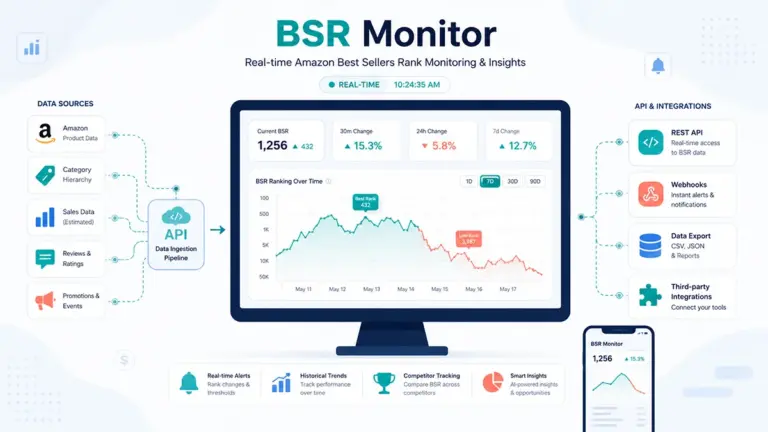
BSR (Best Seller Rank) is the single most important signal in Amazon sales data estimation. Amazon’s BSR is, in essence, a real-time weighted snapshot of recent sales velocity — the higher the rank, the faster recent sales. By building a “BSR range → monthly units range” mapping table, it becomes possible to infer sales for any ASIN.
This mapping relationship follows a pronounced power-law distribution, not a linear curve. In Home & Kitchen, the BSR #1 ASIN might move 50,000+ units per month, while BSR #500 might sell a few hundred, and BSR #10,000 might sell in single digits. This “extreme top concentration” pattern means the conversion coefficient varies enormously across BSR tiers and across categories — which is why applying a single generic BSR conversion table across all categories produces systematically wrong estimates.
Supporting Signals: Review Velocity and Keyword Traffic
Relying solely on BSR creates accuracy problems: BSR fluctuates sharply during promotions, flash sales, and inventory events, making point-in-time sampling unreliable. Review velocity — the rate at which new reviews accumulate over time — serves as a smoother proxy for actual purchase behavior. If the average review conversion rate in a category is around 1.5–2%, and an ASIN added 30 reviews in the past 30 days, the implied monthly sales are approximately 1,500–2,000 units.
Keyword search volume provides a demand-side validation layer. By estimating the total search demand for a category’s core keywords, distributing that demand by click-through rate across ranking positions, and applying an average conversion rate, you can cross-check supply-side BSR estimates against a demand ceiling — a cross-validation that significantly improves confidence when both methods converge.
Where Precision Realistically Lands
To be direct about it: the best current Amazon sales estimate data carries single-ASIN error rates of 15–30% for high-frequency, AI-weighted multi-signal models, and 30–50% for daily-sampling, single-BSR approaches. That sounds imprecise, but it is sufficient for the decisions that matter. You do not need “competitor sold 2,347 units” — you need “this category runs 2,000–3,000 units per month at rank #50, total category demand is around 80,000 units, and top 5 ASINs hold 65% share.” That framework supports a go/no-go sourcing decision with or without fractional precision.
Estimation accuracy scales positively with four factors: BSR sampling frequency (minute-level vs. daily); length of the historical BSR sequence (longer windows calibrate for seasonality); category-specific calibration model quality (BSR-to-sales curves differ by 20x across top-level categories); and signal richness (single BSR vs. multi-signal fusion including review velocity, price history, ad placement frequency).
4. Five Core Business Applications of Amazon Sales Estimate Data
Once you understand the what and the how, the more important question is: which actual business problems does this data solve? Here are the five most impactful applications.
1. Product Research: From Gut Feel to Data-Driven Falsification
Product selection is the highest-stakes, lowest-error-tolerance decision in Amazon operations. A wrong sourcing choice can lock up capital for 6–12 months in slow-moving inventory. The core value of Amazon sales estimate data in this context is not telling you what sells well — it is helping you quickly falsify products that appear to sell well but have limited real demand.
When evaluating a subcategory, the most diagnostic metric is not the top 3 ASINs’ sales (that tells you how strong the incumbent is, not whether you have room to enter). It is the sales distribution of the mid-tier: ASINs ranked #11 to #50. If those ASINs sustain 500+ monthly units, the category distributes enough organic traffic for a new entrant to survive. If the mid-tier collapses below 100 units, this is a winner-take-all category where new entrants face a structural disadvantage. That distinction is impossible to make without sales estimate data.
2. Inventory Planning: Ending the Overstock-Stockout Dilemma
Amazon FBA storage fees escalate sharply with age — items stored beyond 365 days incur monthly fees five times higher than standard rates. Stockouts, on the other hand, cause BSR to collapse: 72 hours of out-of-stock can erase months of ranking momentum. Competitor sales velocity data gives you a reference baseline for your own replenishment planning — how fast the market is moving, what a reasonable inventory turn target looks like, and when a competitor’s apparent BSR dip signals an inventory shortage you can exploit with incremental ad spend.
3. Pricing Strategy: Turning Price Wars into Intelligence Wars
Most sellers interpret pricing competition as a race to the bottom. The more effective frame is matching price to demand elasticity: hold price when demand is strong, promote when demand softens — not mirroring competitor price moves blindly. Amazon sales estimate data is the instrument that distinguishes between a competitor dropping price to clear overstocked inventory (temporary, likely worthwhile to match) versus a competitor lowering price because category demand is structurally declining (trend-driven, matching destroys margin without recouping share). The difference is entirely visible in the competitor’s sales velocity curve around the price change event.
4. Competitive Intelligence: Mapping the Real Market
Competitor analysis that stops at “does their listing look good” or “what’s their review rating” is content benchmarking, not competitive intelligence. Real market mapping answers harder questions: who is actually profitable? Who is burning cash to hold position? Who is quietly exiting? Sales estimate data combined with price and review count lets you approximate a competitor’s monthly revenue. Add an estimated category margin and you can infer whether they are running at profit or operating at a loss — an important signal when assessing whether a category’s competitive dynamics are stable or about to shift.
5. Fundraising and Valuation: Data That Survives Due Diligence
For sellers considering outside investment or an exit, Amazon sales estimate data carries specific strategic weight. The standard acquisition multiple for Amazon businesses is 3–5x annual net profit. Sophisticated acquirers use third-party sales estimate data to cross-verify seller-reported financials — backend screenshots alone will not survive a professional due diligence process. Conversely, when evaluating an acquisition target, historical sales estimation data reveals the full annual operating trajectory, including the off-season troughs that seller-provided screenshots conveniently omit.
5. How New Sellers Can Start Working with Amazon Sales Estimate Data
Understanding the concept is step one. Building the practice is step two. Two practical entry paths follow.
Starting with Free Tools
Keepa is the most valuable free starting point: its BSR history chart covers most major ASINs, the 90-day free window is sufficient to identify recent trend direction, and learning to read it builds the foundational habit of making observations from data rather than impression. Pair it with CamelCamelCamel for price history, and you have a free, serviceable starting kit for early-stage product research. The ceiling of free tools is low — Keepa’s free tier is ASIN-by-ASIN only, with no bulk query capability, and no integration path into any automated workflow — but the habit of using them is worth building before upgrading.
Scaling to Professional Tools and Data APIs
When your research scope expands to systematically evaluating a category — analyzing 50 to 100 ASINs, tracking competitor BSR over time, monitoring pricing events — you need tools that batch and automate. AMZ Data Tracker provides a visual competitor monitoring interface that automatically tracks target ASINs’ BSR, price, and review count, with update frequency significantly higher than traditional subscription tools, and no coding required to set up automated tracking pipelines.
For sellers with technical teams building proprietary Amazon sales data infrastructure — SaaS tools, brand intelligence platforms, data service providers — Pangolinfo Scrape API offers minute-level BSR sampling, 99%+ data collection success rate, and real-time access to Amazon data across all categories and marketplaces. Unlike subscription SaaS, the API model supports pay-as-you-go pricing with no concurrency limits, built for the throughput that category-level analysis actually demands.
For a complete breakdown of how to combine these data sources with specific estimation methods — BSR reverse-engineering, review velocity modeling, multi-signal fusion, and a full walkthrough of the 7 core data types — see our Amazon Sales Estimate Data: Complete 2026 Playbook. It covers the full implementation framework, including AI-enhanced estimation techniques and a checklist of the six most common estimation errors to avoid.
Conclusion
Amazon sales estimate data is not a magic number. It is a structured method for converting publicly available platform signals into actionable competitive intelligence. The value it provides is proportional to the rigor of the estimation approach — sampling frequency, signal diversity, category-specific calibration — and inversely proportional to how literally you take any single output figure.
The right way to use this data is as a decision framework, not a scoreboard. “This category runs 2,000–3,000 units at mid-tier, demand is growing, the top 5 hold 60% share” is a meaningful input to a sourcing decision. “Competitor sold 1,847 units” is a false precision that overstates what the method can actually deliver.
For sellers just starting out, Keepa’s free BSR charts are a perfectly sufficient first tool. As your operations scale and your analysis requirements grow more systematic, the step up to professional monitoring platforms and data APIs becomes a clear leverage point — not just on the quality of individual decisions, but on the velocity and repeatability of the research process itself.
Start tracking competitor sales velocity today with AMZ Data Tracker, or build your own Amazon sales estimate data pipeline with Pangolinfo Scrape API. Free credits on signup, no credit card required.