
Most Amazon Product Launches Fail Not Because the Product Was Bad — But Because the Research Was Wrong From the Start
Every few months, someone in the Amazon seller community shares a “winning product” story: they found an underserved niche, launched, hit the top three in their category within 90 days, and pulled in six figures monthly. What happens next is predictable. Hundreds of copycats rush in. Most of them end up with six months of dead inventory, five-figure ad losses, and product ratings hovering at 3.2 stars.
This is not a coincidence — it is the natural outcome of a flawed research process. A large portion of Amazon sellers make product selection decisions based on instinct and trend-following rather than systematic analysis. The problem is rarely the product itself. It is that sellers enter oversaturated markets without realizing it, underestimate the moat built by established brands, or misread what users actually want versus what they assume users want.
Amazon product selection is fundamentally not about “finding a product that looks like it could sell.” It is about using systematic data analysis to progressively eliminate options with unacceptable risk profiles. Professional product selection does not chase certainty of success — it focuses on improving the probability of success under controlled risk conditions.
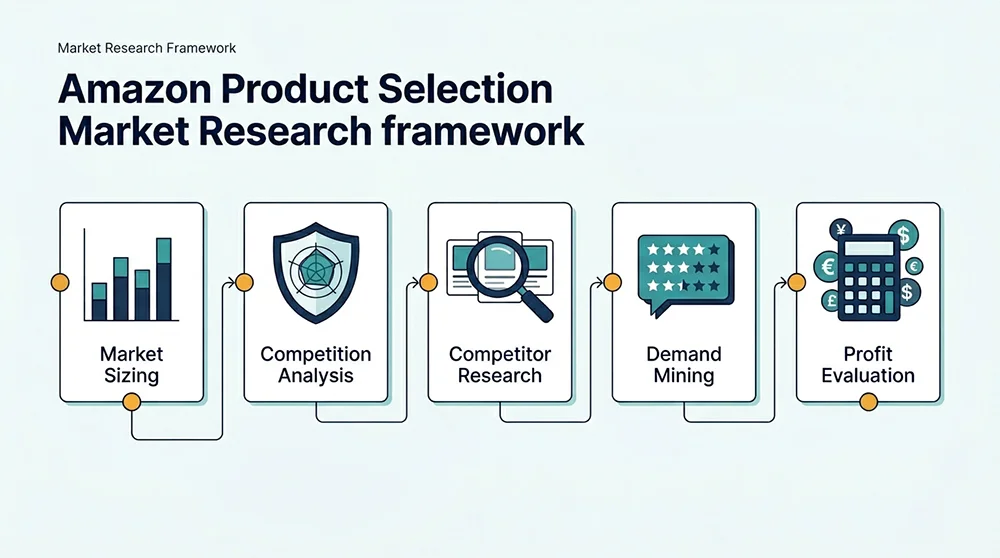
This guide walks through a complete 5-step Amazon product selection market research framework, with specific analytical dimensions and data acquisition approaches for each step, to help you build a reusable, low-emotion, high-probability decision system.
The Core Logic: Five Questions Your Research Must Answer
Before diving into individual steps, it is worth clarifying what the entire framework is designed to answer. A mature market research process is, at its core, a systematic decision logic built for uncertainty. Every step is designed to answer one of five fundamental questions:
First: Can this market support my revenue targets? A market that is too small means even capturing 30% share may not reach basic viability. Second: Can I actually enter this market? Some categories look attractive on the surface, but the review moats of top brands, patent barriers, or Amazon’s own first-party price pressure make new entry economically irrational. Third: If I enter, how do I carve out a position? Identifying the specific differentiation angle that avoids head-on competition with incumbents. Fourth: Is there a genuine unmet need? Real user pain points, not assumed ones, are the foundation of product improvement and sustainable competitive advantage. Fifth: After all costs, will this project actually generate profit?
These five questions map directly to five research modules: market analysis, competition analysis, competitor research, demand mining, and profit and risk evaluation. A decision framework with any module missing is structurally incomplete.
Step 1: Market Analysis — Is This Market Worth Entering?
The goal of market analysis is to establish the basic parameters of a category: Is it large enough? Is it growing or declining? Are there significant seasonal demand cycles? Many sellers skip this step and go straight to competitor research, only to discover they have entered a shrinking market or committed to a product with a two-month peak season — with the cash flow pressure that creates arriving months after the buying decision was made.
Market Sizing
Several dimensions are commonly used to size a market. Aggregating the estimated monthly sales of the Top 100 ASINs in a category gives a rough category volume. Multiplying by average selling price converts that into approximate monthly GMV. The share of total sales captured by the top 10 sellers reveals market concentration — high concentration typically means limited room for new entrants.
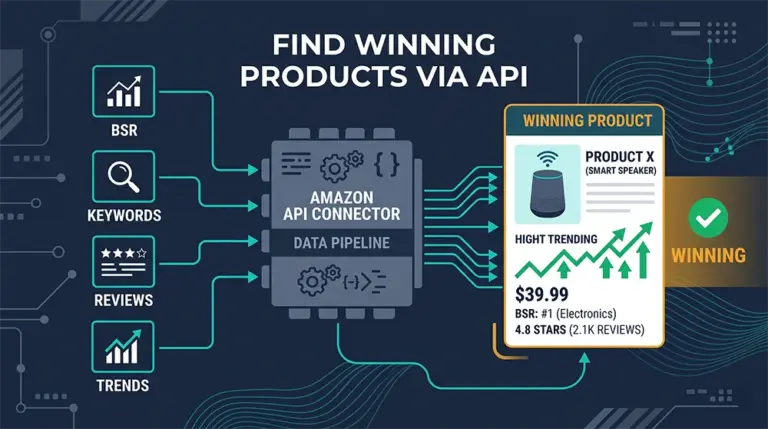
One thing to keep in mind: BSR data is dynamic. What you see today may differ meaningfully from yesterday, and peak-season versus off-season data swings can be dramatic. Relying on screenshots or periodic manual recording makes it nearly impossible to track genuine trend shifts. For sellers who need to monitor multiple categories continuously, using the Pangolinfo Scrape API to batch-collect Amazon category ranking data as time series — updated at minute-level intervals — is far more reliable than being constrained by the fixed dashboards of subscription tools.
Trend Analysis: Search Trends vs. Sales Trends
Search trends and sales trends are two distinct signals that need to be read separately. Search trends reflect the evolution of user demand — Google Trends shows macro-level movement, while changes in Amazon internal search volume reveal platform-specific user behavior shifts. Sales trends are more direct: the BSR trajectory of leading products over the past 12–18 months tells you whether a category is growing, plateauing, or declining.
A common misread: search volume rising while sales are actually falling. This typically signals that seller supply is increasing faster than buyer demand, driving down conversion rates across the category. When the two signals diverge, dig deeper rather than defaulting to one metric.
Seasonal Patterns
The impact of seasonality on inventory and cash flow planning is consistently underestimated. A product whose peak season concentrates in Q4 (October through December) means you need inventory purchased and shipped by August — compressing both cash commitment timelines and logistics logistics pressure into the same window. During off-seasons, insufficient cash reserves often force sellers into markdowns or stockouts, which directly undermines ranking momentum heading into the next peak.
The most direct way to identify seasonal patterns is to review two years of monthly BSR data for leading ASINs, cross-referenced with Google Trends seasonal curves. Building seasonality into financial modeling at the selection stage is far safer than reacting to it after launch.
Step 2: Competition Analysis — Can I Actually Break In?
A large market does not equal an accessible market. Competition analysis addresses the entry barrier question: how friendly, or how hostile, is this category to new sellers?
Brand Concentration
Look at the top 50 results in a category and count how many distinct seller brands appear. Note what percentage of total category sales the top five sellers capture. If the top five positions are all occupied by ASINs from the same brand family, or if the top three sellers each have more than 10,000 reviews, the category is effectively closed to new entrants — not impossible to crack, but the cost of doing so is substantial.
High brand concentration also means ad placements are dominated by incumbents, CPCs tend to run high, new products receive almost zero organic traffic during launch, and cold-start depends entirely on paid promotion. Unless you have a clear product differentiation or supply chain cost advantage, a direct frontal assault on a concentrated category is rarely a sound allocation of capital.
New Product Success Rate
Tracking how new listings launched in the past 6–12 months have performed is a valuable but often overlooked signal. If a category has seen multiple new entrants break into the top 20 within that window, the market is relatively new-seller-friendly. If every new listing has gone to near-zero sales within three months, either the products were poorly executed or — more likely — the market has exhausted its available space for new entrants.
Promotional Difficulty and Cost
Keyword competitiveness, first-page ranking difficulty, and keyword CPC collectively define the cost envelope of promotional investment. Monthly search volume and competition index for core keywords can be sourced through keyword tools. The review count threshold for first-page eligibility (roughly how many reviews a product needs to appear on page one) is a useful proxy for time-to-competitiveness. CPC directly impacts advertising ROI — high CPC means new products will run very high ACOS during launch, requiring deeper capital reserves.
A useful reference benchmark: if average first-page review counts exceed 500, core keyword CPC exceeds $2, and brand concentration is high, the cold-start cost for a new product in that category will exceed the financial capacity of most small and mid-sized sellers.
Step 3: Competitor Research — What Are They Doing, and Where Can You Beat Them?
Competitor research is the most information-dense step in the entire research process — and the one most prone to staying at the surface level. “Competitor analysis” that stops at looking at main images and copying listing keywords is not analysis. Genuinely useful competitor research requires dissecting strategy, not just tactics.
Full-Category Competitor Scan
Systematically scan all competitors across the category, with particular attention to: price distribution (where the mainstream price band sits, and whether any price gaps exist); brand entry timelines (established incumbents versus recent entrants); distribution of style/color/function/attribute combinations (which attribute groupings dominate, which are absent); fulfillment methods (FBA vs. FBM ratio); and rating distribution (category average star rating, percentage of products below 4 stars).
Reading these data points together surfaces category “gaps” — price ranges no one is covering, color or material combinations barely represented, fulfillment approaches with better user feedback. Gaps are not automatically opportunities, but gaps are the starting point for differentiation hypotheses.
Deep Analysis of Top Competitors
Select two to three of the highest-volume competitors for detailed dissection. Product line strategy: does the brand rely on a single hero SKU or does it use multi-variation coverage to capture different user segments? Pricing strategy: how frequently are promotions run, and what is the gap between the displayed price and effective transaction price (via coupons or deals)? Advertising strategy: which keywords are they targeting with Sponsored Products, and are their ad placements concentrated on page-one search results or product detail pages? Brand marketing approach: is there a brand store, how complete is the A+ content, and is there evidence of external traffic sources such as deal sites or social media?
Review analysis on top competitors is one of the highest-value information sources in the entire process. Frequently recurring themes in five-star reviews reveal the core value drivers users genuinely care about. Frequently recurring themes in one-star and two-star reviews are direct product improvement targets. Manually reading through hundreds of reviews is extremely inefficient. Using the Reviews Scraper API to bulk-extract reviews and run keyword clustering analysis surfaces the dominant themes from hundreds of reviews in minutes — a qualitatively different speed and coverage than manual reading.
Successful New Entrant Analysis
Identify two to three sellers who entered the category in the past 6–12 months and have already broken into the top 20. Study their path to traction. Did they differentiate on product features, compete on price, or win through precise keyword targeting and operational execution? The shared characteristics of successful new entrants tend to reveal where the genuine current opportunity window in the market actually sits.
The review accumulation velocity of new entrants is also instructive. How long did it take to go from launch to 100 reviews? Fast accumulation signals strong organic market demand. Slow accumulation suggests high market education costs or insufficient product-market fit.
Failed Competitor Post-Mortem
Studying failure cases is often more valuable than studying success cases. Find two to three competitors that briefly entered the top ranks but then saw sales collapse or go to near-zero. Analyze the failure modes. Common patterns: product quality deficiencies triggering a review avalanche that drives star ratings below 3, crashing conversion rates; pricing strategy errors where initial pricing too high or too low misaligned brand positioning; advertising overreach where runaway ACOS exhausted capital before the product could establish organic momentum; keyword targeting mismatches that drove high-volume but low-intent traffic, generating poor conversion signals in the A9 algorithm.
Failed competitor post-mortems provide inverse calibration signals for your own product and operational strategy.
Step 4: Demand Mining — What Do Users Actually Want?
Demand mining is the user-perspective lens in the research process. Market analysis and competitor research answer “what does the market look like.” Demand mining answers “what do users genuinely want” — which often diverges meaningfully from what sellers assume users want.
Review Deep Analysis
Reviews are, without qualification, the most honest user feedback data source available on the Amazon platform. A 4,000-word product description cannot compete with what 100 authentic user reviews reveal about user psychology and unmet expectations.
Review analysis operates at three levels. Level one: what do users value? — high-frequency positive review keywords reveal the core value proposition that the category delivers (portability, durability, color options, ease of assembly). Level two: what are users dissatisfied with? — negative review keyword clusters surface the pain points present across the current product generation (flimsy construction, unclear instructions, slow charging). Level three: real usage contexts — the specific scenarios users describe in their reviews are raw material for product positioning and listing copy development.
Importantly, analyzing only a single competitor’s reviews is insufficient. Cross-referencing review themes across multiple competitors in the category is what separates category-level user insight from individual product anecdote.
Search Keyword Analysis
Keyword analysis surfaces user demand from a different angle. What users type into the Amazon search bar directly reveals their purchase intent and their mental model of the product they are looking for.
Keyword analysis covers several layers: core keyword search volume and competitiveness (available through third-party keyword tools); long-tail keyword distribution — long-tail terms often reveal more specific user needs, and while their individual search volumes are lower, their conversion rates tend to be substantially higher; and conversion keywords from search term reports — which terms actually drove purchase behavior is the most direct measure of traffic quality.
Combining review analysis and keyword analysis produces a fairly complete “user demand map”: what users search for, and what they say after buying, with the intersection of those two data sets revealing the most actionable product development and operational optimization targets.
Step 5: Profit and Risk Evaluation — Will This Project Actually Make Money?
Even the most thorough analysis in the preceding four steps ultimately must answer one question: will this project generate positive cash flow? Profit modeling and risk evaluation are the final gate in the selection decision, and the step most vulnerable to optimism bias.
Profit Modeling
The standard profit formula: Profit = Selling Price − COGS − Inbound Freight − FBA Fees − Amazon Referral Fee − Advertising − Returns/Losses − Miscellaneous Costs.
Every line item requires real numbers, not estimates. FBA fees can be calculated directly using Amazon’s FBA Revenue Calculator. Referral fees vary by category, typically between 8% and 15%. Advertising costs need to be back-calculated from your target ACOS and expected sales volume. A useful calibration rule: expect new product ACOS to run at two to three times your target ACOS during the first three months. This launch-phase advertising cost needs to be included in startup capital planning, not treated as an expectation that will be achieved from day one.
A healthy profit structure benchmark: pre-advertising gross margin should reach at least 40% to leave sufficient room to cover advertising costs and still generate positive net margin. If gross margin is below 30%, the new product phase is likely to produce persistent losses regardless of how tightly advertising is managed.
Risk Assessment
Risk assessment needs to cover three dimensions. Policy and regulatory risk: Amazon’s category enforcement has tightened considerably in recent years, with some categories requiring certifications or licenses, and periodic crackdowns affecting entire category segments. Black-hat competitive risk: vulnerability to negative review attacks, hijacking, or listing suppression, and the platform’s current enforcement posture toward these tactics. Patent infringement risk: design patent and utility patent exposure is the most frequent legal risk facing Chinese sellers in the North American market.
Patent risk is the most commonly overlooked at the selection stage — and the most devastating when it materializes. A valid patent complaint in the US can result in listing removal, account holds, or broader account consequences. Before moving into product development, run at minimum a basic patent search through the USPTO database or a professional IP service to confirm that the target product’s design and core functionality do not carry obvious infringement exposure.
The Framework in Practice: Using Systematic Analysis to Manage Uncertainty
The Amazon product selection market research process is, fundamentally, a risk filtration mechanism. Each analytical step asks: does this option carry a category of critical risk that eliminates it from consideration? Market analysis filters out categories that are too small or in structural decline. Competition analysis filters out markets with insurmountable entry barriers. Competitor research surfaces the specific differentiation angles that remain viable. Demand mining validates whether the user pain point being targeted is genuinely underserved. Profit modeling confirms economic viability.
What survives all five steps is not “a product guaranteed to succeed.” It is “a direction where, given current available information, risk is relatively controlled and the probability of success is relatively higher than alternatives.” That distinction matters enormously — there is no certainty in product selection, only better and worse probabilities.
For sellers who need to track market dynamics and competitor data on a continuous basis, AMZ Data Tracker provides a visual monitoring dashboard for tracking BSR, pricing, and review changes across key ASINs — transforming market research from a one-time exercise into an ongoing decision support system. For teams with higher-volume or more customized data requirements, Pangolinfo Scrape API enables direct integration into custom analytics systems, supporting full automation from data collection to decision output. API documentation is available at docs.pangolinfo.com.
The quality of your Amazon product selection market research ultimately shows up in your decision quality. A systematic analytical framework does not guarantee a win every time, but it means that at every decision point, you are operating with a materially higher probability of success than competitors relying on intuition alone.
Ready to upgrade your Amazon product research with real-time data? Explore AMZ Data Tracker or visit Pangolinfo Docs to review API integration options.