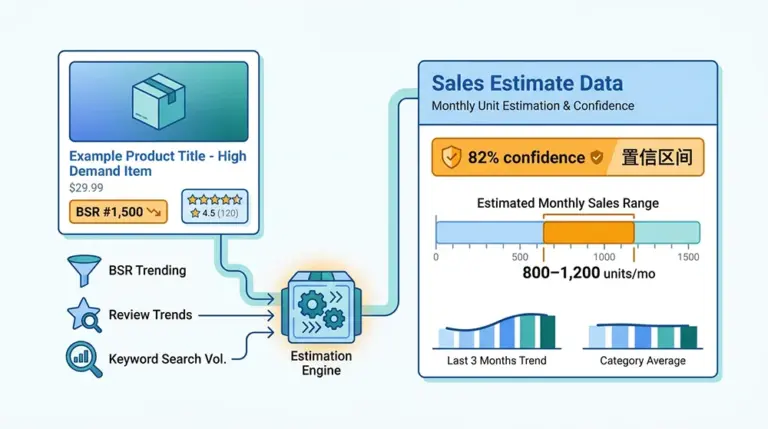


Every product decision on Amazon rests on a number that most sellers have never seriously interrogated: the monthly sales estimate their tool just showed them. How old is that number? Is it from today, or is it a three-week-old snapshot? That distinction is almost never surfaced in the tool interface — and it matters far more than most sellers realize.
Amazon does not publish actual sales data for any third-party seller. This is not a technical limitation but a deliberate business policy. Every Amazon sales tracker tool on the market — Jungle Scout, Helium 10, SellerSprite, or any API-based solution — is producing an estimate. The difference between tools is how they estimate, how recently they collected the data, and how accurately their model translates BSR signals into unit volumes.
This guide starts from that foundation and works outward: first explaining how sales estimation actually works at the data layer, then walking through all five tool categories in detail, then providing a practical selection framework for sellers at different business stages, and finally showing how teams with technical capacity can replace or supplement SaaS subscriptions with a real-time API pipeline. By the end, you will be able to answer one concrete question: given my current business scale and data needs, which Amazon sales tracker tool gives me the best return on investment?
Chapter 1: The Data Logic Behind Sales Estimation
Amazon Never Releases Sales Numbers — Every Tool Is Estimating
Best Seller Rank is the only public signal Amazon provides that correlates meaningfully with sales velocity. Every product that generates sales receives a BSR in its parent category and, usually, one or more subcategories. Amazon updates BSR frequently — hourly for high-velocity categories like Electronics, daily for slower-moving ones like Collectible Coins. Over time, data companies have built statistical models that map BSR positions to approximate unit volumes, using a combination of proprietary seller data partnerships, panel data, and algorithmic calibration.
The result is an estimate that can be directionally accurate in large, liquid categories and significantly off in niche or seasonal ones. A BSR of 500 in Kitchen and Dining might represent 3,000 to 4,000 monthly units; the same BSR in Industrial and Scientific might represent 40 units. Tools that have robust data sets for major US categories often struggle with accuracy in smaller European marketplaces or highly specialized niches where their training data is thin.
Data Freshness: The Underappreciated Variable
Most sellers evaluating an Amazon sales estimator focus on accuracy — they want to know whether the monthly sales number is right. Fewer ask how old it is. In many operational contexts, freshness matters more than precision. A competitor that just launched a promotional campaign last Tuesday has a dramatically different sales profile today than it did last week, but if your tool refreshes data every five to seven days, you are making decisions based on pre-promotion numbers.
The practical consequence shows up in replenishment decisions, competitive response timing, and opportunity identification. Teams that have moved to real-time API-based monitoring report a qualitative shift in their ability to detect competitive movements — not because the estimates became more accurate, but because they became current. Staleness, it turns out, is a bigger source of decision error than model imprecision.
Realistic Error Ranges Across Tool Types
Based on documented comparisons between tool estimates and verified seller account data, the accuracy landscape looks roughly as follows: major SaaS tools like Jungle Scout achieve approximately plus or minus 25 to 30 percent error in high-volume US categories, rising to plus or minus 100 percent or more in niche subcategories. Free BSR-only estimates done without systematic calibration tables can produce errors of 200 to 300 percent. Real-time API data gives you accurate BSR at the moment of query — the estimation model applied to that fresh BSR data carries the same statistical uncertainty as any other tool, but the input signal itself is not stale.
Chapter 2: Five Types of Amazon Sales Tracker Tools
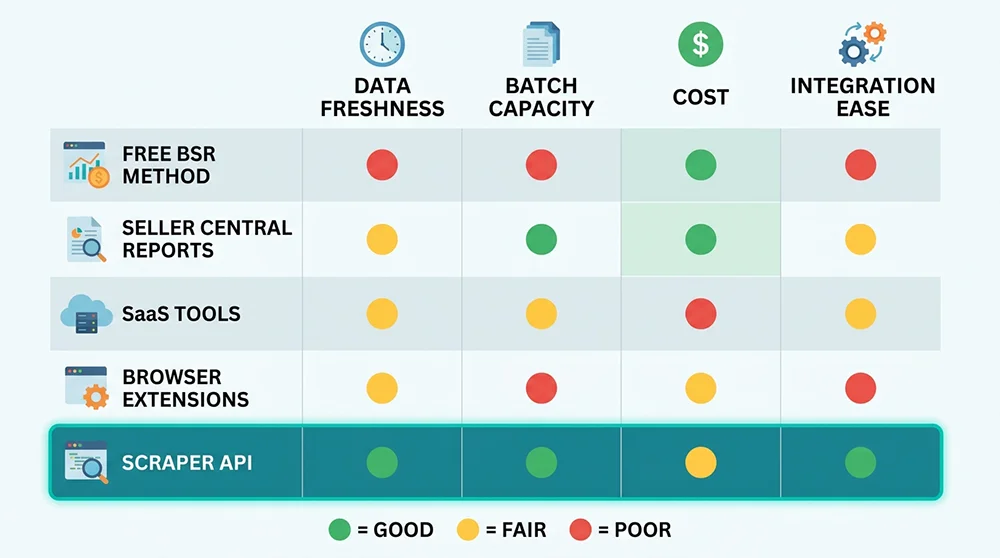
Method 1: Direct BSR Inspection — Free but Coarse
The most accessible Amazon sales tracker approach requires nothing more than visiting a product detail page and reading the Best Sellers Rank field in the Product Information section. Paired with a category-specific BSR-to-sales conversion table — Jungle Scout publishes a free reference on their website — this method can produce a rough monthly sales estimate in under two minutes per ASIN.
The use case is narrow but legitimate: preliminary screening of a large candidate list when you want to quickly eliminate obviously low-velocity products. The limitations are equally clear: no trend data, no batch processing, no monitoring capability. You are seeing a single point in time, not a pattern. For any seller managing more than thirty active ASINs or running systematic competitive research, this method becomes a bottleneck before long.
Method 2: Amazon Seller Central and Brand Analytics
Sellers with active accounts have access to Business Reports inside Seller Central — actual unit and revenue data for their own listings, filterable by day, week, and month, accurate to the real transaction. This is the one place in the Amazon ecosystem where you get genuine sales numbers rather than estimates, but the scope is limited strictly to your own products.
Brand Analytics, available to sellers enrolled in Brand Registry, adds a layer of competitive intelligence through Search Frequency Rank data: how often a keyword is searched relative to others, and which ASINs capture the highest click and conversion share for that keyword. Cross-referencing a competitor ASIN persistent click share in a high-volume keyword with your own conversion rate benchmarks lets you construct rough sales estimates for specific search contexts. It is indirect and imprecise, but it is directionally useful and costs nothing beyond the Brand Registry requirement.
Method 3: SaaS Tools — Jungle Scout, Helium 10, and SellerSprite Compared
These three tools dominate the paid Amazon sales estimator market and share a fundamentally similar architecture: they sample BSR data, apply proprietary estimation models, and present the output through polished interfaces with added features like historical trend charts, opportunity scoring, and competitor tracking lists.
Jungle Scout has built its reputation on estimate accuracy in US categories, claiming a tested accuracy rate based on comparisons against actual seller data. Its Opportunity Finder and product database enable systematic filtering across millions of ASINs by estimated sales, review count, price range, and competition metrics. Pricing ranges from around sixty-nine to one hundred forty-nine dollars per month depending on tier.
Helium 10 packages its sales estimation inside the Xray Chrome extension, which activates on any Amazon search results or product page and displays a real-time overlay of estimated sales, revenue, BSR, and review data for all visible products. Its broader suite — keyword research with Cerebro, listing optimization with Scribbles, and inventory management tools — makes it a natural choice for sellers who want a single subscription covering the full operational workflow. Monthly pricing ranges from roughly ninety-seven to two hundred ninety-seven dollars.
SellerSprite is the dominant Chinese-language option, offering comparable core functionality at significantly lower price points (approximately thirty to eighty USD per month), with stronger localization for Chinese sellers and robust coverage of US, European, and Japanese marketplaces. Data quality is competitive in major categories; niche coverage is slightly thinner than Jungle Scout.
The shared ceiling of all three: daily query volume caps, update cycles measured in days rather than hours, no native API for data integration, and subscription costs that scale poorly when monitoring large numbers of ASINs. A seller tracking five hundred competitors across three marketplaces will spend significantly more on SaaS subscriptions than they would on an equivalent API-based solution.
Method 4: Browser Extensions — Instant Lookup at Page Level
Every major SaaS tool offers a Chrome extension that overlays sales data directly onto Amazon product and search pages. The workflow is fast: you browse normally, and the extension surfaces key metrics without requiring a context switch to a separate dashboard. For a human-paced research workflow — reviewing dozens of products during a selection session — extensions are genuinely efficient.
The hard limit is that extensions are inherently reactive and single-user. They cannot run unattended, cannot schedule batch queries, and cannot generate alerts when a watched ASIN changes status. They are tools for individual research sessions, not systems for ongoing competitive intelligence at scale.
Method 5: Scraper API — The Infrastructure-Grade Solution
When your operational requirements exceed what any SaaS subscription can reasonably deliver — monitoring thousands of ASINs daily, feeding live data into an internal ERP or BI system, providing data services to multiple brand clients — an Amazon sales tracker built on a scraper API becomes the appropriate foundation.
The Pangolinfo Scrape API retrieves real-time Amazon product data — including BSR rankings across main and subcategories, current price, review count, availability status, and Buy Box winner — in structured JSON format. Query volume is metered by actual usage rather than capped by subscription tier, making the per-unit cost substantially lower than SaaS tools at high volume. The API supports concurrent batch requests, enabling a five-hundred-ASIN monitoring run to complete in minutes rather than hours.
Chapter 3: Selection Framework by Business Scale
Early-Stage Sellers: The Zero-Cost Toolkit
If your monthly revenue is below one hundred thousand dollars and you are managing fewer than fifty SKUs, a subscription to a professional SaaS tool is probably not where your next dollar of investment should go. The free toolkit — Seller Central Business Reports, a BSR-to-sales reference table, Keepa free tier for price history, and Google Trends for seasonality — covers the analytical needs of early-stage product research adequately.
The core research workflow: when evaluating a new product, check the main category BSR for a baseline sales velocity estimate, review ninety days of BSR history on Keepa to identify whether the product is in a growth, stable, or declining trend, and cross-reference review growth rate over the past thirty days to validate ongoing demand. Three data points, all available free, covering the essential viability question: is there consistent demand here?
Growth-Stage Sellers: Getting Real Value from SaaS Tools
Between one hundred thousand and one million dollars in monthly revenue, with a catalog of fifty to three hundred ASINs and a small operations team, a SaaS Amazon sales estimator delivers real efficiency gains. The key is understanding what the tool is actually good for versus where its limitations matter.
SaaS tools excel at systematic opportunity discovery — filtering large product databases by defined criteria to surface candidates you would not find by manual browsing — and at trend visualization, which makes seasonal patterns and demand shifts visible at a glance. Where they fall short is in precision at the individual ASIN level (estimates carry meaningful error ranges) and in real-time competitive response (data lags mean you learn about competitor moves after the fact).
The practical implication: use SaaS estimates to identify promising market segments and filter the competitive landscape, not to calculate precise unit economics. Treat a Jungle Scout sales estimate as a directional indicator — is this product in the hundreds-per-month range, the thousands, or the tens-of-thousands? — rather than as an input for precise P&L modeling.
Enterprise Sellers and Data Teams: API as Infrastructure
At the scale where you are monitoring over one thousand ASINs, running multi-marketplace analysis across US, UK, and EU sites simultaneously, or building data products for brand clients, SaaS tool architecture becomes a structural constraint rather than just an inconvenience. Query caps are hit routinely, integration with internal systems requires brittle workarounds, and subscription costs multiply across user seats and marketplace add-ons.
The Pangolinfo Scrape API removes these constraints. Query volume scales with actual need, not subscription tier. Multi-marketplace queries use the same API call structure. JSON output integrates cleanly with Airtable, BigQuery, Snowflake, or any data warehouse. Teams that have made this shift typically report both lower data infrastructure costs and meaningfully fresher competitive intelligence — the two outcomes most impactful for decision quality at scale.
For teams that need visualization and alerting without building custom dashboards, AMZ Data Tracker provides a no-code monitoring and alert layer on top of the API, enabling product managers and operations teams to track BSR, price, and availability changes across monitored ASINs with configurable alert thresholds.
Chapter 4: Building a Real-Time Amazon Sales Monitoring System with API
Python Implementation: Batch ASIN Sales Lookup
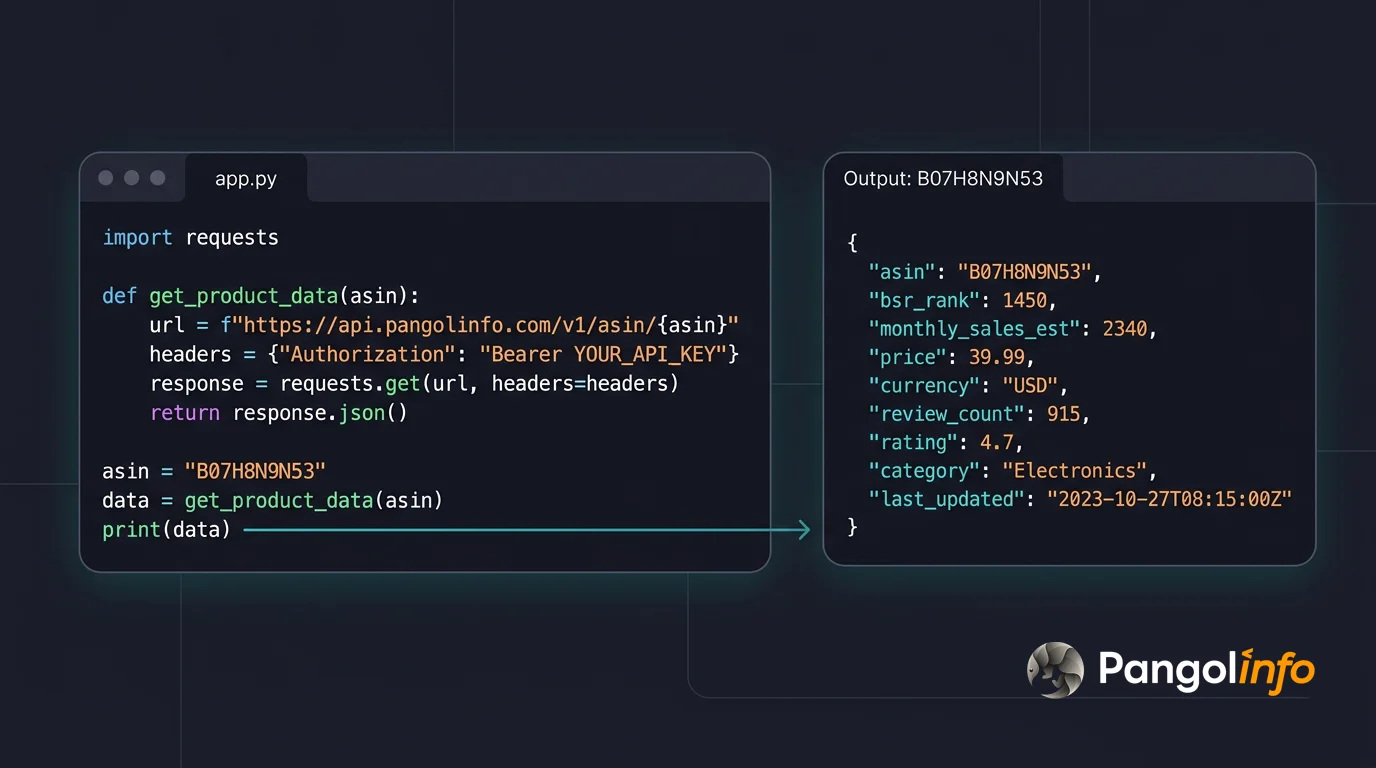
The following complete Python example queries BSR and sales-relevant fields for a list of target ASINs using the Pangolinfo Scrape API:
import requests
import json
import time
from datetime import datetime

API_KEY = "your_pangolinfo_api_key"
BASE_URL = "https://api.pangolinfo.com/v1/amazon/product"

TARGET_ASINS = ["B08N5WRWNW", "B07XJ8C8F5", "B09G9FPHY6"]
MARKETPLACE = "US"

def query_asin(asin):
    headers = {"Authorization": f"Bearer {API_KEY}"}
    payload = {"asin": asin, "marketplace": MARKETPLACE}
    resp = requests.post(BASE_URL, headers=headers, json=payload, timeout=30)
    resp.raise_for_status()
    return resp.json()

# BSR-to-sales conversion table (US Home and Kitchen reference values)
BSR_SALES_TABLE = {100:12000, 500:4000, 1000:2200, 3000:900, 5000:600, 10000:300, 30000:80}

def estimate_sales(bsr):
    if bsr is None:
        return None
    for k in sorted(BSR_SALES_TABLE):
        if bsr <= k:
            return BSR_SALES_TABLE[k]
    return 5

results = []
for asin in TARGET_ASINS:
    try:
        data = query_asin(asin)
        bsr_data = data.get("best_sellers_rank", [])
        main_bsr = bsr_data[0]["rank"] if bsr_data else None
        results.append({
            "asin": asin,
            "timestamp": datetime.now().isoformat(),
            "main_bsr": main_bsr,
            "category": bsr_data[0]["category"] if bsr_data else None,
            "estimated_monthly_sales": estimate_sales(main_bsr),
            "review_count": data.get("review_count"),
            "price": data.get("price"),
            "availability": data.get("availability"),
        })
        print(f"{asin}: BSR={main_bsr}, est_sales={estimate_sales(main_bsr)}")
    except Exception as e:
        print(f"Failed {asin}: {e}")
    time.sleep(0.5)

with open("asin_sales_data.json", "w") as f:
    json.dump(results, f, indent=2)
print("Saved to asin_sales_data.json")
Converting to a Scheduled Monitoring Pipeline
Schedule the above script to run daily via cron or Python APScheduler, persisting results to a lightweight database like SQLite or a cloud warehouse. Compare each day’s BSR values against the previous day’s snapshot — when a monitored ASIN shows a BSR change of more than thirty percent within twenty-four hours, fire an alert via Slack, Feishu, or any webhook-compatible service. This architecture costs a few hours to set up and a fraction of what an equivalent-coverage SaaS subscription would run monthly, while providing both higher freshness and full integration flexibility.
Chapter 5: Common Mistakes and Advanced Techniques
Mistake 1: Reading Current BSR as a Stable Signal
A BSR of 200 today might reflect yesterday’s flash deal, a viral social media moment, or the tail end of a seven-day promotional campaign. Treating it as representative of normal velocity can lead to significant over-forecasting in replenishment decisions. The safest habit is to view any BSR reading in the context of a thirty-to-ninety day trend rather than as a standalone number. Tools that surface rolling average BSR — or a chart where you can visually spot the spike-and-decay pattern of promotional events — give you a much more reliable input for inventory planning.
Mistake 2: Using Sales Volume as the Sole Entry Signal
High monthly sales in a category are a necessary but not sufficient condition for a viable market entry. The more relevant question is: what does the competitive distribution look like? If the top three ASINs hold seventy percent of the category’s estimated sales and each has over three thousand reviews, the addressable opportunity for a new entrant is the remaining thirty percent — which may be far smaller than the top-line category sales figure suggests.
Before treating any sales volume figure as an opportunity, layer in review barrier analysis (how many reviews do top performers have, and at what rate are they accumulating new ones), landed cost and FBA fee modeling, and an honest assessment of whether your product has a meaningful point of differentiation in the eyes of the buyer.
Advanced Technique: Review Velocity as a Sales Cross-Check
For durable goods categories — tools, electronics accessories, kitchenware — review accumulation rate provides a useful second signal for sales estimation that is largely independent of the BSR-to-sales model. The review rate for durable goods typically runs between one and three percent of units sold. A product that gains one hundred fifty reviews in a thirty-day window implies somewhere between five thousand and fifteen thousand units sold during that period.
This method is most reliable in categories where the product form does not encourage repeat purchase from the same user. For consumables and replenishment categories — supplements, pet food, personal care — review rates are typically far lower (well under one percent), and this technique produces unreliable estimates unless you have category-specific calibration data.
Advanced Technique: Multi-Marketplace BSR Comparison
Comparing the BSR of a target ASIN across US, UK, and DE marketplaces simultaneously can surface competitive asymmetries that single-marketplace analysis misses. A product sitting at BSR three thousand in the US — a reasonably competitive position — might hold BSR eight thousand in Germany, which in a proportionally smaller marketplace could represent a similar absolute sales volume with significantly less competition. Teams monitoring multiple marketplaces through an API integration can systematically surface these cross-market opportunities in a way that is impractical using per-marketplace SaaS subscriptions.
Conclusion: Choosing the Right Amazon Sales Tracker Tool
The five categories of Amazon sales tracker tools serve distinct purposes, and the right choice is a function of your operational scale and data requirements — not of which tool has the most impressive demo. Free BSR methods work for early validation. Seller Central data gives you ground truth on your own catalog. SaaS tools accelerate research at growth scale. Browser extensions add speed to manual browsing workflows. API solutions are the only viable foundation once monitoring requirements exceed what any subscription product can deliver.
If your team is already running into the ceiling of your current Amazon sales estimator — whether that means hitting daily query limits, making decisions on week-old data, or paying escalating subscription fees for capabilities you have outgrown — it is worth evaluating an API-based approach. The Pangolinfo Scrape API provides real-time Amazon product data including BSR, pricing, review counts, and availability, queryable at any volume and output in clean JSON. Start with the API documentation to understand the full field set and integration options.
Sales data is one input into a complex decision. But it is the input that most often determines whether a product idea survives contact with the market. Getting that input right — current, accurate, and at the scale your operation demands — is foundational to everything else that follows.
Ready to upgrade your Amazon sales tracking capability? Explore Pangolinfo Scrape API for real-time, scalable Amazon ASIN data.