

The Evolution of MCP E-Commerce Data Architecture in the AI Agent Era
As artificial intelligence transcends the shallow interactive boundaries of natural language processing and officially enters the era of AI Agents—characterized by autonomous execution and complex logical reasoning—the data infrastructure of the cross-border e-commerce industry is undergoing a profound paradigm shift. For years, the traditional Software-as-a-Service (SaaS) model has dominated e-commerce data analytics. These platforms rely heavily on Graphical User Interface (GUI) interactions and cloud-based, pre-calculated, periodically updated static relational databases. However, as Large Language Models (LLMs) evolve into Agents capable of autonomous planning, the structural bottlenecks of traditional SaaS—closed data silos, lagging update frequencies, and rigid analytical frameworks—have become glaringly apparent in multi-step dynamic reasoning, cross-domain information fusion, and real-time decision-making.
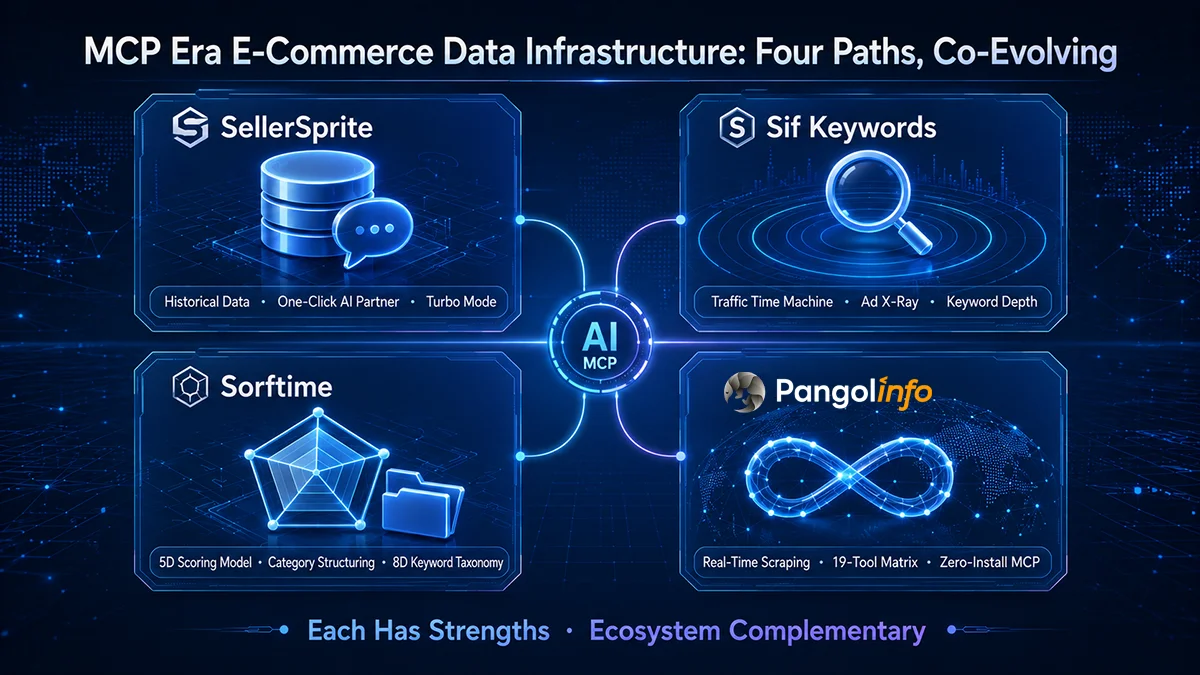
The emergence and standardization of the Model Context Protocol (MCP) present a historic opportunity to shatter these technical shackles. MCP is not merely a data transmission protocol; it acts as the central nervous system connecting LLMs to the external real world, allowing AI Agents to natively discover and invoke professional tools and live data streams. Against this macro backdrop, mainstream e-commerce SaaS providers like SellerSprite, Sif, and Sorftime, alongside emerging universal data infrastructure providers like Pangolinfo, have launched their respective MCP solutions or underlying API architectures.
This research aims to systematically deconstruct and compare the technical pathways, underlying logic, and commercial applications of these four representative tools under the MCP framework. Our deep-dive analysis reveals that while traditional SaaS tools have encapsulated MCP interfaces to grant LLMs preliminary access, their core architectures remain deeply constrained by the inertia of static databases and pre-set methodological frameworks. In stark contrast, Pangolinfo—with its zero-install, remote HTTP streaming architecture and extreme high-concurrency real-time scraping capabilities—has completely transcended the “SaaS replacement” narrative. By examining the global operational complexities of enterprise giants like DJI, this report will definitively prove that in the future AI Agent ecosystem, Pangolinfo is not a competitor to traditional SaaS, but rather an indispensable, foundational data engine and sensory pipeline required to build omnichannel competitive moats.
The Architectural Mapping and Era Limitations of Traditional SaaS MCPs
When evaluating the MCP transition of mainstream e-commerce tools, a core architectural phenomenon emerges: the vast majority of traditional SaaS MCP services are merely Language User Interface (LUI) mappings of their existing static relational databases. While this wrapper model significantly lowers the barrier for users to access proprietary platform data in the short term, it inherently passes on the system’s legacy limitations—staleness, rigidity, and confined exploration boundaries—to the AI Agent.
SellerSprite MCP: A Static Data Probe Bound by Token Constraints
SellerSprite explicitly defines its MCP service as a “universal toolbox connector” linking LLMs with its proprietary Amazon database. Its primary goal is to replace the outdated, cluttered, and unstructured web information found in basic AI chats with precise, highly structured e-commerce metrics. From a deployment perspective, SellerSprite’s MCP demonstrates strong ecosystem adaptability, supporting clients ranging from Chatbox, Cherry Studio, and Claude Desktop to customized Coze agent platforms. Connection is established by injecting a Secret Key into a remote HTTP pipeline.
However, a deep dive into the System Prompts and Operational Protocols hardcoded into SellerSprite’s MCP reveals deep structural limitations in the Agent era. To mitigate exorbitant Token consumption and prevent API timeout errors when processing massive e-commerce datasets, SellerSprite forcibly injects a “Turbo Mode” directive at the architectural level. This mandatory protocol strictly caps the data retrieval size (Size Limit) for tasks like ASIN diagnosis or keyword research to a mere 10 items. Furthermore, the system explicitly bans the AI from outputting raw JSON data, forcing it to extract only the top 3 to 5 metrics and condense them into highly simplified tables. To ensure compliance and suppress AI hallucinations, the prompt mandates a strict “Telegraphic” output style—professional, objective, and aggressively minimalist—rejecting any generalized operational advice. Analytically, the LLM is forced to anchor its logic solely on the injected “Current Runtime” timestamp to judge seasonality.
The secondary effect of this highly optimized, rigid design is the severe castration of the AI Agent’s autonomous reasoning and macro-data mining capabilities. In true data science, statistical significance relies on cross-referencing massive datasets. When data throughput is forcefully choked to 10 rows per call, the LLM devolves into a basic database query translator. It is stripped of its ability to process long-tail data, identify weak market signals, and perform multi-dimensional cross-validation. Additionally, the mandated parallel execution rules (forcing simultaneous calls for asin_detail, traffic_source, and traffic_keyword) lock the AI into a rigid Standard Operating Procedure (SOP). The model cannot dynamically adjust its exploration path based on anomalous intermediate findings. Ultimately, SellerSprite’s MCP is a shallow encapsulation; its data freshness, breadth, and deductive depth remain firmly imprisoned within the update cycles and scheduling constraints of its proprietary cloud database.
Sorftime MCP: Logical Ossification Under Pre-set Methodologies
If SellerSprite’s MCP is constrained by Token costs and query pipelines, Sorftime’s limitations stem from its extreme reliance on its proprietary product-selection methodologies. Sorftime defines its MCP as an intelligent service component built upon its enterprise API and Claude Skills. Instead of merely exposing raw query endpoints, Sorftime has deeply hardcoded five core analytical skills into its MCP server: single-item Listing penetration analysis, full-category selection logic, 8-dimensional keyword research, user review sentiment mining, and LLM-driven product research.
Sorftime’s architecture embeds human expert evaluation standards directly into the server logic. The most prominent example is its 100-point “Five-Dimensional Scoring Model.” When an Agent executes a category selection task, Sorftime’s MCP automatically calculates scores across five fixed dimensions: Market Size (20 pts), Growth Potential based on 1P share (25 pts), Competitive Intensity (20 pts), Entry Barrier (20 pts), and Profit Margin (15 pts). Based on this rigid mathematical framework, the system feeds qualitative conclusions (e.g., “Excellent,” “Enter with Caution”) directly to the LLM.
In its data processing pipeline, Sorftime enforces extreme structural outputs. Its keyword research tool gathers up to 1,500 words but forces the LLM to categorize them strictly into 8 preset dimensions (Negative, Brand, Material, Scenario, Attribute, Function, Core, Other). Its review analysis relies on a 6-dimensional pain point framework with strict, pre-set risk thresholds (e.g., triggering a danger alert if complaints about defective items exceed 5%).
However, this extreme operationalization is Sorftime’s Achilles’ heel in the Agent era. In this highly modular, threshold-bound architecture, the AI’s autonomy is completely usurped. The LLM acts merely as a natural language formatter and multi-format report generator (Markdown, Excel, HTML). Real commercial environments are highly non-linear and multidimensional. When a seller faces complex challenges requiring the fusion of off-site social media trends, global IP disputes, or supply chain fluctuations, Sorftime’s rigid methodological framework fails to provide insights beyond human experience, instead acting as a cognitive straitjacket for the AI Agent.
Sif Keywords: Extreme Traffic Deconstruction and the Shift of Underlying Scraping
The technical evolution of Sif provides a highly forward-looking case study in e-commerce data architecture. Founded in 2021 as the industry shifted from a high-growth dividend era to a hyper-competitive zero-sum game, Sif pioneered a keyword-centric operational framework. By introducing highly innovative features like the “Ad X-Ray” and “Traffic Time Machine,” Sif achieved total transparency over Amazon’s organic search, PPC ads, Deal events, and recommendation algorithms, allowing top-tier sellers to reverse-engineer competitor traffic strategies dynamically.
The core technical hurdle in reconstructing these massive traffic pathways in microscopic time-slices isn’t front-end UI design or algorithmic modeling—it is the continuous, stable acquisition of high-frequency, high-fidelity raw web data to fuel the backend engines. As anti-scraping technologies (browser fingerprinting, dynamic CAPTCHAs, behavioral tracking) become increasingly draconian, maintaining an in-house global scraping engine with low ban rates and high concurrency is financially and technically unsustainable for most application-layer SaaS companies.
This brings us to a critical industry revelation: to power its massive Traffic Time Machine, Sif deeply integrated Pangolinfo’s Scrape API matrix into its underlying architecture. This allows Sif to bypass geographical ZIP code restrictions and execute immense concurrent scraping tasks with extreme DOM structure fidelity. Sif’s trajectory represents the future of SaaS: top-tier application tools are hyper-focusing on data cleansing, algorithmic modeling, and industry methodologies, while outsourcing the brutal, computationally expensive, and technically punishing task of real-time web scraping to enterprise-grade underlying data hubs like Pangolinfo. This symbiotic division of labor lays the logical foundation for Pangolinfo’s MCP positioning.
Pangolinfo MCP: High Grab Rates, Real-Time Flexibility, and the Technical Moat
Understanding how traditional SaaS platforms map static databases via MCP and how application layers are bottlenecked by data acquisition immediately reveals the technical moat of Pangolinfo. Pangolinfo never intended to be a terminal SaaS product with flashy dashboards or rigid SOPs. Instead, it packages its battle-tested, high-fidelity, cross-platform real-time web scraping capabilities into a zero-code, zero-dependency remote HTTP streaming architecture, natively empowering any MCP-compatible AI client.
Zero-Install Remote HTTP Architecture and Geek-Level Client Ecosystem
Traditional SaaS MCP setups often require users to execute complex command-line installations (like npm install) on local terminals or cloud servers, creating massive friction and dependency conflicts. Pangolinfo’s architecture radically disrupts this by entirely abandoning local execution environments. Users simply insert a single remote Streamable HTTP URL (https://mcp.pangolinfo.com/mcp) and a long-term Bearer API Key into their client’s mcp.json file. This pure remote-hosting model ensures the Agent always accesses the latest API version and eradicates local environment crashes.
This minimalist deployment seamlessly penetrates the core ecosystem of developers and automation engineers. Pangolinfo natively supports 7 mainstream and bleeding-edge AI clients: Claude Code, Cursor, Cline, Windsurf, Codex, Hermes, and OpenClaw.
When cross-border e-commerce data is directly accessible within an AI-driven IDE like Cursor, operational boundaries vanish. Advanced analysts no longer suffer the fragmented workflow of exporting CSVs from closed SaaS dashboards to run Python scripts. In the Pangolinfo ecosystem, an AI Agent can be instructed via natural language to fetch real-time competitor Best Seller lists, autonomously write a Python regression script to clean the resulting JSON stream, and directly inject the insights into the company’s internal PostgreSQL database or ERP system. This seamless fusion of raw data acquisition, code generation, and multi-step automation is a generational leap over closed SaaS dashboards.
A 19-Tool Matrix Crossing Single-Domain Boundaries
While traditional SaaS vision is confined to Amazon’s internal metrics, Pangolinfo arms Agents with a matrix of 19 specialized, real-time data extraction tools. This unprecedented network extends beyond Amazon to encompass intellectual property, offline physical geographies, and frontier AI search engine mechanics, granting the Agent true real-world commercial awareness.
Module 1: Amazon Core Data Deep Dive (5 Tools). Allows the Agent to extract unfiltered e-commerce realities. Tools like search_amazon and get_amazon_product bypass severe anti-bot mechanics instantly, returning deep JSON structures including BuyBox prices, hidden backend attributes, A+ content, and full variant matrices. Crucially, the get_amazon_reviews tool breaks frontend pagination limits, pulling highly granular datasets including “Verified Purchase” tags, Vine Voice identifiers, helpful votes, reviewer geographies, and raw media links. These raw datasets provide a level of precision for LLM sentiment analysis that pre-digested SaaS summaries cannot match.
Module 2: Dynamic Category Reconstruction and Niche Filtering (8 Tools). Transcends Amazon’s rigid Browse Node taxonomy. Advanced tools like filter_niches and filter_categories empower the Agent to run dynamic, SQL-level queries combining dozens of metrics based on real buyer intent. Parameters span from traffic (searchVolumeT90Min) and monopoly risk (top5BrandsClickShareMax) to operational viability (successfulLaunchesT360 and avgOosRate). The AI can dynamically reconstruct category trees and pull live list_bestsellers snapshots, replacing lagging weekly SaaS reports.
Module 3: SERP Engine and AI Frontier Tracking (3 Tools). As Generative AI (like Google’s AI Overviews) reshapes traffic distribution, Pangolinfo’s ai_search tool allows the Agent to pull real-time AI Mode text summaries, precise citation networks, and even Base64 full-page visual screenshots in milliseconds. This empowers the LLM to reverse-engineer “Rank Zero” algorithmic logic and citation weights, while simulating localized queries (using UULE parameters) for cities like New York or Tokyo.
Module 4: IP Compliance and Offline Spatial Mapping (3 Tools). This module shatters the e-commerce data silo. The wipo_search tool directly interfaces with the World Intellectual Property Organization’s global database, allowing the Agent to screen cross-border trademark infringement risks in real-time. The pacer_search tool dives into the US Federal Court’s electronic records, reconstructing the entire litigation history of patent trolls to strip away massive legal risks. Finally, search_local_maps extracts real-time Point of Interest (POI) data streams—including operating hours, exact street addresses, and local sentiment—from specific zip codes, providing a physical spatial coordinate system for omnichannel brand distribution.
Six Pre-set Workflows and Autonomous Orchestration
To reduce the cognitive load of managing 19 discrete tools, Pangolinfo provides 6 battle-tested prompt workflows: Single ASIN 360° Audit, Blue Ocean Keyword Scan, IP Infringement Pre-check, AI Traffic Entry Analysis, Full Seller Catalog Mapping, and Offline Store Coverage.
Powered by a built-in “Auto-Validation & Discovery” mechanism, the AI Agent exhibits astonishing autonomous chaining capabilities. Without requiring human API manuals, the Agent dynamically reads format constraints. In a typical workflow, the LLM can extract a brand name using get_amazon_product, autonomously pass that entity into wipo_search for global trademark screening, and seamlessly feed suspicious matches into pacer_search to verify past federal litigation histories—all in one uninterrupted, autonomous logic chain. This fluid, multi-domain cross-validation is impossible for traditional SaaS tools bound by hardcoded analytical paths.
Real-Time Zero-Latency Infrastructure
The foundation supporting these chain-invocations is a backend infrastructure built for extreme scale. Pangolinfo processes over 30 million cross-border data requests daily, maintaining a staggering 99.9% success rate with an average response latency of under 3 seconds. This requires a massive technical middle-office featuring automated CAPTCHA bypassing, intelligent rotation of millions of global residential IP proxies, and self-healing ML algorithms that adapt to Amazon’s frequent DOM structure mutations.
Mathematically, the accuracy of an AI Agent’s decision-making is strictly bound by data decay. We can approximate Agent accuracy as a limit function: $E_{agent} = \lim_{\Delta t \to 0} f(D_{real-time}) \times \sum (W_i \cdot C_i)$, where $\Delta t$ represents the system latency from the real-world event to the AI inference execution. By utilizing a brute-force, pure real-time on-demand scraping architecture, Pangolinfo pushes $\Delta t$ to near-zero millisecond network limits. This asymmetric advantage eradicates the “hallucination by outdated data” flaw inherent in static SaaS databases, providing absolute mathematical assurance for precise AI decision-making.
DJI Global Case Study: Redefining the Fundamental Commercial Cognitive Boundaries of AI Agents
To truly grasp the ecological divide between Pangolinfo and traditional SaaS in the Agent era, we can sandbox the highly complex global operations of the tech hardware titan DJI (Da-Jiang Innovations). Dominating the global consumer drone and professional gimbal markets, DJI’s operational challenges far exceed the elementary needs of small sellers tracking BSR fluctuations or basic ad conversion rates. Their strategic focus centers on circumventing international patent trolls, maintaining global offline retail price parity, optimizing “Rank Zero” AI search reputation, and fusing online marketing with physical distribution networks.
If DJI’s legal, PR, and e-commerce Agents relied solely on MCP services from traditional SaaS, they would suffer from fatal blind spots. While SaaS can cleanly chart the 9-month sales trend of a competitor’s micro-drone or deconstruct PPC bid structures, DJI’s existential risks do not lie in selling a thousand extra units on Amazon. The real threats are hidden in obscure legal jurisdictions and physical retail networks. By integrating Pangolinfo’s MCP architecture, DJI’s Agents gain an asymmetric, multidimensional strategic defense capability:
- Instant Penetration Warning for Patent Litigation: Before a new drone launches, DJI’s legal Agent triggers the
pacer_searchtool, bypassing e-commerce entirely to dive into US Federal Court records. The LLM extracts historical lawsuits filed against similar flight-control algorithms, analyzes the plaintiff’s litigation patterns, and reconstructs the historical timeline of patent trolls, mitigating catastrophic legal injunctions before mass production begins. - Global Multi-Jurisdiction Trademark Radar: The brand management Agent utilizes
wipo_searchto autonomously track global trademark filings. It cross-references phonetic similarities or visual logo similarities across emerging markets (like Latin America or the Middle East), instantly intercepting malicious trademark squatting by gray-market distributors—a strategic vision entirely invisible to pure e-commerce SaaS platforms. - Holographic Validation of Omnichannel Physical Retail Networks: DJI’s sales heavily rely on premium physical experiences (e.g., Best Buy). Using the
search_local_mapsPOI tool, the channel expansion Agent can bombard specific zip codes (e.g., Frankfurt or Los Angeles) to extract exact coordinates, operating hours, and localized Google reviews of authorized dealers. The Agent cross-references this real-world spatial data with online pricing to detect rogue distributors dumping inventory or providing subpar warranty service offline. - AI Zero-Ranking Interception and Content Ecosystem Guidance: As users increasingly ask Google AI for “the best entry-level drone,” AI Overviews dictate top-of-funnel traffic. The
ai_searchtool allows DJI’s PR Agent to capture exact AI-generated answers and reverse-engineer the specific tech blogs, YouTube videos, or Reddit threads the AI cited as its source of truth. Armed with this algorithmic citation map, DJI can precisely deploy PR content to high-weight nodes, manipulating the AI’s training ecosystem. The ROI of this asymmetric strategy vastly outperforms burning cash on Amazon PPC.
This DJI case study conclusively proves that in an enterprise data ecosystem, Pangolinfo is not a zero-sum competitor to SaaS methodologies. It is a highly independent, foundational sensory pipeline providing real-time, cross-domain situational awareness to the LLM.
Industry Panorama: A Deep Comparative Analysis of the Four Major MCP Tools
To provide industry decision-makers with a crystal-clear understanding of the technical pathways of these tools, we have synthesized a high-density comparative matrix across core architectural parameters:
| Evaluation Dimension | SellerSprite MCP | Sorftime MCP | Sif (with Pangolinfo API) | Pangolinfo MCP |
| Data Engine Foundation | Internal private cloud clusters; highly structured historical static databases. | Enterprise-level aggregated database APIs, deeply cleansed internally. | Internal historical keyword database powered by Pangolinfo’s massive real-time scraping API engine. | Global, dynamic, anti-blocking real-time network extraction and adaptive parsing engine. |
| Response Latency | Step-by-step batch processing (e.g., weekly/daily updates) with inherent synchronization delays. | Heavily dependent on the underlying table update frequency of its cloud database. | High-speed traffic reverse-engineering, heavily reliant on Pangolinfo’s high-fidelity page rendering. | Absolute Zero-Latency; every LLM request triggers real-time scraping actions. |
| Tool Scale & Boundary | Conservative design; restricted to basic ASIN details, traffic sourcing, and conventional keyword retrieval. | 5 highly structured core business workflows based on rigid expert methodologies. | Focuses on granular traffic network transparency, deep search term expansion, and ad placement mapping. | 19 cross-domain tools spanning deep e-commerce data, local maps, IP compliance, and AI SERP tracking. |
| AI Autonomy | Extremely Low. Prompts force table outputs, limit results to 10 items, and strip raw JSON metadata. | Low. The model is confined to a mandatory 100-point scoring system and 5-dimensional/8-dimensional frameworks. | Medium. Offers high resolution within the finite scope of traffic structure causality analysis. | Unlimited. AI accesses raw, unadulterated real-time JSON streams, autonomously determining analytical paths. |
| Cross-Domain Capability | Strictly on-site Amazon data; completely lacks external IP compliance or physical entity mapping. | Focused exclusively on on-site category competition; no external legal or physical business defense data. | Focused on on-site multi-dimensional ad traffic deconstruction; no external long-tail data domains. | Natively integrates global WIPO trademarks, US PACER patent litigation, and Google Maps offline POI. |
| Client Compatibility | Geared towards out-of-the-box chat interfaces like Chatbox, Coze, and Cherry Studio. | Relies on Claude desktop and highly customized, closed-system Skills frameworks. | No standalone public MCP protocol endpoints; focused entirely on SaaS dashboard monetization. | Highly geek-friendly; seamlessly integrates with Cursor, Windsurf, Claude Code, Cline, and other IDEs. |
| Ultimate Strategic Position | Application-layer monetization tool for private siloed data, adapted as a shallow natural language plugin. | Secondary logical interface encapsulation of advanced Amazon product selection methodologies. | High-margin, visually appealing data dashboard platform backed by high-compute traffic algorithms. | Pure, invisible underlying data conduit focused on breaking global anti-scraping defenses and cleaning raw data. |
Strategic Foresight and Industry Restructuring
As the LLM-driven cognitive revolution sweeps across global commercial supply chains, the traditional paradigms of e-commerce data acquisition and application are undergoing an irreversible structural deconstruction.
The first wave of MCP integration initiated by traditional SaaS giants like SellerSprite and Sorftime was essentially a defensive maneuver—a “UI retention war” designed to protect their high-margin private data moats. By deploying airtight system prompts and rigid mathematical constraints, they forcefully domesticated LLMs into obedient, formatted report generators. While this satisfies the lazy demand for “one-click conclusions” and solves the UI friction of clunky dashboards, it fundamentally neuters the true power of AI. The revolutionary potential of LLMs lies not in formatting Markdown tables, but in their boundless capacity for cross-domain heterogeneous data association, emergent causal reasoning, and real-time adaptability to unknown commercial chaos. Imprisoning an Agent inside a lagging, single-dimensional relational database is a systemic tragedy for AI capabilities.
Sif’s strategic decision to quietly plug into Pangolinfo’s massive real-time scraping engine proves a brutal truth in today’s cutthroat e-commerce landscape: the extreme freshness, unadulterated purity, and zero-latency acquisition of foundational raw data is the sole bedrock determining the accuracy and survival of any upper-layer algorithmic model.
At this historical juncture, the emergence of the Pangolinfo MCP architecture represents a violent downward shift in global data infrastructure, transferring the power of AI development from closed SaaS platforms directly into the hands of full-stack developers, growth hackers, and enterprise Agent networks. By utilizing an ultra-lightweight remote HTTP protocol, Pangolinfo absorbs the devastating complexities of the dark web’s anti-scraping wars—dynamic IP routing, CAPTCHA reverse-engineering, and DOM self-healing—into an invisible backend black box. In return, it streams the purest, most comprehensive commercial data (spanning Amazon depths, WIPO trademarks, PACER lawsuits, and Google Maps geographical POIs) directly into the neural networks of modern IDEs like Cursor and autonomous cloud Agents.
For global titans like DJI, and for the rising class of super-sellers aiming to operate as a “one-person multinational corporation” via Agent swarms, the future is clear. Traditional, experience-bound SaaS tools will inevitably be downgraded to “Copilots,” relegated to managing routine dashboard reporting and basic operational SOPs. Meanwhile, Pangolinfo will act as the “all-weather nuclear-powered sensory engine”—the indispensable, raw data conduit that breaks the human cognitive silo, allowing AI Agents to execute lethal risk assessments, unearth hidden cross-border intelligence, and drive autonomous, paradigm-shifting strategic decisions in the real world.