

Why mine reviews
Reviews are the largest structured-voice dataset a seller will never read. A listing with 5,000 reviews contains a complete product requirements document — written by buyers, in their own words, ranked by how many found each point helpful. Nobody reads it because nobody can.
Review mining is the conversion of that unstructured corpus into structured signals: which product aspects draw praise, which draw complaints, how the balance shifts over time, and how your profile compares to competitors’. The output is not sentiment scores. The output is decisions: which defect to fix first, which feature to advertise, which competitor weakness to exploit.
Three demand types drive the investment. Product teams mine reviews for defect discovery and roadmap input — the complaint themes are the backlog, pre-prioritized by frequency. Brand operators mine for early warning: a new defect pattern appears in reviews weeks before it shows up in return rates. Category managers mine competitors’ reviews, because a rival’s 1-star themes are a free teardown of their product.
The business value of complaint detection
If review mining is the research function, complaint detection is the alarm function. It watches the review stream for specific failure signatures:
- Defect outbreaks. A manufacturing batch goes wrong; 1-star reviews mentioning the same failure mode cluster within days. Detection latency determines the size of the response window: days of lead time mean a listing note and a supplier call; weeks of delay mean a returns wave and a permanent 1-star tail that suppresses conversion for months.
- Safety signals. Words like “fire,” “burn,” “shock,” “choke,” “allergic” in reviews are liability events, not product feedback. They need same-day triage, not a quarterly report.
- Counterfeit and quality drift. “Not like the original,” “packaging different,” “smells like chemicals” clustering on your own listing can indicate commingled-inventory counterfeits or a supplier quietly substituting materials.
- Review-bombing and attack patterns. Sudden 1-star velocity from unverified purchases with similar phrasing is a different event from organic dissatisfaction and demands a different response.
Amazon itself validates the premise at the fulfillment layer: its Project P.I. system uses generative AI and computer vision to scan products for defects before dispatch, and a multi-modal LLM reviews customer feedback to investigate root causes when defects slip through (reported by SiliconANGLE, Fast Company, 2024). Sellers don’t have imaging tunnels. Reviews are their sensor.
The difficulties
Reviews are unstructured. Ratings are structured; the signal is not. A 3-star review can contain a critical defect report (“works but the handle gets dangerously hot”); a 5-star review can contain a complaint (“love it, though the app crashes constantly”). Aspect-level analysis is required — document-level sentiment is nearly useless for product decisions.
Rating ≠ sentiment ≠ severity. The three variables move independently. Complaint detection must score severity, not sentiment: a polite 2-star review describing a fire hazard outranks an angry 1-star review about slow shipping.
Fake and incentivized reviews are noise. (verified: the official Review API page confirms verified-purchase status and helpful-votes fields, plus a Verified Purchase Filter) Verified-purchase flags and helpful-vote counts are the standard noise filters; unverified review bursts need separate handling.
Multilingual reality. US listings accumulate Spanish reviews; EU listings mix five languages. A lexicon built for English misses the complaint entirely.
Amazon’s anti-scraping posture. Review pages are among the hardest targets: aggressive rate limiting, CAPTCHAs, layout changes. Every self-built review collector pays this maintenance tax permanently.
Where current solutions fall short
- SaaS review tools watch your own listings in their dashboard. They rarely offer programmatic access, and they never cover competitors’ listings at API scale.
- Generic sentiment APIs (cloud NLP services) score polarity. They don’t know what “the zipper broke after two weeks” means for a luggage seller versus a jacket seller — e-commerce aspect semantics are absent.
- Manual reading doesn’t scale, isn’t recorded, and samples the most recent reviews rather than the most representative ones.
- Amazon’s own Brand Analytics covers your brand’s search terms, not the review corpus, and nothing about competitors.
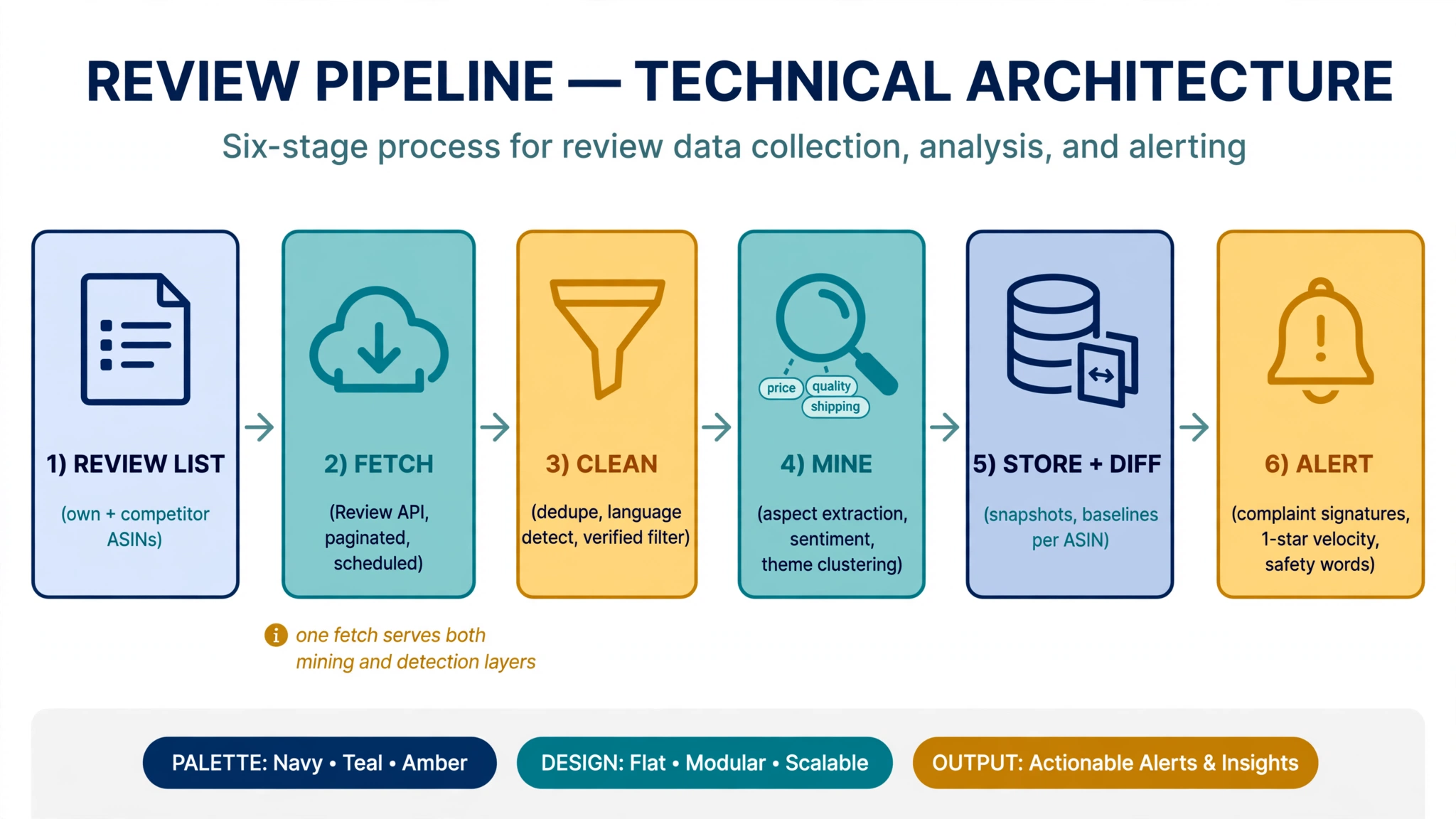
System architecture: fetch → clean → mine → alert
Review list (own ASINs + competitor ASINs)
        → Fetch (Review API, paginated, scheduled)
        → Clean (dedupe, language detect, verified filter, spam heuristics)
        → Mine (aspect extraction → aspect-level sentiment → theme clustering)
        → Store + diff (snapshots, baselines per ASIN)
        → Alert (complaint signatures, 1-star velocity, safety words)
One fetch serves both layers: the mining pipeline and the complaint detector read the same review stream. This is the architectural fact the whole guide follows from.
A reproducible monitoring protocol — the part worth citing
Most review-monitoring advice can’t be checked: thresholds without baselines, “spikes” without sampling schedules. Below is a fixed protocol. Anyone running it on the same ASINs gets comparable numbers — which is what makes it citable.
Fixed parameters. ASIN list (own + competitors, labeled A/B/C if anonymized), marketplace, pages per ASIN (3 for detection, full depth for mining), sampling time (daily, 02:00 UTC), tool version pinned.
Published formulas.
- 1-star rate = rating_1 / review_count (per snapshot)
- Negative ratio = (rating_1 + rating_2) / review_count
- Baseline = median of the trailing 30 daily snapshots (median, not mean — robust to single-day bursts)
- Alert rule: current 1-star rate > 1.5 × baseline AND at least 3 new 1-star reviews in the window
Open data. The SQLite database (review_stats + review_history tables) and the generated report are committed to the repository daily. Anyone can recompute every number in this guide from that file — no hidden steps.
What this doesn’t claim. One ASIN’s curve doesn’t prove category trends; lexicon sentiment is transparent but crude; safety-word scanning on aggregated theme words catches only frequent terms (per-review scanning needs raw texts — see the code section).
Next: a 7-day real sample. The protocol above is the citable asset today. Running it for 7 days on fixed ASINs produces the continuous-monitoring chart this topic deserves — 1-star rate and negative ratio over time, computed exactly as above. That chart plus its data appendix is the single highest-value addition a follow-up edit can make. Sampling spec: 3 fixed ASINs, US marketplace, 3 pages each, daily 02:00 UTC, commit DB + report daily.
Signal design for complaint detection
Four signal classes, each with its own threshold logic:
- 1-star rate spike. Baseline per ASIN (e.g., trailing 30-day 1-star share); alert when the 7-day rate exceeds baseline by a set margin. This is the smoke alarm — sensitive, noisy, never ignored.
- Defect lexicon hits. A maintained dictionary of failure-mode phrases per category (“stopped working,” “fell apart,” “won’t charge,” “leaking”). New reviews matching lexicon entries are extracted with context, not just counted.
- Safety words. A short, high-priority list (“fire,” “burn,” “smoke,” “shock,” “choke,” “allergic reaction”). Any hit triggers immediate human review regardless of volume.
- Negative velocity. Reviews per day in the 1–2 star band, differenced against baseline. Distinguishes a genuine outbreak (sustained, accelerating) from a single angry customer (one spike, decays).
Severity scoring combines them: safety word > defect lexicon cluster > 1-star spike > isolated negative review.
Runnable code: from the open-source analyzer to a complaint detector
Built on the actual open-source tool pangolinfoapi/amazon-review-analyzer (MIT, Python standard library only; behavior verified against its source):
Step 1 — run the real tool.
git clone https://github.com/pangolinfoapi/amazon-review-analyzer.git
cd amazon-review-analyzer
export PANGOLIN_TOKEN="your-free-key-from-tool.pangolinfo.com"
# edit reviews.json — replace placeholder ASINs with real ones
python amazon_review_analyzer.py run      # fetch + score + store
python amazon_review_analyzer.py report   # generate reports/latest.md
What run stores per ASIN in data/reviews.db (SQLite): review_stats (review_count, avg_rating, rating_1…rating_5, pos/neu/neg counts, top_complaints and top_praise as JSON word lists) and review_history (one row per ASIN per day: avg_rating, neg_ratio). report renders rating distribution plus top complaint/praise themes into reports/latest.md. Put it on GitHub Actions and the repo becomes a tracked dataset.
Step 2 — a complaint detector on that data. Standard library only; reads the tool’s database, no new API calls, every name defined:
import sqlite3, json

SAFETY_WORDS = {"fire", "burn", "smoke", "shock", "choke", "allergic"}

def detect(db_path="data/reviews.db"):
    conn = sqlite3.connect(db_path)
    for asin, r1, r2, total, complaints in conn.execute(
            "SELECT asin, rating_1, rating_2, review_count, top_complaints"
            " FROM review_stats"):
        total = max(total, 1)
        neg_ratio = (r1 + r2) / total
        hist = [r[0] for r in conn.execute(
            "SELECT neg_ratio FROM review_history WHERE asin=?"
            " ORDER BY captured_date DESC LIMIT 30", (asin,))]
        baseline = sorted(hist)[len(hist) // 2] if hist else 0
        if baseline > 0 and neg_ratio > 1.5 * baseline and r1 >= 3:
            print(f"[1STAR_SPIKE] {asin}: {neg_ratio:.1%} vs baseline {baseline:.1%}")
        themes = set(json.loads(complaints or "[]"))
        hit = themes & SAFETY_WORDS
        if hit:
            print(f"[SAFETY] {asin}: {sorted(hit)} — human review, today")

detect()
Honest boundaries. The tool stores aggregates, not raw review texts — so the safety scan above only catches safety words frequent enough to reach the top-8 theme list. Per-review safety scanning needs the raw texts (the Review API returns them; extending the tool to store them is the natural next step). The lexicon scorer is transparent but crude — the repo’s README recommends piping reviews into your own model for production NLP. Thresholds (1.5×, n≥3) are starting points, not validated constants: tune them against your own baseline.
Free-tier clarity. Two separate free allowances, not stackable: signing up at tool.pangolinfo.com includes 60 free requests; users of the official open-source tools (this analyzer, the keyword-rank tracker) get 200 free calls per the repos’ READMEs. Both are claimed at tool.pangolinfo.com — check the current page for terms.
Scenario 1: catching a defect outbreak early
(Illustrative scenario — hypothetical, not a customer case. A real case study would add: sampling dates, the ASIN (or an anonymized id), the actual 1-star-rate series, and screenshots of the alert.)
A kitchen appliance brand runs daily review pulls on its hero ASIN. On a Thursday, the 1-star rate crosses 1.5× baseline with 5 new reviews; three mention “the lid latch broke” — a defect lexicon cluster. Friday’s pull shows 9 more with the same phrase. The operations team identifies the batch (a supplier changed the latch plastic in March shipments), pauses the listing’s ads, and posts a proactive replacement offer in the listing’s Q&A before the weekend.
Counterfactual without detection: the pattern surfaces in return-rate reports three weeks later, by which time 400+ units of the bad batch have shipped and the listing carries a permanent 1-star tail that suppresses conversion for months.
Scenario 2: competitor review intelligence
(Illustrative scenario — hypothetical, not a customer case.)
A luggage seller tracks three competitor ASINs’ reviews weekly. Theme clustering on a rival’s 1–2 star reviews shows “zipper broke” rising from 8% to 31% of negatives over six weeks — a supplier problem the competitor hasn’t fixed. The seller’s response: accelerate their own reinforced-zipper variant launch, and add “YKK zippers, lifetime warranty” to bullet points and A+ content, quoting no one, citing nothing — just answering the complaint the competitor’s buyers keep writing.
What it costs
Review data is heavier than product data: on Pangolinfo’s pricing (verified October 2026), the Review API costs 5 credits/page. Cost = ASINs × pages per ASIN × runs per month × 5.
| Setup | Volume | Credits/month |
|---|---|---|
| 10 own ASINs, 5 pages each, daily | 10 × 5 × 30 | 7,500 |
| 10 own + 20 competitor ASINs, 5 pages, daily | 30 × 5 × 30 | 22,500 |
| 50 ASINs, 10 pages, daily | 50 × 10 × 30 | 75,000 |
First 60 requests free — enough to wire the fetch loop against real ASINs. The cost lever is pages per ASIN: complaint detection needs only recent pages (1–3); deep mining of the full corpus is a weekly or monthly job, not a daily one. Tier the two workloads separately.
Build, buy, or start from open source
- Build if review intelligence is core IP (e.g., you’re a VOC SaaS). Budget for parsers, proxies, CAPTCHA handling — and a lexicon per category you cover.
- Buy the API for structured review data at 5 credits/page; you own the mining and alerting logic.
- Start from open source: pangolinfoapi/amazon-review-analyzer — free review sentiment scoring + complaint/praise theme mining, daily snapshots via GitHub Actions, SQLite history, 200 free API calls for open-source users.
Choosing a provider
Review text completeness (truncated vs full text); rating, date, and verified-purchase fields present; pagination depth (can you reach page 50+ of reviews?); review sorting options (recent vs helpful); multi-marketplace coverage; Amazon-specific uptime; cost per review modeled on your page budget.
FAQ
How is this different from Amazon’s Brand Analytics? Brand Analytics covers your search terms, not the review corpus — and nothing about competitors’ reviews.
Can I detect fake reviews? Heuristics (unverified bursts, phrasing similarity, reviewer history) flag candidates; no system proves fakery from text alone.
How often should I pull reviews? Complaint detection: daily on hero ASINs (recent pages only). Deep mining: weekly or monthly.
Do I need the full review history? For mining, yes — themes need volume. For complaint detection, no — recent pages suffice.
What does it cost? 5 credits/page. 10 ASINs × 5 pages daily ≈ 7,500/month. First 60 requests free. Pricing.
Related reading
Review mining tells you what buyers think; our Product Research API guide covers what to sell them, and the Competitor Price Monitoring API guide covers defending the revenue those reviews support, while the Keyword Rank & Sponsored Ad Monitoring API guide covers where you stand when those reviews move conversion.