

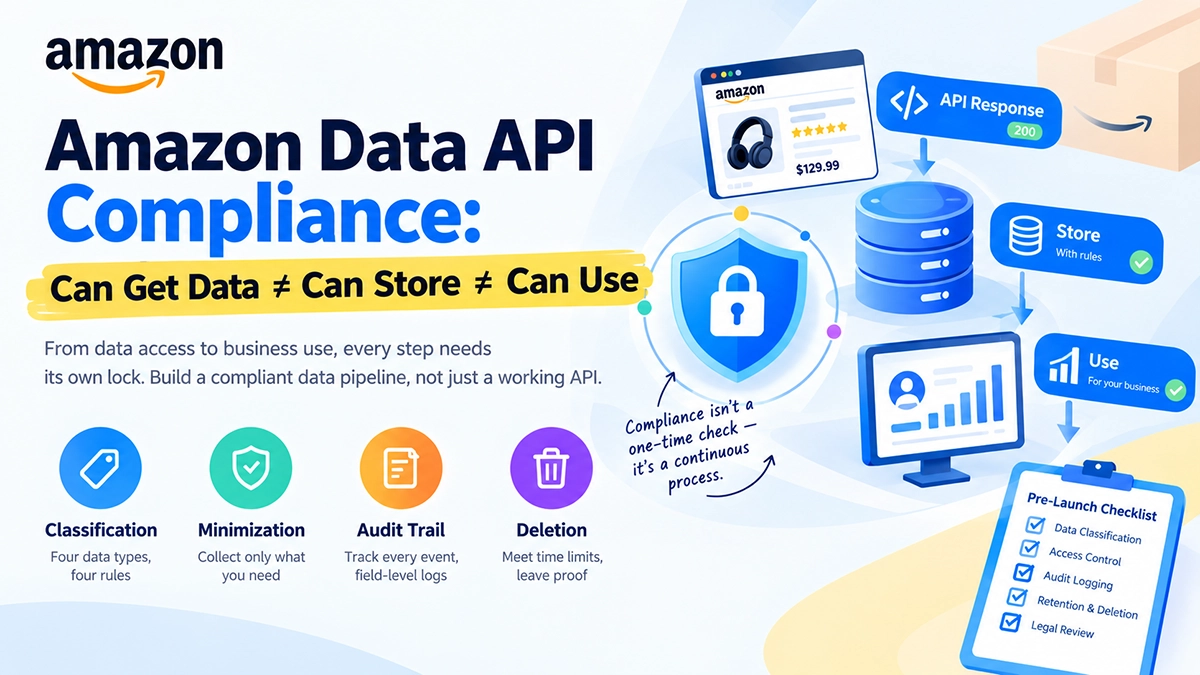
With an Amazon data API, compliance fails in a specific way: a team treats an HTTP 200 as a safety signal. The endpoint returned data, so the technical path works. Whether that data may enter your database, whether you may show it to your users, and whether you may build a business on it are three separate questions, and each door has its own lock. Compliance is not a pre-launch review you run once; it is a set of controls that run inside your pipeline all the time: classify, minimize, keep evidence, and stay able to delete. This article ships a checklist that engineering and legal can share — a four-class data taxonomy, an audit-log field design, a deletion workflow with deadlines, and a pre-launch checklist you can tick line by line. It offers no legal conclusions; for a ruling, talk to a lawyer. What it offers is the engineering ground that lets you answer when the questions come.
1. Three Questions, Three Locks: Split Compliance the Right Way
Compliance stalls when teams discuss it as one blob. Any data intake answers three questions in order: may you fetch it, may you keep it, and may you use it. No answer implies another.
Fetchability looks at how you acquire: did the source publish this data, does your collection respect the terms of service and robots directives, do you pass login walls or captchas. Storability looks at what the data is: a price is a public fact, low risk to store; a reviewer nickname is personal data, and storing it puts you under data protection law; a product image is copyrighted expression, and storing it counts as reproduction in most jurisdictions. Usability looks at the use case: internal price analysis, public display, model training, and redistribution sit at different risk levels — the same image file is fine in an internal comparison and a different question on your public page.
The classic misalignment: engineering gets an API key, runs a request, dumps the full payload into storage, and moves to the next ticket. Months later, when legal or a customer asks, the database holds personal data nobody meant to keep, and nobody can say which job produced which field. The common failure shape is not getting caught; it is having no answer when asked. This checklist targets that shape.
One scoping note: this list covers acquiring public data through a proper API. It covers your handling duties after the data arrives; it does not cover running your own scraper against anti-bot systems — a different risk class. Using a proper collection endpoint such as the Amazon Scraper API means the vendor already carries part of the acquisition-side duty, but storage-side and use-side duties do not transfer with the API. Those stay with you end to end.
2. Classify First: Four Data Classes, Four Legal Profiles
The first compliance move is not reading statutes; it is tagging every returned field by its legal profile. Amazon product data falls into four classes, each with its own handling rules. The table below is the baseline — copy it into your field dictionary.
| Class | Typical fields | Legal profile | Core action | Risk |
|---|---|---|---|---|
| Public facts | price, inStock, star, ratingDistribution, seller name | Factual information, no independent copyright | Store and analyze; keep capture time and source | Low |
| Copyrighted content | images, productDescription, features, review body text | Protected expression | Store references and summaries by default; display needs license or a link back | Medium |
| Personal data | Reviewer nicknames and avatars, reviewer profile links, seller contact details | Personal data (GDPR / CCPA scope) | Do not store by default; when required, pseudonymize and record the basis | High |
| Platform-generated | BSR rank, Amazon’s Choice badge, coupon markers | Platform metrics and dynamic results | Stamp with capture time; never imply an official endorsement | Medium |
Three usage notes on this table. First, classify fields, not endpoints — one review endpoint returns a rating distribution (public fact), a review body (copyrighted), and a reviewer nickname (personal data) in the same payload, and they must travel different paths. Second, classification belongs in the schema, not in meeting notes: attach a data_class tag per field and drive retention, masking, and audit scope from that tag. Third, version the taxonomy — Amazon redesigns produce field churn every quarter, and the taxonomy must move with it, or audits stop matching reality.
From our own field dictionary, tags hang on the field contract itself:
# Compliance class tags in the field dictionary (YAML excerpt)
fields:
  price:
    data_class: public_fact      # public facts
    retention: 24m               # keep 24 months
  images:
    data_class: copyrighted      # copyrighted content
    retention: 7d                # keep the reference for 7 days, never the binary
    display: "reference_only"
  reviews:
    data_class: copyrighted      # review body text
    retention: 12m
  reviewer_name:
    data_class: personal         # personal data
    retention: 0d                # never stored
    transform: drop              # dropped at ingestion, never reaches storage
  bsr:
    data_class: platform_metric  # platform-generated
    retention: 24m
    display: "with_timestamp"    # display must carry the capture timestamp
The next four sections walk through each class.
3. Public Facts: Low Risk Is Not Zero Duty
Prices, stock status, and rating distributions are factual information. Nobody holds a copyright on “this product costs $129 right now,” so collecting, storing, and analyzing it carries low risk in most jurisdictions. Low risk still comes with three duties.
First, timestamp everything. Prices move minute by minute, and every stored price describes one capture moment. A price without a timestamp is not only a quality problem (field contracts are the topic of another article) but a compliance one: showing a stale price as the current one can mislead. Freshness is an independent property in its own right — how to measure it is its own topic. The minimum is a captured_at on every row and a “price captured at …” notice wherever you display it.
Second, traceable provenance. Every fact should answer “which marketplace, which endpoint, which job.” That is not just debugging convenience — when a customer or regulator questions your numbers, the source chain is your first line of evidence. We recommend a fixed four-tuple: (marketplace, asin, task_id, captured_at).
Third, honest acquisition. Even factual data has red lines on the fetch side: no identity spoofing, no login-wall bypass, no captcha replay. If your data vendor crosses one, the risk travels to you — “we bought the data” does not cut liability. Two questions separate vendors: do they collect from public pages, and do they publish collection quality and coverage reports? In our case, Pangolinfo publishes SP ad-slot coverage across 13 marketplaces at 91.4% overall. A vendor willing to put that number on a public page has made itself auditable.
4. Copyrighted Content: Fetched Does Not Mean Redistributable
Product images, A+ content, bullet points, and review bodies are copyrighted. Receiving them through an API is an acquisition event; what you do next is a copyright question. One-line principle: keep references, not copies; run analysis, not redistribution.
Images are the most common trap. Downloading a product image to your own server and showing it on your page reproduces and communicates a protected work — attribution does not cure it. Two compliant paths: store only the image URL and render from the source (accept link decay, mitigate with a scheduled check), or, where copies are required (say, historical price paired with historical main image), shrink the scope to thumbnails and record the basis. The same test applies when picking a vendor: a proper service returns image URLs, not re-hosted binaries. That detail belongs on your vendor scorecard.
Review text has finer edges. Using review bodies for statistical analysis — sentiment distribution, keyword frequency, negative-review driver ranking — processes facts and opinions at low risk. Lifting review passages wholesale onto your product pages as marketing material reproduces protected content, and the reviewer attribution drags in personal data (next section). The middle ground is quoted snippets: few, attributed, serving your own analysis. That usage finds broad acceptance. Filtered endpoints such as the Amazon Review API serve the analysis side — you pull data to compute signals, not to carry content.
Bullet points and product descriptions follow the same rule. Comparing competitors by splitting the features array into structured points is analysis; pasting a competitor’s A+ copy verbatim into a customer-facing report crosses the line. A practical test: the more your output relies on protected content, and the more it substitutes for the original page, the higher the risk.
5. Personal Data: Making Minimization Concrete
Reviewer nicknames, avatars, profile links, and seller contact details are personal data. Once you serve users in the EU (GDPR) or California residents (CCPA), storing any of it makes you a data controller with duties to inform, limit purpose, and delete on request. For most data teams the cheapest strategy is not building that obligation stack — it is never letting the data in. The most complete form of data minimization is absence.
Three implementation steps. Step one, drop at the door: the ingestion pipeline discards personal-data fields before any write, storage included. Leaks often happen in debug logs, not databases — a team logs the full payload, and the log ships to a third-party observability platform. Step two, substitute when a need is real: if you must track “reviews from the same person,” use a one-way hash instead of the plain nickname; if you must show who said something, show an aggregate (“one reviewer said”) rather than the name. Step three, record the basis: any personal datum kept on purpose carries three lines — business purpose, legal basis, retention deadline — attached in the data catalog where anyone can find them.
Seller information deserves its own paragraph. The store name is a public fact and may be stored; the registered email, phone, and address are personal data and should be dropped even when the response includes them. For seller analysis, aggregate by store name and contact sellers through the platform’s own messaging channel.
6. Platform-Generated Data: Freshness Is a Compliance Issue Too
BSR ranks, Amazon’s Choice badges, and deal markers are dynamic results the platform computes and displays. They belong to no third party, but two constraints apply.
First, display is bound to time. BSR moves by the hour; today’s rank holds only for today. Using BSR in promotional material (“ranked first in category”) without a capture date turns a fact into a misleading claim once the rank drops. So the rendering rule belongs in code: any BSR or badge display must concatenate captured_at, and rows without a timestamp never reach a report.
Second, no implied endorsement. An Amazon’s Choice badge is an algorithmic snapshot at one moment. Placing it in marketing that implies “Amazon endorses our product” invites trademark and false-advertising exposure. Internal decisions are fine — these numbers exist to serve your sourcing calls. Outward, state the fact (“the product held the badge on date X”) without manufacturing an association.
7. Access Control and Audit Logs: What Will You Show When Asked
The previous five sections cover handling data; this one covers proving you handled it. The vehicle is the audit log, and it must be designed in advance — logs reconstructed after an incident carry no evidentiary weight.
Access control first, three baselines: API keys never enter version control (inject from a secrets manager or environment); data access follows least privilege (analysts touch cleaned tables, not raw payloads); any exceptional access to personal-data fields goes through approval and leaves a trace. These are standard security practice, listed here because they form the entry point of your evidence chain — without access control, your audit log cannot answer “who touched this data, when.”
Audit-log design centers on field-level recording of data events. Here is the minimal field set running in our production:
{
  "event_id": "aud_20260916_e3f1c8",
  "event_time": "2026-09-16T09:14:22+00:00",
  "event_type": "acquire",          // acquire | store | access | transform | delete
  "actor": "svc://ingest-worker-07",  // service account or user ID
  "source": {
    "provider": "pangolinfo",
    "endpoint": "product_detail",
    "marketplace": "US",
    "task_id": "tsk_884213"
  },
  "subject": {
    "asin": "B0CMZFCQ6D",
    "fields": ["price", "inStock", "ratingDistribution"],
    "data_classes": ["public_fact"]   // highest sensitivity touched by this event
  },
  "policy_version": "v2026.3",        // taxonomy version in force
  "retention_until": "2028-09-16",    // expiry for this batch
  "checksum": "sha256:9f2a..."       // payload digest, ties the log to the data
}
Five design points. event_type spans the five lifecycle events; missing one leaves an audit blind spot. data_classes records the highest sensitivity touched, so you can answer “did personal data ever enter the system” in one query. policy_version binds each entry to the taxonomy version, so historical behavior is judged by the rules in force at the time. retention_until gives deletion jobs a machine-readable trigger. checksum ties log entries to payloads and prevents the “log says yes, database says no” stalemate. The log is append-only, and access to the log is itself logged.
8. Retention and Deletion: Deletion Requests Reach the Data Layer Within 72 Hours
Retention answers “how long do we keep data”; deletion answers “how fast can we remove it when required.” Both need a pre-defined, executable policy — not a paragraph in a handbook. Which pipeline layer carries which of these duties is a design question of its own — see the pipeline layering article.
Set retention per class: public facts can run long (we keep 24 months to support multi-year price analysis); copyrighted originals stay short (image references checked every 7 days); personal data defaults to zero (dropped at the door). Deadlines live in the field dictionary (the retention tags in section 2), a scheduled job sweeps for expiry, and the deletion queue picks up expired data without manual triage.
Deletion has two triggers. Expiry is machine-judged and needs no human in the loop. Request-triggered deletion — a reviewer asks for removal, or a regulator demands disclosure or erasure — needs a deadline. Our internal standard: the deletion reaches the data layer within 72 hours and issues a receipt:
# Deletion job skeleton (essentials only)
def handle_deletion_request(req):
    # 1. Locate: sweep every storage layer by the identifier given
    #    (nickname hash / ASIN / task id)
    targets = locate(req.identifier, include=["db", "warehouse", "cache", "backup", "logs"])
    assert targets, "record an empty deletion even when nothing matches"

    # 2. Execute: purge layer by layer; backups get tombstones,
    #    cleared on the backup rotation schedule
    for t in targets:
        t.delete_or_tombstone()

    # 3. Receipt: issue proof of deletion, write the audit entry
    receipt = {
        "request_id": req.id,
        "completed_at": now(),
        "layers_purged": [t.name for t in targets],
        "verified_by": "second_scanner_pass",   # an independent second sweep
    }
    audit_log.write(event_type="delete", payload=receipt)
    return receipt  # back to the requester within 72 hours
Two details people miss. Derived data: when the source row is gone, do downstream aggregates, caches, and model features follow? Decide in advance — aggregates that no longer point to a person can stay in most cases, but when a requester demands full-chain erasure, the derived layers join the target list. Backups and append-only stores: what cannot be deleted gets a tombstone plus rotation cleanup; the audit log itself is never deleted — recording deletions is one of its jobs.
9. The Pre-Launch Checklist: 12 Engineering Items + 6 Legal Items
In the final step, the eight control points roll up into a checklist you tick before launch. Engineering and legal sign on separate lines, but both draw on one evidence base — the taxonomy, the audit log, the deletion receipts.
Engineering items (12, signed by the tech lead):
- Every returned field carries a
data_classtag in the field dictionary; - Personal-data fields drop at ingestion by default, with drop events logged;
- Debug logs contain no full payloads (verify against the last 1,000 log lines);
- Copyrighted fields store references by default, rendering goes through the reference path;
- Every fact row carries
captured_atand the four-tuple source identifier; - Display templates concatenate timestamps; timestamp-less data never reaches reports;
- Audit logs cover all five event types, fields complete, append-only;
- Retention deadlines are configured per class, the expiry job runs and leaves records;
- The deletion workflow has been rehearsed once: 72-hour deadline, receipt, second sweep all produced;
- No hardcoded API keys, access follows least privilege, exceptions go through approval;
- The taxonomy is versioned and a named owner handles vendor-driven field changes;
- The vendor’s collection method and coverage reports are archived for reference.
Legal items (6, signed by legal or compliance):
- A written use-case inventory (internal analysis / public display / model training, itemized);
- Jurisdictions in scope confirmed (EU, California), duties assessed;
- Review text and image usage stays inside copyright bounds (quote ratio, attribution, no redistribution);
- Platform-generated data never implies an official endorsement;
- Any personal-data exception carries purpose, basis, and deadline records;
- Vendor agreement reviewed for data-source legality and liability split.
Do not file this checklist after one pass. A taxonomy version bump, a vendor redesign, a new marketplace in scope — each trigger forces a re-run. Write the triggers into the process, and the checklist stays alive.
10. Closing and FAQ
Back to the opening claim: legal to fetch is not safe to keep, and neither is licensed to ship. You can move part of the acquisition-side duty to a proper data vendor; storage-side and use-side duties stay with you, and they all demand evidence. Four controls — classify, minimize, keep evidence, stay able to delete — belong to engineering as much as to legal; documents produced after the questions arrive, by contrast, carry less weight. Run the checklist, and let every batch of data carry its compliance identity from day one.
FAQ
Does using a proper data API transfer compliance duty to the vendor?
No. The vendor carries the main acquisition-side duty (collection method, robots, anti-bot boundaries). Storage-side and use-side duties do not transfer: once data enters your system, minimization, retention, deletion, and audit are yours. A vendor with clean collection lowers upstream risk; it exempts nothing downstream.
Which Amazon product data fields count as personal data?
Reviewer identity fields (nickname, avatar, profile link) and seller-registered contact details. The product’s own price, stock, rating distribution, and BSR are facts or platform data, not personal data. The test: can the value point to a natural person on its own or in combination with other data?
May I store product images and review text?
The two need different answers. For images, default to URL references, never the binary; where copies are required, shrink to thumbnails and record the basis. Review text in statistical analysis is low risk; wholesale lifting onto public product pages is high risk. Shared principle: analyze, do not redistribute; reference, do not copy.
What is the minimum set of audit-log fields?
Seven: event ID, event time, event type (acquire, store, access, transform, delete), actor, source (vendor, endpoint, marketplace, task), fields touched with their data classes, and retention expiry. Add a payload checksum to tie log entries to data.
How fast must a deletion request be fulfilled, and how deep does it go?
As an internal standard, commit to reaching the data layer within 72 hours and issuing a deletion receipt. Scope covers databases, warehouse, cache, and logs; backups get tombstones plus rotation cleanup. Derived aggregates can stay in most cases (they no longer point to a person), but a full-chain erasure demand pulls them into scope too. The audit log itself is never deleted — recording deletions is one of its purposes.