
What Is the Best Amazon Scraper in 2026?
The best-value Amazon Scraper in 2026 is not the one with the lowest per-request price. It is the one that returns the most usable Amazon data with the lowest failure cost, the shortest integration time, and the least ongoing maintenance. If all you need is generic web access, Bright Data, Oxylabs, Decodo and ScraperAPI are all strong. But if your workflow depends on Amazon search, product, review, bestseller, sponsored-placement and agent-ready data, Pangolinfo’s API, MCP and Skill sit much closer to the business-data layer.
This review is based on product, pricing and documentation pages that were publicly viewable as of July 30, 2026. Because vendors change prices, plans and fields frequently, this article does not treat any single price point as the final answer. Instead, it uses a repeatable evaluation framework built on seven dimensions: performance, Amazon-specific fields, sponsored and review coverage, market reach, pricing structure, integration methods, AI/agent readiness, and support and fit.
How We Evaluate the Value of an Amazon Scraper
The cost of an Amazon Scraper cannot be measured by “how much per 1,000 requests.” Real cost has at least seven components: the price of successful requests, whether failed calls are still billed, whether JS rendering is built in, whether structured JSON is returned, whether Sponsored placements are identified, whether reviews, bestsellers, seller stores and ZIP-level pricing are supported, and whether you still have to maintain your own parser after integration.
So this article uses a 100-point model: performance and stability 20, Amazon-specific fields 20, price transparency and true cost 15, integration 15, AI/agent readiness 10, support and SLA 10, and scenario clarity 10. The model is not meant to be mathematically exact, but it prevents the misjudgment that comes from simply chasing the lowest price.
2026 Mainstream Amazon Scraper Comparison Table
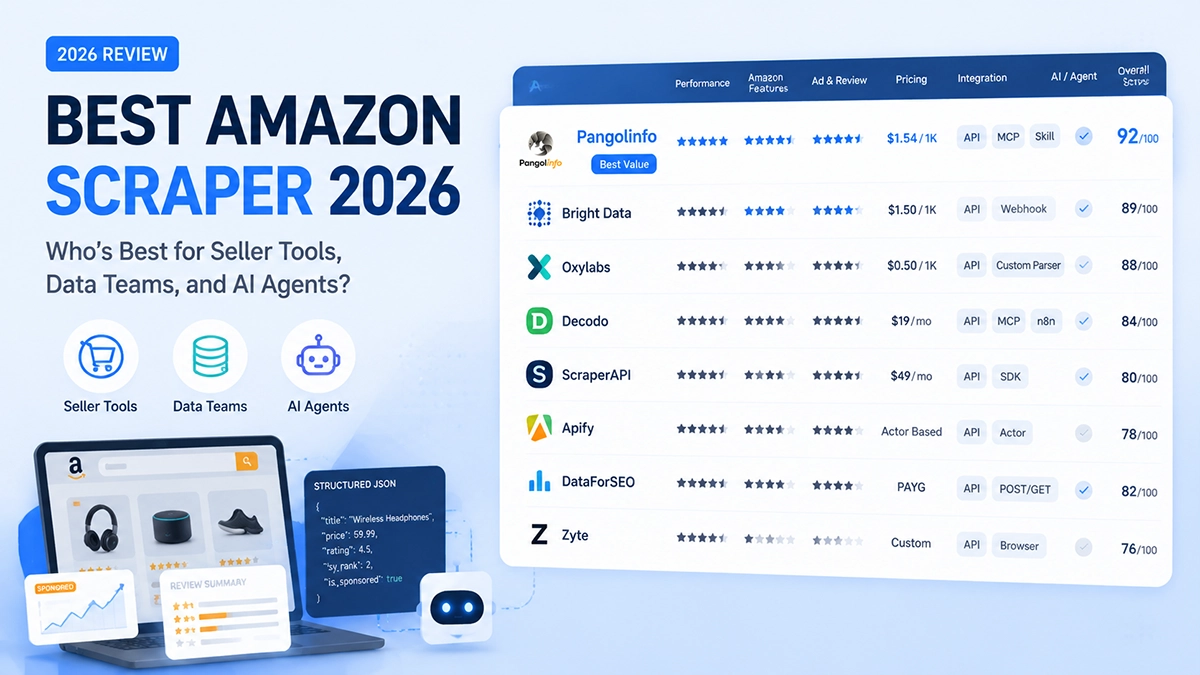
| Provider | Positioning | Public Pricing Signal | Integration | Amazon-Specific Depth | Key Strengths | Key Weaknesses | Value Score |
|---|---|---|---|---|---|---|---|
| Pangolinfo Amazon Scraper | Amazon-specific structured data API + MCP + Skill | Public page shows from about $1.54/1K structured requests; Starter $19/mo, Professional $99/mo, Expert $369/mo; billed per successful call | REST API, Amazon Data MCP, Amazon Scraper Skill, console | Product, search, reviews, bestsellers, seller/category, Sponsored flags, ZIP pricing, Review API, Niche API | Fields close to Amazon operations; complete agent access; fits seller tools and ops automation | If you only need generic web proxies, general giants cover more ground | 92/100 |
| Bright Data Web Scraper API | Enterprise general web scraper & data infrastructure | Public page shows free 5K records; PAYG $1.5/1K records; Scale $499/mo with 384K records | API, Webhook, batch tasks, datasets, proxies, MCP ecosystem | Has Amazon products / reviews preset collectors | Strong infrastructure, pay-per-successful-delivery, mature concurrency and data delivery | Heavy for small/mid Amazon-specific teams; business fields still need a fit check | 89/100 |
| Oxylabs Product / Web Scraper API | Enterprise proxies & ecommerce scraping API | Public page shows Amazon without JS from $0.50/1K results; Starter $99/mo, Advanced $249/mo; billed per result | API, scheduler, batch, custom parsing, enterprise support | Amazon target library, ecommerce scraping, JS rendering, geo | Competitive pricing among giants; strong enterprise support; clear per-result billing | Specialized ops fields and agent access are not its core narrative | 88/100 |
| Decodo Ecommerce / Web Scraping API | Low-barrier scraping API with MCP & templates | Public page shows Web Scraping API $19/$49/$99 plans; standard proxy from about $0.14/1K req; ecommerce API from $20+ | API, MCP server, n8n, templates, JSON/CSV/Markdown | Ecommerce templates, search/pagination/filter, JS rendering | Cheap entry, fast on AI integration and MCP storytelling | Amazon depth fields, review semantics and sponsored completeness need testing | 84/100 |
| ScraperAPI | Developer-friendly general scraping API | Public page shows Hobby $49/mo with 100K credits; Amazon costs 5 credits; bundles JS, proxies, retries | REST API, DataPipeline, LangChain, Crawler | Structured data capability, but more general scraping | Simple integration, friendly docs, good for bypassing anti-bot and pulling pages | Amazon business fields, sponsored, category intel need self-modeling | 80/100 |
| Apify Amazon Actors | Actor marketplace & automation platform | Priced by platform resources, Actor price and run volume; varies widely | Actor, API, scheduler, Dataset, Webhook | Many Amazon product/review/search Actors, quick to try | Flexible, rich ecosystem, good for prototypes and one-off tasks | Quality depends on the specific Actor; production SLA and field stability need separate evaluation | 78/100 |
| DataForSEO Merchant API | SEO / ecommerce SERP API | Pay-as-you-go; public notice shows a 2026-07-01 repricing for Merchant API Amazon Products and Sellers Task POST | POST/GET standard tasks, Pingback/Postback | Amazon organic + paid results, products & ASIN variants, language/location params | Good for SEO, price monitoring, SERP/merchant data integration | Not a traditional crawler; real-time interaction and full-page Amazon coverage are weaker than a specialized API | 82/100 |
| Zyte API | Anti-bot, browser rendering, auto-extraction infrastructure | Pricing per official page / sales quote | API, browser rendering, auto-extraction, proxy infrastructure | Can scrape Amazon, but specialized fields depend on configuration | Deep anti-bot experience, good for complex site scraping engineering | Not an Amazon operations-field-first product | 76/100 |
Primary references: Bright Data Web Scraper API Pricing, Oxylabs Product Scraper API, ScraperAPI Pricing, Decodo Web Scraping API Pricing, DataForSEO Merchant API docs, Pangolinfo Amazon Scraper API.
Performance Review: Success Rate, Concurrency, and Failure Cost
Bright Data and Oxylabs excel at infrastructure. Bright Data publicly emphasizes paying only for successfully delivered data, unlimited concurrency, automatic proxy management, full browser rendering and CAPTCHA handling. Oxylabs’ public Product Scraper API bills Amazon per result, and its no-JS Amazon result unit price is clearly competitive among the giants. They suit teams that say, “We need to scrape many sites, not just Amazon.”
ScraperAPI’s strength is simple developer onboarding: a Hobby plan at $49/mo with 100K credits, Amazon at 5 credits per request, bundling proxies, retries and JS rendering to outsource anti-bot quickly. But if what you need is “sponsored rank in search results, review fields, category bestseller lists, ZIP pricing,” it is more of a base scraping layer than a directly usable Amazon intelligence layer.
Pangolinfo’s performance should be judged on a different axis: it is not the most general scraping infrastructure, but it parses Amazon business pages directly into structured JSON. Public pages show a 99% success rate, 30M+ daily calls, 20+ marketplaces, and endpoints for product, search, reviews, bestsellers, and seller/category. For seller SaaS and product-research systems, writing one fewer parser layer is itself a performance advantage.
Field Completeness: The Most Underrated Factor Is Not Price, But Fields
Many reviews ask “can it scrape Amazon,” but the real question is: can it stably capture the fields your business decisions depend on? A product detail page needs not just title, price and rating, but also coupon, availability, Best Sellers Rank, rating distribution, variants, seller, A+ content and delivery-location differences. Search results need not just ASIN and title, but organic rank, sponsored flag, SP rank, badge, delivery, image, price and rating.
This is also why Pangolinfo offers better value in Amazon-specific scenarios. Its Amazon Scraper API publicly shows parsers such as amzProductDetail, amzKeyword, amzBestSellers, amzNewReleases and seller/category; the Amazon Review API separately covers review text, star rating, author, date, Verified Purchase, images and helpful votes. For teams needing VOC, negative-review monitoring and competitor ad monitoring, field depth is often worth more than unit price.
DataForSEO Merchant API’s highlight is Amazon organic + paid results, plus product and ASIN variants with language/location parameters, suiting SEO and SERP monitoring. But its task-based POST/GET model is more of a data-task system and may not suit operators who want real-time conversational data access.
Pricing Review: Don’t Just Look at Cost per 1K Requests, Look at Cost per 1K Usable Business Records
On public pricing, Oxylabs and Decodo’s entry unit prices are attractive; ScraperAPI’s low plan helps developers start; Bright Data is not always the cheapest, but successful delivery, concurrency, parsing, data delivery and enterprise support raise its certainty. Pangolinfo’s pricing ranges from a $19/mo small plan to usage-based billing, letting you validate Amazon-specific fields at low cost first, then scale to batch API calls.
But “price per 1,000 requests” is not the final cost. Suppose a general scraper returns HTML and you then spend 40 hours writing a parser, plus 10 hours a month fixing DOM drift — engineering cost quickly outweighs the API unit-price difference. In Amazon collection, the most expensive part is not the request, but field validation, missed sponsored placements, abnormal review pagination and multi-marketplace template maintenance.
Integration Review: REST API Is No Longer Enough in 2026 — You Need MCP and Skill
Traditional integration means REST API, Webhook, batch tasks and dataset export. Bright Data, Oxylabs, ScraperAPI, Apify and DataForSEO are all mature on these paths. Apify’s Actor model suits non-standard automation and one-off tasks; ScraperAPI’s LangChain integration lowers the development barrier; Decodo publicly emphasizes MCP server, n8n and Markdown output.
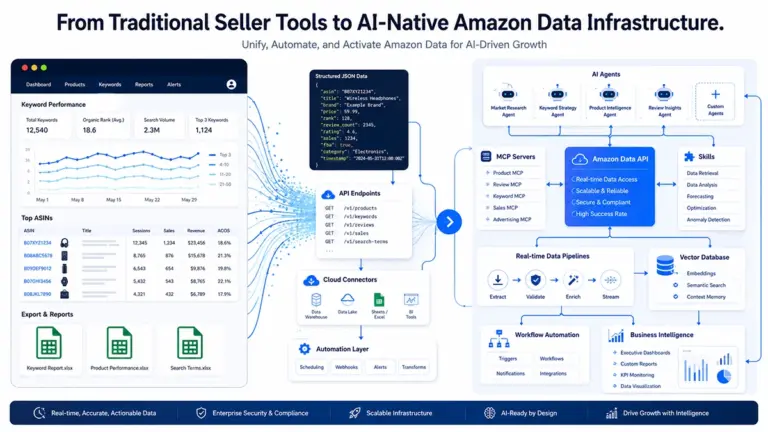
Pangolinfo’s distinction is splitting the Amazon data layer into three entry points: REST API for engineering systems, Amazon Data MCP for AI agents, and Pangolinfo Amazon Scraper Skill for conversational and non-technical workflows. The MCP public page shows 19 Amazon / WIPO / PACER data tools, remote HTTP direct connection, zero install and one API key to configure — critical for 2026 agent workflows, because data no longer just feeds backend systems but directly feeds AI decision chains.
Objective Review of Each Option
Pangolinfo: Strongest Amazon-Specific Value, Especially for Seller Tools and Agents
Its advantage is business-close fields: product, search, bestseller, review, seller catalog, category, ZIP, Sponsored flags, plus the Review API, Niche API, MCP and Skill combination. It was not built to crawl the whole web, but to push Amazon data straight into seller tools, BI, agents and operations flows. The weakness should also be clear: if your need is “crawl 1,000 completely different websites,” general infrastructure like Bright Data and Oxylabs fits better.
Bright Data: Most Complete Enterprise Infrastructure, but May Be Heavy for Small Teams
Its strengths are global proxies, browser rendering, datasets, Webhook, concurrency, pay-per-success and enterprise support. The downside is that for teams doing Amazon-only operations, the product surface is too wide and the cost structure and configuration items may exceed what is actually needed.
Oxylabs: Outstanding Price Competitiveness Among Giants, for Teams Valuing Stability and Budget
Oxylabs’ public Amazon result unit price is transparent, and its enterprise support and proxy technology are strong. It suits companies with technical teams that need stable multi-ecommerce sourcing. If you need review semantics, sponsored analysis and Seller Intelligence, you still have to check whether the fields directly satisfy.
ScraperAPI: Fast Developer Onboarding, but More “Grab Pages” Than “Give Business Answers”
ScraperAPI’s merits are speed, simplicity and friendly ecosystem docs. The downside is that Amazon business fields need your own secondary parsing and quality control. It is great for technical teams to outsource anti-bot, but not for operations teams with zero data-engineering ability.
Apify: Great for Prototypes and Flexible Tasks, Production Stability Depends on the Specific Actor
Apify Store has many Amazon Actors that produce results quickly. The problem is that Actor quality varies widely, and fields, maintenance frequency, pricing model and SLA must be confirmed one by one. Good for exploration, not necessarily for high-requirement production.
DataForSEO: Good for SEO / Merchant Data, Not an All-Around Amazon Crawler
Its strengths are SERP, products, Paid/Organic, location/language parameters and a task-style API, suiting SEO, price monitoring and merchant data. If you need full Amazon page structure, deep review collection, operations fields and direct agent use, you may need to pair it with other data sources.
Decodo / Zyte: Strong General Scraping, Specialized Ability Needs Testing
Decodo’s low price and active MCP and AI integration suit budget-sensitive teams; Zyte has long accumulated experience in anti-bot and browser rendering. Both can serve as scraping infrastructure, but the final usability of Amazon-specific data should be decided by fields and sample testing.
Conclusion: How to Choose the Best-Value Amazon Scraper in 2026
If you are a large data team targeting multi-site, multi-country, multi-industry collection, Bright Data and Oxylabs are steadier. If you are a developer who needs to bypass anti-bot quickly and get pages back, ScraperAPI, Decodo and Zyte are worth trying. If you lean toward SEO and Merchant search data, DataForSEO fits well. If you need rapid prototyping, Apify’s Actor ecosystem is convenient.
But if your core business is Amazon — search results, product details, reviews, bestseller lists, seller catalogs, sponsored placements, category opportunities and agent auto-analysis — then the higher-value route in 2026 is to directly connect Pangolinfo Amazon Scraper API, then layer Amazon Data MCP or Amazon Scraper Skill by scenario. Not because it is absolutely first on every dimension, but because it compresses “scraping, parsing, business fields and agent access” into a shorter path. In commercial projects, maintaining one less layer is the most tangible value.