
Abstract
In the rapidly evolving landscape of agentic commerce, relying on stale, static data is a fatal flaw for e-commerce operations. This comprehensive report explores how an Amazon AI Agent real-time data pipeline fundamentally outperforms legacy SaaS tools. By migrating to the Model Context Protocol (MCP) and integrating cross-channel validation across Amazon, Google, and social media, brands can construct a zero-latency telemetry system. This architecture thoroughly eliminates large language model (LLM) hallucinations, ensuring algorithmic decision-making—from automated pricing to niche discovery—is built on absolute precision and structural clarity.
The Consumer-Shopper Schism: A Fundamental Restructuring of E-Commerce Operations
The global e-commerce ecosystem is undergoing a structural transformation driven by artificial intelligence, characterized primarily by the rapid decoupling of the “Consumer” and the “Shopper”. Over the past decade, the underlying assumption of platform algorithms and Search Engine Optimization (SEO) strategies has consistently been that the person using the product and the entity executing the purchase decision are the exact same physical being. However, as Large Language Models (LLMs) with autonomous decision-making capabilities and e-commerce AI agents are deeply integrated into retail environments, this unity has been completely shattered—a phenomenon defined by both academia and industry as “The Shopper Schism”. In this emerging paradigm, human consumers still define the need—such as requiring healthier food or better noise-canceling headphones—but the processes of discovering products, evaluating specifications, comparing prices, and ultimately executing the transaction are increasingly being delegated to algorithmic agents.
This shift in underlying logic places unprecedented demands on cross-border e-commerce operations. The primary objective for retailers and third-party sellers is no longer merely optimizing the visual experience for human buyers; rather, it is imperative to provide highly readable digital signals for the algorithmic agents acting on their behalf. The year 2025 marked a watershed moment in this transition, with Walmart launching Sparky and Amazon rolling out its generative AI shopping assistant, Rufus, to all U.S. customers. Data indicates that Rufus rapidly attracted over 300 million users post-launch, and the conversion rate of users interacting with the AI assistant was 60% higher than that of traditional search users, generating over $10 billion in incremental sales for Amazon. This staggering conversion data explains why Amazon briefly pulled its entire product catalog from Google Shopping—Amazon is no longer optimizing for today’s traditional search customers, but rather building a defensive moat for tomorrow’s algorithmic buyers.
Against this backdrop, traditional Keyword Stuffing and static data analysis have rapidly become marginalized, replaced by “Agentic Engine Optimization” (AEO) or “Generative Engine Optimization” (GEO). For e-commerce enterprises, deploying internal AI agents to take over pricing, inventory management, market research, and advertising bidding is no longer an experimental venture, but a foundational infrastructure required to maintain market competitiveness. However, the actual efficacy of these automated operational agents is strictly constrained by the quality, structure, and latency of the data they consume. When autonomous systems are fed outdated, unstructured, or fragmented data, their logical reasoning capabilities collapse instantly, leading to a cascade of flawed decisions that severely erode corporate profit margins. Therefore, in the e-commerce battles of the AI era, the decisive battleground is not the parameter size of the LLMs themselves, but the underlying data pipeline architecture that provides real-time sensory perception to these models.
The Decisive Impact of Real-Time Data on E-Commerce AI Agents and the Pathology of Failure
A prevalent misconception within the industry is that when an AI agent makes an erroneous decision, operations teams often attempt to resolve the issue by upgrading the underlying foundational model (e.g., migrating from GPT-4 to a newer iteration) or endlessly tweaking the prompt engineering. However, in-depth analysis reveals that over 90% of decision quality issues with Amazon AI agents are not rooted in the model’s reasoning deficiencies, but are directly attributable to three systemic failures in the underlying data pipeline: data staleness, missing fields, and noise interference from unstructured inputs. An AI agent is essentially a deterministic reasoning engine; the quality of its commercial output is strictly capped by the telemetry data it is fed.
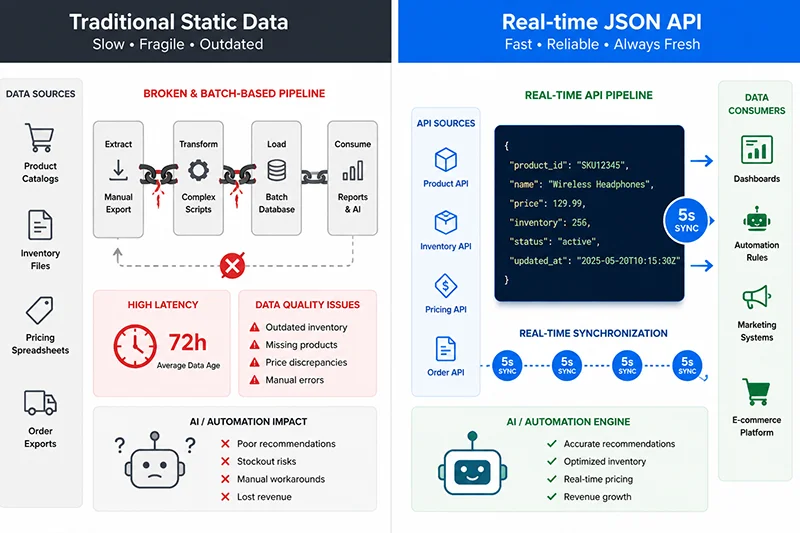
Data staleness is the primary culprit behind agent decision failures. Amazon’s product data exhibits extreme volatility. In hyper-competitive categories, the pricing matrix of core competitors might fluctuate every 15 to 30 minutes, Best Sellers Rank (BSR) is recalculated hourly, and inventory status changes the exact second an FBA (Fulfillment by Amazon) shipment arrives. Traditional e-commerce data architectures rely heavily on 24- to 72-hour batch scraping snapshots, forcing AI agents to navigate a rapidly shifting market using an expired “topographical map”. For instance, if a core competitor quietly drops their price from 29.99 to 23.99 at 10 PM and simultaneously activates a 15% discount coupon, this tactical adjustment is sufficient to push conversion rates up by 30% to 40% in the mid-tier price segment. If an enterprise’s AI agent relies on static data synced a day prior, it remains entirely oblivious to this offensive maneuver, thereby missing the optimal window to trigger defensive price matching or adjust advertising bids, resulting in market share being silently devoured.
Missing fields create severe information asymmetry, inducing model “hallucinations.” Amazon frequently conducts A/B testing and continuously alters its page DOM (Document Object Model) structure, causing unmaintained hard-coded scrapers to silently drop critical fields, even if they continue to successfully extract basic titles or total review counts. When an agent cannot access promotional indicators (such as Lightning Deal badges or Subscribe & Save discounts), complex variant price matrices for different colors and sizes, or crawlable A+ page content, it constructs highly fluent but completely flawed reasoning based on an incomplete picture. For example, if a scraper fails to extract review data parsed by variant structure, the agent will naturally assume the product’s overall star rating represents a uniform quality level, completely ignoring a fatal manufacturing defect present in a specific size or color configuration. The agent receives an incomplete dataset but remains unaware of its own blind spots; such analytical reports, regardless of how rigorous the reasoning process appears, inevitably yield disastrous outcomes.
Unstructured input and chaotic data formatting further degrade agent efficacy. Feeding raw, unprocessed HTML or messy Markdown text directly into an LLM’s context window not only dilutes genuinely valuable commercial signals with massive amounts of navigation menus, footer links, and ad tracking codes, but also highly inefficiently consumes precious token allowances. Moreover, LLMs exhibit a high error rate when attempting to extract precise numerical values (like prices or ranks) from unstructured layouts. Even more lethal is the flaw in error handling mechanisms: if a traditional scraper encounters a CAPTCHA block while fetching a price and defaults to logging it as a numerical 0 or an empty string, the agent will interpret this as an absolute commercial fact—deducing that the competitor is running a 0 clearance sale. Translating a system scraping failure into a legitimate business action triggers a cascade of automated pricing blunders, making subsequent root-cause attribution tracing exceptionally difficult.
The Stringent Engineering Requirements for E-Commerce Data in the Agent Era
To fundamentally eliminate these hidden dangers in decision-making, enterprises must abandon traditional data collection methods designed for human visual analysis and rebuild their underlying data pipelines from scratch, adhering to the rigorous standards of autonomous algorithmic consumption. In the Agent Era, data must not only be readable but must also possess strict algorithmic determinism, ultra-high timeliness, and profound granularity.
Real-time availability and low latency form the bedrock of the agent’s cognitive loop. Agents no longer need to rely on static databases; instead, they require data pipelines with On-Demand Fetching capabilities. When an agent needs to validate a hypothesis during its reasoning chain, the tool interface must return the latest scraped results within 3 to 5 seconds (P95 response time) to prevent the LLM’s reasoning process from timing out. To balance the API costs associated with high-frequency refreshing, the system should implement a tiered refresh strategy: high-volatility pricing and inventory fields require 30-minute refreshes; BSR rankings demand hourly updates; while relatively stable titles and A+ image content can be downshifted to daily updates.
Regarding data completeness, agents require the simultaneous retrieval of all critical fields supporting a decision to prevent the LLM from making baseless assumptions. The Minimum Viable Dataset (MVD) encompasses not just basic prices and rankings, but must strictly include promotional badges, exact coupon values, real-time Buy Box ownership, comprehensive variant price matrices, full A+ content text, and structured review data stamped with “Verified Purchase” (VP) tags and precise timestamps. Particularly when handling cross-border localized data, the data pipeline must support ZIP Code Targeting. For instance, only by passing a specific regional postal code (e.g., 10001 for New York or 90001 for Los Angeles) in the API request can the agent retrieve true inventory availability and localized delivery estimates for that precise geographic coordinate, which is absolutely critical for regional pricing strategies.
The normalization of format and structure is the decisive factor in minimizing token consumption and maximizing extraction accuracy. A high-quality data pipeline must output highly structured JSON formats rather than raw HTML. Financial data (such as prices) must be strictly typed as floating-point numbers (e.g., 19.99), completely stripped of currency symbols to eliminate any parsing ambiguity. All timestamps must uniformly adhere to the ISO 8601 standard, enabling the agent to leverage built-in code interpreters to autonomously calculate data staleness. State indicators (like is_prime or is_in_stock) must be strict booleans, entirely avoiding ambiguous text strings like “Yes” or “No”. Most crucially, a definitive error code taxonomy must be established. If a specific data point fails to collect, the pipeline must absolutely never return a zero value or an empty string as a fallback; instead, it must explicitly return null accompanied by a precise error_code (e.g., "CAPTCHA_HIT" indicating network interception, or "NO_A_PLUS_CONTENT" confirming the objective absence of the module). This deliberate design informs the agent whether the missing data stems from network issues or factual business reality, empowering it to make the correct decision on whether to retry the request or adjust its analytical weighting.
A Comprehensive In-Depth Comparison of Amazon Real-Time Data Acquisition Channels
Faced with the stringent data requirements of the Agent Era, e-commerce enterprises evaluating Amazon data acquisition channels are confronted with several distinct technological evolutionary paths. An in-depth comparison between traditional SaaS software, RPA automation tools, in-house web scraping teams, and next-generation dedicated real-time data APIs (represented by Pangolinfo) clearly reveals the strategic advantages and disadvantages of each architecture in driving AI decision-making.
The Data Limitations of Traditional SaaS Software (e.g., SellerSprite, Sif, Sorftime)
Over the past decade, a plethora of excellent SaaS software platforms emerged (such as SellerSprite, Sif, Sorftime, and Jungle Scout). The core architecture of these tools was explicitly designed for the visual browsing of human analysts, with their backends typically relying on massive, asynchronous daily batch scraping operations to populate vast static databases. For small to medium-sized sellers lacking technical teams, or human operators requiring only rudimentary market research, these tools offer user-friendly Graphical User Interfaces (GUIs) and a plug-and-play experience with an extremely low learning curve.
However, when organizations attempt to pivot these SaaS tools into primary data sources for AI agents, their underlying architectural flaws are starkly exposed. The most fatal issue is severe data lag; their APIs typically return data reflecting the market state 24 hours ago or longer, completely incapable of supporting high-frequency automated operations. Secondly, to mitigate the exorbitant storage and compute costs associated with massive databases, SaaS platforms routinely sacrifice data completeness and depth, opting out of scraping deep variant descriptions or complex review sentiment tags. Regarding scraping success rates, Amazon’s Sponsored Product (SP) placements employ highly dynamic black-box algorithms. Traditional SaaS platforms generally suffer a sub-70% success rate when capturing these high-value ad placements, preventing agents from accurately calculating a brand’s true Share of Voice (SOV).
From a commercial cost perspective, SaaS pricing models are usually strictly tethered to user seats or highly restrictive API call limits. Should an enterprise attempt to build a high-concurrency internal data stream by calling SaaS APIs, they face exorbitant subscription fees and punitive overage charges. For example, under a model requiring 1 million API calls monthly, the Total Cost of Ownership (TCO) using a traditional SaaS solution can soar to roughly 23,000 RMB per month (encompassing base packages, severe overage penalties, and supplementary data cleansing costs mandated by poor data quality), all while carrying a tremendous risk of Vendor Lock-in.
The Dilemma of RPA Automation and In-House Scraping Teams
Attempting to shatter the data silos of SaaS platforms, some enterprises with development capabilities resort to Robotic Process Automation (RPA) tools or establish internal web scraping teams. While RPA tools—which extract data by simulating human browser behavior—are relatively simple to configure, they are exceedingly fragile. Amazon’s incessant front-end DOM structural changes cause RPA workflows to break continuously, requiring endless manual intervention and repairs. Furthermore, RPA execution is remarkably slow, and its predictable behavioral patterns are easily flagged by anti-bot systems, rendering it unviable for large-scale data harvesting.
Building an in-house scraping team, conversely, triggers a technological arms race with bottomless costs. Enterprises are forced to employ specialized scraping engineers, anti-bot experts, and DevOps personnel, pushing monthly human capital expenses into the tens or hundreds of thousands. To counter Amazon’s continuously evolving defensive perimeters, teams must constantly procure and maintain massive dynamic residential IP proxy pools and continuously rewrite DOM parsers. Although this model guarantees absolute data ownership and the highest degree of customization, its agonizingly long development cycles (often requiring months to a year to stabilize) and perpetually high hidden maintenance costs restrict its viability strictly to top-tier multinational behemoths.
The Next-Generation Real-Time API Architecture (The Technological Breakthrough of Pangolinfo API)
To address all the aforementioned pain points, the “Data API as a Service” architecture—exemplified by the Pangolinfo Scrape API—was introduced. This is a production-grade data pipeline explicitly engineered for developers, data scientists, and AI Agents. It completely encapsulates the heavy lifting—massive anti-bot infrastructure, continuous proxy rotation, CAPTCHA solving, and complex DOM node parsing—within the cloud, exposing only a highly stable, high-concurrency RESTful API endpoint to the user.
This architecture demonstrates overwhelming superiority across technical metrics. In terms of timeliness, leveraging a distributed cloud infrastructure, the API synchronously returns real-time, parsed JSON data with an ultra-low average latency of just 5 seconds. Regarding extraction precision, thanks to highly specialized data capture algorithms, Pangolinfo achieves a phenomenal 99.9% overall success rate. Even when targeting the notoriously difficult Sponsored ad placements, it maintains an industry-leading 98% accurate capture rate, furnishing agents with an unparalleled foundation for keyword traffic modeling. Furthermore, the API features Self-Healing parsers; when Amazon deploys layout modifications, the cloud-based parsers autonomously track and adapt to the changes, completely eradicating the user’s code maintenance burden.
On the economic front, dedicated APIs operate on a pure Pay-as-you-go consumption model. Users are not forced to subsidize bloated infrastructure or redundant GUI features; they are billed exclusively for successful data calls. As request volumes scale, the economies of scale drastically reduce the marginal cost per call. Reverting to the 1-million-call monthly scenario, the TCO utilizing the Pangolinfo API drops to approximately 13,000 RMB—yielding a direct 43% capital savings compared to traditional SaaS alternatives, alongside a quantum leap in raw data quality.
| Evaluation Dimension | Traditional SaaS Software (e.g., SellerSprite/Sif) | In-House Scraping Systems / RPA | Dedicated Real-Time Data API (Pangolinfo) |
| Data Timeliness | Historical snapshots (typically lagging 24-72 hours) | Dependent on internal compute & IP scale | Absolute real-time (P95 latency ~5 seconds) |
| Anti-Bot & Maintenance Costs | Extremely low (platform managed, but access is restricted) | Exorbitant (trapped in a perpetual tech arms race) | Zero maintenance (fully automated proxy rotation & parser healing) |
| Ad Placement Accuracy | Low (typically < 70%) | Highly unstable (frequently blocked by anti-bot measures) | Extremely high (industry-leading 98% SP ad capture rate) |
| Output Format & Adaptability | Visual GUI / Exported CSV / Rigid API responses | Raw HTML (requires heavy internal compute to parse) | Agent-native strongly typed structured JSON or Markdown |
| Granular Control Capabilities | Limited to country-level aggregated data | Complete autonomous control | Supports hyper-localized extraction via specific ZIP Codes |
| Economic & Cost Model | Expensive fixed annual fees + severe API overage penalties | Massive engineering payroll + proxy/bandwidth expenses | Pure pay-per-call (marginal costs decrease at scale), saving over 40% |
Model Context Protocol (MCP) Reshaping the Interaction Paradigm of E-Commerce Agents
While RESTful APIs resolve the hurdles of real-time access and data structuring, integrating them into enterprise AI workflows still historically required backend engineers to write massive amounts of “glue code” to handle authentication, parameter mapping, retry logic, and tool orchestration. To eradicate this integration friction, the artificial intelligence industry is rapidly standardizing around a revolutionary architectural framework: the Model Context Protocol (MCP).
The Technical Architecture and Economic Significance of MCP
Introduced by Anthropic in November 2024, MCP is an open-source, universal adapter standard designed to establish secure, standardized, two-way communication channels between LLMs and external tools or datasets. Within the industry, MCP is aptly conceptualized as the “USB-C port for AI applications”—just as USB-C unified hardware connectivity, MCP standardizes how AI agents perceive and interact with external world states.
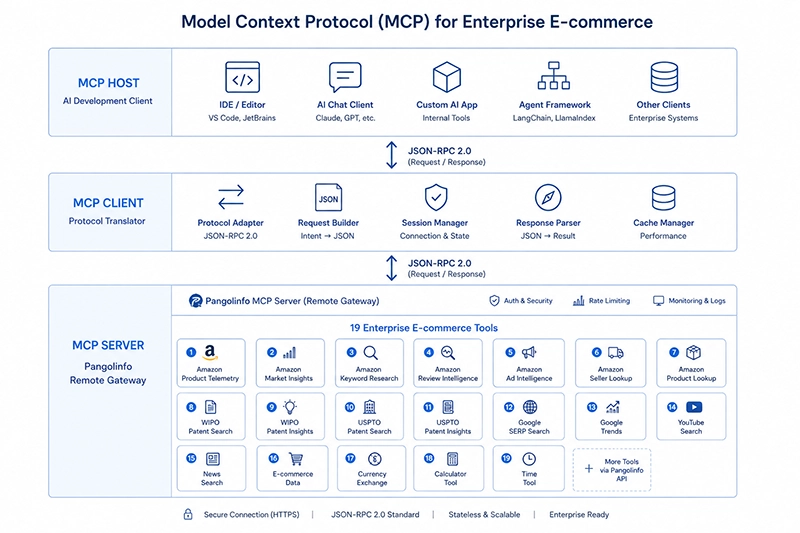
The MCP architecture is comprised of three core layers: first, the MCP Host containing the LLM (such as development environments or chat interfaces like Claude Code, Cursor, or Windsurf); second, the MCP Client residing within the Host, responsible for translating the LLM’s intent into standardized protocol requests; and finally, the MCP Server, acting as the external service gateway that provides the actual business logic, data retrieval capabilities, and tool definitions. Communication between client and server flows seamlessly through a transport layer (e.g., local stdio or remote streamable HTTP) utilizing JSON-RPC 2.0 messaging.
In the context of e-commerce, the deployment of MCP is profoundly disruptive. Sellers and developers are no longer burdened with building complex, bespoke API bridge programs for Shopify, Amazon data platforms, ERP systems, and email marketing providers. By wrapping these disparate services into standardized MCP Servers, AI agents can traverse multiple tools with complete autonomy. When an operator issues a natural language command: “Pull last week’s sales data, identify the three worst-performing products, use AI to generate new lifestyle scenario images, and automatically schedule a promotional discount email campaign,” the agent can autonomously read the Schema definitions of each MCP Server, automatically validate the parameters, and dynamically orchestrate the execution sequence across these four previously isolated systems. Industry practice indicates that when AI agents utilize standardized protocols rather than custom integrations, the efficiency of multi-tool automation surges fourfold, completely neutralizing the risk of vendor lock-in.
The Omnichannel Data Capabilities Provided by Pangolinfo MCP
Capitalizing on this architectural shift, Pangolinfo released the Amazon All-in-One Scrape MCP. This is a purely remote, zero-dependency MCP Server that requires no local installation. It universally packages 19 distinct data tools—spanning e-commerce analytics, trademark clearance, litigation history, and macro search trends—and injects them simultaneously into the AI client’s context window.
Unlike traditional REST APIs, which force programmers to write scripts that rigidly adhere to documentation for parameter passing, MCP endows AI with highly interactive, ad-hoc research capabilities. A user merely needs to insert a few lines of configuration (specifying the mcp.pangolinfo.com/mcp URL and the authentication Bearer Token) into their AI client’s config file (e.g., mcp.json). Upon restarting the client, the agent instantaneously masters 19 professional e-commerce skill sets.
These 19 capabilities extend far beyond on-site Amazon data, deeply integrating off-site verification and macro-analysis tools to form four core functional matrices :
- Amazon Core Telemetry (Amazon Core Data): Features tools such as
get_amazon_productandget_amazon_reviews. Agents utilize these to directly extract deeply parsed data, including A+ content, bullet points, and reviews tagged with verified purchase flags. - Category Navigation and Niche Discovery (Category & Niche Analysis): Includes tools like
list_bestsellersandsearch_categories. This empowers the agent to freely traverse Amazon’s colossal Browse Node Tree, instantly pulling the Top 100 ranking fluctuations within any subcategory over a 24-hour period to acutely identify breakout “dark horse” products. - Search Engine and AI Result Analysis (Search & SERP AI): Encompasses tools such as
ai_search. This permits the agent to pierce Amazon’s walled garden, scraping Google’s AI Overviews and organic SERP sources to rigorously analyze off-site traffic funnels. - Intellectual Property and Map Compliance (Maps & IP Compliance): Innovatively introduces
wipo_search(WIPO Global Brand Database) andpacer_search(U.S. Federal Court Case System). During the critical product selection phase, the agent autonomously cross-references target brands for design patent infringement risks or historical TRO (Temporary Restraining Order) litigation, front-loading legal risk management to the very first second of research.
Enabled by the LLM’s advanced reasoning, users can trigger complex, multi-tool orchestration sequences with a single, simple prompt. For instance, inputting “Execute a 360° diagnostic audit on this competitor” prompts the agent to autonomously call the product detail tool to map the variant matrix, deploy the review tool to synthesize a pain-point analysis from negative feedback, leverage the keyword tool to audit their sponsored ad placements, and ultimately synthesize a highly strategic intelligence briefing—all executed without a single line of human-written code.
It is crucial to note that, as AI agents are capable of triggering hundreds or thousands of concurrent tool calls within seconds, traditional “seat-based” subscription models or rudimentary API billing models will face total collapse in the MCP era. API providers are fundamentally required to integrate deep API observability and metering layers (such as Moesif) to precisely track every LLM-triggered token consumption and data interface call. This architecture prevents backend systems from being overwhelmed by unpredictable agent behavior while ensuring absolute transparency and fairness in usage-based billing.
| Functional Dimension | Integration via Traditional REST API | Integration via Model Context Protocol (MCP) |
| Tool Calling & Orchestration | Requires hardcoding by backend engineers per documentation | LLM autonomously parses Schema, dynamically selecting and chaining tools |
| Parameter Discovery & Validation | Programmers manually map variables and handle exceptions | AI automatically validates required parameters and auto-corrects format errors |
| Authentication & Configuration | Centralized on the server-side, scope management is complex | Configured once in the AI client (e.g., Cursor), universally applied across projects |
| Optimal Use Case | Automated batch processing, large-scale backend system integration | Conversational data analysis, high-frequency interactive ad-hoc market research |
Cross-Channel Data Validation: Building a Cognitive Loop Across Amazon, Google, and Social Media
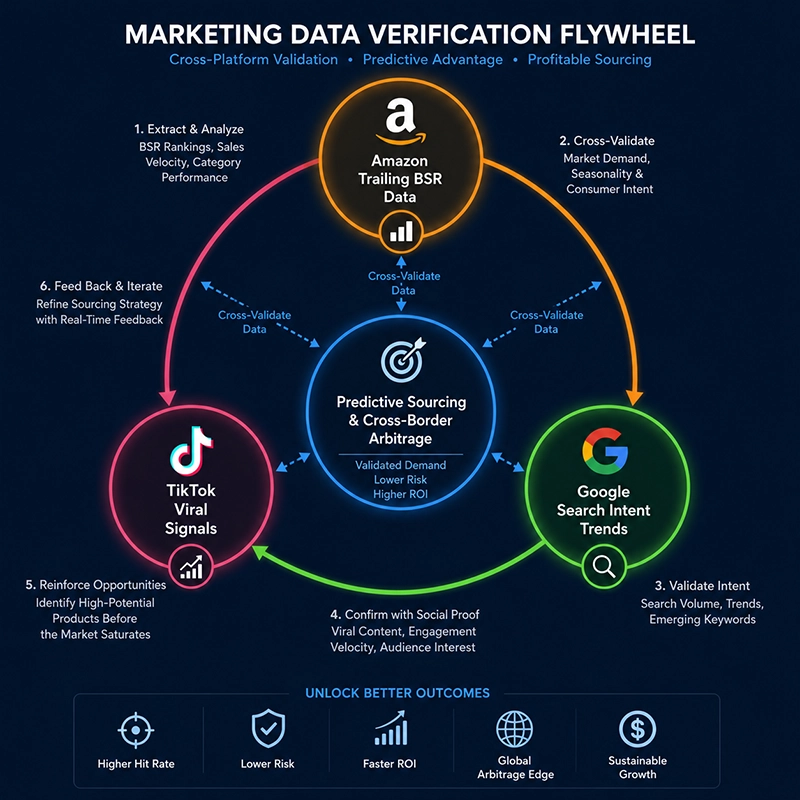
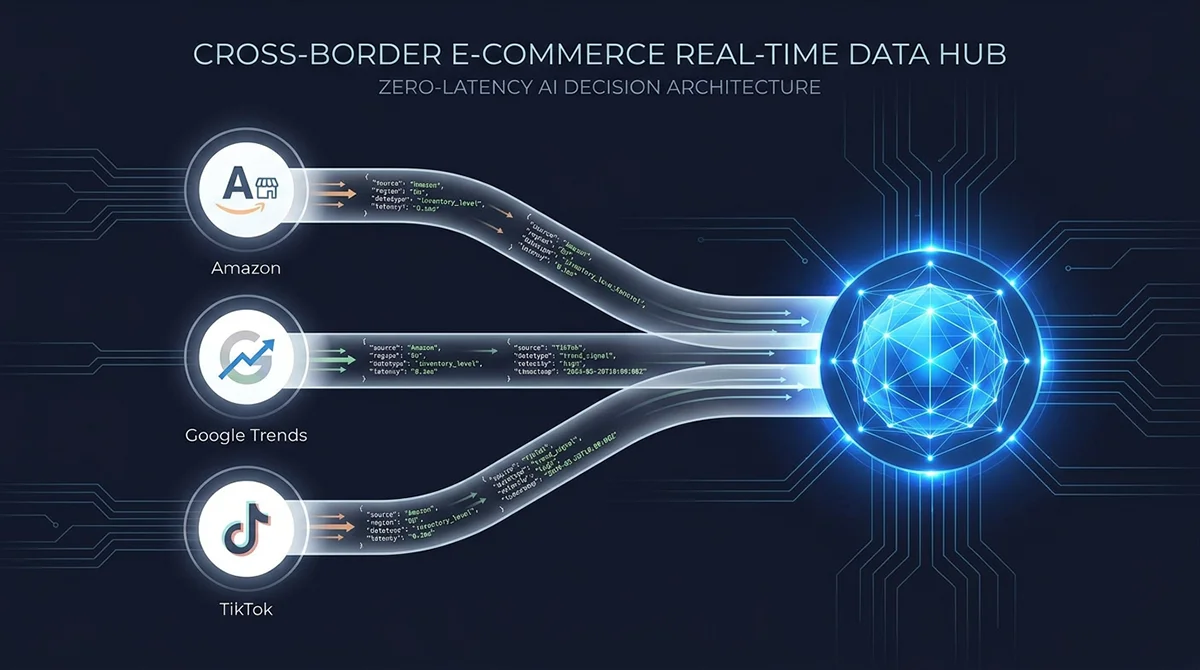
A solitary data source invariably reflects only a fragmented cross-section of the market. In the Agent Era, the most formidable capability of an automated system lies not merely in processing massive datasets, but in its ability to span disparate digital ecosystems. By executing deep cross-validation between Amazon transaction data, Google macro search trends, and TikTok social media vitality, AI agents construct dimensional strike strategies for product selection and operations.
Aligning the Timelines of Amazon Transaction Data and Google Search Trends
Traditional product selection models suffer from an over-reliance on on-site historical sales and BSR. However, BSR is fundamentally a “Trailing Indicator”—it merely reflects transaction outcomes that have already materialized. To secure true strategic first-mover advantage, AI agents must be capable of capturing and analyzing the “Leading Indicators” of consumer intent.
Via the Keyword Trends API provided by Pangolinfo, agents gain a critically vital “time dimension” perspective. While conventional SERP APIs only supply instantaneous snapshots of current rankings, the Keyword Trends API interfaces directly with massive macro search databases, supporting cross-regional (e.g., region: "US") and long-cycle (e.g., timeRange: "today 12-m") search heat analysis. The deep JSON payload returned features critical data arrays, including timelineData (chronological interest distribution) and keywordsRankData (breakout search query leaderboards).
In a live, intelligent product selection workflow, the AI agent will initially call Amazon’s list_new_releases tool to identify a burgeoning running shoe design. It will subsequently feed this attribute keyword directly into the Keyword Trends API. If the agent detects a steep, ascending search volume curve on Google, accompanied by massive breakout long-tail queries, while the design’s BSR on Amazon has not yet explicitly detonated, the agent classifies this as a “blue ocean” category. By synthesizing these two data streams, it generates a high-precision “Best-Seller Prediction Model”. This rigorous cross-referencing of macro search intent against micro e-commerce rankings dramatically mitigates inventory risk.
Social Media Arbitrage and the Systemic Exploitation of “The Viral Lag”
Social media platforms, particularly short-video networks epitomized by TikTok, are functioning as the true incubators for contemporary blockbuster products. The integration of AI agents empowers sellers to systematically exploit a phenomenon known as “The Viral Lag”—the chronological gap between a product achieving viral proliferation on social media and the supply chain satisfying that demand within specific regional markets—with unprecedented speed and precision.
By coupling specialized social media trend monitoring tools (like Virlo or Nexscope, which track TikTok content angles and conversion rates) with Pangolinfo’s real-time data, an agent can engineer a fully automated arbitrage flywheel. For example, the agent’s crawler module flags a massage gun video on TikTok featuring a specific hashtag that has accumulated over 3 million views in the past 48 hours. The agent instantly initiates a verification protocol: it first calls the Pangolinfo get_amazon_product tool targeting the U.S. marketplace, discovering the product has amassed over 8,000 reviews, thereby validating the fundamental product logic. The agent then flips the site parameter to the UK, deploying the list_seller_products or search tools for comparison, and shockingly discovers that the exact same viral product possesses a meager 47 reviews in the UK market, with incumbent sellers failing to even offer FBA (Prime) fulfillment.
For an astute cross-border enterprise, this “Logistics Moat” deficiency and “Social Proof Gap” identified by the agent represent a golden ticket into the local market. The enterprise can rapidly mobilize inventory to UK overseas warehouses, seizing the Buy Box from sluggish competitors and executing a highly lucrative, cross-border dimensional strike before incumbents can even react.
The Intellectual Property Firewall and Brand Citations under a Global Perspective
Within this high-frequency, cross-border rapid deployment model, intellectual property (IP) infringement looms as a Damoclean sword over sellers. Historically, IP clearance required days of legal consultation or tedious manual database queries. Today, empowered by the MCP architecture, compliance screening is deeply embedded within the millisecond-level execution sequences of the product selection workflow.
The moment an AI agent locks onto a high-potential niche via cross-channel validation (utilizing the filter_niches tool), it automatically extracts the core brand names, patent structural features, and manufacturer data of top-ranking products. With zero latency, the agent pipes these parameters into the WIPO API to verify the global registration status of design patents and trademarks. Furthermore, the agent concurrently triggers the PACER API to penetrate the U.S. Federal Court system, pulling the complete litigation historical timeline for the brand and its affiliated entities. Should the system detect a high frequency of recent patent lawsuits or TRO applications filed by the target entity, the agent immediately triggers a red alert to the operations team, autonomously halting the product launch sequence.
Additionally, concerning brand influence cultivation, Pangolinfo’s AI Overview SERP API furnishes an indispensable external vantage point. Google’s AI Overviews (formerly SGE) are currently intercepting 13% to 30% of organic search traffic. By scraping structured data and citation links from Google’s AI summaries in real-time, the AI agent evaluates the brand’s visibility within AI-generated responses (a metric termed “Share of Model”). If the agent identifies competitor products frequently dominating these recommendation summaries, it reverse-engineers the product parameters and textual structures favored by the LLM. This intelligence dictates the brand’s off-site PR strategy and social media corpus generation (Data Enrichment), ensuring the brand secures the high ground within AI-native search engines.
Agentic Engine Optimization (AEO): Reconstructing Product Catalogs for AI
The revolution in data acquisition technologies will ultimately force a fundamental paradigm shift in how e-commerce products are presented. As the weighting mechanisms of Amazon’s A9 algorithm pivot heavily toward large language models, AI shopping assistants like Rufus, Alexa, and Sparky have essentially seized control of the search bar. This signifies that the algorithm itself has evolved into the most formidable gatekeeper standing between the product and the consumer.
Consequently, the core focus of e-commerce optimization must pivot definitively from traditional Search Engine Optimization (SEO) to Agentic Engine Optimization (AEO) or Generative Engine Optimization (GEO). The legacy A9 algorithm leaned heavily on exact textual Keyword Matching and the linear accumulation of historical sales velocity; conversely, LLM-driven AI shopping assistants possess profound semantic comprehension. When a user queries Rufus, the AI’s highest logical criteria for evaluating a product detail page (Listing) shifts to: “Based on the content provided on this page, can the AI confidently recommend this product to resolve the user’s highly specific pain point?”
To secure survival space within the recommendation arrays of AI assistants, the structure and articulation of product data must undergo a radical reconstruction to achieve exceptional “AI Readability”.
Firstly, the traditional, keyword-stuffed but logically incoherent “Feature-heavy copy” must be entirely discarded, replaced by conversational, problem-solving content structures. Because LLMs rigorously avoid the risk of “hallucinations” when generating answers, Amazon’s AI assistants assign massive trust weights to listings that feature structured, rigorous, and exhaustive product attributes (e.g., precise material composition ratios, detailed cross-device compatibility matrices, and millimeter-exact dimensional data).
Secondly, crawlable, LLM-comprehensible A+ page text and FAQ (Frequently Asked Questions) modules have emerged as the most lethal weapons in the AEO arsenal. AI assistants exhibit an extreme bias toward content that proactively answers queries arising in the consumer’s mid-funnel decision phase. At this juncture, Pangolinfo’s pioneering Amazon Alexa API delivers an irreplaceable strategic advantage. As the world’s first commercial scraping API purpose-built for Alexa for Shopping, it simulates user inputs to reverse-extract the follow_up_questions proactively generated by the AI assistant when recommending a specific ASIN. Sellers can seamlessly reverse-engineer these exact questions—which the AI has mathematically determined the consumer cares about most—alongside authoritative answers directly into the text layers of their bullet points and A+ content. This not only perfectly maps to the LLM’s internal dialogue tree but also drastically elevates the product’s recall rate during multi-turn conversational interactions.
Finally, the AEO era imposes draconian demands on pricing rigor. While human consumers are notoriously susceptible to the illusions of artificial discounts, AI assistants ruthlessly pierce through any marketing fog. They possess the capability to instantly access and compute a product’s unadulterated, 12-month historical price curve. Should a seller attempt to artificially inflate the strikethrough price prior to a peak-season promotion to fabricate a phantom discount, this lack of pricing coherence will be laid bare under algorithmic scrutiny. Not only will the listing fail to accrue any promotional weighting, but the brand’s foundational trust score will be severely penalized. Enforcing strict pricing discipline at the code level, supported by uninterrupted competitor monitoring via real-time data APIs, represents the solitary path for brands to sustain competitiveness under the transparent, unblinking gaze of the algorithm.
Conclusion
As cross-border e-commerce definitively crosses the threshold into Agentic Commerce, traditional SaaS data silos—architected on static snapshots, batch processing, and visual interaction—have calcified into historical baggage severely impeding enterprise automation. The sudden emergence of the Model Context Protocol (MCP) architecture, deeply interwoven with an underlying network of real-time, strongly-typed, anti-bot data extraction APIs, has forged the definitive next-generation digital infrastructure.
On this entirely new battlefield, the defensive moat of an enterprise is no longer defined merely by supply chain leverage or raw advertising budgets. It is dictated by the latency limits of its data pipelines, its structural completeness, and the absolute breadth of its cross-channel validation. Only those enterprises capable of seamlessly piercing the foundational layers of Amazon transactions, the macro-intent webs of Google, the viral detonation points of TikTok, and the global patent registries of WIPO at millisecond speeds—feeding their AI agents a diet of pure, structured JSON data—can execute true dimensional strikes and sustain exponential growth in a future where algorithms dictate consumer choice.