
The AI “Blue Ocean” Product Your Tool Just Recommended? Competitors Found It 3 Months Ago
Here’s a scenario every Amazon seller running an AI product research tool will recognize: you feed the AI a category keyword, it confidently returns a list of “high-potential products,” you go to verify the opportunity — and find the BSR top 50 is already locked in, the niche has been saturated for two months, and the window you were supposed to catch has long since closed.
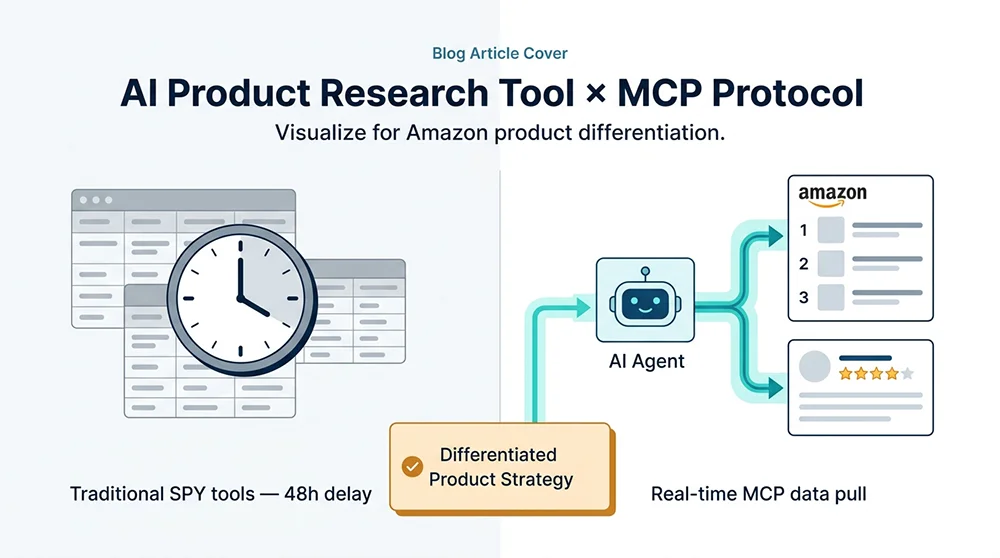
The AI didn’t fail you. The data underneath it did. Nearly every AI product research tool on the market today draws from subscription database snapshots with refresh cycles between 24 and 72 hours — some weekly for long-tail categories. In a marketplace where thousands of SKUs list and delist daily and new product rankings shift on an hourly basis, that lag isn’t a minor inconvenience. It’s a structural problem that invalidates the entire premise of “real-time market intelligence.”
The subtler failure mode is differentiation analysis. Being told “users complain about clogged filters” is useful. Being told “three of the top-5 BSR products share this exact complaint in reviews posted in the last 30 days, while two newer entrants have addressed it” is actionable intelligence. The second type of insight requires live, programmatic data access — something static databases fundamentally cannot provide.
This isn’t a Prompt engineering problem. It’s a data infrastructure problem. And MCP protocol is the layer that finally bridges AI reasoning with real-time Amazon data.
Why Most AI-Powered Product Selection Tools Hit a Ceiling — and Where It Comes From
Before jumping to solutions, it’s worth being precise about what’s broken — because “just use fresher data” misses the structural depth of the problem.
Constraint 1: One-way pipeline latency. Traditional product research tools operate on an offline batch-processing model: crawl → clean → warehouse → display. The AI can only query what has already been loaded into the database. It has no mechanism to dynamically request updated data mid-analysis. When you ask “is there a viable entry window in this subcategory right now,” the AI’s answer actually means “was there one 48 hours ago.”
Constraint 2: No live tool-calling capability. Large language models excel at reasoning and generation but cannot proactively “reach out” for fresh data on their own. Without a tool-calling layer, the model’s analytical capability is bounded by its training data and whatever context is manually provided. Developers have built various wrappers to address this — but these solutions are fragmented, model-specific, and difficult to maintain across frameworks.
Constraint 3: Insufficient granularity for differentiation. Knowing “this product category has high negative review rates” informs category selection. Knowing “the top-3 BSR products in this category all show clustering of 1-star reviews mentioning ‘battery failure within 60 days’ in the past six weeks” informs specific product engineering decisions. Aggregate statistics and individual-product real-time review mining are entirely different data access patterns — and existing AI product research tools optimized for the former cannot deliver the latter.
MCP (Model Context Protocol) addresses all three constraints at once. It gives AI Agents a standardized interface to call external tools — including live data collection APIs — during the reasoning process itself. The model doesn’t just retrieve cached data; it actively requests the current state of the Amazon marketplace at the moment you ask the question.
MCP Product Sourcing Solution vs. Traditional Subscription Tools: A Framework Shift, Not an Upgrade
The differences play out across four dimensions that matter for sourcing decisions:
Data freshness: Subscription tools refresh at 24–72 hour intervals at best. An MCP-connected AI agent pulling data via live scraping API operates at minute-level latency — from Amazon’s servers to the model’s reasoning context. For new product monitoring (where competitors typically decide within 72 hours whether to accelerate a launch), this gap determines whether you’re chasing or leading.
Analysis depth: Subscription tools surface aggregated metrics — average ratings, estimated monthly revenue, historical pricing curves. An MCP-enabled AI-powered product selection workflow can target specific ASIN clusters, pull their most recent 30 negative reviews, perform time-series sentiment analysis, and surface service failures or product defects that are actively occurring right now, not three months ago.
Differentiation strategy generation: Traditional tools generate differentiation suggestions by pattern-matching historical success cases: “products with these features tend to outperform.” MCP-based AI agents can run a complete reverse-engineering loop: scrape real-time competitor reviews → cluster high-frequency pain points → cross-reference current BSR top-10 specs → generate specific product engineering improvement recommendations. That’s not pattern library lookup — that’s live diagnosis.
Cost structure: Leading subscription tools run $600–$3,600 per year per account; team-scale licensing compounds quickly. API-based models like Pangolinfo charge per actual usage volume, with sufficient concurrency capacity for millions of pages per day — but typical sourcing research workflows consume a fraction of that ceiling. The marginal cost per research session drops dramatically as you scale.
Building the Real-Time Sourcing Pipeline: Pangolinfo Scrape API + MCP
Connecting an AI Agent to live Amazon data requires solving two engineering problems: first, a stable, programmable interface for collecting Amazon’s public data at scale; second, exposing that interface to the AI via MCP so the model can invoke it autonomously during reasoning.
Pangolinfo Scrape API handles the first problem. It covers full-catalog Amazon data collection — product detail pages, BSR Top 100 rankings, new arrivals, keyword search results, reviews, Q&A, and Sponsored Product ad placements (98% collection rate, highest in the industry). Output is structured JSON ready for direct model consumption. Critically, it supports location-specific collection by ZIP code — meaning you can retrieve the actual prices and inventory status a specific regional audience sees, essential for cross-region pricing analysis and FBA eligibility research.
The second problem is handled by the Pangolinfo Amazon Scraper Skill — a pre-packaged MCP Skill deployable directly to MCP-compatible AI frameworks including Claude Desktop, Cursor, and custom LLM agents. Once configured, the AI Agent gains a registered tool: whenever its reasoning requires Amazon data, it calls this Skill automatically — no manual copy-paste, no switching tabs, no data staleness from manual lookup delays.
For teams that need ongoing multi-competitor surveillance rather than one-off research sessions, AMZ Data Tracker adds a monitoring and collaboration layer — no-code configuration of competitor tracking dashboards, price movement alerts, and rating change notifications, with structured output suitable for bulk AI analysis pipelines.
The three products compose a complete stack: Scrape API for live data collection, Amazon Scraper Skill as the MCP bridge to AI reasoning, and AMZ Data Tracker for ongoing monitoring and team-scale data management.
Practical Implementation: Agent Prompt Framework for End-to-End Differentiation Analysis
The following Agent task prompt is designed for use with Claude, GPT-4o, or any tool-calling-capable model with Pangolinfo Amazon Scraper Skill configured as an available tool:
## Task: Amazon Product Differentiation Analysis Report

### Data Collection Instructions
1. Use Amazon Scraper Skill to pull the current BSR Top 20 for the following category:
   - Category: [e.g., "Kitchen & Dining > Coffee Makers"]
   - Fields required: ASIN, title, rating, review count, current price, variant count, first available date
   - Location: ZIP 10001 (New York, for price benchmarking)

2. For ASINs ranked in the top 5 with review count > 500, pull the 30 most recent
   1-star and 2-star reviews for each. Extract: review date, review body, purchased variant.

### Analysis Instructions
3. Cluster the negative review content along these dimensions:
   a) Product functional defects (hardware / software / materials)
   b) User experience issues (setup complexity / noise / odor / learning curve)
   c) Logistics and packaging issues (exclude from product redesign scope)

4. Cross-reference high-frequency pain points (≥3 occurrences) from categories (a) and (b)
   against the current product specs of the BSR top-5 listings. Determine:
   - Which pain points are universal (present across all top competitors)?
   - Which are limited to specific price tiers or brands?

### Output Format
5. Generate a Differentiation Opportunity Report including:
   - Market overview (BSR top-20 average price, rating distribution, competitive density)
   - Top 3 differentiation angles (each with: pain point source, current market gap, recommended spec direction)
   - Risk flags (patent sensitivity zones, Amazon policy constraints, category restrictions)
For teams preferring direct API integration over the MCP Skill layer, here’s a Python implementation using Pangolinfo Scrape API to collect the raw data for the above workflow:
import requests
import json

# Pangolinfo Scrape API — Real-time Amazon automated Amazon niche finder data collection
# Full API docs: https://docs.pangolinfo.com/en-api-reference/universalApi/universalApi

API_KEY = "your_api_key_here"
ENDPOINT = "https://api.pangolinfo.com/v1/scrape"


def fetch_amazon_bsr(category_node_id: str, marketplace: str = "US", zipcode: str = "10001") -> list:
    """
    Fetch real-time Amazon BSR Top 100 data for a specified category.

    Args:
        category_node_id: Amazon browse node ID for the target category
        marketplace: Target marketplace (US, UK, DE, etc.)
        zipcode: Delivery ZIP code — determines displayed price and inventory availability

    Returns:
        List of product dicts with ASIN, title, rank, price, ratings data
    """
    payload = {
        "target": "amazon_bestsellers",
        "category_id": category_node_id,
        "domain": f"amazon.{'com' if marketplace == 'US' else marketplace.lower()}",
        "location": zipcode,
        "output_format": "json"
    }

    headers = {
        "Authorization": f"Bearer {API_KEY}",
        "Content-Type": "application/json"
    }

    resp = requests.post(ENDPOINT, json=payload, headers=headers, timeout=30)
    resp.raise_for_status()
    return resp.json().get("results", [])


def fetch_negative_reviews(asin: str, limit: int = 30) -> list:
    """
    Fetch the most recent 1–2 star reviews for a given ASIN.
    Used for competitor pain-point mining in the differentiation workflow.

    Args:
        asin: Amazon Standard Identification Number
        limit: Number of reviews to retrieve (default 30)

    Returns:
        Cleaned list of review dicts with date, rating, body, variant info
    """
    payload = {
        "target": "amazon_reviews",
        "asin": asin,
        "star_rating": [1, 2],
        "sort_by": "recent",
        "limit": limit,
        "output_format": "json"
    }

    headers = {
        "Authorization": f"Bearer {API_KEY}",
        "Content-Type": "application/json"
    }

    resp = requests.post(ENDPOINT, json=payload, headers=headers, timeout=30)
    resp.raise_for_status()

    return [
        {
            "asin": asin,
            "date": r.get("date"),
            "rating": r.get("rating"),
            "title": r.get("title"),
            "body": r.get("body"),
            "variant": r.get("variant_attributes", {})
        }
        for r in resp.json().get("reviews", [])
    ]


if __name__ == "__main__":
    # Example: Coffee maker category BSR analysis + competitor negative review collection
    print("Fetching live BSR data...")
    bsr = fetch_amazon_bsr(category_node_id="284507", marketplace="US")

    # Target top-3 products with sufficient review volume
    top_asins = [p["asin"] for p in bsr[:3] if p.get("asin")]

    all_reviews = []
    for asin in top_asins:
        print(f"Collecting negative reviews for {asin}...")
        reviews = fetch_negative_reviews(asin=asin, limit=30)
        all_reviews.extend(reviews)

    with open("competitor_negatives.json", "w", encoding="utf-8") as f:
        json.dump(all_reviews, f, ensure_ascii=False, indent=2)

    print(f"✅ Done. {len(all_reviews)} negative reviews collected → competitor_negatives.json")
    print("Next: Pass this JSON as context to your AI agent with the differentiation analysis prompt.")
The data this code collects is sourced directly from Amazon’s live pages — not cached in any third-party database, not subject to subscription refresh cycles. Feed the output JSON alongside the analysis prompt above to any capable LLM, and you’ll have a complete end-to-end AI product research tool workflow running on real-time data.
The AI Is Smart Enough — It Just Needs Real-Time Eyes
MCP protocol’s significance isn’t that it introduced a new concept. It’s that it resolved the longstanding weakness in every AI product research tool on the market: the AI reasoning layer is capable, but it’s been operating blind to current market state. When an AI Agent can autonomously call live data interfaces during its own reasoning process, “AI product selection” finally means what the name implies — intelligent, real-time market scanning — rather than “AI-formatted historical database queries.”
The stack outlined here — Pangolinfo Scrape API as the data layer, Amazon Scraper Skill as the MCP bridge, and a capable LLM as the reasoning layer — constitutes a complete operating system for modern product research. Differentiated strategies aren’t discovered by “looking things up” in a tool. They’re computed from fresh data. Internalizing that distinction matters more than mastering any single platform feature.
If you want to validate how this automated Amazon niche finder workflow performs against your current tooling, start a free trial at the Pangolinfo Console, configure the Amazon Scraper Skill in your preferred MCP-compatible framework, and run one complete category analysis. Compare the freshness and specificity of the output against what your subscription tool delivers. The gap will be self-evident.
Connect Pangolinfo Scrape API to your AI workflow today. Real-time Amazon data, MCP-ready, from live BSR collection to automated differentiation strategy generation — the complete AI-powered product selection pipeline.