
What does it mean to scrape Amazon product title and description, and why do teams do it?
Answer-first:When you scrape Amazon product title description, you are turning storefront text that has already been market-tested into structured data you can compare, monitor, and operationalize for listing optimization, competitor intelligence, and scalable content production.
On paper, a title and a description look like plain text. In practice, they are the public surface of a competitive system where every word is shaped by constraints: character limits, category norms, policy boundaries, keyword relevance signals, conversion psychology, and the habits of shoppers who skim faster than they read. That is why serious operators do not treat titles and descriptions as a one-off writing task. They treat them as a measurable asset that evolves through iteration.
Scraping is the difference between guessing and observing. Instead of debating what “should” work, you can quantify what currently works in your category: how top listings order attributes, what claims appear early, how they phrase compatibility, what risk-reversal language they use, which benefits are repeated across competitors, and how all of that changes before major events like Prime Day, peak season, or a wave of negative reviews.
And this is not only about copying competitors. The real leverage comes from turning market language into a reusable framework: extracting patterns, then combining them with your actual product truth (materials, specs, warranty, certification, differentiation) so your listing becomes both relevant and credible. When you do it well, scraping is not a shortcut; it is a disciplined feedback loop.
How does scraping titles and descriptions improve listing optimization results?
Listing optimization is often misrepresented as “put more keywords into the title.” That framing is too narrow, and it pushes teams into the wrong behavior: stuffing, repetition, and copy that reads like a search query. A better framing is that a listing is a compact argument. The title sets the promise and context, the bullets defend the promise with specifics, and the description or A+ content resolves objections and strengthens trust.
1) Keyword coverage is not a word list; it is a set of semantic blocks
Most categories have stable semantic blocks that recur across high-performing listings. Think in blocks such as material and build quality, compatibility and sizing, use-case and scenario, performance claims, care and cleaning, safety and compliance, and what I call “risk removal” (no odor, hypoallergenic, easy returns, warranty, customer support). Scraping lets you see which blocks dominate the category and how sellers sequence them. The blocks matter because shoppers scan for the block that matches their concern, not for an exact keyword match.
When you treat the output as structured text rather than raw paragraphs, you can do analysis that is actually actionable: measure how often certain blocks appear, how early they appear, which phrasing variants correlate with higher ranking clusters, and which blocks are missing from your own listing. This is where scraping starts behaving like product research rather than copywriting.
2) Policy boundaries are easier to understand through real examples
Amazon policies can be strict, and the enforcement bar is not always obvious from reading policy pages alone. Titles and descriptions are where the enforcement shows up in the wild. When you scrape competitor listings, you can build a “boundary dataset” for your category: what kinds of claims are common, what claims appear only rarely, which claims appear only in certain marketplaces, and how sellers phrase sensitive promises to stay within acceptable language.
That dataset saves time. Instead of arguing abstractly about whether a term is risky, you can look at hundreds of real listings, see the distribution, and decide with more confidence. Scraping will not replace compliance review, but it can prevent naive mistakes and help you localize responsibly when expanding to multiple regions.
3) Copy changes often, and those changes usually signal strategy
Operators track price and rank, but they often ignore copy changes. That is a blind spot because copy changes typically reflect experiments: a competitor shifts positioning, introduces a new differentiator, responds to review complaints, or tries to capture new keyword intent. Monitoring titles and descriptions over time gives you early detection of strategy shifts. In some categories, the copy changes are more frequent than price changes, especially around launches, promotions, and quality improvements.
If your system flags “meaningful changes” rather than re-scraping everything blindly, you can turn copy monitoring into a lightweight but powerful signal: when a top competitor changes their first 60 characters, that is rarely random. It is usually a new hypothesis about what shoppers care about.
4) Titles and descriptions feed ad creative, A+ modules, and off-Amazon assets
Teams who scale across many ASINs or marketplaces eventually hit a content bottleneck. Scraping helps you build a living content library: common benefit statements, scenario phrases, compatibility wording, measurement formats, and “objection-handling” claims. That library can then inform not only listings, but also Sponsored Brand copy, store pages, landing pages, email campaigns, and even customer support macros.
The value becomes even clearer when you connect scraped text to outcomes: CTR on ads, conversion rates, returns, and review sentiment. Scraping provides the inputs; your analytics layer turns those inputs into decisions.
Why is scraping Amazon product title description hard at scale?
Scraping a single page is easy. Building a system that can scrape tens of thousands of pages per day, stay stable for months, and produce consistent, comparable output is the real challenge. Amazon is not a static website; it is a dynamic, personalized, heavily defended storefront with continuous experiments and template changes.
Challenge 1: The same ASIN can render different storefront text
Variation is not an edge case; it is a default reality. The marketplace (amazon.com vs amazon.co.uk), language, currency, zipcode, Prime eligibility, device type, login state, and even the path you take to reach the page can influence what you see. In some cases, experiments change copy modules, reorder bullets, or adjust snippets displayed near the title. If you scrape without controlling context, you will mix multiple “versions” of the listing into the same dataset and then mistake that mix for meaningful changes.
A reliable system treats context as data. That means your job payload should include marketplace, zipcode, language preferences, timestamp, and a record of whether the request required full rendering. That context is what makes your time series analysis defensible.
Challenge 2: Dynamic loading and modular templates break brittle parsers
Titles are often present in HTML in a relatively stable way, but descriptions, A+ sections, and certain attribute blocks may be assembled through scripts or fetched via internal endpoints. On top of that, Amazon uses different templates by category, brand, and region. A naive approach that relies on a single CSS selector will work until it does not, and when it fails, it tends to fail silently: you get empty fields, truncated bullets, or merged content that looks plausible but is wrong.
At scale, silent failure is more dangerous than hard failure. Hard failure triggers retries and alerts. Silent failure feeds bad data into your optimization loop, which can lead to bad decisions and wasted effort. This is why parsing needs resilient logic, fallback rules, and post-extraction validation.
Challenge 3: Anti-bot and risk controls determine whether you can keep running
Most bulk scraping projects fail in operations, not in code. Detection can be triggered by abnormal frequency, low-quality IPs, inconsistent headers, unstable browser fingerprints, and unnatural browsing patterns. Even if you solve the first month, scaling often forces you into a maintenance treadmill: rotating proxies, dealing with CAPTCHAs, tuning concurrency, handling retries, and chasing template changes. The engineering cost becomes continuous.
This is also where teams underestimate “the second-order work.” It is not enough to get a 200 response. You need a system to route challenges, degrade gracefully when a cluster of failures appears, and avoid burning through your budget on retries that will never succeed.
Challenge 4: Compliance is a design decision, not a legal footnote
Public pages are not an invitation to unlimited automation. Teams that scrape responsibly usually adopt a few principles: collect only what you need, refresh on a schedule that matches the business use-case, cache aggressively, and keep clear internal policies on how the data is used. This matters not only for risk, but for cost. The most compliant systems often become the most efficient systems because they avoid unnecessary collection.
In practice, you should decide early whether you are collecting for internal research, for building a tool used by others, or for data redistribution. Each scenario has different guardrails. The right approach is to treat compliance as part of the product requirements, not as a check at the end.
What solutions exist today, and what are their limitations?
Most teams end up choosing among three broad approaches: manual extraction and browser tools, self-built scraping stacks, and API-driven collection. There is also Amazon SP-API, but it plays a different role. The right choice depends on your scale, your technical resources, and whether you need competitor data or authorized catalog data.
Option A: Manual copy/paste or browser extensions
This is the “small scale, immediate need” option. It is useful for exploratory research: comparing a dozen listings, spotting a pattern, or drafting initial copy. The limitation is that it does not scale and it is hard to reproduce. You cannot reliably associate the captured text with context (zipcode, variation selection, timestamp), and you cannot easily track changes. For serious optimization or monitoring, it becomes a dead end.
Option B: Self-built scraper (requests + HTML parsing, or browser automation)
A self-built system offers control. You can customize extraction rules, adapt to niche modules, and integrate tightly with your internal workflows. If you are building a very specialized product, that control can matter.
The limitation is long-term operational load. Once you move beyond a few hundred pages per day, you tend to accumulate infrastructure: proxy pools, browser rendering clusters, fingerprint management, CAPTCHA handling, job queues, parsing templates, monitoring dashboards, and on-call processes for when Amazon changes a layout overnight. Many teams can build the first version quickly, but they struggle to sustain it without dedicating full-time engineering time.
There is also a business limitation: internal teams often underestimate the opportunity cost. Every hour spent maintaining scraping infrastructure is an hour not spent improving product selection, creative strategy, customer research, or actual listing experimentation. This is why even technical teams increasingly prefer to outsource acquisition and focus on analysis and iteration.
Option C: Amazon SP-API (authorized catalog data, not a full storefront mirror)
SP-API is the most straightforward in terms of official integration, but it is designed around authorization. For your own brand and products, it can be powerful. For competitor listings, it is not the primary path. Even when catalog endpoints return attributes like title, the coverage may be incomplete, and it may not match what shoppers see on the storefront, especially for modules that are composed dynamically or influenced by experiments.
A practical strategy is to treat SP-API as “first-party truth for authorized items” and storefront scraping as “market observation.” If you mix these sources carefully, you can get the best of both worlds: official data where available, and storefront text where you need competitive intelligence.
Option D: Enterprise scrape APIs (page acquisition and parsing as a service)
Enterprise scrape APIs package the hard part: anti-bot mitigation, rendering when needed, parser maintenance across templates, and scalable infrastructure. What you typically receive is structured JSON, raw HTML, or both. Your team then focuses on what actually drives value: which products to monitor, how often to refresh, how to detect changes, how to compute keyword coverage, and how to turn insights into experiments.
The limitation is that you need to choose a provider that matches your requirements: stability across marketplaces, localization parameters like zipcode, data completeness for title/bullets/description/A+ modules, and clear operational guarantees. You also need to design your downstream pipeline responsibly so you do not turn a reliable API into an unreliable workflow.
What is the best approach right now, and why is it usually “scrape API + job system”?
For most e-commerce operators and SaaS teams, the best approach today is a split architecture: use a proven scrape API for acquisition and parsing, then build your own job system for scheduling, incremental refresh, data quality, and business logic. This separation is not only convenient; it is strategically sound. It turns the most volatile part of the problem (anti-bot and page templates) into a service boundary and keeps your unique value (analysis and workflows) in-house.
With Pangolinfo Scrape API, you can model “scrape Amazon product title description” as a standard task: input an ASIN plus marketplace and zipcode parameters, output normalized fields such as title, bullet points, description, A+ summary fragments, brand, category breadcrumbs, and variation metadata. Once the output is stable, you can build reliable downstream automation: compare competitor structures, detect meaningful copy changes, generate rewrite candidates, and route those candidates to human review.
If you are building AI-assisted workflows, the Amazon Scraper Skill adds a second layer of leverage: it makes scraping callable within an agent flow. That means your system can scrape competitor listings, summarize patterns, extract differentiators, propose experiments, and draft listing variants in one continuous process. The scraping step becomes a tool call rather than a separate engineering project.
This is also where the economics shift. The cost of building and maintaining scraping infrastructure is not linear; it spikes with scale and volatility. In contrast, a job system built on top of a stable API tends to scale more predictably. Your complexity remains in your domain: what to scrape, why, when, and what to do with the results.
How do you bulk scrape Amazon titles and descriptions without your pipeline collapsing?
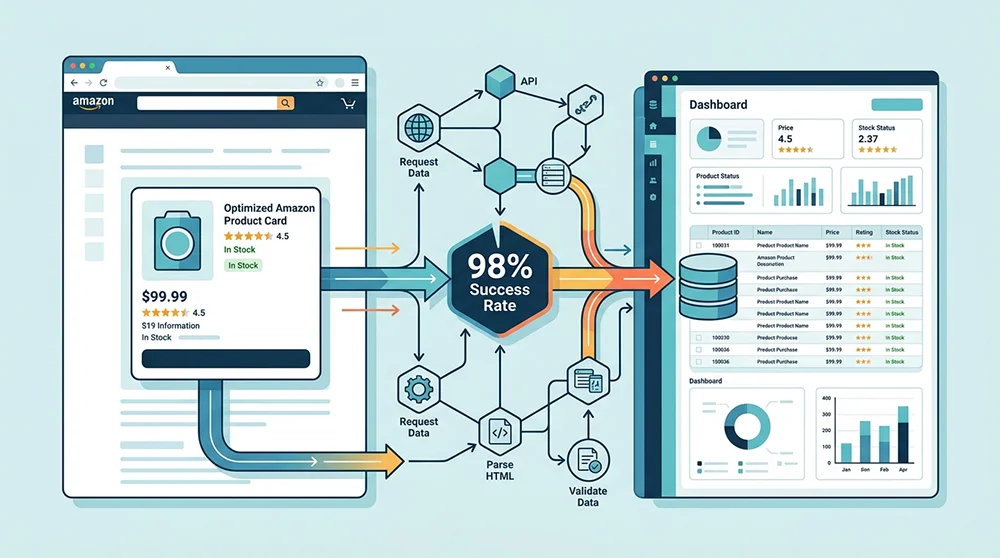
Bulk scraping is a pipeline problem. You are not collecting “pages”; you are producing datasets that other systems rely on. The most reliable teams design bulk scraping like a production data service: standardized inputs, predictable outputs, strong quality checks, and explicit failure handling. This section describes a pragmatic architecture that can run for weeks and still be trusted.
Step 1: Standardize the job payload and store context as first-class data
Before you worry about concurrency, decide what a job is. A useful job payload includes at least: ASIN or URL, marketplace, language preference, zipcode, whether to render, and a timestamp. It should also carry a “purpose” field (competitive monitoring, keyword research, localization verification, or content refresh) because purpose controls frequency and downstream routing.
On the output side, define your schema. For titles and descriptions, you typically want normalized fields, plus raw extracts for auditing. It is also valuable to store the raw HTML or key fragments for sampling and debugging. In bulk operations, debuggability is not optional; it is the only way you keep quality stable when Amazon changes a template.
Step 2: Build incremental refresh strategies instead of re-scraping everything
The biggest waste in bulk scraping is re-collecting unchanged pages. A smart system uses incremental refresh. High-impact items get more attention: top competitors, high-traffic keywords, or products that have shown volatility. Long-tail items refresh less frequently. You can also use change-triggered refresh: if rank shifts sharply, if price changes, if review volume spikes, or if your parser detects partial fields, enqueue an additional job. The goal is not maximum volume; the goal is maximum useful coverage per dollar.
In practice, incremental strategies often reduce total jobs dramatically while improving actionable coverage. Teams are often surprised that only a small portion of their monitored catalog needs frequent refresh. When you embrace that, you free budget for better rendering, richer extraction, and stronger QA.
Step 3: Treat data quality like accounting reconciliation
Bulk scraping fails quietly when quality controls are missing. Add at least four layers of QA:
First, completeness checks: title present, bullets count within expected range, description length above a minimum threshold. Second, structural checks: bullet points should not collapse into one merged paragraph; HTML artifacts should not appear in plain text fields. Third, anomaly detection: sudden drops in title length, spikes in repeated characters, or abrupt changes in language. Fourth, sampling audits: periodically fetch raw pages and compare against extracted fields for a random subset.
When QA runs continuously, you do not need to “trust” the pipeline; you can verify it. That is the mindset that separates a research script from a production system.
Step 4: Integrate the output into the optimization loop
Scraping is only the first step. The output becomes valuable when it feeds workflows: keyword coverage dashboards, competitor change alerts, rewrite suggestion queues, and experiment tracking. For example, you can publish a daily digest of “meaningful copy changes” among top competitors, or a weekly report of “newly emerging phrases and risk-removal claims.” Those insights then turn into controlled tests on your own listings.
If you want to connect copy to customer feedback, you can pair listing text with review data using Reviews Scraper API. The combination is powerful: you extract what competitors promise and what customers praise or complain about, then you build copy that aligns with real demand and real objections.
A minimal runnable example (illustrative)
The snippet below shows the principle: include context in the request, request normalized fields, and store structured output. Production systems need authentication, retries, idempotency keys, rate controls, and logging, but the idea is the same.
import json
import time
from urllib.request import Request, urlopen

API_URL = "https://api.example.com/amazon/scrape"
API_KEY = "YOUR_API_KEY"

def scrape_title_description(asin: str, marketplace: str, zipcode: str):
    payload = {
        "asin": asin,
        "marketplace": marketplace,
        "zipcode": zipcode,
        "fields": ["title", "bullets", "description", "a_plus"],
        "render": True
    }
    req = Request(
        API_URL,
        data=json.dumps(payload).encode("utf-8"),
        headers={
            "Content-Type": "application/json",
            "Authorization": f"Bearer {API_KEY}"
        },
        method="POST"
    )
    with urlopen(req, timeout=60) as resp:
        return json.loads(resp.read().decode("utf-8"))

if __name__ == "__main__":
    data = scrape_title_description("B0XXXXXXX", "amazon.com", "10001")
    print(data.get("title"))
    time.sleep(1)
This structure scales because it is explicit about context and output. When you are scraping at volume, clarity is a reliability feature.
Conclusion: Turn listing text into a reusable data asset
Titles and descriptions are not just words; they are compact representations of category norms, buyer intent, and competitive experimentation. Scraping Amazon product title and description becomes valuable when you treat it as a system: control context, extract reliably, validate continuously, and feed the output into an optimization loop. The real outcome is not a dataset. It is faster learning and more repeatable decisions.
If your goal is a one-time snapshot, manual tools may be enough. If your goal is sustained monitoring and scalable optimization, the more durable path is a scrape API for acquisition plus your own job system for scheduling, incremental refresh, and QA. Starting with Pangolinfo Scrape API helps you reach production faster, and layering the Amazon Scraper Skill can turn scraping into a callable capability inside agentic workflows.
FAQ: Scrape Amazon product title description
What is scraping Amazon product title and description used for?
Listing optimization and competitor monitoring, plus ad copy iteration, localization checks, and repeatable content frameworks built from real category language.
Why can the same ASIN return different titles or descriptions?
Marketplace, zipcode, language, device, login state, experiments, and variation selection can change what loads. Fix parameters and store context with timestamps.
Can Amazon SP-API be used to get competitor titles and descriptions?
SP-API is designed for authorized access and may not reflect storefront modules. Competitor research is usually page-level extraction via compliant scrape APIs.
What is the hardest part of bulk scraping Amazon titles and descriptions?
Long-term reliability: anti-bot, template changes, dynamic rendering, cost control, parser resilience, deduplication, incremental refresh, and compliance guardrails.
What is the best approach today?
Use an enterprise scrape API for acquisition/parsing and your job system for scheduling, incremental refresh, QA, and downstream workflows.