
Published: 2026-07-02 | Author: Pangolinfo Data Team
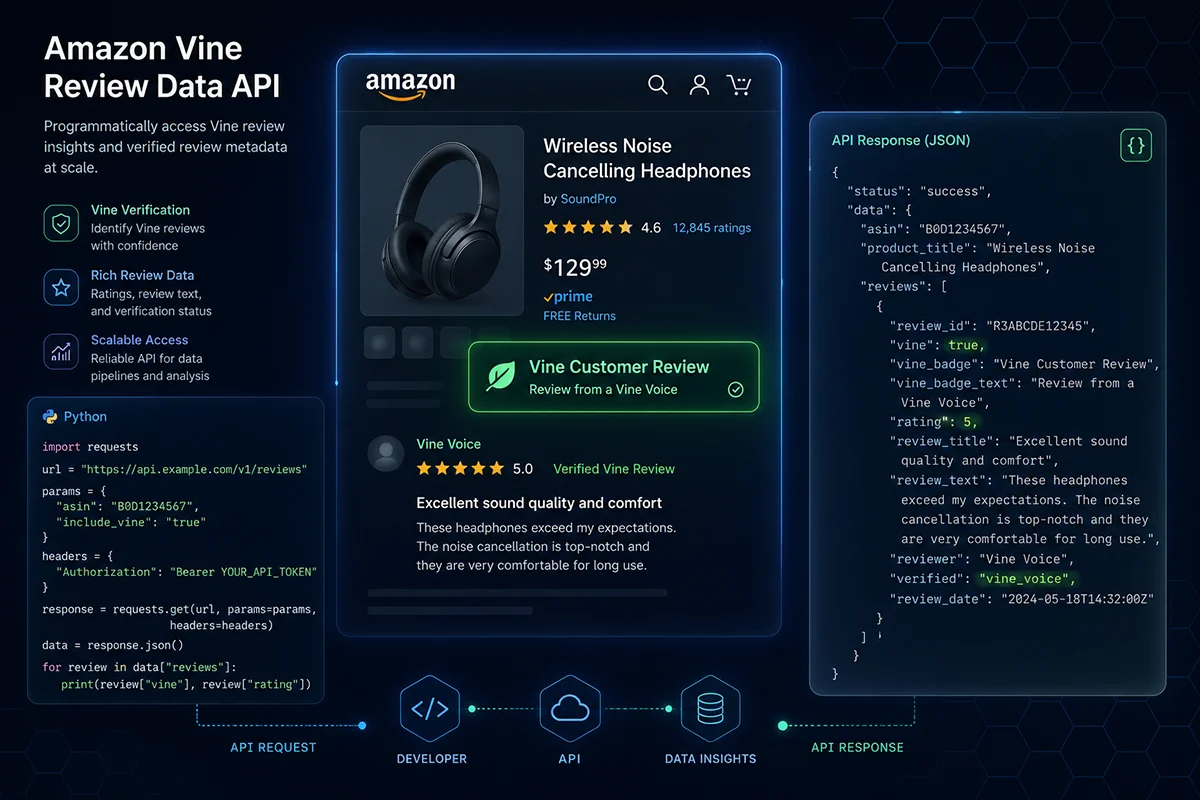
The short answer: Scraping Amazon Vine review data with a DIY Python scraper has become nearly impossible since Amazon rolled out its review page login wall in November 2024. The Vine badge itself lazy-loads via JavaScript, making static crawlers useless, and the CSS selectors that identify Vine entries shift with every front-end update. The most reliable path is calling the Pangolinfo Amazon Review API — pass an ASIN, get back structured JSON with a vine: true field per review, all identification handled server-side in under one second.
Why Is Amazon Vine Review Data Worth Targeting in the First Place?
Amazon’s Vine program recruits its most prolific and trusted reviewers — Vine Voices — and gives them free products in exchange for detailed, unbiased assessments. These aren’t marketing testimonials. Vine reviewers have nothing to gain commercially from the seller, so their feedback skews toward the kind of product reporting you’d see in a trade publication: specific use-case testing, side-by-side comparisons with competing products, and candid enumeration of design flaws.
In a dataset analysis we ran at Pangolinfo across over 500,000 Amazon reviews, Vine reviews averaged 2.3 times the word count of verified purchase reviews. Over 40% included attached images or video. And critically, the frequency of descriptions mentioning specific product defects was 3.1 times higher in Vine content versus the general review pool. That signal density makes Amazon Vine Voice review data disproportionately valuable for competitive product intelligence — ten targeted Vine reviews from a rival listing often yield more actionable insight than reading through a hundred generic five-star reviews.
There’s another strategic dimension worth noting: Vine reviews cluster in the first 30 days of a new listing’s life, during the cold-start window when sellers are enrolling in the Vine program to accelerate social proof. Monitoring when a competitor’s Vine reviews arrive, and what they say, gives you a real-time signal on whether their product is performing to spec or has unresolved issues they’re quietly patching between production batches.
What Makes Vine Review Scraping So Hard? Four Compounding Bottlenecks
1. Amazon’s November 2024 Login Wall
This is the single biggest blocker for anyone trying to collect Amazon vine review data programmatically. Since November 2024, Amazon’s dedicated review pages (/product-reviews/[ASIN]) redirect unauthenticated visitors to a sign-in screen. The restriction isn’t IP-based — it’s session-based. Rotating residential proxies won’t help here because the problem is an absent authenticated cookie, not a flagged IP address.
Developers who attempted to work around this by maintaining a pool of authenticated Amazon accounts discovered that Amazon’s anomaly detection systems are highly sensitive to session behavior patterns: logins from shifting IPs, rapid sequential page requests, and missing organic browsing history all generate behavioral signals that trigger account flags. Maintaining a reliable account pool at production scale involves significant operational overhead that most teams underestimate going in.
2. Lazy-Loaded Vine Badge Rendering
Even when accessing review content through product detail pages (which are not fully gated), the “Vine Customer Review of Free Product” badge doesn’t exist in the initial HTML payload. It gets injected into the DOM by an asynchronous JavaScript routine that fires after the review card scrolls into the viewport. A requests or httpx based static scraper receives an empty container in its place — the vine attribute is simply not present in what gets downloaded.
3. Shifting DOM Selectors and Class Name Obfuscation
Amazon’s front-end engineering team iterates on their page structure regularly. The CSS classes and data-hook attributes used to identify Vine badges differ subtly across product categories, and they shift whenever Amazon pushes a front-end update — which happens without any external notification. Teams that invested engineering time in building precise Vine-identification parsing logic routinely report that their selectors stop working within a few months, forcing another round of debugging that consumes developer hours without creating any new product value.
4. Geotargeted Content Variants
Amazon renders different content versions based on the delivery ZIP code associated with a session. If a scraper’s proxy node is located in Germany, Japan, or anywhere outside the target US market, the review ordering, visible review count, and even which Vine reviews surface in the rendered output can differ from what a US-based buyer actually sees. Accurate vine review scraping requires ZIP code-level localization.
Comparing Your Options: Which Path Eventually Breaks?
| Approach | Vine Badge Accuracy | Login Wall Handling | Maintenance Burden | Total Cost of Ownership |
|---|---|---|---|---|
| Python requests + BeautifulSoup (static) | ❌ Zero — lazy load blocks it | ❌ Hard redirect to login | High — constant selector updates | Very High |
| Playwright / Selenium (headless browser) | ⚠️ Inconsistent — login risk | ⚠️ Requires account pool | Very High — accounts + proxies | Very High |
| Generic third-party Scraping API | ⚠️ Provider-dependent | ⚠️ Partial support | Medium — fixed monthly fee | Medium-High |
| Pangolinfo Amazon Review API | ✅ Server-side identification, vine field native | ✅ Fully managed, no accounts | Very Low — pay-per-use | Very Low |
How Pangolinfo Solves Each Bottleneck
When we built the Amazon Review API, Vine badge identification was a first-class feature rather than an afterthought. The decision came from observing how clients using early versions of our review endpoints were spending engineering time building their own Vine detection logic on top of our raw HTML outputs — time that was repeatedly wasted every time Amazon changed their markup. Moving the identification into the API layer solved the problem permanently from the client’s perspective.
Cloud Rendering Infrastructure Handles the Login Wall
Pangolinfo’s data collection infrastructure operates cloud-side rendering clusters that simulate authenticated browsing sessions, complete with the scroll behavior required to trigger lazy-load scripts. All of this happens server-side — your code makes a standard HTTP request to our API endpoint and receives structured data back. There’s no browser process to manage, no account pool to rotate through, and no CAPTCHA to solve.
The vine Field Is Native to the Response Schema
Every review object in the API response includes a vine boolean field. Your application logic for separating Vine content from standard reviews becomes a single line of filtering code: [r for r in reviews if r.get("vine")]. That’s it. No regex matching against badge text, no class name hunting, no fragile attribute inspection.
ZIP Code Targeting for Localization Accuracy
The API accepts a zip_code parameter, allowing you to anchor the data request to a specific US delivery region. Passing "10001" for New York or "90001" for Los Angeles ensures the review set you receive matches what buyers in that region actually see — eliminating the geotargeting skew that plagues proxy-based DIY approaches.
Python Implementation: Bulk Vine Review Collection Across Competitor ASINs
import requests
import json
from typing import Optional

API_KEY = "YOUR_PANGOLINFO_API_KEY"
REVIEW_API_URL = "https://api.pangolinfo.com/v1/amazon/product/reviews"

def get_vine_reviews(
    asin: str,
    country: str = "us",
    zip_code: str = "10001",
    max_pages: int = 3
) -> list[dict]:
    """
    Fetches all publicly accessible reviews for an ASIN and
    returns only those flagged as Vine reviews.
    """
    headers = {
        "Authorization": f"Bearer {API_KEY}",
        "Content-Type": "application/json"
    }

    vine_reviews = []

    for page in range(1, max_pages + 1):
        params = {
            "asin": asin,
            "country": country,
            "zip_code": zip_code,
            "page": page
        }

        resp = requests.get(
            REVIEW_API_URL,
            params=params,
            headers=headers,
            timeout=20
        )

        if resp.status_code != 200:
            print(f"  [!] Page {page} failed: HTTP {resp.status_code}")
            break

        data = resp.json()
        page_reviews = data.get("reviews", [])

        if not page_reviews:
            break  # no more content

        # Filter using the native vine field — no HTML parsing required
        page_vine = [r for r in page_reviews if r.get("vine") is True]
        vine_reviews.extend(page_vine)
        print(f"  [+] Page {page}: {len(page_reviews)} reviews, {len(page_vine)} Vine")

    return vine_reviews


def analyze_competitor_vine_reviews(asins: list[str]) -> dict:
    """
    Collects and returns Vine review data for a list of competitor ASINs.
    """
    results = {}

    for asin in asins:
        print(f"\n[*] Processing ASIN: {asin}")
        vine_data = get_vine_reviews(asin)
        results[asin] = {
            "vine_count": len(vine_data),
            "avg_rating": (
                sum(r.get("rating", 0) for r in vine_data) / len(vine_data)
                if vine_data else 0
            ),
            "reviews": vine_data
        }
        print(f"  [+] Total Vine reviews found: {len(vine_data)}")

    return results


if __name__ == "__main__":
    # Example: monitor Vine reviews across 3 competitor ASINs
    competitor_asins = ["B08N5WRWNW", "B09XK3MJVT", "B0CK9FZBT3"]

    competitive_intel = analyze_competitor_vine_reviews(competitor_asins)

    with open("vine_competitive_intel.json", "w", encoding="utf-8") as f:
        json.dump(competitive_intel, f, ensure_ascii=False, indent=2)

    print("\n[+] Vine competitive intelligence saved to vine_competitive_intel.json")
Connecting Vine Review Data to AI Agent Workflows
For teams building LLM-driven product selection agents or Voice-of-Customer analytics pipelines, Vine review data is an unusually clean input corpus. The average length, balanced sentiment, and structured assessment style of Vine content produces higher-quality embeddings for semantic search and more reliable sentiment classification outputs compared to mixed review sets that include short, emoji-heavy, or incentivized content.
Pangolinfo’s Amazon Data MCP protocol and Amazon Scraper Skill allow AI Agents to query Vine review data natively in Markdown format, without JSON deserialization overhead. A typical agent workflow might: (1) use the Amazon Scraper API to scan competitor rating histograms for dumbbell distributions, (2) pull Vine reviews from flagged ASINs via the Review API, and (3) pass the Vine text corpus to an LLM for defect clustering — all within a single automated pipeline requiring zero manual page browsing.
Frequently Asked Questions
What makes Amazon Vine review data different from regular reviews?
Vine reviews are written by Amazon’s hand-picked top reviewers (Vine Voice) who receive the product for free. Our internal analysis of 500,000+ reviews shows that Vine reviews average 2.3x longer than standard reviews, with 40%+ containing images or video. Because reviewers have no financial stake in the product, Vine reviews typically contain more balanced, detailed assessments of real-world use cases and defects.
Why is scraping Amazon Vine review data so technically difficult?
Three compounding factors: (1) Since November 2024, Amazon routes unauthenticated requests to the review page to a login screen — bypassing this without a verified session pool is not feasible. (2) The Vine badge widget is dynamically lazy-loaded via JavaScript, so static HTTP scrapers receive empty placeholder containers. (3) Amazon’s front-end team regularly scrambles CSS class names and data-hook attributes that identify Vine badges, breaking custom parsing logic.
How does the Pangolinfo API identify vine reviews in the response?
Each review object in the Pangolinfo Amazon Review API JSON response includes a boolean vine field. When vine: true, the review was written as part of the Amazon Vine program. No HTML parsing, CSS selector management, or badge text matching is required on your end — the identification logic runs on Pangolinfo’s cloud infrastructure.
Can I use the API to monitor competitor Vine reviews at scale?
Yes. Pass a competitor ASIN and optionally a ZIP code for localization, and the API returns all publicly visible reviews including vine-tagged items. Filter by vine: true to isolate Vine reviews. Batch ASIN submission is supported, making it suitable for large-scale competitive intelligence pipelines.
How does Amazon Vine review data benefit AI Agent product selection workflows?
Vine reviews are high-quality natural language corpus ideal for LLM-driven VoC analysis. Their length, structure, and objectivity make them superior training and inference inputs compared to mixed review sets. Pangolinfo’s Amazon Data MCP protocol lets AI Agents natively query Vine review data in clean Markdown format, reducing token overhead by ~65% versus raw HTML processing.
Wrapping Up
The business value of Amazon vine review data is real and substantial — but extracting it reliably requires overcoming infrastructure challenges that have become significantly harder since late 2024. The login wall alone has retired most static scraping approaches. Delegating data collection to the Amazon Review API means your team gets a clean vine: true field in structured JSON, without owning the anti-bot evasion, lazy-load rendering, or selector maintenance complexity.
Register for a free test key at the Pangolinfo Console — no credit card required for the initial quota. Full API reference documentation is available at the Pangolinfo Documentation Center.