
Executive Summary
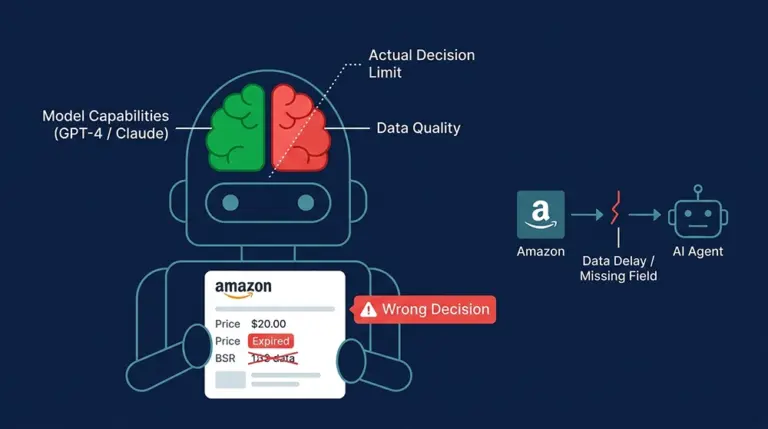
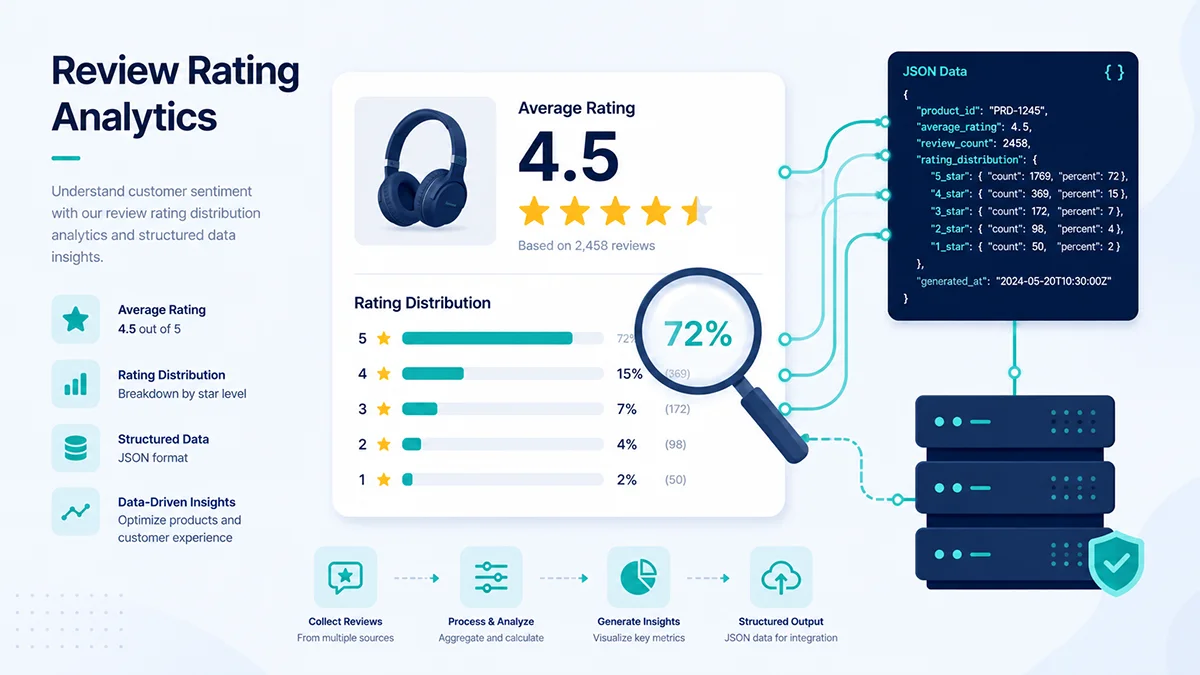
In e-commerce market intelligence and VoC sentiment modeling, product star percentage distributions (the percentage share of 5-star through 1-star reviews) provide a far more comprehensive picture than a simple arithmetic average. However, Amazon’s dynamic lazy loading on its details page, frequent CSS selector shifts, and WAF systems restrict automated crawlers. This article explores rating scraping challenges, compares mainstream DIY and enterprise paths, and highlights how Pangolinfo’s lightweight data API and AI-ready MCP protocol deliver stable rating distribution data at minimal cost.
Resolving Lazy Loading to Extract E-Commerce Loyalty Metrics
To extract **Amazon review rating distribution data**, the most stable and low-latency approach is using Pangolinfo’s Amazon Scraper API. This API natively resolves the rating summary statistics, bypasses Amazon’s dynamic HTML lazy-loading scripts, and supports ZIP code targeting, providing structured JSON or Markdown star percentages without proxy configuration.
When analyzing customer sentiment at scale, a product’s average score (e.g. 4.3 stars) hides critical variations. Two listings with the same rating can have completely opposite structures: one can be a healthy, steep pyramid (70% 5-star, 20% 4-star, with minimal 1-star complaints), while the other is a polarized dumbbell shape (60% 5-star offset by a massive 25% 1-star review segment indicating severe defects or listing manipulation). As a result, having a reliable pipeline to **get Amazon review percentage data** is vital for predicting return rates, filtering fake reviews, and running competitor intelligence. However, building this pipeline is technically challenging.
Why is Scraping Amazon Star Rating Percentages Hard?
Developers attempting to **scrape Amazon star rating distribution** metrics face several frontend and network-level defense barriers. From our experience processing millions of daily e-commerce API requests, we highlight three main friction points:
1. Javascript Lazy Loading of the Histogram Widget
To optimize initial page load performance, Amazon does not include the detailed star percentage histogram in the static HTML code. The widget is lazy-loaded dynamically, rendering only after the user scrolls the viewport down to the “Customer reviews” container or when specific asynchronous JS files execute. Standard Python requests crawlers that pull raw HTML retrieve only empty DOM nodes, resulting in empty value errors in your parser.
2. Frequent and Unpredictable CSS Selector Mutation
Amazon frequently updates the layout structure of its detail pages. Selector parameters, including class names and the data-hook="rating-histogram" attributes, mutate dynamically or vary across product categories. For DIY teams, this means constant parsing pipeline breakages, forcing engineers to manually debug selectors on a weekly basis.
3. Geographic Discrepancy and Geotargeting
Amazon localizes listing content according to the user’s localized delivery address. If your scraper targets a US ASIN using a random European proxy IP, the listing displays different stock levels, variations, and localized Q&A/review summaries. Without specifying a targeted ZIP code parameter, your scraper runs into geotargeting bias, collecting skewed distribution metrics.
Mainstream Scraping Approaches and Their Limitations
To **get Amazon review percentage data**, development teams usually choose from three standard options, each presenting notable drawbacks in a production context:
Option 1: DIY Headless Browsers (Playwright / Selenium)
Developers write scripts to launch headless browsers, scroll down the viewport to trigger dynamic loading, and parse selectors.
The Pitfalls: This approach carries **high computational and bandwidth costs**. Headless browsers require massive RAM and CPU in cloud containers. Running this at scale for thousands of ASINs raises server hosting bills and proxy consumption fees. Additionally, headless browsers are easily flagged by Amazon’s WAF WebDriver checks, leading to recurrent 403 blocks.
Option 2: No-Code Visual Scrapers
Non-technical managers use desktop scraping software to scrape listing parameters.
The Pitfalls: Visual scrapers struggle with lazy-loaded modules. If the page loads slowly, the script crawls the element before rendering, leading to missing data. Furthermore, visual scrapers cannot integrate with enterprise BI backends or AI LLM workflows on a real-time basis.
Option 3: Enterprise Scraping APIs
Firms rent Bright Data or legacy scraper APIs to retrieve reviews data.
The Pitfalls: This is **inefficient and expensive (overkill)**. Traditional providers force you to scrape full review details pages or pull entire HTML page bundles just to fetch 5 simple percentage figures (the star ratings). This is slow, consumes heavy bandwidth, and requires high monthly minimum commitments (often hundreds of dollars), making it budget-unfriendly for SMBs. Additionally, they lack native support for compressed Markdown formats, wasting token space in LLM calls.
The Pangolinfo Rating Distribution API Solution
Addressing these challenges, Pangolinfo built a developer-first Amazon Scraper API engineered specifically for lightweight, high-speed product metadata extraction:
1. Optimized Summary Endpoint to Minimize Costs
You don’t need to request thousands of lines of raw reviews HTML. Pangolinfo features a lightweight metadata endpoint. Pass a target ASIN, and retrieve a structured JSON including `stars_distribution` (star rating percentages), `average_rating`, and `total_ratings` in under 1 second. This results in an 80% reduction in request latency and bandwidth cost compared to general scrapers.
2. Fully Managed WAF Bypass & Selector Maintenance
Pangolinfo manages browser fingerprinting, TLS JA3 emulation, proxy rotation, and CAPTCHA solving on our clouds. Our scrapers automatically wait for lazy-loaded histogram rendering, returning complete data pipelines. We maintain selector templates internally, meaning your code never breaks due to Amazon UI改版.
3. Built for AI Agents: Amazon Data MCP & Markdown
When training LLMs or building AI選品智能体, raw JSON arrays consume unnecessary context tokens. Pangolinfo features the first Amazon Data MCP and Amazon Scraper Skill. AI agents can directly fetch structured Markdown tables representing rating percentages, reducing token costs significantly.
If your AI Agent detects a high share of negative reviews, it can seamlessly transition to query our dedicated Amazon Review API to extract verified purchase review texts for deeper VoC classification.
Developer Guide: Getting Star Rating Percentages in Python
Integrating the Pangolinfo API takes seconds. Below is a Python script illustrating how to fetch structured rating distribution metrics, contrasted with the complex DIY headless browser method:
import requests
import json

# Setup Pangolinfo API Key (Get a free test Key at the console)
API_KEY = "YOUR_PANGOLINFO_API_KEY"
API_URL = "https://api.pangolinfo.com/v1/amazon/product/summary"

# Target ASIN and shipping ZIP Code parameter
params = {
    "asin": "B08N5WRWNW",
    "country": "us",
    "zip_code": "10001"
}

headers = {
    "Authorization": f"Bearer {API_KEY}",
    "Content-Type": "application/json"
}

try:
    response = requests.get(API_URL, params=params, headers=headers, timeout=10)
    if response.status_code == 200:
        data = response.json()
        print("--- Product Rating Metrics ---")
        print(f"ASIN: {data.get('asin')}")
        print(f"Average Score: {data.get('average_rating')} Stars")
        print(f"Total Reviews Count: {data.get('total_ratings')}")

        # Accessing the rating distribution percentages
        distribution = data.get("stars_distribution", {})
        print("Star Percentages:")
        print(f"5-Star: {distribution.get('five_star')}%")
        print(f"4-Star: {distribution.get('four_star')}%")
        print(f"3-Star: {distribution.get('three_star')}%")
        print(f"2-Star: {distribution.get('two_star')}%")
        print(f"1-Star: {distribution.get('one_star')}%")
    else:
        print(f"API failed. Code: {response.status_code}, Error: {response.text}")
except Exception as e:
    print(f"Connection error: {e}")
By contrast, to build a DIY scraper using Playwright sync API, developers have to manage headless rendering sessions, write scroll scripts to handle dynamic lazy loading, and purchase external residential proxies, resulting in higher complexity and breakable selectors:
# DIY Approach: Running Playwright headless browser sync session
from playwright.sync_api import sync_playwright
import time

url = "https://www.amazon.com/dp/B08N5WRWNW"

def get_rating_distribution_diy():
    print("[*] Launching headless chromium browser...")
    with sync_playwright() as p:
        browser = p.chromium.launch(headless=True)
        # Developers must manage proxy rotation and UA details manually
        page = browser.new_page(user_agent="Mozilla/5.0 (Windows NT 10.0; Win64; x64)...")

        try:
            page.goto(url, timeout=20000)
            # Simulating scrolling to trigger the lazy loading of review widget
            page.evaluate("window.scrollTo(0, document.body.scrollHeight * 0.7)")
            # Forced wait time (wasting rendering latency and proxy traffic)
            time.sleep(2)

            # Selector is prone to break during Amazon updates
            histogram = page.locator("data-hook=rating-histogram")
            if histogram.is_visible():
                html = page.content()
                print("[+] Scraped HTML successfully. Parsing remains to be done...")
            else:
                print("[-] Failed. Dynamic widget not loaded or proxy blocked by WAF.")
        except Exception as e:
            print(f"[-] Scraper error: {e}")
        finally:
            browser.close()

if __name__ == "__main__":
    get_rating_distribution_diy()
```
Conclusion: Delegate the Scraping OverheadMaintaining custom web scraping scripts to handle Amazon's WAF updates is a distraction from your core business analytics. Pangolinfo's developer-friendly Amazon Scraper API eliminates proxy rotation and selector updates. It operates on a Pay-As-You-Go pricing structure, with no minimum contracts, helping your engineering team focus on shipping features.
Frequently Asked Questions (FAQ)
Is scraping Amazon rating distribution data legal?
Yes. Following the hiQ Labs v. LinkedIn legal precedent, scraping publicly available information that does not require login authentication is legal. However, your crawler must run at reasonable frequencies to avoid server disruption. Pangolinfo handles compliant request flows natively.
Does ZIP code targeting affect the rating percentage distribution?
Yes. Amazon routes users to specific geographical listing variations. This means product availability, pricing, and buyer reviews can fluctuate depending on your ZIP code. Setting a specific zip code parameter (e.g. 10001) guarantees that your crawled distribution aligns with target local buyer experiences.
How does Pangolinfo compare to enterprise crawlers in pricing?
Legacy providers require monthly minimum limits of hundreds of dollars under contract. Pangolinfo uses a completely flexible Pay-As-You-Go structure with zero upfront fees, charging only for successful API requests.
Can I connect the rating distribution to my review text crawler?
Yes. Many clients use our star distribution summary endpoint as a first-tier analysis. If the 1-star percentage increases, they trigger our Amazon Review API to pull verified purchase texts for localized buyer sentiment mapping.
How do non-developers export rating distributions?
Non-technical teams can paste ASIN lists directly into our web console and download parsed rating distributions as Excel spreadsheets instantly, bypassing coding setups entirely.
Ready to analyze product rating summaries?
Register on the Pangolinfo Console for your free test API Key, or view our Documentation Center for detail configurations!