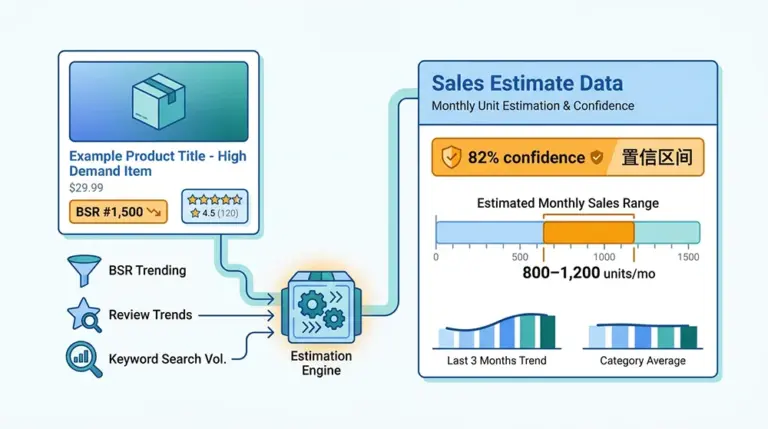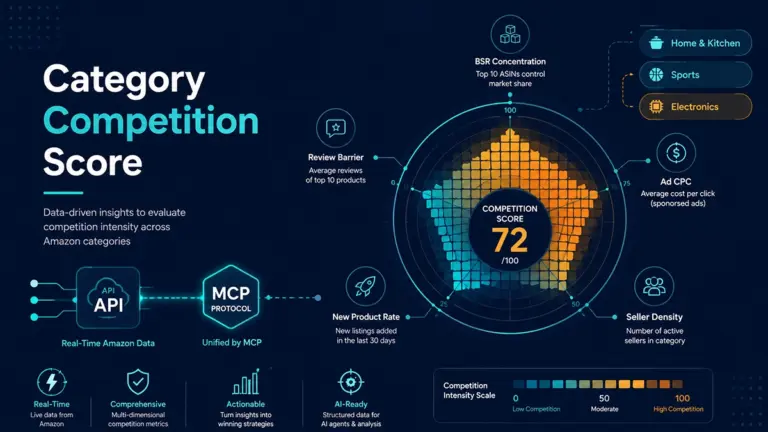

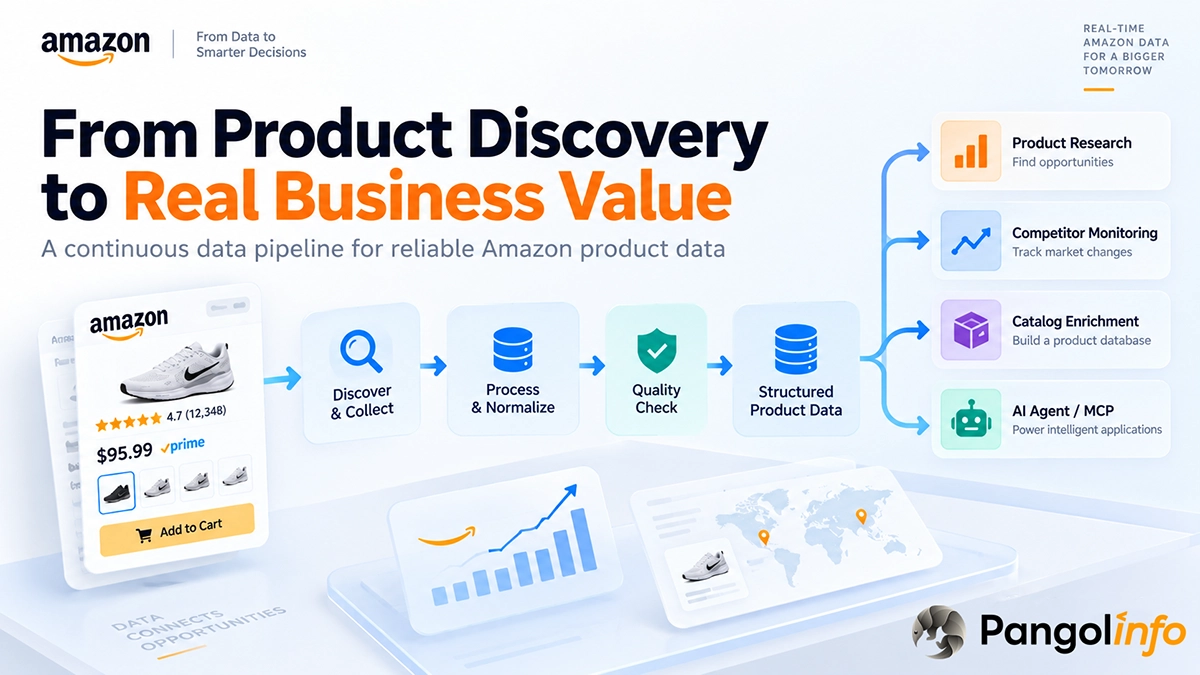
An Amazon product data API becomes useful when product identity, content, offers, location, and time form a verifiable observation. Define the business action first, then choose a source and acceptance rules. A title and a price alone cannot support every research, monitoring, or catalog task.
A team evaluating product data must answer more than whether an endpoint returns JSON. Where will the target products come from? How will variants be identified? Which offer does a price describe? Can a result support a location-specific comparison? What happens when the source changes or the application needs a historical view? This guide follows one decision: how to build a product data workflow that can support those tasks with evidence.
Official documentation and product sources were checked on September 28, 2026. Limits and coverage need another check before deployment. The article distinguishes documented facts, historical project notes, and hypothetical calculations. It does not turn a sample response into a guarantee of sales, exact stock, complete coverage, or service performance.
1. What is an Amazon product data API, and which job does it serve?
Why separate catalog items, listings, offers, and observations?
An Amazon product data API provides programmatic access to product-related information. A request can target an ASIN or discover candidates through keywords, categories, rankings, or seller pages. Output can be structured JSON, source HTML, or Markdown. Each format leaves a different amount of parsing work with the application.
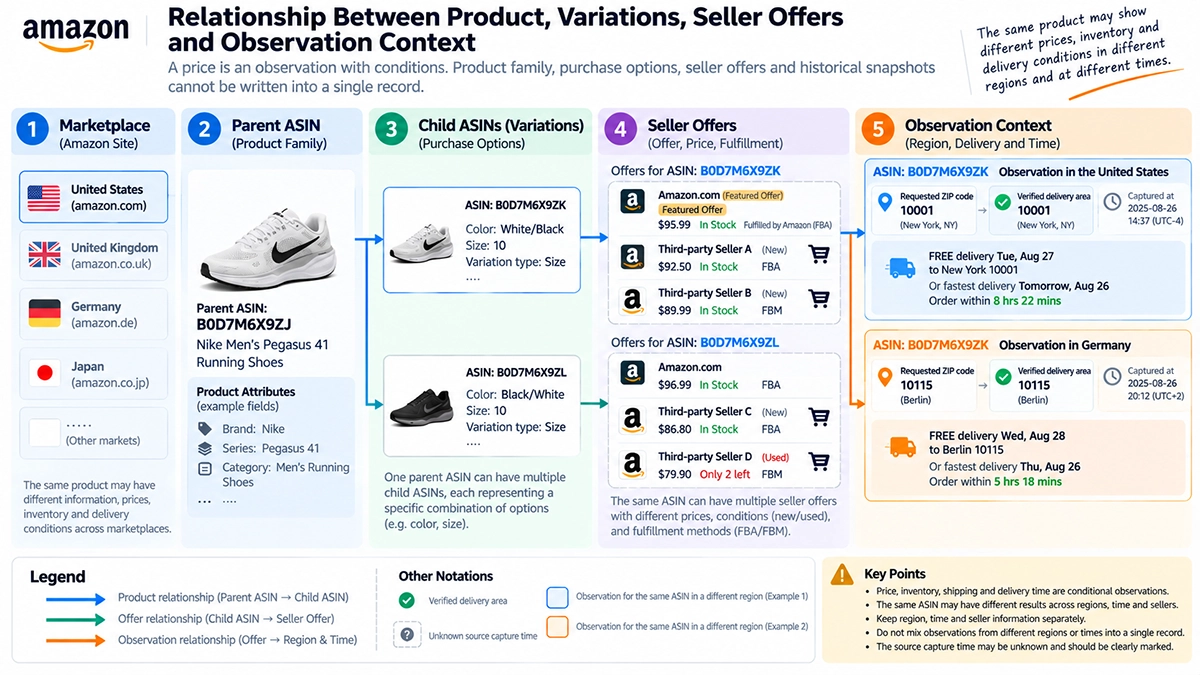
The phrase product data hides several entities. Catalog information describes the item, such as its brand, model, and attributes. A seller listing describes a seller’s participation and business information. An offer describes selling conditions. A page observation records what was visible in one retrieval context. The same ASIN can be associated with multiple seller offers, and the selected purchase option is not a substitute for the whole variation family.
Separate the product entity from its observations. The entity maintains identity and relationships; an observation retains the price, delivery information, rating context, and evidence from a particular retrieval. If an application overwrites one price per ASIN, an update from another destination or seller can erase the conditions behind an earlier alert. The system has a latest value but cannot explain its history.
One response may contribute to several entities. That does not justify storing every value under one key. A seller change, a selected-option change, and an offer-price change have different meanings. Preserve enough structure to distinguish them before the data reaches a dashboard.
Do you need a current page, historical data, or authorized account information?
These are different procurement requirements. Current-page data concerns the conditions of a retrieval. Historical data requires observations that were collected and retained in the past. Authorized account information depends on business access and permissions. Starting a live collection today does not produce last year’s price history, and a public availability label does not grant access to a seller’s inventory ledger.
Consider a hypothetical request to identify competitors that have reduced prices over several periods. Today’s price answers only what the source showed for this observation. A trend needs comparable historical observations and checks for changes in options, seller, currency, and promotion terms. The requirement is a comparable price series, not a field named price.
For catalog enrichment, images and specifications may matter more than a short refresh interval. For an offer alert, identity and destination evidence can be essential. For an AI agent, the result also needs provenance, time information, and unknown states so that the model can recognize the limits of its evidence.
What should the data requirement specify?
Write the target object, scope, action, and evidence into the brief. For example: observe a named competitor set in two delivery regions, alert the team when comparable offers meet its change rule, and retain the source behind each event. That statement reveals requirements for discovery, retrieval, destination checks, history, and review.
Define missing-data behavior and responsibility as well. An unknown price might not prevent image enrichment, while an unverified destination should block a location-specific comparison. A single success flag cannot make that decision for every consumer of the record. Acceptance belongs to a task, even when several tasks share the same source response.
2. Which product fields can you retrieve, and what do they mean?
How do you build a field list around a business decision?
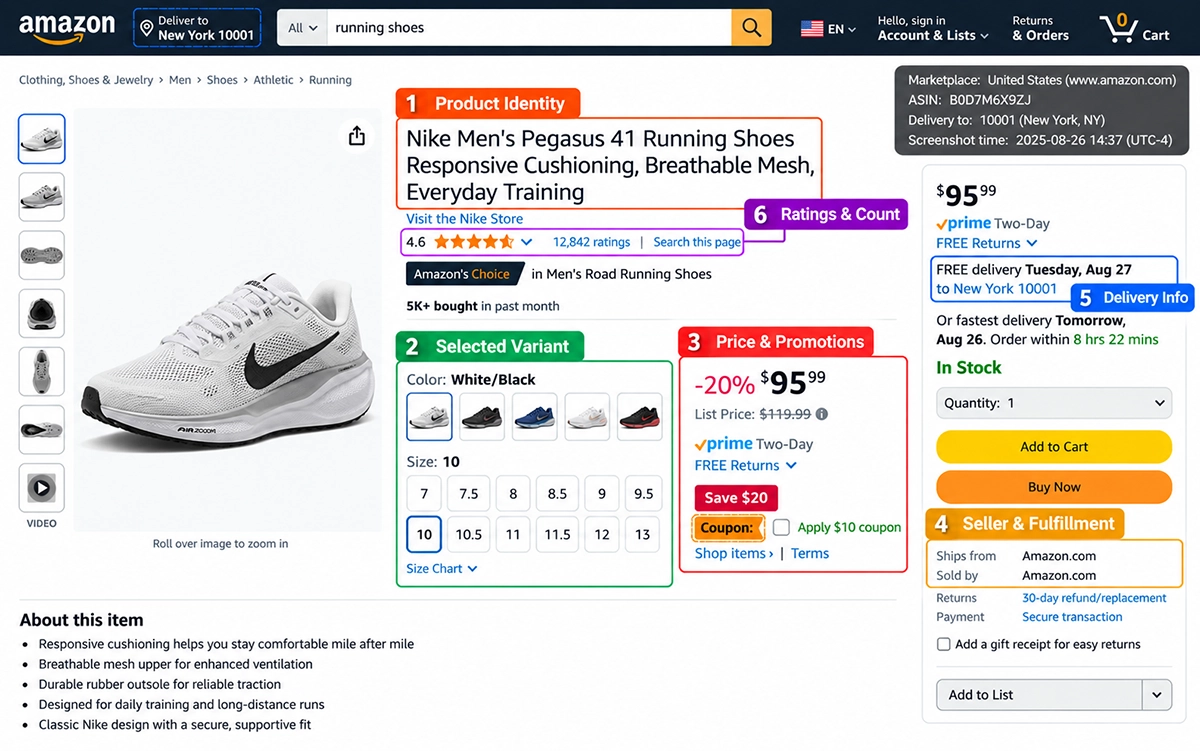
Write the object, raw representation, unit, and intended use beside each field. A price key does not settle a pricing requirement. An image array does not establish permission to reproduce the media. The groups below are an acceptance framework, not a promise that every source supplies every field for every item and marketplace.
| Group | Typical information | Useful for | Boundary to retain |
|---|---|---|---|
| Identity and relationships | ASIN, parent links, brand, model, external identifiers | Matching and variant discovery | Same item, same family, and similar item are different relationships |
| Content and media | Title, bullets, images, description, A+ content | Enrichment and content review | Missing content and reproduction rights require separate checks |
| Attributes and packaging | Capacity, dimensions, weight, color, pack count | Filters and unit-price comparisons | Item versus package measurements; one unit versus a bundle |
| Offers and promotions | Amount, currency, reference label, coupons, conditions | Price and promotion monitoring | Eligibility changes the meaning of a price |
| Seller and fulfillment | Seller, shipper, availability, delivery estimates | Supply and destination observations | Seller and shipper may differ; availability is not exact inventory |
| Ratings and classification | Stars, counts, themes, categories, BSR | Feedback and category research | Scope, category, and sampling affect interpretation |
Required fields depend on the output. Pack count is essential for a unit-price calculation but might not prevent a job from identifying an ASIN found for the first time. One universal schema can also conceal differences between apparel size, device memory, and food weight. The label size is not a universal measurement dimension.
What if the documentation and example use different shapes?
Preserve the discrepancy and verify the target response. Documentation can use a broad type label while an example contains nested arrays. Versions, parsers, and source pages can also change. An adapter should combine the current reference, a representative response, and a confirmed contract instead of assuming that a type label settles every case.
The Pangolinfo product example checked for this article places task objects under data.json and product results under each task’s data.results. The root object is not a product. The documentation also separates coupon, savingsPercentage, promotions, and discountTypes. Preserve those concepts instead of merging every discount-related value into one column. Product API reference
Retain raw and normalized values together. For money, keep the original text, decimal value, and currency. For an attribute, retain its original label, normalized name, value, and unit. When conversion fails, record the failure and source value instead of inventing zero. This lets analysts use consistent fields while preserving a route back to the evidence.
Unit pricing needs a verified sales unit. In a hypothetical example, a two-pack priced at 100 and an equivalent single item priced at 60 become 50 and 60 per item. That conversion fails if the individual contents differ. Store pack count, contents per unit, and measurement unit apart before choosing a per-item, weight, or volume comparison. A number in the title is not enough evidence to establish quantity.
How should missing values and field drift be handled?
An empty string, null, and an absent key describe a response shape. They do not, by themselves, establish whether the source lacked content, the field did not apply, or collection failed. Distinguish a field that was not requested from one that was promised but absent, and distinguish a parse failure from confirmed source absence. Unknown is a useful state when evidence cannot establish the cause.
Pangolinfo project notes dated September 14, 2026 recorded two related samples with 48 and 49 attribute entries and different reference-price labels: List Price and Typical price. These observations motivate name-based attribute handling and preservation of price labels. They do not estimate prevalence, and this article did not repeat those collection calls or treat the recorded values as current product facts.
At procurement level, the question is whether the field can support the intended task. A provider cannot make every source page identical, but it should explain its contract and diagnostic evidence. Store exceptions in a form that can be investigated rather than cleaning away the information needed to explain them.
3. How should you choose official access, a custom collector, or a managed API?
What product and pricing signals can SP-API provide?
SP-API is a collection of business APIs with roles, authorization, and operation-specific boundaries. Catalog Items supports catalog discovery and item information. Product Pricing supports pricing workflows. Customer Feedback provides another route for review insights. A single official API checkbox obscures these differences.
The Catalog Items v2022-04-01 search reference includes relationships, salesRanks, images, and attributes. The Product Pricing guide documents a batch Featured Offer workflow for up to 20 ASINs and a FOEP workflow for up to 40 SKUs. Claims that official access has no variants, rankings, or competitive pricing signals are therefore too broad. Access to a particular data set still depends on the operation, role, market, and intended use. Catalog search reference, Product Pricing guide
Record the exact operation and required context in the evaluation matrix. Confirming an item in the catalog does not establish its final purchase conditions for a particular seller and destination. If an operation returns a location sample, check its definition rather than treating it as an arbitrary customer’s checkout result.
Does Creators API serve the same purpose as public-page collection?
Amazon has marked PA-API 5 as deprecated and identifies Creators API as its successor. Creators API serves eligible affiliate shopping integrations and includes SearchItems, GetItems, GetVariations, and GetBrowseNodes. A new implementation should check the current interface and participation requirements rather than reproduce an old PA-API tutorial. Deprecation notice, Creators API introduction
An affiliate shopping page and an internal cross-region observation archive are different use cases. Receiving a field does not settle its permitted retention, display, or redistribution. Check the applicable content and usage terms for the project rather than treating eligibility as permission for every downstream use.
When does a custom, managed, or mixed approach fit?
| Route | Reason to evaluate it | Work the application retains |
|---|---|---|
| SP-API | Authorized seller or vendor operations | Permissions, operation choice, meaning, limits, integration |
| Creators API | Eligible affiliate shopping content | Participation, content terms, display and refresh rules |
| Custom collection | Control over public-page access and parsing | Maintenance, access constraints, source changes, recovery |
| Managed product API | Outsource public-page collection and parsing | Context, acceptance, history, cost, permitted use |
| Mixed sources | Combine authorized business information with market observations | Provenance and time for each field group; explicit reconciliation |
Custom collection trades maintenance responsibility for control. A managed source transfers part of that work but still needs evaluation against the task. Neither route defines a comparable offer or a valid review population for the business. Changing the collection tool will not resolve an undefined data requirement.
A mixed approach should not fabricate a single capture moment. Catalog attributes from one source, prices from another, and ratings from a third each need provenance and timestamps. The resulting record is a combined view. Consumers should be able to see which components are current, which are stale, and which cannot yet be reconciled.
4. How do you discover products through ASINs, keywords, categories, and sellers?
Why separate discovery from detail enrichment?
ASIN lookup suits an existing target list. Keywords, categories, rankings, and seller pages create candidate sets. The title and price in a discovery result can support screening, but the result need not contain the full attributes, media, or purchase context of a detail page. Separate the two jobs so discovery coverage and detail usability can be measured on their own terms.
For a new-product monitor, save each discovered ASIN with the entry point, position, and observation time. Enrich new items and refresh existing ones according to the task. A product absent from one result set is not proven delisted: ranking, pagination, entry point, or visible scope may have changed.
Keyword results, category pages, and seller storefronts describe different populations. State the entry points in a sampling report. If the business needs every known competitor, maintain a verified target list as a separate reference. A broad-looking search result cannot serve as evidence that the market has been exhausted.
Which batch and pagination limits matter?
For Catalog Items v2022-04-01 search, identifiers accepts up to 20 values, marketplaceIds accepts one value, and identifiers and keywords cannot be combined in the same request. These are limits of that operation, not a universal Amazon API batch size. Organize multi-market requests around the actual contract. Official parameter reference
Pangolinfo’s Amazon Scraper API offers detail, keyword, category, seller, Best Sellers, and New Releases parsers. Its current documentation limits pageCount to the seller-products parser, amzProductOfSeller, with a maximum of three pages. A three-page response does not prove that an entire storefront has been collected. Verify the pagination method of every parser instead of carrying one parameter across all of them. Parser and pagination parameters
Retain task parameters, page or cursor position, status, and deduplication results. Cursor-based work needs a resumable checkpoint. Page-based work needs a plan for movement in the source ordering. Stop according to a documented response signal or an agreed scope; a run of pages with no new items is not proof of complete market coverage.
How should variants and cross-market matches be resolved?
Parent-child links describe a family; child identifiers locate purchase options. Save the relationship, option attributes, source, and observation time. Distinguish relationships discovered by the response from relationships verified by the application. A returned list cannot be both the coverage result and its own denominator.
Across markets, similar titles may conceal different packs, plugs, weights, capacities, or model suffixes. Use verifiable identifiers and critical attributes before applying similarity as a candidate-matching aid. Google Merchant Center’s identifier guidance also treats variant identifiers as distinct, reinforcing why size or color options cannot be collapsed without checking the item. Product identifier guidance
Matching can produce confirmed same item, related but different option, and unresolved candidate states. A research task may accept comparable alternatives while a price alert requires the same purchase option. Keep that distinction explicit so a loose research match does not enter an automated comparison.
Also distinguish first seen from first released. A product found for the first time by your collector may have existed for years. Keep first_seen_at separate from any source release date, and verify the latter’s definition. This prevents a discovery event from becoming an unsupported new-launch claim.
5. What makes price, promotion, and delivery data comparable?
How do offer prices, reference prices, and coupons differ?
A monetary amount needs a currency, purchase option, seller, condition, quantity, and time. Discount calculations also need a reference-price label. A buyer-cost comparison may require shipping, eligibility, quantity conditions, and tax treatment. Without that context, report the observed page value rather than a price every customer can pay.
Preserve reference labels such as List Price and Typical price. Their appearance in a crossed-out position does not make them interchangeable. A change in reference basis can break a discount time series even when both amounts parse as valid decimals. Pause comparisons across an unresolved basis change instead of treating numeric validity as semantic validity.
A coupon is not proof that its reduction has been applied. Clipping, membership, quantity, subscription, or other conditions may affect eligibility. When an interface separates those concepts, preserve the separation. Do not subtract every percentage and monetary incentive from an offer without evidence that the conditions are met and the incentives can be combined.
Why can one ASIN have several valid prices?
Different sellers, item conditions, and fulfillment terms can produce different offers for the same child ASIN. The Featured Offer is not the complete seller-offer set. Its absence also does not prove that no supply exists. A monitor targeting one seller should retain seller identity; a monitor targeting the selected page offer should record a seller change as its own event.
That distinction changes the response to an alert. A new offer owner can warrant a supply review, while a price reduction by the same seller may enter a pricing rule. A system that subtracts two price fields without context collapses both events into the same story.
Public stock and delivery labels require similar care. Availability, a quantity hint, or a purchase limit is not an exact warehouse balance. If the task needs authorized inventory accounting, use the relevant business interface and keep that measure distinct from public market availability observations.
How do destination, shipping, and time alter the conclusion?
Set the target destination and retain both the requested value and any response evidence. Pangolinfo’s current documentation says the backend selects a marketplace ZIP when bizContext.zipcode is omitted. An unspecified request should therefore not be treated as a consistent location sample across a long-running monitor. A supplied ZIP is still a request, not proof that the returned page used that context.
The same reference states that shippingFee can be “0” for free shipping or for missing shipping information. Without other evidence, that value cannot establish a confirmed delivered total. Track known free shipping, known shipping charges, and unknown shipping as separate states. Other sources may use a different contract, which should be checked rather than inferred from the key name. Shipping and destination field definitions
Consider a hypothetical offer A at $100 with confirmed shipping of $10, and offer B at $106 with unknown shipping. A has a known item-plus-shipping total of $110. That does not establish B as cheaper. If B is later confirmed to have free shipping and the other conditions match, that part of the comparison becomes supported; tax treatment still follows the task’s definition.
Time is another condition. Request time, source capture time, receipt time, and business-use time answer different questions. When a source timestamp is unavailable, record that absence instead of renaming the local receipt time as source freshness. The business must define how much separation between observations is acceptable for a comparison.
For currency conversion, retain original amounts alongside reporting values. Record the exchange-rate source, timestamp, precision, and rounding rule rather than overwriting the source price. A shared reporting currency does not reconcile tax, packaging, or delivery terms. Historical analysis must also specify whether it uses the rate at observation time or a current reporting rate; those choices answer different questions.
6. What can BSR, ratings, and reviews establish?
Why is BSR not an exact sales counter?
Amazon describes BSR as relative sales performance within a category and distinguishes it from search ranking. Retain marketplace, category, and time with the rank. Position 100 in two different categories does not establish equal sales, and a keyword position change is not the same event as a BSR change. Amazon BSR guide
Rank is an ordering result, not a transaction ledger. Estimating units from it requires another model, calibration data, and an error assessment. With BSR alone, a defensible report describes rank movement or relative position in the named category. A page sales hint expressed as a threshold or range should also not be converted into an exact order count.
Ranking lists have different scopes. Amazon describes Movers & Shakers as the largest sales-rank gains over the past 24 hours and says the list updates hourly. That window can support candidate discovery. It does not establish the refresh rate of every detail-page field or prove that a collector retained each historical update. Amazon product research guide
Use a ranking list to discover candidates, then observe them over time. Preserve the node and list type so a classification change can be recognized as a break in the series. A lone rank number hides the fact that the comparison population may have changed.
Why are rating aggregates different from review records?
Displayed stars are an aggregate, a ratings count is not a count of retrievable text reviews, and one page of reviews is not the whole feedback population. Specify market, time, variant scope, filters, and visible sample when comparing sentiment. Low-star sampling can surface problems but cannot establish the sentiment distribution of all buyers.
For Amazon review data extraction, define review identifiers, linked product identity, dates, stars, text, media, and filters as a separate data requirement. Detail-page snippets and Customer Says-style summaries may point toward useful questions; they do not replace pagination and attribution checks for a review collection. Do not overwrite every review-linked ASIN with the request target.
Official insight products offer another option. The Customer Feedback API guide states that data refreshes weekly, is available only in English, and covers seven listed Amazon stores. Review insights can be provided at ASIN and browse-node level, while return insights are at browse-node level. Topic insights, raw reviews, and current page summaries are therefore distinct inputs, chosen according to the research question. Customer Feedback API guide
How can review analysis produce traceable recommendations?
Define a topic, such as sizing, installation, or packaging, then retain its evidence snippets, counting denominator, and product scope. A model’s topic label is a derived result and should not replace the source text. A reviewer needs a route from the conclusion back to the records to inspect translation errors, irony, duplicates, or identity mistakes.
Cross-language comparisons should state whether translation was used and whether the same classification rules were applied. A score with several decimal places does not create accuracy. For sparse samples, show the evidence count and limitations instead of presenting an unstable composite score as a precise measurement.
A complaint is a lead for investigation, not proof of a product defect or safety conclusion. The API supplies observations. Research methods and business validation determine how strong a conclusion those observations can support.
7. How does product data support research, monitoring, enrichment, and agents?
How can product research move beyond a popular-item list?
Suppose a team studies a home-goods niche. Discovery creates candidates from categories, keywords, and rankings, retaining each entry point and time. Enrichment adds specifications, offers, sellers, ratings, and classification. Analysis groups related options so several colors of one family are not counted as independent competitors.
The output should contain testable hypotheses. Is a specification missing from an observed price band? Do negative review themes suggest an unmet need? Does rank improvement persist across observation windows? Attach evidence and unanswered questions to each hypothesis. An observed association is not a demonstration of causation.
Expose the sample denominator. A collection discovered on the first page of one query cannot establish whole-category market share. It can describe brand representation within that collected set. Market-size estimates require another supported source or model; a count of returned products is not market size.
How does competitor monitoring separate market events from data failures?
Fix the target definition before writing the alert: a child ASIN, one seller’s offer, or the page’s selected offer. If price drops while the seller changes, preserve an offer-owner event. If the selected option changes, hold the comparison until identity has been checked.
Use event detection, evidence checks, and a business threshold as separate stages. Detection finds a changed value. Evidence checks examine identity, currency, destination, and time. The business threshold decides whether the event merits attention. Choose that threshold from risk tolerance and pilot behavior, not an unexplained universal percentage.
When many products lose prices in the same batch, investigate common task, context, or parser failures before interpreting a market-wide stock event. Display collection coverage alongside business alerts. For high-impact actions, a repeat observation or human review may be appropriate before changing a price or procurement plan.
How can enrichment prevent one bad attribute from spreading?
Catalog enrichment aims to create trusted master data, not fill every empty cell. Set source priorities for brand, model, capacity, pack count, and images. Preserve conflicts for resolution rather than assuming the newest record is the most accurate one.
Separate raw-source storage from the reviewed catalog. Retain conversion rules, versions, media provenance, and applicable usage conditions. If a memory field was mapped to storage capacity, a versioned transformation allows the team to identify affected outputs and rebuild them from evidence.
External publication needs another check. Receiving an image URL does not establish permission to copy it into every channel. Internal analysis and public distribution can use different access and output policies. That separation makes reuse easier to govern without pretending all uses have the same conditions.
How should an AI agent use current product information?
Amazon Data MCP provides a tool route for requesting product data in an agent workflow. Tool access addresses retrieval, not the strength of every resulting conclusion. Return identity, market, request context, available time evidence, and status with the values instead of handing the model a source-free summary.
If a user asks which option is cheaper at a specified destination, the agent needs comparable offers, shipping evidence, and promotion eligibility. Unknown shipping should lead to an explicit limitation or another verification step, not an invented zero. Unknown source time should prevent an unsupported claim about the lowest price at this instant.
Keep retrieval separate from business writes. Product text is external content; instructions inside it should not become the agent’s governing instructions. Repricing, ordering, or catalog updates need their own authorization and audit trail. Set a tool budget, maximum attempts, and timeout behavior so repeated model calls cannot turn an unresolved question into uncontrolled cost.
8. How do you retrieve and process product data with Pangolinfo?
What is needed for the first request?
Prepare an API key, marketplace, target ASIN, and delivery destination. Use amzProductDetail for detail retrieval and the relevant parser for discovery tasks. Do not copy one parser’s parameters into every other parser or assume an example configuration suits every market.
The Amazon Scraper API reference lists 13 supported marketplaces and JSON, rawHtml, and Markdown output formats as checked on September 28, 2026. This is a documented scope, not a promise of identical field coverage everywhere. The request below requires your credential; paid product collection was not executed for this article.
export PANGOLINFO_API_KEY='YOUR_API_KEY'
curl --request POST 'https://scrapeapi.pangolinfo.com/api/v1/scrape' \
  --header "Authorization: Bearer $PANGOLINFO_API_KEY" \
  --header 'Content-Type: application/json' \
  --data '{
    "url": "",
    "parserName": "amzProductDetail",
    "site": "amz_us",
    "content": "B0B4NLGCH5",
    "format": "json",
    "bizContext": {"zipcode": "10041"}
  }'
The requested ZIP is a requirement, not a verified outcome. The requested ASIN is a target, not a reason to skip identity checks. After receiving a response, inspect the outer business status, task status, and result list before applying acceptance rules. HTTP 200 answers only part of the transport question.
How can Python preserve evidence and parse the nested result?
Save the following as fetch_product.py and run it with Python 3. It uses the standard library. The –fixture option reads local JSON for offline response handling; online mode requires a key and can consume credits. The program saves the raw response before parsing, avoids logging the credential, and does not rename receipt time as source capture time.
"""One product request or offline response fixture; Python standard library."""
import argparse
import json
import os
from datetime import datetime, timezone
from pathlib import Path
from urllib.error import HTTPError
from urllib.request import Request, urlopen
from uuid import uuid4

ENDPOINT = "https://scrapeapi.pangolinfo.com/api/v1/scrape"


def product_results(payload):
    if not isinstance(payload, dict) or payload.get("code") != 0:
        raise ValueError("Outer API status failed")
    data = payload.get("data")
    tasks = data.get("json") if isinstance(data, dict) else None
    if not isinstance(tasks, list) or not tasks:
        raise ValueError("Expected nonempty data.json task list")
    products = []
    for task in tasks:
        if isinstance(task, str):
            task = json.loads(task)
        if not isinstance(task, dict) or task.get("code") != 0:
            raise ValueError("Product task status failed")
        result_data = task.get("data")
        rows = result_data.get("results") if isinstance(result_data, dict) else None
        if not isinstance(rows, list) or not rows:
            raise ValueError("Expected nonempty data.results list")
        if not all(isinstance(row, dict) for row in rows):
            raise ValueError("Expected product objects")
        products.extend(rows)
    return products


def main():
    parser = argparse.ArgumentParser()
    parser.add_argument("--asin", required=True)
    parser.add_argument("--site", default="amz_us")
    parser.add_argument("--zipcode", required=True)
    parser.add_argument("--fixture", type=Path)
    parser.add_argument("--output", type=Path, default=Path("captures"))
    args = parser.parse_args()
    args.output.mkdir(parents=True, exist_ok=True)
    raw_path = args.output / ("response-" + uuid4().hex + ".json")
    started_at = datetime.now(timezone.utc).isoformat()
    if args.fixture:
        raw = args.fixture.read_bytes()
    else:
        key = os.environ.get("PANGOLINFO_API_KEY")
        if not key:
            raise RuntimeError("Set PANGOLINFO_API_KEY before an online request")
        body = {"url": "", "parserName": "amzProductDetail",
                "site": args.site, "content": args.asin, "format": "json",
                "bizContext": {"zipcode": args.zipcode}}
        request = Request(ENDPOINT, data=json.dumps(body).encode(),
                          headers={"Authorization": "Bearer " + key,
                                   "Content-Type": "application/json"},
                          method="POST")
        try:
            with urlopen(request, timeout=30) as response:
                raw = response.read()
        except HTTPError as error:
            raw_path.write_bytes(error.read())
            raise RuntimeError(f"HTTP {error.code}; response saved at {raw_path}") from None
    received_at = datetime.now(timezone.utc).isoformat()
    raw_path.write_bytes(raw)
    payload = json.loads(raw)
    products = product_results(payload)
    output = {
        "mode": "fixture" if args.fixture else "online",
        "request_started_at": started_at,
        "response_received_at": received_at,
        "source_captured_at": None,
        "requested_context": {"site": args.site, "asin": args.asin,
                              "zipcode": args.zipcode},
        "destination_verified": None,
        "raw_response_path": str(raw_path),
        "records": [{"returned_asin": row.get("asin"),
                     "identity_match": row.get("asin") == args.asin,
                     "title": row.get("title"), "price_raw": row.get("price")}
                    for row in products],
    }
    print(json.dumps(output, ensure_ascii=False, indent=2))


if __name__ == "__main__":
    main()
The example makes one request. Authentication errors, timeouts, and failed task states require caller handling rather than an unbounded retry loop. Because the reference’s type table and example differ on the shape of data.json elements, the extractor accepts either objects or JSON strings. Unexpected structures stop processing instead of becoming an empty product set.
The output is not yet a comparable offer record. It retains raw price and requested context, with source time and destination verification left unknown. A production adapter must establish currency, seller, condition, selected option, promotion terms, and shipping status from evidence before applying the relevant business rules.
Which checks belong to the integration and which belong to the task?
The integration checks authentication, response shape, task status, and target identity. Normalization handles types, units, and mappings. Business acceptance determines whether the result can support research, price comparison, or catalog publication. These layers should emit distinct reasons. An unknown destination can block comparison without preventing retention of an image source.
Keep the adapter version with derived records. If a field later proves to have been misinterpreted, stored responses can be transformed again instead of requiring every historical observation to be purchased again. Where a field’s meaning is undocumented, send the sample and intended use for clarification before assigning a permanent interpretation.
Offline checks demonstrate parser behavior, not current product truth, destination fulfillment, or service success rates. A live pilot needs its own request logs, responses, source comparisons, and acceptance results. Keep these evidence types distinct so a deployment review can see what was tested in code and what was observed at the source.
9. How does a one-off request become a continuing data service?
How should discovery, refresh, history, and caching interact?
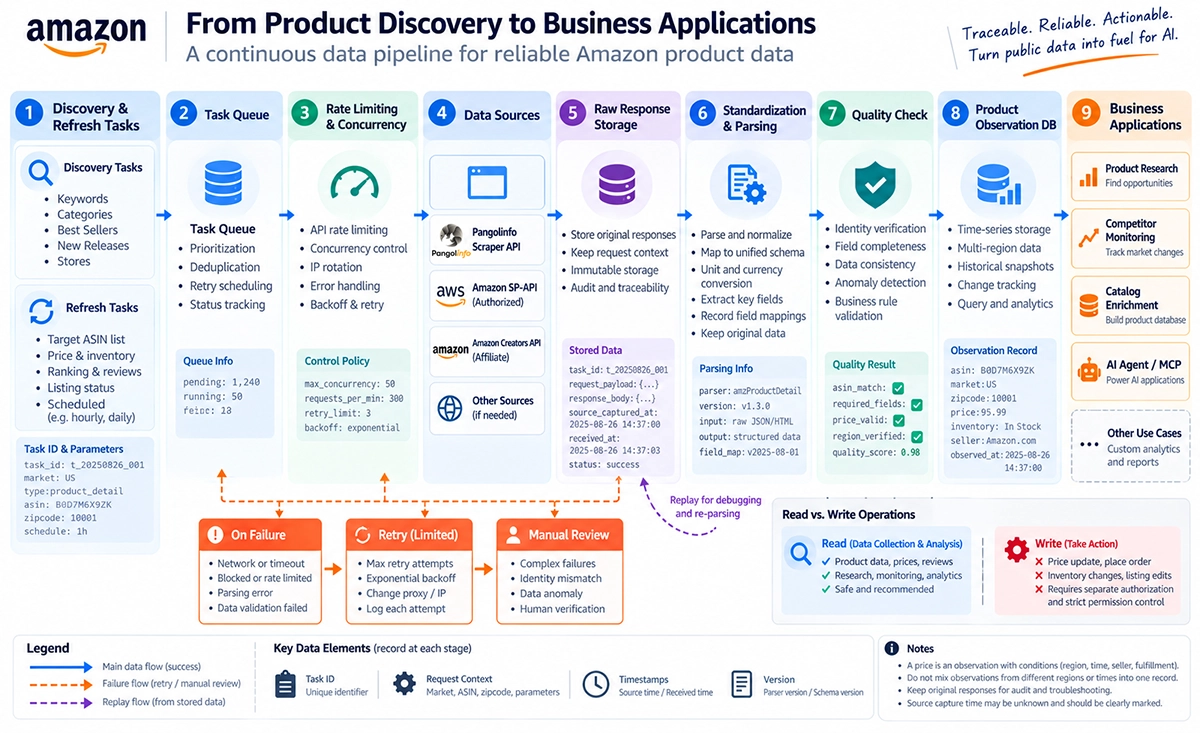
Discovery expands the candidate set; refresh updates known targets. They need not use the same schedule. Prioritize according to business importance, value of change, and tolerated delay. The fact that an endpoint accepts live requests does not make high-frequency refresh useful for every item or field.
Store observations in addition to raw responses. Include marketplace, requested and returned identity, requested destination, verification state, source time when available, receipt time, and transformation version. Do not manufacture missing history. If a source offers backfill, verify its sampling and scope, and distinguish backfill jobs from live observations so imports do not overwrite current events.
A cache key is part of the data meaning. An ASIN-only key can mix markets, destinations, or parser requests. Include the request conditions that affect the result. State when cached values expire and whether stale values can be served. Serving an older observation can be an explicit availability choice, but its age and state must remain visible.
Measure freshness at the point of use. With a trustworthy source timestamp, age is business-use time minus source capture time. Queue delay, cache residence, and downstream processing consume that budget. A response received in three seconds can still contain older material, so response latency is not a substitute for age. Without source time, report the known delay since receipt and preserve unknown source age instead of treating it as zero.
Why manage rate, concurrency, and retries as separate controls?
Concurrency is the number of tasks in flight; request rate is the number submitted per unit of time. A slower source can increase in-flight work even when submission rate stays constant. Bound concurrency, submission rate, and queue delay instead of treating a larger thread count as a throughput plan.
Amazon documents token-bucket limiting for SP-API and notes that limits depend on factors including operation, account, and application. One operation’s default rate does not apply to every operation, and a response header need not expose every applicable limit. This supports operation-aware throttling; a managed API should be scheduled against its own capacity and billing contract. SP-API usage plans
Classify failures before retrying. Fix authentication and parameter errors. Use bounded backoff and jitter for suitable temporary failures, respecting Retry-After when supplied. A timeout can leave completion uncertain: check task lookup, idempotency, or deduplication support before assuming another submission cannot duplicate work or charges.
How do quality checks and recovery prevent silent errors?
Monitor technical and business outcomes apart. Technical metrics include completion, format errors, and latency. Data checks include required-field coverage, identity match, and destination verification by market, category, and parser. Business measures include comparable observations and false alerts. One overall success rate hides these different denominators.
Keep unresolved records in an investigation path rather than deleting them or filling invented defaults. Before deploying an adapter or parser change, replay stored examples and compare meaning, type, and acceptance outcomes. Expand use after reviewing the differences. Preserve a way to roll back the transformation and rebuild results from source evidence.
Provider failover also needs semantic checks. Two price fields may differ in shipping, tax, or promotion treatment. Mark the source change and re-establish comparability before resuming affected alerts. Business continuity does not require an unsupported number at every moment; a clear unavailable-for-comparison state can be the more useful output.
10. How do you price, test, and govern the resulting workflow?
Why is request price only one input to cost?
Start with workload. In a hypothetical plan, 2,000 child ASINs across two markets and three destinations per market, refreshed four times daily, produce 48,000 planned observations per day. This assumes one target observation per retrieval and excludes discovery, extra pages, reviews, and retries. It is a planning calculation, not a provider’s billing commitment.
Batching does not settle cost either. Verify whether charges apply per request, page, task, successful result, or credit unit. Check how parser, format, and failure type affect billing. One call can yield multiple pages or products, so requests and usable observations should not be treated as interchangeable units.
Cost per thousand usable observations is the relevant in-period cost divided by deduplicated accepted observations, multiplied by 1,000. Define which API costs, retries, storage, transformations, and exception handling are included. If human investigation is excluded, state that exclusion before comparing two providers.
For a hypothetical $120 workload with 10,000 responses but 8,000 observations accepted for a price-comparison task, cost per thousand usable observations is $15. Dividing by all responses gives $12. The difference is a denominator issue, not evidence of a hidden price increase. The Amazon data API cost analysis develops this distinction.
What should a procurement trial measure?
Begin with a small set to discover failure modes, then expand by relevant strata. Two variants across two destinations at two times produce eight observations, enough to exercise a context workflow but not to prove a production success rate. Add the markets, categories, option structures, absent offers, restricted destinations, and promotion cases that the project will use.
Name each numerator and denominator. Identity match concerns tasks that require an identity match. Destination confirmation concerns observations that request and need verified destination context. Comparable-price rate concerns candidates for that comparison task. List exclusions instead of removing difficult failures and presenting the remainder as universal success.
| Acceptance area | Evidence | Failure handling |
|---|---|---|
| Identity and coverage | Target set, discovery scope, returned identity, relationships | Verify mappings or collect more; exclude unresolved identities from claims |
| Field meaning | Raw response, units, labels, state definitions | Isolate ambiguous values and fix the adapter |
| Context and time | Requested conditions, destination evidence, source time or unknown state | Hold affected comparisons and gather evidence |
| Operation and recovery | Error classes, retry bounds, task identifiers, replay results | Repair the workflow and repeat relevant cases |
| Cost and ownership | Billing units, actual costs, investigation responsibility | Recalculate on the same basis and document responsibilities |
Use buyer-selected tasks as well as provider demonstrations. Preserve failures and repeat observations. Set business thresholds before seeing the results, so the acceptance target does not move to match the demo. A colleague who did not attend the demonstration should still be able to inspect the evidence and reproduce the decision.
Control observation-time differences when comparing vendors. Fix targets, markets, destinations, field rules, and an allowed time window, then run within that window where possible. Morning and evening prices can differ because the source changed. Preserve both responses and gather page evidence before assigning an extraction error. Keep adapter-development examples separate from the final acceptance set so the rules are not tuned only to products already seen.
What should be checked before retention and redistribution?
Record provenance, acquisition time, intended use, and retention policy. Technical access does not establish every downstream right. Check the applicable terms for official and managed sources; affiliate content has its own licensing context. Review media, text, and redistribution conditions for the proposed use rather than assuming one permission covers everything. Creators API license entry point
For review text, user media, or author information, identify the minimum fields required, control access, and set a retention period. Do not retain or distribute all available content on the basis that it might become useful. External images, excerpts, and generated summaries need their own use assessment. These are governance checks, not a legal conclusion about a particular project.
Responsibility also needs to be assigned. The provider explains collection and field behavior, the data team maintains transformations and quality checks, and the business defines acceptable actions. No party can substitute a successful API response for its part of that work.
What is the next practical step?
Choose one business task, name its targets, and define market, destination, time tolerance, and required fields. Use the Amazon product data API reference to assemble a minimal request set, preserve responses, and verify identity and meaning before expanding to exceptions. If the task needs reviews, evaluate Amazon Review API as a distinct collection requirement.
End the pilot with an inspectable result: which tasks are supported, which conditions remain unknown, which failures can be recovered, and what accepted observations cost. Expansion should follow that evidence and its business value. Put the error you can least tolerate into the acceptance sheet first, then ask the source to demonstrate whether it fits the job.
Additional questions
Can I use product data APIs without a seller account?
It depends on the source. Official business interfaces can require seller authorization or specified roles, while public-page data services have their own account and credential requirements. Check eligibility for the data and intended use rather than applying one route’s rules to every source.
Can an API export product data to Excel?
API output and file export are separate steps. Structured results can be converted to CSV or Excel. Use separate tables for one-to-many entities such as variants, offers, and reviews instead of flattening away their relationships.
Can one request find the same product in every marketplace?
There is no universal guarantee. Batch and marketplace limits depend on the operation, and cross-market identity needs identifier and attribute checks. A completed request does not establish a same-item match across packaging, currency, and regional differences.
Can a new collector recover past prices?
Live collection creates current observations. Backfill requires a source that retained the relevant history, with sampling time, destination, and offer meaning checked. Without historical evidence, current values should not be used to fabricate earlier observations.
Does a free trial mean continuing collection is free?
No. Trial allowances, billing units, concurrency, and features depend on the service plan. A production budget should include discovery, details, pagination, retries, storage, and exception handling, using accepted observations as its cost denominator.