

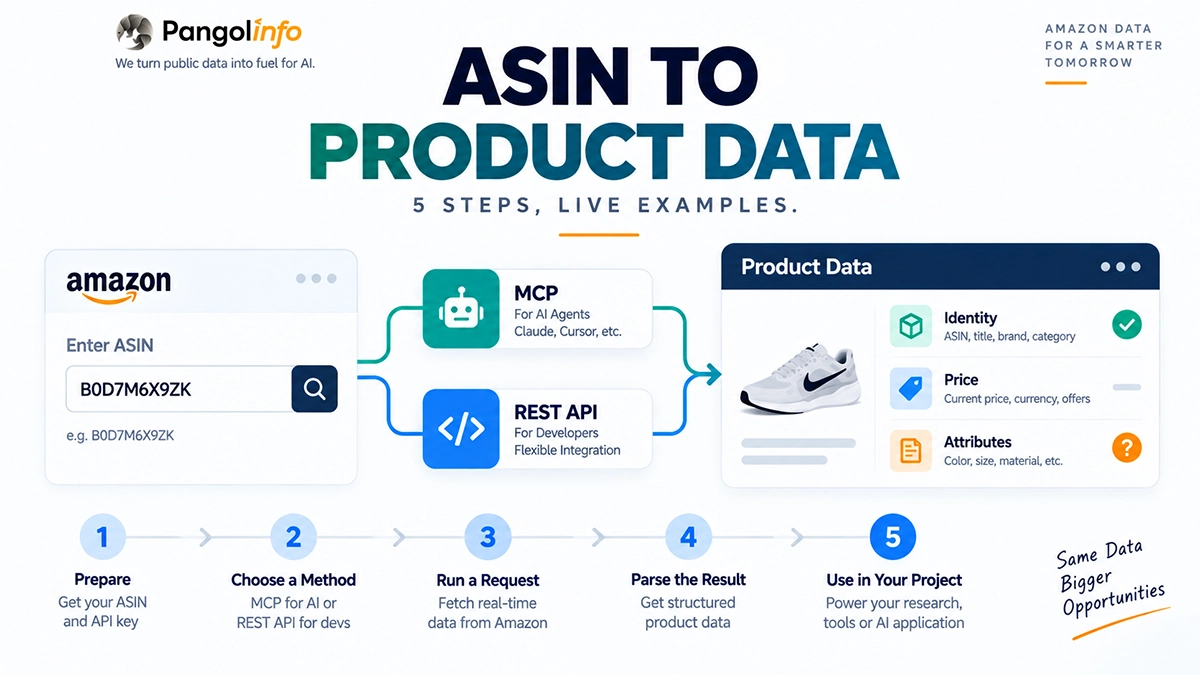
To get Amazon product details by ASIN, send the identifier with a marketplace and destination, then read the product result through an Amazon product data API or MCP tool. Check the returned identity before extracting prices, images, and specifications. An HTTP 200 response is the start of validation, not its conclusion.
We made live requests on September 28, 2026, to build this tutorial. Two observations of one renewed iPhone returned $619.00 and $619.95 from different sellers. The product’s top-level size was 8 GB, while its attribute table named 512 GB as storage capacity. Those responses drive the examples below, including the requests that failed.
The observations were collected between 08:23:53 and 08:26:19 UTC; exact client timestamps are retained in the evidence records. We did not inspect the Amazon pages in a browser or retrieve a source capture timestamp or account billing statement. These are observed API outputs, not a claim that every value was verified against the page or remains current when you read this article.
1. Should an ASIN lookup use REST or MCP?
REST suits a script, scheduled job, or application that must control requests and retain results. Amazon Data MCP exposes tools to an agent that needs to look up a few products during a conversation. We used both routes. Their outer response envelopes differ, so one path through the JSON does not parse both without an adapter.
Amazon also offers getCatalogItem for catalog-item retrieval within SP-API. That is an official business interface with authorization requirements; the public product-page collection route demonstrated here is a separate option. Decide whether the job needs catalog information, visible purchase conditions, or authorized account data before choosing an interface. An ASIN does not remove access requirements.
This article implements a known-product lookup. The Amazon product data API pillar covers the wider source-selection decision. Here, the goal is to produce an observation whose identity, request conditions, raw response, and missing values remain inspectable.
What did we request, and why?
Two child ASINs came from earlier project records, but all numbers presented here come from fresh calls. We then used the parent identifier found in the responses, submitted a malformed input, and tested a constructed ten-character identifier. A REST request for the white child provided a second transport example. Historical records selected the sample; they did not supply today’s prices.
| Request | Input | Marketplace / ZIP | Purpose |
|---|---|---|---|
| MCP white phone | B0CMZFCQ6D | amz_us / 10041 | Baseline detail and fields |
| MCP white phone | B0CMZFCQ6D | amz_us / 90001 | Different requested destination |
| MCP black phone | B0CMZ5KBNS | amz_us / 10041 | Separate child and attributes |
| MCP parent, twice | B0GP8D698X | amz_us / 10041 | Parent lookup and one recheck |
| MCP malformed input | BAD-ASIN | amz_us / 10041 | Input validation |
| MCP constructed input | B000000000 | amz_us / 10041 | Content plausibility, existence not assumed |
| REST white phone | B0CMZFCQ6D | amz_us / 10041 | REST envelope and saved output |
This accounts for eight business-tool or API calls, including validation and the parent recheck. Initialization and discovery are separate. The sample supports a tutorial; it cannot estimate a service success rate, market coverage, or average production latency.
2. Step one: identify the ASIN without losing the source URL
An Amazon product URL often places a ten-character identifier after /dp/. Retain the input URL, identify its marketplace, and extract the ASIN rather than passing a seller SKU or a share link as if it were the identifier. A local format check can accept letters and digits and normalize case. Passing that check does not establish that a matching product exists in the selected marketplace.
The live get_amazon_product schema required asin and exposed site, zipcode, and format. We supplied each contextual input instead of relying on defaults. A known-product lookup does not need an extra search call just to rediscover its identifier. Nor should an agent invent an identifier that resembles the expected pattern.
Parent and child identities need distinct handling. Both phones returned parentAsin B0GP8D698X. A direct request for that parent produced a tool error saying that the Amazon page was not found or did not match the requested ASIN. One recheck produced the same message. This does not prove that every parent ASIN fails, or that the children are unavailable.
What did the two unusual inputs reveal?
BAD-ASIN failed tool validation with BAD_INPUT and a ten-letter/digit requirement. Repeating the same malformed value cannot repair it. B000000000 passed format validation and returned code 0, but its title described tortilla chips while category_name described rollerball pens and the attribute brand named another business. We excluded that record from normal product examples.
The response alone does not locate the cause. A source-page issue, special identifier, or extraction behavior would require more evidence to distinguish. The supported lesson is narrower: format, transport, and business status can pass while content still needs investigation. A constructed identifier must not be labeled nonexistent before that premise is verified.
3. Step two: supply a marketplace and a destination
Our requests used amz_us and explicit ZIP values of 10041 or 90001. Store those inputs beside the ASIN. Marketplace determines the intended catalog environment; destination describes the requested delivery context. Reusing one country’s ZIP in another marketplace is not a meaningful test of regional differences.
The product API documentation says the backend selects a marketplace ZIP when it is omitted. That may suit a destination-independent task, but it is a poor implicit default for a monitor that promises observations for one fixed location. Requiring ZIP in the calling application makes that choice visible.
Did changing ZIP cause a price change?
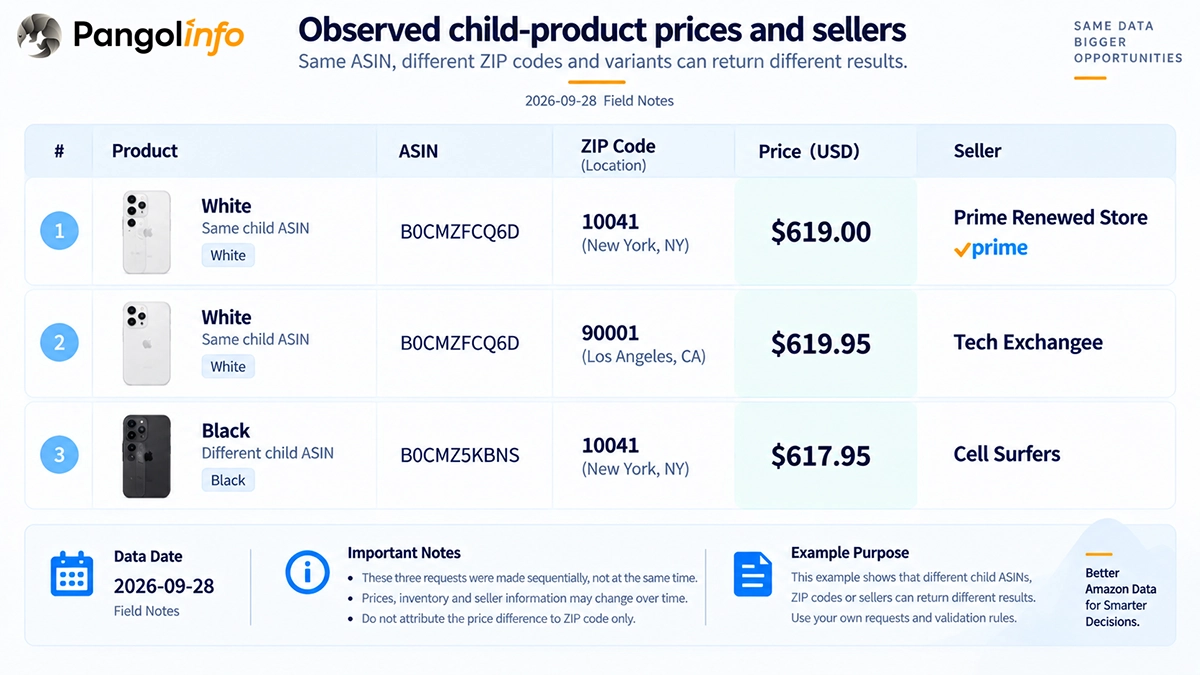
The white phone returned $619.00 from Prime Renewed Store for 10041 and $619.95 from Tech Exchangee for 90001. Both observations identified the same child and parent, and both delivery strings read Tomorrow, September 29. They were requested about 40 seconds apart, not under simultaneous controlled conditions.
We can report different prices and sellers under the two requested contexts. We cannot attribute the $0.95 difference to ZIP alone: seller selection and time also changed, and the result did not provide independent evidence confirming the applied destination. Our output distinguishes requested_zipcode from destination_verified, leaving the latter unknown.
The shippingFee string was 0 in both cases. The field documentation permits that value for free shipping or missing information. Empty shipper and fastestDelivery values were also present. Preserve those states; do not infer a confirmed delivered total from one zero or convert an empty delivery field into a claim that shipping is unavailable.
4. Step three: connect MCP and call the product tool
We completed initialize, the initialized notification, tools/list, and pangolinfo_capabilities over Streamable HTTP. The server identified itself as pangolinfo-mcp version 0.9.2 and exposed 21 tools. Discovery gives the interface available at connection time; a marketing-page tool count is not the contract your client should parse against.
This is a generic configuration example, not a file containing our credential. Client field conventions differ; consult the connection and authentication reference. Our experiment used a temporary client session and did not write the credential into project files or change a global client configuration.
{"mcpServers":{"pangolinfo":{"url":"https://mcp.pangolinfo.com/mcp","headers":{"Authorization":"Bearer <YOUR_API_KEY>"}}}}The following tool arguments were used for the baseline. MCP places zipcode at the top of arguments. The REST route places it under bizContext. That small translation matters when moving a working agent lookup into application code.
{"name":"get_amazon_product","arguments":{"asin":"B0CMZFCQ6D","site":"amz_us","zipcode":"10041","format":"json"}}For an agent, make the scope explicit: “Look up ASIN B0CMZFCQ6D on Amazon US with ZIP 10041. Call product details only. Return the title, raw price, seller, parent ASIN, RAM, and storage capacity. Record missing fields; do not add review collection.” A bounded request prevents a detail lookup from expanding into unrelated searches or paid review tasks.
How should connection errors be separated from product errors?
Our first Python urllib connection received a Cloudflare 403/1010 response describing a client-signature restriction. A standard curl HTTP client then reached authentication and completed the MCP handshake. This is an observation about this connection path, not a universal fix for 403 or evidence that the key was invalid.
Treat transport access, MCP initialization, argument validation, and product retrieval as separate layers. A credential error needs credential checks; BAD_INPUT needs changed arguments. The parent lookup’s SERVER error called for checking the object or a bounded recheck. We stopped after its second failure despite the tool marking the error retriable.
5. Step four: make a REST request and locate the product result
For a script, the REST request below targets the same white phone as the MCP baseline. It uses content for the ASIN and leaves url empty. Keep parserName aligned with the page type. Do not supply a full URL that identifies one item while content identifies another.
{"url":"","parserName":"amzProductDetail","site":"amz_us","content":"B0CMZFCQ6D","format":"json","bizContext":{"zipcode":"10041"}}The request goes to the documented /api/v1/scrape endpoint with bearer authentication and application/json content. Our REST result had HTTP 200, code 0, and pointCost 1.0, followed by data.json. MCP added a JSON-RPC envelope with a text block containing the API payload. Both successful paths then exposed task objects and product results.
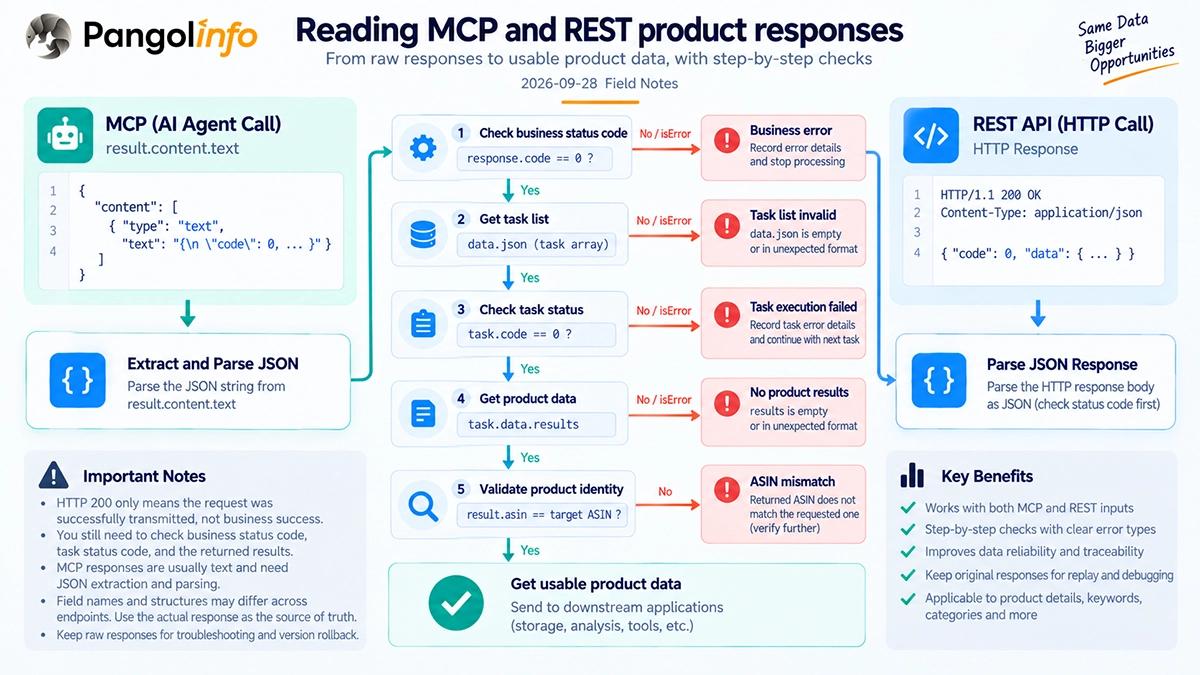
Check transport first, then JSON-RPC error and MCP isError where present, then the API code, task code, and results. Validate returned identity before extracting values. Reading response.price skips every actual container. Treating HTTP 200 as the success condition would accept the malformed-input and parent errors as product data.
What does the captured JSON contain?
The excerpt below comes from the 10041 MCP response. It omits other keys and array entries for readability without inventing values. It records this September 28 observation, not a current offer guarantee.
{
  "asin": "B0CMZFCQ6D",
  "parentAsin": "B0GP8D698X",
  "title": "Apple iPhone 15 Pro, 512GB, White Titanium - Unlocked (Renewed)",
  "price": "$619.00",
  "size": "8 GB",
  "color": "",
  "seller": {
    "hasLink": true,
    "name": "Prime Renewed Store",
    "link": "/gp/help/seller/at-a-glance.html/ref=dp_merchant_link?ie=UTF8&seller=A1NY8YUA22BXMM&asin=B0CMZFCQ6D&ref_=dp_merchant_link",
    "id": "A1NY8YUA22BXMM"
  },
  "delivery": {
    "deliveryTime": "Tomorrow, September 29",
    "fastestDelivery": ""
  },
  "attributes": [
    {
      "value": "8 GB",
      "key": "RAM Memory Installed"
    },
    {
      "value": "512 GB",
      "key": "Memory Storage Capacity"
    },
    {
      "value": "White Titanium",
      "key": "Color"
    }
  ]
}
The result object contained 51 top-level keys, 49 attributes, and three images entries, plus other image arrays serving different purposes. Those counts do not establish that all fields were populated or every business requirement passed. Choose the image array your output requires, retaining provenance and handling duplicates or size constraints in the application.
RAM Memory Installed was 8 GB, Memory Storage Capacity was 512 GB, and Color was White Titanium. Top-level size was also 8 GB, while color was empty. Mapping size to phone storage would be wrong; declaring color unavailable would overlook its named attribute. Build a mapping by attribute name and preserve the source array rather than depending on element positions.
The title also specified Renewed. That condition belongs to the purchased item and should not disappear when a comparison joins new and renewed offers. Save seller.id and seller.name alongside price. Removing the dollar symbol and the seller may make a spreadsheet shorter, but it also removes evidence needed to interpret differences.
Why are 18 variation entries not 18 distinct products?
The baseline’s variantDetails array held 18 entries but only 15 distinct ASIN values. The selected child appeared in several dimensions such as capacity, color, carrier, or product condition. This is option information, not an accepted independent-product count. Empty option prices should remain empty rather than inherit the selected product’s price.
The black child B0CMZ5KBNS returned $617.95 from Cell Surfers in its own call and shared the parent’s identifier. That supports querying the two purchase options apart; it does not prove whole-family coverage. A dedicated variation workflow would need a known comparison set and its own acceptance conditions.
The baseline also contained 13 review entries, while the 90001 response had reviews set to null. That is not evidence that the second destination has no reviews. For pagination, filters, and review attribution, evaluate Amazon Review API as a separate task rather than treating detail-page snippets as a review archive.
6. Step five: save results with Python, JSON, and CSV
The accompanying product_by_asin.py example supports live REST retrieval and offline inspection of captured MCP or REST records. It reads the key from the environment and sends curl configuration through standard input. It saves the raw record before parsing, so rejected output can still be investigated. Live mode requires Python 3.10 or later and curl.
python3 examples/product_by_asin.py --asin B0CMZFCQ6D --site amz_us --zipcode 10041 --output capturesTo reproduce the article’s saved observation without another remote request, use fixture mode. It checks the original request context against the CLI arguments and labels the output fixture. A replay is not a new live query, and a saved 10041 response must not be relabeled as a new 90001 observation.
python3 examples/product_by_asin.py --asin B0CMZFCQ6D --site amz_us --zipcode 10041 --fixture 04_元数据/evidence/product-us-10041.json --output replayThis extraction function is the core of the supplied script. The full file also handles requests, raw evidence, JSON output, and CSV. It accepts task entries encoded as objects or JSON strings; our live responses used objects.
import json

def extract(response):
    if 'error' in response:
        raise ValueError('JSON-RPC error; inspect saved evidence')
    if 'result' in response:
        result = response['result']
        if result.get('isError'):
            raise ValueError('MCP tool error; inspect saved evidence')
        parts = [x['text'] for x in result.get('content', []) if x.get('type') == 'text']
        if len(parts) != 1:
            raise ValueError('Unexpected MCP content shape')
        response = json.loads(parts[0])
    if response.get('code') != 0:
        raise ValueError('API business error')
    tasks = response.get('data', {}).get('json')
    if not isinstance(tasks, list) or not tasks:
        raise ValueError('Missing task list')
    rows = []
    for task in tasks:
        task = json.loads(task) if isinstance(task, str) else task
        if not isinstance(task, dict) or task.get('code') != 0:
            raise ValueError('Task error')
        items = task.get('data', {}).get('results')
        if not isinstance(items, list) or not items or not all(isinstance(x, dict) for x in items):
            raise ValueError('Missing product results')
        rows.extend(items)
    return rows
Expand the complete Python request and export script
"""Fetch a single ASIN through REST, or inspect a saved MCP/REST capture.
Requires Python 3.10+ and curl for live requests. No credentials in files.
"""
import argparse
import csv
import json
import os
from pathlib import Path
import re
import subprocess
from datetime import datetime, timezone
from uuid import uuid4


def extract(response):
    if 'error' in response:
        raise ValueError('JSON-RPC error; inspect saved evidence')
    if 'result' in response:
        result = response['result']
        if result.get('isError'):
            raise ValueError('MCP tool error; inspect saved evidence')
        parts = [x['text'] for x in result.get('content', []) if x.get('type') == 'text']
        if len(parts) != 1:
            raise ValueError('Unexpected MCP content shape')
        response = json.loads(parts[0])
    if response.get('code') != 0:
        raise ValueError('API business error')
    tasks = response.get('data', {}).get('json')
    if not isinstance(tasks, list) or not tasks:
        raise ValueError('Missing task list')
    rows = []
    for task in tasks:
        task = json.loads(task) if isinstance(task, str) else task
        if not isinstance(task, dict) or task.get('code') != 0:
            raise ValueError('Task error')
        items = task.get('data', {}).get('results')
        if not isinstance(items, list) or not items or not all(isinstance(x, dict) for x in items):
            raise ValueError('Missing product results')
        rows.extend(items)
    return rows


def csv_safe(value):
    text = '' if value is None else str(value)
    return "'" + text if text.lstrip().startswith(('=', '+', '-', '@')) else text


def main():
    parser = argparse.ArgumentParser()
    parser.add_argument('--asin', required=True)
    parser.add_argument('--site', default='amz_us')
    parser.add_argument('--zipcode', required=True)
    parser.add_argument('--fixture', type=Path)
    parser.add_argument('--output', type=Path, default=Path('captures'))
    args = parser.parse_args()
    asin = args.asin.strip().upper()
    if not re.fullmatch(r'[A-Z0-9]{10}', asin):
        parser.error('ASIN must contain 10 letters/digits')
    args.output.mkdir(parents=True, exist_ok=True)
    if args.fixture:
        record = json.loads(args.fixture.read_text())
        req = record.get('request', {})
        context = req.get('params', {}).get('arguments', {}) if req.get('method') == 'tools/call' else req
        captured_asin = context.get('asin', context.get('content'))
        captured_zip = context.get('zipcode', context.get('bizContext', {}).get('zipcode'))
        if (captured_asin, context.get('site'), captured_zip) != (asin, args.site, args.zipcode):
            raise ValueError('Fixture request differs from CLI context')
        mode = 'fixture'
    else:
        key = os.environ.get('PANGOLINFO_API_KEY', '')
        if not key or '\n' in key or '\r' in key:
            parser.error('Set PANGOLINFO_API_KEY in the process environment')
        payload = {'url': '', 'parserName': 'amzProductDetail', 'site': args.site,
                   'content': asin, 'format': 'json', 'bizContext': {'zipcode': args.zipcode}}
        started = datetime.now(timezone.utc).isoformat()
        config = 'url = "https://scrapeapi.pangolinfo.com/api/v1/scrape"\nrequest = "POST"\n'
        for h in ['Content-Type: application/json', 'Authorization: Bearer ' + key]:
            config += 'header = ' + json.dumps(h) + '\n'
        config += 'data = ' + json.dumps(json.dumps(payload)) + '\n'
        env = {k: v for k, v in os.environ.items() if k != 'PANGOLINFO_API_KEY'}
        proc = subprocess.run(['curl', '-sS', '--max-time', '60', '--config', '-',
                               '--write-out', '\n%{http_code}'], input=config,
                              text=True, capture_output=True, env=env)
        raw = proc.stdout.replace(key, '[REDACTED]')
        body, _, status = raw.rpartition('\n')
        record = {'request': payload, 'started_at_utc': started,
                  'received_at_utc': datetime.now(timezone.utc).isoformat(),
                  'http_status': int(status) if status.isdigit() else 0,
                  'curl_exit': proc.returncode, 'raw_body': body}
        try:
            record['response'] = json.loads(body)
        except ValueError:
            record['response'] = {}
        mode = 'live'
    stem = args.output / (mode + '-' + uuid4().hex)
    stem.with_suffix('.raw.json').write_text(json.dumps(record, ensure_ascii=False, indent=2))
    if record.get('http_status') != 200 or record.get('curl_exit', 0):
        raise ValueError('Transport failure; inspect saved evidence')
    rows = extract(record['response'])
    outputs = []
    for item in rows:
        if item.get('asin') != asin:
            raise ValueError('Returned ASIN mismatch; inspect saved evidence')
        attrs = {}
        for a in item.get('attributes') or []:
            attrs.setdefault(a.get('key'), []).append(a.get('value'))
        outputs.append({'mode': mode, 'requested_asin': asin, 'returned_asin': item['asin'],
                        'site': args.site, 'requested_zipcode': args.zipcode,
                        'received_at_utc': record.get('received_at_utc'),
                        'source_captured_at': None, 'destination_verified': None,
                        'title': item.get('title'), 'price_raw': item.get('price'),
                        'size_raw': item.get('size'), 'attributes_by_name': attrs,
                        'ready_for_price_comparison': False})
    stem.with_suffix('.json').write_text(json.dumps(outputs, ensure_ascii=False, indent=2))
    columns = ['requested_asin', 'returned_asin', 'site', 'requested_zipcode', 'title', 'price_raw']
    with stem.with_suffix('.csv').open('w', newline='', encoding='utf-8-sig') as handle:
        writer = csv.DictWriter(handle, fieldnames=columns)
        writer.writeheader()
        writer.writerows({k: csv_safe(row.get(k)) for k in columns} for row in outputs)
    print(json.dumps({'mode': mode, 'records': len(outputs), 'output_stem': str(stem)}))


if __name__ == '__main__':
    main()
The normalized output retains raw price, raw size, named attributes, requested destination, and client receipt time. Source capture time and destination verification remain null because the sample does not establish them. ready_for_price_comparison remains false: structural parsing and identity checks do not settle offer comparability.
Duplicate attribute names retain multiple values instead of overwriting an earlier one. Missing values do not become zero. The CSV is a small viewing projection rather than a lossless substitute for JSON; it also escapes leading characters that spreadsheet software may treat as formulas. Raw evidence stays unchanged. These are application choices, not additional fields claimed to exist in the API response.
7. How should one lookup become a repeatable job?
This product tool takes one ASIN. For a list, deduplicate, queue requests, and save each result; a client loop is not proof of a native batch endpoint. Include marketplace, ASIN, ZIP, and requested format in the task identity so deduplication does not merge observations with different conditions.
Start with restrained concurrency and adjust against the service agreement and observed errors. Separate completed tasks from invalid inputs, uncertain transport outcomes, rechecks, and records needing investigation. BAD_INPUT returns to input correction. A timeout leaves the outcome uncertain. The parent error in this run stopped after one recheck rather than entering an unbounded retry loop.
The three normal MCP child observations and one REST comparison each declared pointCost 1. The constructed identifier also declared 1, making five points across those five response fields. The parent and validation errors did not provide a value that establishes their charge. We did not inspect billing, so five is not a verified total debit. Use the pricing page and account records for current charges.
The three normal MCP calls took about 4.47–5.22 seconds on this client; the REST comparison took about 5.29 seconds. These are individual end-to-end timings, not backend processing measurements. Sequential requests with uncontrolled network and cache conditions cannot rank the speed of MCP against REST.
8. Which observations should stop downstream use?
| Observation | Evidence from this run | Application response |
|---|---|---|
| HTTP 200 with isError=true | Parent and format-error calls | Handle the tool error before reading fields |
| size differs from required capacity | 8 GB versus named 512 GB storage | Map attribute meaning and preserve originals |
| Same child, different seller and price | Two white-phone observations | Compare context without assuming ZIP causation |
| code 0 with conflicting content | Constructed identifier | Isolate and seek independent evidence |
| Zero shipping value with missing details | Normal phone responses | Keep uncertainty instead of claiming delivered price |
This does not mean every record needs a human reviewer. Structure, identity, required fields, and known formats can be checked in code. Conflicting category and title, a changed attribute meaning, or seller transitions need rules fitted to the task. A catalog-image job and a price alert should not inherit one universal acceptance flag.
For broader applications, see Pangolinfo data collection case studies. Those are separate projects, not evidence for the scale or performance of this experiment. Agent users can also evaluate Amazon Scraper Skill; a different entry point does not remove data-meaning checks.
An Amazon product details API by ASIN becomes useful when each value retains its object, marketplace, and request conditions. Start with one child, save its raw response, and inspect the fields your decision needs. For pricing, include seller, variant, currency, and destination. For catalog enrichment, check attribute meaning and source priority before writing into the catalog.
Frequently asked questions
Do I need an Amazon seller account?
That depends on the route. This tutorial used Pangolinfo account credentials. Official Amazon business interfaces have their own authorization requirements; one route does not define eligibility for every other route.
Can a parent ASIN replace a child ASIN?
Do not assume it can. Our parent lookup failed twice while the child calls returned results. Check each case; use the intended child when retrieving purchase conditions.
Is the returned price the final amount payable?
No. Seller, condition, currency, delivery, shipping, and promotion eligibility also matter. A zero shippingFee alone does not establish a confirmed delivered total.
Can one call retrieve several ASINs?
The get_amazon_product tool used here accepts one asin. A client queue can make several requests, but that does not mean the tool accepts a native batch array.
Can I open the results in Excel?
The supplied script exports CSV for viewing in a spreadsheet. Keep the raw JSON as well so nested attributes, request context, and missing states are not lost.