
Any rigorous review analysis starts with data collection: you cannot analyze reviews you cannot access. Before running the 6-step SOP, solve review acquisition first — use the Amazon Reviews Scraper API to build a corpus with complete metadata.
Knowing how to analyze Amazon reviews comes down to executing a reproducible 6-step Standard Operating Procedure (SOP)—not hunting for a mythical “one-click insight” tool. As of 2027, no commercial review analysis software on the market is scientifically complete: every existing platform either enforces arbitrary sample caps, completely ignores image and video attachments, or operates as a black box without disclosing the accuracy rates of its underlying sentiment and topic models. Actionable Voice of the Customer (VOC) analysis—the kind that safely guides hardware tooling revisions, packaging updates, and listing optimization—requires treating the methodology itself as the core asset. By enforcing a standardized 14-field data schema, building an unbiased corpus, coding feedback into 10 to 15 mutually exclusive themes, running 5 Whys root-cause investigations, and auditing machine outputs with human sampling, your team can transform raw buyer feedback into auditable business decisions.
Most e-commerce teams fall into one of two traps when approaching review data. Either an operator skims the first two pages of 1-star complaints and mistakes an isolated shipping incident for a systemic product flaw, or the team relies entirely on automated AI summaries—unaware that second-order AI compression systematically erases low-frequency, high-severity safety risks. This guide walks through the complete, end-to-end Amazon review analysis SOP (from Step 0 Decision Framing to Step 6 Monthly Review), compares what current tools can and cannot do against Amazon’s free native baselines, details the 13 analytical blind spots that still require human judgment, and accounts for the major 2027 platform shifts—including category-by-category variation review splitting and the evolution of Rufus into Alexa for Shopping.
Watch the video version of this article.
The Complete 6-Step SOP for Analyzing Amazon Reviews: From Decision Framing to Monthly Review
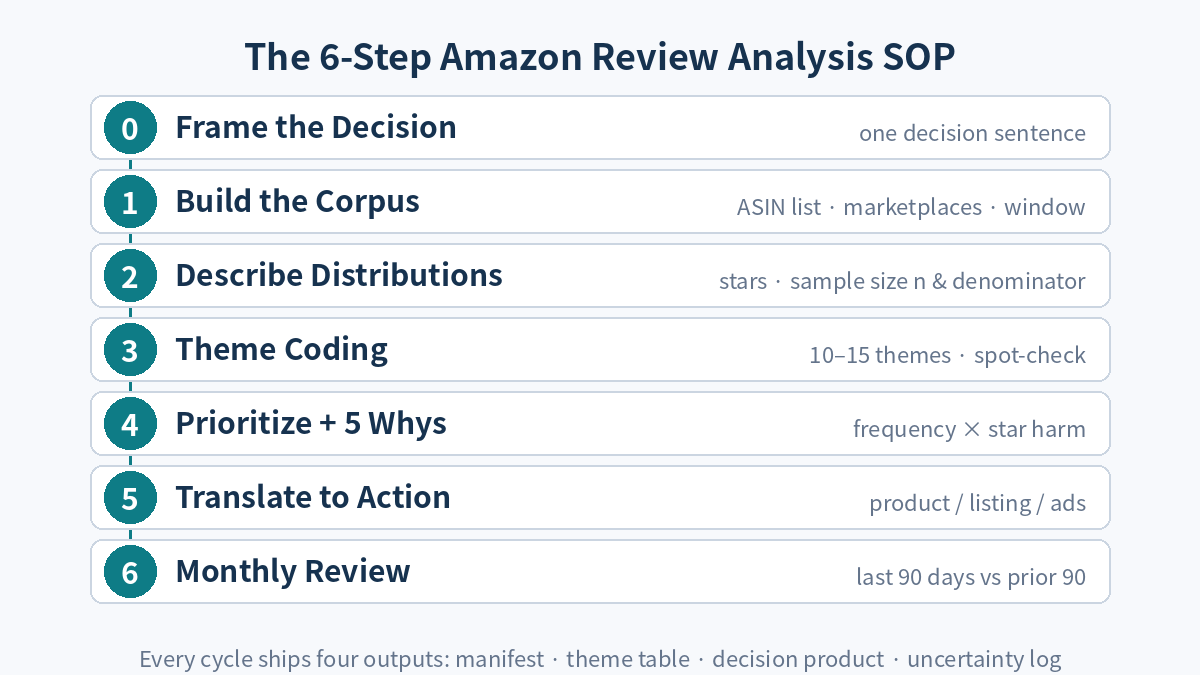
A rigorous Amazon review analysis workflow follows a closed loop from Step 0 (Frame the Decision) to Step 6 (Monthly Review), requiring four standardized deliverables at the conclusion of every cycle. Analysis conducted without upfront constraints produces decorative word clouds that no engineer or copywriter can act upon; only by locking in the target decision, corpus boundaries, and row-level schema upfront can your team compare findings across months, product iterations, and marketplaces.
Step 0: Frame the Decision
Before pulling a single review, write down in one sentence the specific business decision this analysis will inform. Different operational goals demand different analytical granularity and cohort boundaries:
-
Supply Chain & Quality Control (QC) Remediation: Focuses on structural breakage, material degradation, batch-specific defects, and transit damage, requiring strict attribution down to the child variant (size, color, style) and production date window.
Listing Copy & Visual Optimization: Focuses on “Expectation Gaps” and natural buyer phrasing to inform main image callouts, bullet point clarifications, and A+ Content comparison charts.
New Product Development (NPD) & Category Entry: Focuses on comparing pain-point distributions across top-ranking incumbent ASINs and rising challengers to identify structural customer needs that existing products fail to solve.
During Step 0, lock in your input parameters: target ASINs, benchmark competitor ASINs, target marketplaces, date window, and the specific stakeholder who will act on the report (e.g., R&D engineers, packaging specialists, or listing managers).
Step 1: Build the Corpus
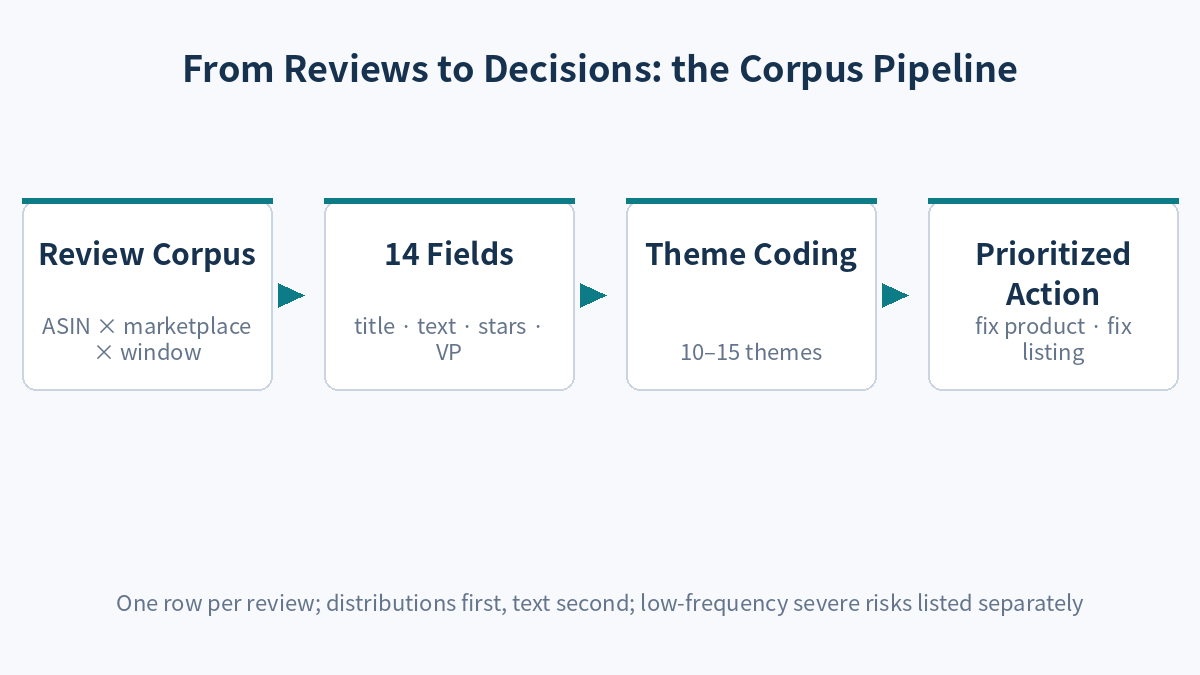
The ceiling of your analytical accuracy is determined by the integrity of your underlying corpus, where every individual review row must capture at least 14 mandatory minimum fields. Many internal VOC projects fail because the team only exports “Star Rating + Review Body,” stripping away variation metadata, purchase verification flags, and marketplace language. Without those attributes, cross-tabulating root causes later in the workflow becomes impossible.
When constructing your review database, enforce the following minimum row-level schema:
| Field Name | Data Type / Standard | Analytical Purpose in the SOP |
|---|---|---|
| ASIN | 10-character ID | Identifies the parent listing or standalone product page |
| Variant | Text (Size, Color, Style) | Isolates mold defects, color mismatches, or sizing issues to a specific SKU |
| Marketplace | Country code (US, UK, DE, JP) | Separates regional voltage standards, carrier damage, and cultural norms |
| Language | ISO code (en, de, es, ja) | Ensures cross-lingual text is mapped to a unified taxonomy during coding |
| Date | YYYY-MM-DD | Tracks quality spikes, seasonal carrier delays, or post-revision shifts |
| Star Rating | Integer from 1 to 5 | Calculates rating distribution shapes and severity weights |
| Review Text (Title + Body) | Full title and body text | The object of theme coding and aspect sentiment |
| Review URL & ID | Review URL and unique ID | Traceability to the source, dedup, and re-check |
| Verified Purchase | Yes / No | Distinguishes Amazon-verified transactions from unverified submissions |
| Vine | Yes / No | Flags early-access Amazon Vine reviews to prevent long-form early bias |
| Theme | 1 of 10–15 standard labels | Categorizes the core topic discussed (supports one-to-many mapping) |
| Aspect Sentiment | Positive / Negative / Neutral / Mixed | Captures sentiment toward the specific theme rather than the overall review |
| Usage Stage | Pre-unboxing / First use / Long-term / Warranty | Pinpoints whether failures occur upon arrival, setup, or after months of wear |
| Suspicion Flag | Normal / Review Needed | Flags suspected inauthentic patterns, template spam, or off-topic noise |
Step 2: Describe Distributions
Before reading individual comments or running topic models, you must map the macro distribution of your corpus and always report both the sample size (n) and the exact denominator. Never write a vague claim like “25% of customers hate the battery life.” Instead, report the exact statistical context, for example: “Out of 400 total reviews collected between January and March, 60 reviews mentioned battery life (15.0% of the total corpus), and 42 of those expressed negative aspect sentiment (70.0% of battery mentions; 10.5% of the total corpus).”
Complete four baseline statistical checks in Step 2:
-
Star Rating Shape: Tabulate the count and percentage share of 1-star through 5-star reviews to measure rating polarization.
Temporal Velocity: Plot review volume and star-rating mix by week or month to spot sudden structural breaks (e.g., a post-Prime Day return wave or a defective factory container hitting FBA).
Variant & Marketplace Concentration: Check whether feedback is heavily skewed toward a single top-selling color or size. Especially after Amazon’s 2026 variation review split, documenting the exact sample size per child variant prevents over-generalizing findings to low-volume SKUs.
Verified Purchase vs. Vine Share: Measure what percentage of your corpus consists of Verified Purchases versus early Vine reviews so that a handful of detailed Vine essays do not distort early frequency counts.
Step 3: Theme Coding (10–15 Themes)
Theme coding transforms unstructured text into quantifiable data, and the most effective taxonomy restricts the codebook to 10 to 15 mutually exclusive, collectively exhaustive themes. If your codebook uses fewer than 8 buckets (e.g., “Good Quality,” “Bad Shipping,” “Price”), the categories are too broad for an engineer to act upon. If your codebook expands beyond 20 granular labels, semantic overlap causes both human analysts and Large Language Models (LLMs) to assign inconsistent tags from month to month.
Enforce three operational rules during Step 3:
-
Code “Aspect Sentiment” Rather Than Whole-Review Sentiment: A single 4-star review often contains conflicting data points: “The espresso extraction is rich and hot (Brew Quality: Positive), but the water tank lid rattles loudly (Build Noise: Negative) and the manual omits descaling steps (Documentation: Negative).” Relying on overall star rating buries two actionable flaws inside a “positive” 4-star review.
Maintain a Written Codebook: Define every theme with clear inclusion criteria, exclusion criteria, and two to three canonical example quotes.
Mandate Human Verification Sampling: Automated sentiment and topic models routinely fail on sarcasm, mixed sentiment, and short reviews (such as “Works” or “Never again”). Whenever you use an LLM prompt or commercial software to tag a corpus, randomly sample 20 to 30 reviews and manually verify the tags against your codebook, logging every disagreement to refine your rules.
Step 4: Prioritize + 5 Whys Root-Cause Analysis
Once themes are coded, rank negative issues using a composite of Frequency, Severity, and Trend Slope rather than raw mention counts alone, then subject the top priorities to a 5 Whys root-cause investigation. A minor packaging blemish might appear frequently in 4-star reviews without hurting conversion, whereas a low-frequency complaint like “charger port sparked and melted” represents an immediate 1-star safety hazard.
-
Prioritization Formula (Three Dimensions): Evaluate each negative theme across three dimensions to establish your remediation queue:
- Frequency: The share of total reviews (or variant-specific reviews) citing the negative theme. Severity: The average star-rating drag associated with the theme (how far the mean rating of reviews containing this theme falls below the product’s overall average) plus a critical weight for safety or total functional failure. Trend Slope: The month-over-month or 30-day vs. 90-day rate of change in mention share. 5 Whys Root-Cause Tracing (Brief Example): Customer reviews describe symptoms, not engineering root causes. For your top prioritized issues, pull all associated verbatim reviews—paying special attention to 3-star and long-form reviews—and ask “Why” five times: Symptom: Buyers complain a blender “leaks from the base after two uses.” Why 1: Why does it leak? — Verbatim reviews note the black silicone gasket came loose. Why 2: Why did the gasket come loose? — Buyers reinstalled the gasket upside down after their first wash. Why 3: Why did they install it upside down? — Both sides look nearly identical and lack an asymmetrical locking ridge. Why 4: Why didn’t the instructions prevent this? — The quick-start guide omits gasket orientation diagrams. Why 5: Why did complaints spike this month? — A new supplier batch shipped with slightly looser gasket tolerances, making it slip out during rinsing. Action: Insert an orientation warning card immediately (short-term) and tighten supplier mold tolerances with a keyed ridge (long-term).
Step 5: Translate to Action
An analysis is only complete when every validated root cause is mapped to a specific complaint mechanism, assigned to an owner, and tied to a measurable verification metric. Route your findings according to four distinct complaint categories:
-
Design Flaws Assign to R&D and Industrial Design for mold modifications, component upgrades, or firmware patches in the next production run.
Batch Defects Assign to Supply Chain and QC to trace factory lot numbers, tighten incoming inspection tolerances, or quarantine affected FBA inventory.
Customer Misuse Assign to Packaging and Support to redesign unboxing inserts, add on-product warning labels, or publish troubleshooting videos.
Expectation Gaps Assign to Listing Operations and Creative teams to rewrite bullet points, add dimension callout graphics, and clarify compatibility boundaries.
Step 6: Monthly Review
Amazon review analysis is a continuous monthly audit cycle, not a one-off project. On a fixed day each month, pull the incremental reviews from the past 30 days using the exact same 14-field schema and 10–15 theme codebook. Compare the new cohort against your rolling baseline to verify whether fixes deployed 30 to 60 days ago measurably reduced target complaint rates, and to catch emerging variant or seasonal defects early.
The Four Mandatory Outputs of Every SOP Cycle
Every completed analysis cycle must archive four standard deliverables to maintain auditability:
-
Corpus Manifest: Documents analyzed ASINs, marketplaces, date range, total sample size , star-rating breakdown, Verified Purchase share, Vine share, and filtering rules.
Theme Table: Lists all 10–15 themes, their positive/negative/neutral mention counts, percentage share of total , variant concentration, and representative verbatim quotes.
Decision Artifact: Contains prioritized rankings, 5 Whys root-cause chains, assigned owners, deployment deadlines, and target verification metrics.
Uncertainty Log + Reproducibility Note: Records analytical limitations (e.g., child variants with , unanalyzed video attachments, or edge cases found during the 20–30 review human audit), paired with exact script versions, API parameters, or prompts so any colleague can reproduce the results.
What Review Analysis Tools Can and Cannot Do: A Layered Comparison from Native Baselines to Third-Party Software
Commercial Amazon review tools excel at rapid aggregation and surface-level summarization, but no tool on the market automates corpus completeness checks, variant-level 5 Whys attribution, or human credibility auditing. Before paying for third-party software, anchor your workflow against Amazon’s free native baselines and understand the structural boundaries of each software tier.
| Tool Tier & Platform | Core Capabilities & Verified Parameters | Key Limitations & Analytical Blind Spots | Pricing Verification |
|---|---|---|---|
| Amazon Native Free Baseline (AI Highlights & Seller Central VOC) | Front-end “Customers say” AI summaries launched 2023-08-14 using only Verified Purchase reviews (per About Amazon); backend shows NCX and return reasons. | Front-end summaries compress away low-frequency severe risks; no bulk raw table export; zero access to competitor backend VOC data. | Free (built into Amazon retail pages & Seller Central) |
| Helium 10 Review Insights | Powered by Amazon’s official Customer Feedback API; covers 7 marketplaces; up to 3 snippets per topic; 6-month trends; CSV export. | Underlying sample size is undisclosed; capping evidence at a maximum of 3 snippets per topic prevents deep 5 Whys analysis; model accuracy is undisclosed. | Paid feature; check the official checkout page |
| Jungle Scout Review Sentiment | Integrated into Ask Cobalt + MCP architecture for conversational sentiment summaries and pain-point overviews. | Built for high-level qualitative Q&A rather than exporting a transparent, row-by-row 14-field coded table or uncertainty log; model accuracy is undisclosed. | Paid feature; check the official checkout page |
| SellerSprite AI Review Analysis 2.0 | Generates a 7-layer structured breakdown covering buyer personas, usage scenarios, pros, and cons. | Enforces a strict sample cap: analyzes roughly 500 reviews per run, capped at roughly 100 reviews per star rating—distorting distribution weights on large ASINs. | Paid feature; check the official checkout page |
| ZonGuru Love-Hate / VOC.AI (Shulex) | ZonGuru visualizes positive vs. negative keyword clouds; VOC.AI provides multi-dimensional consumer insight charts and tag matrices. | Pre-baked taxonomies often miss niche engineering failure modes; neither vendor discloses sentiment/topic model accuracy percentages, and neither parses images or videos. | Paid feature; check the official checkout page |
When using any commercial tool, enforce two guardrails: first, never trust unverified accuracy claims, as no vendor discloses validated accuracy percentages for its sentiment or topic models. Second, watch out for quota-induced distribution bias—pulling roughly 100 reviews per star rating on an ASIN with 4,000 reviews artificially flattens the star distribution to 20% per bucket, distorting true complaint frequencies unless re-weighted.
The 13 Analytical Blind Spots That Still Require Human Judgment
Even when your team pairs clean data with modern AI coding, 13 structural blind spots in the Amazon review ecosystem require human domain expertise to interpret correctly:
-
Temporal Trends: Aggregating multi-year reviews into one chart lets resolved historical defects distort current priorities; always slice data into monthly or post-revision cohorts.
Cross-ASIN & Category Baselines: A 6% complaint rate means nothing in isolation; you must benchmark mention shares against top category peers to know if you outperform or trail the niche baseline.
Image & Video Reviews: No commercial tool discloses the ability to analyze buyer images or video attachments, yet critical evidence of sheared parts, color mismatch, or motor noise often lives exclusively in visual media.
Customer Q&A: Reviews capture post-purchase lagging indicators, whereas Product Q&A captures pre-purchase conversion friction and compatibility confusion that stops shoppers from buying.
3-Star Reviews (Highest Information Density): While 1-star reviews often vent emotion and 5-star reviews offer generic praise, 3-star reviews contain the highest information density, detailing balanced pros, cons, and specific trade-offs.
Complaint Granularity: Automated classifiers lump every failure under “Defective,” requiring human review to separate Batch Defects vs. Design Flaws vs. Customer Misuse vs. Expectation Gaps.
Reviewer Persona: A professional contractor and a casual hobbyist hold vastly different standards for performance, requiring analysts to weigh complaints against the reviewer’s stated use case.
Seasonality: Melted supplements in summer transit or carrier delays in mid-December reflect seasonal logistics stress rather than year-round product flaws.
Multi-Marketplace & Multi-Language Nuance: German, Japanese, and US shoppers enforce different tolerances for manual precision and packaging scuffs; crude machine translation erases regional localization needs.
Variant-Level Attribution: Without cross-tabulating themes by the Variant field, teams risk re-engineering an entire product line to fix a defect isolated to a single size or color SKU.
Review-to-Return / NCX Linkage: Many dissatisfied buyers return items silently without writing a review, making it essential to cross-check your review Theme Table against Seller Central return and NCX reports.
The Silent Majority: As shown by Hu, Pavlou & Zhang, product reviews follow a J-shaped self-selected distribution where extreme 5-star and 1-star buyers over-report while the moderate majority stays silent—meaning review percentages never equal true unit defect rates.
Second-Order AI Summary Distortion: AI summaries compress an already self-selected sample around high-frequency consensus words, systematically erasing low-frequency, high-severity hazards (like rare short-circuits or choking risks).
Five 2027 Platform and Regulatory Shifts Reshaping Amazon Review Analysis
Major platform and regulatory updates across 2024–2027 have fundamentally altered how Amazon reviews accumulate, display, and aggregate:
1. Variation Review Sharing Split by Category (February 12 to May 31, 2026)
According to announcements on the Amazon Seller Central forums, between February 12, 2026, and May 31, 2026, Amazon rolled out a category-by-category split of variation review sharing: child variations now only share reviews when differences are minor and do not affect functionality. Variations differing in function, capacity, flavor, scent, or performance now display separate rating pools—making variant-level tracking in Step 1 mandatory when diagnosing sudden 2026 review count shifts.
2. AI Review Highlights & Rufus Renamed to “Alexa for Shopping” (May 13, 2026)
Per About Amazon, Amazon launched generative AI Review Highlights (“Customers say”) on August 14, 2023, restricted exclusively to Verified Purchase reviews. By 2025, Rufus surpassed 250 million customers, while AI Review Highlights generated hundreds of millions of weekly impressions with interactions up +100% year-over-year; on May 13, 2026, About Amazon announced that Rufus was renamed to “Alexa for Shopping.” Because these AI touchpoints only ingest Verified Purchases, your SOP must monitor recent Verified Purchase cohorts to anticipate which aspect sentiments will surface in front-end AI tags.
3. Pre-Release Amazon Vine Enrollment & Tiers (Effective June 2025)
According to Seller Central updates, starting in June 2025, Amazon Vine enabled pre-release enrollment, allowing Vine reviews to appear as early as Day 1 of launch across three tiers ($0, $75, and $200) with a cap of 30 reviews per ASIN. Because Vine Voices receive free units pre-launch, always segment Vine = Yes from paying Verified Purchase = Yes rows in Step 2 so early Vine reviews do not mask true price sensitivity or long-term durability issues.
4. US FTC Consumer Review Rule (16 CFR Part 465) Enforcement
Per the Federal Trade Commission (FTC), the FTC Consumer Review Rule (16 CFR Part 465) took effect on October 21, 2024, authorizing civil penalties of up to $53,088 per violation against fake reviews, undisclosed insider reviews, review suppression, and variation hijacking.
5. UK CMA Formal Undertakings on Fake Reviews (June 6, 2025)
On June 6, 2025, the UK Competition and Markets Authority (CMA) formally accepted binding undertakings from Amazon to strengthen fake review detection and sanction catalog manipulation—reinforcing the need to filter out historical manipulation residue during competitor analysis.
Credibility Checks: Human Sampling, the Verified Purchase Reality, and Fake Review Clues
Before delivering any report to stakeholders, enforce three credibility checks to filter out model hallucinations and inauthentic noise:
-
Randomly Sample 20–30 Reviews for Human Verification: Sentiment models routinely misclassify sarcasm (“Great, a $50 paperweight after two days”), mixed sentiment, and short comments. After automated coding, manually audit a random sample of 20 to 30 reviews against your codebook and log discrepancies in your Uncertainty Log.
Understand What Verified Purchase Proves: Verified Purchase only proves that an Amazon purchase transaction occurred—it does not prove review authenticity. Off-platform rebate and PayPal-refunded reviews carry the exact same badge, making it a baseline filter rather than proof of organic honesty.
Treat Fake Review Scores as Pattern Clues, Not Verdicts: Automated fake review detection scores are pattern clues, never definitive verdicts. Viral traffic spikes, Lightning Deals, or Seller Central’s “Request a Review” button can trigger velocity bursts that mimic manipulation; log suspicious bursts or off-topic catalog residue in your Suspicion Flag field and test whether excluding flagged rows changes your top priorities.
Establishing a Monthly Review Cadence
Running this SOP on a fixed monthly schedule turns customer feedback into a compounding product advantage:
-
Business Day 1 (Incremental Pull): Fetch new reviews from the prior 30 days for core and competitor ASINs, updating the Corpus Manifest and sample size .
Business Day 3 (Coding & Audit): Code incremental rows into your 10–15 themes, run the 20–30 review human check, and flag rising negative themes or safety keywords.
Business Day 5 (Cross-Functional 5 Whys Review): Meet with Product, QC, and Operations to verify whether prior fixes lowered target complaint shares and sign off on the month’s Decision Artifact.
Quarterly Calibration: Refine codebook boundary definitions and refresh cross-ASIN category baselines.
Conclusion: Analysis Starts with Collection—Solving the Review Acquisition Prerequisite
Every step of a rigorous review analysis SOP depends on a single prerequisite: you cannot analyze reviews you cannot access, which means solving the review collection problem must come before any coding or root-cause work. If your workflow is bottlenecked by front-end pagination limits or incomplete exports that strip out variant and timestamp metadata, even the best analytical framework will stall at Step 1.
To reliably build a complete, row-level corpus with all mandatory fields intact, teams can use the Amazon Reviews Scraper API as a practical data acquisition solution (full endpoint parameters and schemas are detailed in the Amazon Review API Documentation), and pair it with the collection and complaint-analysis methodology covered in How to Scrape Amazon Reviews and Run Negative-Feedback Analysis.
In practice, the basic collection workflow is straightforward: first, obtain your API key from your Pangolinfo account. Next, call the reviews endpoint with your target ASIN and marketplace parameters. From there, paginate through the response pages to pull each page of reviews—complete with star ratings, dates, variant attributes, and Verified Purchase flags—into your corpus table. Each page costs 5 credits, and the free tier includes 60 credits per month, which is enough to validate this entire workflow on a small niche first. The complete, step-by-step collection SOP is the 7th article in this series, “How to Get Amazon Reviews with the Pangolinfo Review API for Analysis,” and a beginner tutorial on Amazon Review API data scraping is also available for reference.
Hands-on practice: StepThrough’s free interactive lesson walks through connecting the Amazon Insight MCP in Claude Code, running a competitor review analysis, and turning it into a product brief (about 7 minutes, in English).
Frequently Asked Questions (FAQ)
1. What is the minimum sample size (n) needed to analyze Amazon reviews reliably?
There is no universal cutoff, which is why the SOP requires always reporting both the sample size and the denominator alongside an Uncertainty Log. When a variant has a small sample (e.g., ), avoid relying on percentage charts; instead, read every review qualitatively (especially 3-star and Vine feedback) and benchmark against larger competitor ASINs.
2. Why do AI review summaries often disagree with our actual FBA return reasons?
First, second-order AI summary distortion compresses text around high-frequency words, erasing low-frequency severe defects that trigger immediate returns. Second, reviews follow a J-shaped self-selected distribution (Hu, Pavlou & Zhang)—many unhappy buyers initiate returns in Seller Central (raising NCX) without writing a public review, so always cross-check return reports.
3. How does Amazon’s 2026 variation review split affect historical review analysis?
Between February 12, 2026, and May 31, 2026, Amazon split variation review sharing by category so only minor variations unaffected in function share reviews. For historical comparisons, filter your corpus by the Variant field to compare the exact same child SKU before and after the split.
4. Why should a review codebook be restricted to 10 to 15 themes?
Fewer than 8 themes produces vague buckets like “Quality Issues” that cannot guide a 5 Whys engineering investigation; expanding beyond 20 themes creates overlapping definitions that cause human analysts and LLMs to tag edge cases inconsistently across months.
5. Does filtering for “Verified Purchase” guarantee a corpus is free of fake reviews?
No. Verified Purchase only proves a transaction occurred—it does not prove authenticity, as rebated reviews also carry the badge. Likewise, fake review detection scores are only pattern clues, not verdicts; flag suspicious clusters in your Suspicion Flag field and test whether removing them shifts your priorities.