

Here is the bottom line up front: cross-border e-commerce datasets split into two camps — macro public datasets (UN Comtrade, Kaggle) are great for strategic research and model pre-training, but they cannot carry frontline tactical decisions, because they are inherently lagging, coarse-grained, and long since hollowed out by anti-scraping and data poisoning. In the LLM era, what is genuinely scarce is real-time, uncapped, high-fidelity first-party data — plus the infrastructure to feed it straight into an AI agent. This whitepaper walks through the 2025–2026 market, the real inventory and limits of public datasets, the data-acquisition crisis, and finally a three-layer rebuild: API to MCP to Agent Skill.
TL;DR
- The market is still growing, but the easy-money era is over — global retail e-commerce penetration rises from 20.1% to 22.6% between 2025 and 2027.
- Public datasets hit a ceiling — UN Comtrade lags months to years and stops at HS categories; Kaggle’s Olist ends in 2018; synthetic sets are not real transactions at all.
- Self-built scrapers are a war of attrition — a large custom crawling cluster can cost up to $14,500/month to maintain, and generic scrapers inject up to 50% fake ranking signals.
- The way out is real-time data infrastructure — Pangolinfo wires first-party data to LLMs through an “API → MCP → Agent Skill” stack, with 3-second median response and 30M+ calls/day.
Cross-border e-commerce datasets in 2026: is it still a good business?
Let me answer the question on everyone’s mind first: the market is still growing, but the days of easy money are genuinely behind us. To answer it well, you first have to see which dimensions the cross-border e-commerce datasets behind your decisions actually cover. 2025 to 2026 is a watershed for the whole industry. Against sluggish global goods trade, digital technology keeps pushing the e-commerce pie bigger — authoritative forecasts put global retail e-commerce penetration climbing from 20.1% to 22.6% between 2025 and 2027. That number looks small, yet it means the online-migration dividend is not spent; the way to capture it has simply changed.
The regional polarization is even more telling. In 2024, China commanded 50.5% of the global retail e-commerce market; add the US at 19.8%, and two countries account for nearly 70% of global volume. The UK (3.7%), Japan (2.8%) and South Korea (2.2%) together do not reach a tenth. That concentration dictates where the main battlefield is — and where the competitors and data sources you need to watch actually live.
China clusters up; Japan is pushed offshore by its currency
China remains the super-hub of global cross-border commerce. In 2025 its cross-border e-commerce trade hit RMB 2.75 trillion, up 69.7% from 2020 — a record. By mid-2025, the number of cross-border e-commerce firms reached 32,000, a net gain of 3,000 in six months (+11.9%), with over 30,000 trademarks registered overseas. Shenzhen alone concentrates about half the country’s sellers and service providers, and its 2025 online transaction volume broke RMB 1 trillion. Clustering and branding are the keywords of this cycle.
Japan’s story runs on entirely different logic. In April 2024, the yen’s real effective exchange rate fell to its lowest since the floating-rate era began in 1973 — international institutions bluntly called it “the world’s weakest currency.” Depreciation shrank domestic purchasing power and raised import costs, but it handed Japanese goods a powerful “reverse haitao” export tailwind: high-value Japanese products suddenly became fiercely price-competitive in the Chinese and US markets.
| Trade flow | Scale | Trend read |
|---|---|---|
| Japan domestic B2C | ¥26.12 trillion (+5.1%) | Goods ¥15.22T (+3.7%), services ¥8.23T (+9.43%); books/AV highest EC rate (56.45%), food/beverage fastest (+6.36%) |
| Japanese buying overseas | From US ¥2.75T / from China ¥2.26T | FX raised real cost, but US/China price-value held the base |
| Overseas buying Japanese goods | To China ~¥2.4–2.6T / to US ~¥1.5–1.6T | FX advantage is the core engine driving Japan offshore |
While mature markets grind through zero-sum competition, emerging markets are erupting. Southeast Asia’s e-commerce GMV reached $128.4 billion in 2024, up more than 3x in five years, with 50% of mid-sized sellers naming it their top strategic market. In Latin America, the deeper shift is financial: in Q1 2025, RMB settlement in cross-border trade surged to 48%, closing in on the US dollar — a fresh strategic buffer against FX volatility and conversion costs.
Whitepaper signals: supply-chain roles flip, emotional consumption erupts
The “Resilience Rebuild — 2025 Global Cross-Border E-Commerce Supply Chain Trends Report” makes a call I agree with: the strategic role of supply-chain logistics is fundamentally reversing. Sellers used to react to logistics anomalies; now a highly coordinated new-generation supply chain has become a core competitive lever for cost and efficiency. The data backs the pain: 57% of merchants are stuck with information silos and opaque costs between transit and delivery warehouses, while 69.1% rank “platform traffic support to boost new-product exposure and sales” as their top supply-chain demand. Commerce flow and logistics flow are now deeply bundled.
At the micro level, demand is mutating structurally. The defining shift in 2025 is the full eruption of “emotional consumption”: in an uncertain macro climate, people spend to build self-reward and a sense of security. Whitepaper data shows emotion-driven categories growing over 20% across the board — trendy blind boxes +32%, health and wellness +30% — even spawning hyper-niche breakouts like “eyebrow raincoats” (+453%) and “men’s BB cream” (+175%).
Hardware exports are changing logic too. Take the US robotic-lawnmower market: competition has moved past spec-stacking. The top three purchase drivers are precise navigation and boundary management (22.7%), ease of use and low maintenance (20.8%), and value plus service assurance (20.6%). Yet negative-review rates for long-term use and after-sales run as high as 57.6% and 52.2% — durability and localized service are the moat brands must cross. In seasonings, the RMB 10–20 band holds 35% and the 20–50 band 38%, with mid-to-high tiers over 70%, while the sub-RMB-10 low end has shrunk to just 18%. The signal is unambiguous: the era of winning on rock-bottom price is over; brand premium and problem-solving are survival.
These whitepaper numbers answer “where to attack and which categories to pick.” What they cannot answer is “what your competitor is doing right now” — and that is exactly where public datasets fall shortest.
What are cross-border e-commerce datasets actually good for?
Data is the raw material of modern recommendation engines, strategy, and forecasting. Today the industry leans on two families of cross-border e-commerce datasets: macro government trade statistics, and micro platform-transaction simulations and snapshots. Each has real value — and each has a hard ceiling. Start with the landscape.
The cross-border e-commerce datasets landscape: from public data to real-time infrastructure
Cross-border e-commerce datasets, part 1 — UN Comtrade: bedrock for macro trade, blind spot for micro ops
The UN Comtrade database is one of the most comprehensive, authoritative cross-border e-commerce datasets in the world, holding import/export statistics for nearly 200 countries since 1962 — over 1 billion records covering more than 99% of global goods trade. Built on the Harmonized System (HS Codes), it records trade flows, totals (CIF or FOB in USD), and net/gross weights. For macro researchers assessing how tariffs hit a category, it is nearly irreplaceable, with excellent trade-balance and bilateral-comparison views.
But at the micro operating level, its limits are hard walls. First, timeliness: official compilation lags months to years and cannot reflect the live market pulse. Second, granularity: it stops at broad HS categories, never reaching specific SKUs, price movements, or the customer reviews that matter most in e-commerce. Third, cost: high-volume API extraction requires a Premium Pro institutional subscription of $6,000 to $12,000 per year. You pay a premium and still get a rear-view mirror.
Cross-border e-commerce datasets, part 2 — the Kaggle ecosystem: a data scientist’s sandbox, not a battlefield map
To offset macro coarseness, data science leans heavily on Kaggle cross-border e-commerce datasets for ML pre-training. Quality is decent, but the ceilings are just as clear.
| Dataset | Structure & core dimensions | Underlying limit |
|---|---|---|
| Olist (Brazil) | 2016–2018, 100K+ real orders, 99K customers, $13.5M+ revenue; star schema, 1 fact + 5 dimension tables (customer/order/payment/review/geo) | Data ends in 2018; real e-commerce data is locked by trade secrets and privacy law, so fresh versions are hard to get |
| Amazon/Shopify synthetic set | 1M synthetic user profiles from real statistical distributions, 57 feature columns (demographics/lifestyle/financial stress/conversion) | Probabilistically synthesized, not real-world live transactions; cannot track real competitor dynamics or keyword ranks |
| Amazon static scrape snapshot | Category metadata (34 fields: BSR, variants, price, media links) plus tens of thousands of reviews | No time-series continuity; badly missing live marketing signals (SP ad placement, real-time Buy Box share) |
Put the three together and the conclusion stings: public datasets are, by nature, “historical samples,” while cross-border e-commerce is a live contest. Using 2018 Brazilian orders to forecast 2026 product picks, synthetic users to guess a real competitor’s moves, or a static snapshot to fight an ad-bidding war that changes hourly — that is carving the boat to find the sword.
Why do self-built scrapers increasingly become a war of attrition?
Once teams realize public data is not enough, the reflex is: I’ll scrape it myself. I get the instinct, but I have to pour cold water on it — against today’s Amazon, in-house scraping is a resource war with no end.
Platforms like Amazon deploy severe layered defenses: high-frequency DOM changes, complex behavioral fingerprinting, CAPTCHA, and dynamic IP-blocking matrices. Traditional in-house scripts facing that combination often survive less than a few hours before collapsing, dragging the team into endless maintenance. How expensive? The figure we have seen: building and running a large custom crawling cluster can cost up to $14,500 per month — proxy IPs, servers, CAPTCHA solving, plus engineering headcount. That bill runs far higher than most expect.
So the question is not “to scrape or not,” but “can the scraped data be trusted.” Data laced with half-fake signals, capped at three pages, and prone to silent failure on every page redesign — feeding a multi-million-dollar restock decision — carries risk far greater than the procurement cost it saves.
How should cross-border e-commerce datasets be rebuilt for the LLM era?
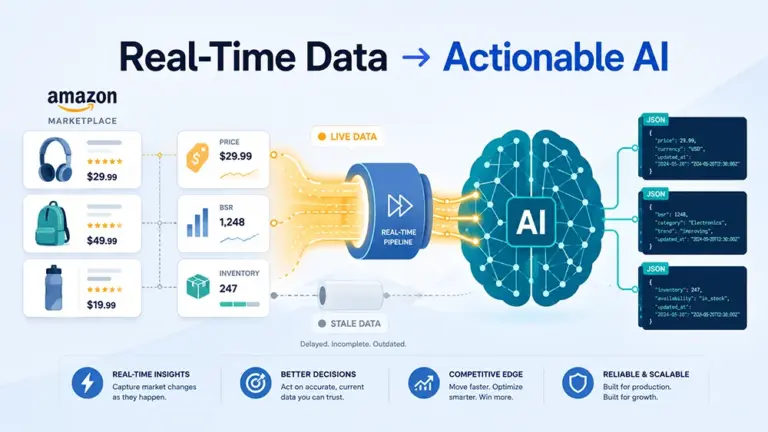
Whether it is lagging macro statistics, stale open datasets, or collapsing in-house scrapers, they all point to the same answer: what enterprises truly need is real-time, uncapped, high-fidelity first-party tactical data — plus infrastructure that feeds it seamlessly into large models. That is exactly what we build at Pangolinfo, rebuilding e-commerce data acquisition through a three-layer, progressive “REST API → MCP → Agent Skill” architecture. Here is the whole picture.
Layer 1: Amazon Scraper API — zero-latency, no-blind-spot penetration
The base API is the foundation for everything. Amazon Scraper API drops the industry-standard T+1 cache batch and hits the storefront for zero-second live scraping on every query. It breaks the pagination limit with Page 0+ on-demand depth, fully capturing long-tail niche dynamics. Most important is its 98% SP ad-placement recognition (industry-leading) — separating paid placements from organic results at the physical layer, enabling zip-code-level competitor ad attribution and eliminating that 50% of data poisoning. At 99.9% uptime, the system sustains 30M+ calls per day with a 3-second median response.
Read the Amazon Scraper API docs →
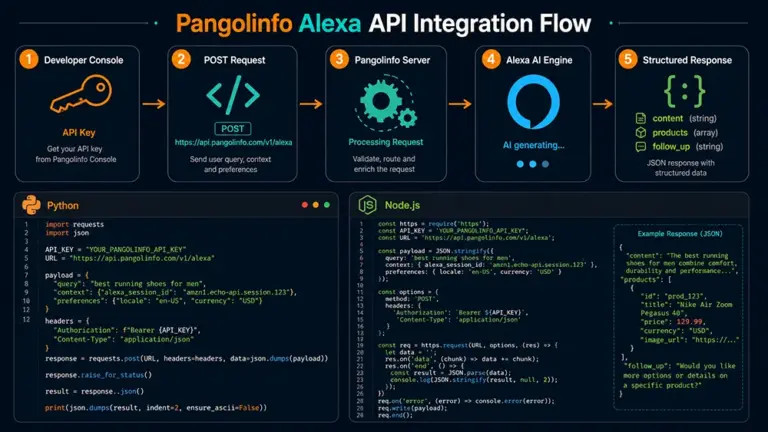
Reviews are another gold mine. Amazon Review API is system-optimized for high-concurrency review scraping, reliably extracting ratings, review text, timestamps, reviewer profiles, and media links. Paired with NLP, you can monitor brand reputation in real time, run cross-language competitor strength/weakness analysis, and trip a stop-loss the moment negative reviews spike. And as generative shopping assistants like Amazon Alexa for Shopping (formerly Rufus) spread, keyword SEO is fading — Amazon Alexa API leads the industry with structured scraping that reverse-engineers the black box of AI-recommended product lists, letting you claim the new generative-AI traffic entry early. That is the lever for AEO (AI Engine Optimization).
Layer 2: Amazon Data MCP — the direct nerve to the AI brain
With a strong data pipeline, the next question is: how do you feed this large, complex structured data seamlessly into models like Claude and GPT? Before the MCP (Model Context Protocol) standard landed in 2025, the flow was painful: have the AI write Python, run it locally, fix errors, then copy-paste JSON back into chat — a “copy-paste loop” that shattered focus and wasted labor.
Amazon Data MCP ends that outdated paradigm. It wraps complex API logic into a standardized service process; drop one JSON config and an API key into any MCP-capable client — Claude Code, Cursor, Windsurf, Cline — and in 3 minutes the AI gains 19 live e-commerce and IP data tools. A built-in pangolinfo_capabilities tool lets the agent auto-read every endpoint’s parameter spec and data schema at startup. So you write no code: give a macro instruction in natural language — “analyze this product’s competitors and check for potential IP infringement risk” — and the AI decides which tools to call, how to sequence parameters, runs all data exchange in the background, and returns a deep report.
Read the Amazon Data MCP setup docs →
READ_ONLY=true mode, ensuring the AI agent has read-only access and cannot write beyond its scope. These engineering details are often what decides whether an enterprise rollout passes review.
Layer 3: Agent Skill — constrain hallucination, fix expert SOPs
If the API solves the acquisition path and MCP solves tool reach, then Pangolinfo Amazon Scraper Skill solves the LLM’s inherent hallucination and unstable execution. In practice, letting an AI freely combine tools in open context often derails as context grows long. The Skill architecture uses Markdown to hard-constrain domain knowledge, step order, validation, and business guardrails. When invoked, the agent follows preset best practices: first probe organic traffic and ad placement, then scrape negative reviews for pain-point modeling, and finally output LLM-friendly JSON or Markdown. It slashes the model’s coordination load, turning unreliable chat into a highly reliable, repeatable operations pipeline.
Read the Pangolinfo Amazon Scraper Skill docs →
So how should I choose a data solution?
After all that, here is a simple framework for choosing cross-border e-commerce datasets — no need to worship any single source:
| Your goal | Recommended source | Why |
|---|---|---|
| Strategic siting, macro trend reads | UN Comtrade + industry whitepapers | Authoritative, broad, macro; lag is acceptable |
| Model pre-training, EDA practice | Kaggle (Olist / synthetic) | Clean structure, free, great for a baseline |
| Frontline picks, competitor monitoring, ad attribution | Real-time APIs (Scraper/Review/Alexa) | First-party, live, SP-ad separable; supports decisions directly |
| Automating analysis with an AI agent | MCP + Skill | Zero-code LLM access, natural-language driven, SOP-stable |
In one line: public datasets for research, real-time data for business. They are not substitutes but a division of labor. The real cost trap is fighting an hourly war with half-year-old data while believing you saved money. The snippet below shows what real-time infrastructure looks like in practice — batch-pull a category’s live bestsellers, separate SP ads, and attribute.
import requests

API = "https://api.pangolinfo.com/v1/amazon/bestsellers"
HEADERS = {"Authorization": "Bearer YOUR_API_KEY"}

def fetch_category_snapshot(category_url, pages=3):
    """Pull live category bestsellers, separate SP ads, return structured JSON."""
    results = []
    for page in range(pages):                 # Page 0+ depth covers the long tail
        resp = requests.get(API, headers=HEADERS, params={
            "url": category_url,
            "page": page,
            "parse": "json",                   # structured output
            "separate_ads": True,              # key: physically split SP ad slots
        }, timeout=15)
        data = resp.json()
        for item in data["items"]:
            results.append({
                "asin": item["asin"],
                "bsr": item["best_sellers_rank"],
                "price": item["price"],
                "is_sponsored": item["is_sponsored"],   # organic vs paid, at a glance
                "captured_at": data["captured_at"],      # timestamp, traceable
            })
    organic = [r for r in results if not r["is_sponsored"]]
    print(f"{len(results)} rows, {len(organic)} organic")
    return results

# Feed results straight to MCP so an AI agent auto-writes the competitor report
Frequently Asked Questions
What cross-border e-commerce public datasets exist, and are free ones enough?
Mainstream free datasets include macro UN Comtrade (trade stats) and micro Kaggle sets (Olist Brazil orders, synthetic user data, Amazon static snapshots). They are enough for academic research, model pre-training, and macro trend reads, but they lag, are coarse, and lack live marketing metrics — so they cannot carry frontline tactics like product picks, competitor monitoring, or ad attribution, where real-time APIs step in.
Why can’t UN Comtrade data be used for day-to-day e-commerce operations?
Three hard limits: timeliness (official stats lag months to years); granularity (only HS categories, no SKU, price, or reviews); and cost (high-volume API extraction needs a $6,000–$12,000/year institutional subscription). It is great for macro trade flows, not for “what a competitor is doing right now.”
How expensive is building a scraper for Amazon data?
A large custom crawling cluster can cost up to $14,500/month, covering proxy IPs, servers, CAPTCHA solving, and engineers. The hidden cost is data quality — generic scrapers cannot tell organic rank from SP ads, injecting up to 50% fake ranking signals, and usually stop at the first three pages. The decision risk far exceeds the fees saved.
What is MCP, and what does it do for cross-border e-commerce data?
MCP (Model Context Protocol) is a 2025 standard that lets LLMs call external tools directly. Amazon Data MCP wraps real-time data APIs into 19 tools; one config connects it to Claude, Cursor, and more in 3 minutes. You give natural-language commands and the agent pulls data, analyzes, and reports — no more “write code then copy-paste JSON” loops.
How should public datasets and real-time APIs be combined?
Divide the labor: public datasets for research — UN Comtrade for siting, Kaggle for pre-training; real-time APIs for business — Scraper/Review/Alexa for picks, monitoring, and attribution; then add MCP and Skill to automate with an AI agent. The rule: public data shows the past, real-time data shows the present — never fight a real-time war with lagging data.
Conclusion: build data acquisition as infrastructure
Looking back over 2025–2026, cross-border e-commerce growth has shifted from crude listing floods to a higher-dimensional contest centered on data intelligence, brand operations, and supply-chain resilience. In that contest, UN Comtrade’s macro trade data and Kaggle’s e-commerce datasets remain irreplaceable for strategic siting, economic forecasting, and building base algorithms. But against a fast-moving micro bidding environment and anti-scraping blockades, the lag of static public datasets means they cannot command the frontline.
The way across the gap is to build data acquisition as infrastructure, not a one-off purchase. REST API provides the live intelligence source, MCP lets any model instantly mount professional tools, and Skill fixes expert logic into hard-constrained workflows — stacked together, that is the data stack an AI-native era demands. Whoever fuses data acquisition, AI orchestration, and automated decisions first will build a moat that is genuinely hard to cross in an increasingly complex global trade map.
Wire real-time Amazon data straight to your AI agent
From first-party real-time data APIs to a 3-minute MCP setup, Pangolinfo helps you skip anti-scraping and data poisoning, so your models get data that can actually fight.
Try Amazon Scraper API Explore Amazon Data MCP Read the full docs →About the author: Leo, Head of Engineering / Chief Architect at Pangolinfo, responsible for the architecture and reliability of Amazon real-time data systems, having led data pipelines at 30M+ daily calls and 99% success. Data cited from the China Cross-Border E-Commerce Market Report 2025 (100EC), the “Resilience Rebuild” 2025 Global Cross-Border Supply Chain Report (Ebrun), Japan METI surveys, UN Comtrade official documentation, and Kaggle public dataset docs.
Updated: 2026-07-14 · Part of the Pangolinfo Cross-Border E-Commerce Data Whitepaper series