

Chapter 1: Everyone Has Tool Opinions. Very Few Have a Framework.
Walk into any Amazon seller community—a Facebook group, a Reddit thread, a Discord channel for cross-border sellers—and within five minutes you’ll see some version of the same debate: Jungle Scout vs. Helium 10? Is this free product research tool any good? Can someone share their sourcing data?
These conversations are not wrong. Tools do matter. But they reveal a gap in how most sellers think about the problem. The implicit assumption in every “which tool is better?” question is that there exists a tool that, if you could only find the right one, would reliably tell you which products to sell. That assumption is incorrect—and understanding why it’s incorrect is the starting point for developing a genuinely effective Amazon product selection strategy.
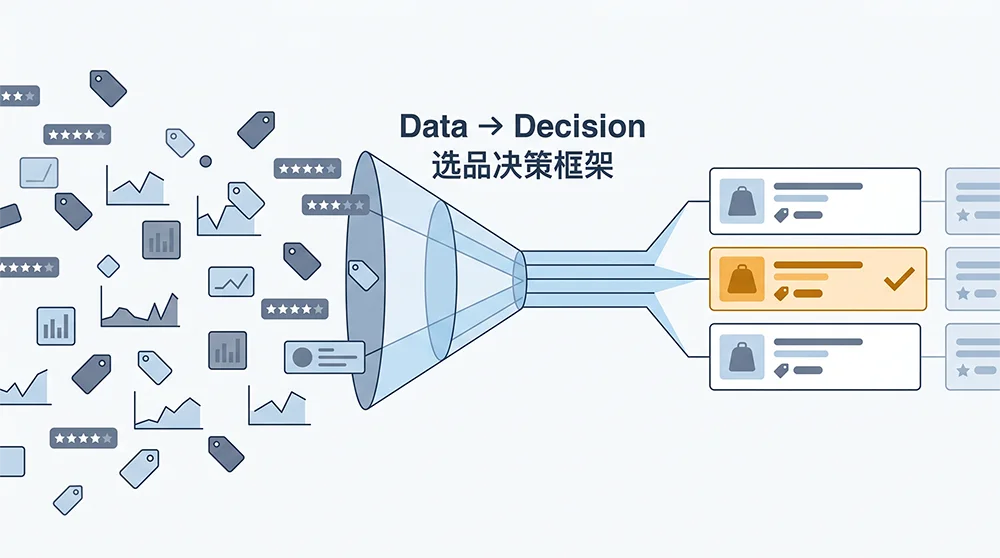
Experienced sellers with years of profitable records often say something that sounds almost paradoxical to beginners: “Product selection doesn’t come from the tool. It comes from your judgment.” What they mean isn’t that data is irrelevant. They mean that data without a decision-making framework is just noise. And a framework without high-quality, timely data is just guesswork dressed up in logic.
The essence of Amazon product selection is probabilistic decision-making under incomplete information. You are making a capital allocation decision—committing money, time, and operational bandwidth to a product—based on imperfect signals about a complex, dynamic marketplace. The goal is not to eliminate uncertainty. The goal is to systematically increase the probability of making the right call. Tools and data are the inputs to that probability calculation. Your framework is the calculation itself.
This guide is about building that framework. We’ll cover what product selection is truly selecting for, what data dimensions it actually requires, what quality standards that data must meet, how to obtain that data reliably, and why the infrastructure you choose to collect it matters more than most sellers realize.
Chapter 2: The Essence of Amazon Product Selection — Identifying Opportunity Windows, Not Finding Hot Products
Let’s start with a counterintuitive question: if product research tools can show you which products have high monthly sales, low review counts, and attractive margins—why do so many sellers still fail?
The answer is deceptively simple: the tool shows you yesterday’s market. You’re trying to sell into tomorrow’s.
Amazon operates on an inherent time lag problem. By the time you see that a product has high sales volume, other sellers have already seen the same data—some of them months before you did, some at the same time but with faster supply chains. The “find a hot product” approach to selection is not a strategy for discovering opportunity. It’s a strategy for chasing an already-diminishing one.
2.1 Three Dimensions of Opportunity
Real, high-quality Amazon product selection means identifying what I call an opportunity window—a convergence of three distinct dimensions:
The Time Window: The market is in a phase where demand is growing but supply has not fully caught up. This window is often narrow. It opens when a product category starts attracting mainstream attention and closes when large, well-funded sellers have entered at scale. Identifying the time window requires tracking demand dynamics continuously, not taking a one-time snapshot.
The Competitive Window: Existing competitors have exploitable weaknesses. This can take the form of concentrated complaint clusters in negative reviews, obvious product design shortfalls, poor listing quality, or structural gaps in pricing tiers or logistics options. Finding the competitive window requires deep, qualitative analysis of competitors—not just high-level metrics.
The Supply Window: You have the capacity to fill the gap at a competitive cost and timeline. All the opportunity in the world is irrelevant if your supply chain cannot deliver the product, at the right quality, in the right timeframe, at a cost that allows profitability.
When all three windows are open simultaneously—that’s where genuine opportunity lives. Most research tools can help you partially assess two of these dimensions (time and competitive, through historical data). Almost none of them help you with the third (supply). And critically, the time dimension requires continuous monitoring, not a one-time lookup.
2.2 The Decision Chain of Product Selection
Breaking product selection into its constituent decision steps reveals a complex chain, each step with distinct data requirements:
Step 1 — Market Scanning: Which categories are attracting growing attention? Which subcategories show new trend signals? This requires dynamic trend data: search volume trajectories, new ASIN entry rates, BSR distribution shifts across subcategories.
Step 2 — Demand Validation: Is there genuine purchase intent, or just browsing interest? These can be very different things. This requires search volume data with conversion context, historical seasonality curves, and qualitative demand signals from buyer reviews.
Step 3 — Competitive Analysis: Who is selling this product? What are their strengths and vulnerabilities? This requires ASIN-level data across multiple dimensions: price history, review velocity, review quality, listing completeness, advertising intensity.
Step 4 — Financial Modeling: At the target price point, after FBA fees, advertising costs, sourcing costs, and inbound freight, is there sustainable margin? This requires precise pricing data and accurate fee rate information.
Step 5 — Feasibility Validation: Can you actually execute? What is the minimum viable first order? How do you design a test launch? This requires cross-validating internal supply chain data with external market signals.
Each step depends on data. But the type, granularity, and freshness requirements of data differ dramatically across steps. This is precisely why “one tool handles all of product selection” is structurally impossible.
2.3 The Most Common Ways Sellers Get Product Selection Wrong
Let’s name the specific cognitive errors that translate into bad product selection decisions:
Treating monthly sales volume as demand. Monthly sales is an output variable, not an input variable. High volume indicates a market exists—but it equally indicates that supply has caught up with that market. Using high sales volume as your primary selection criterion means you’re always chasing, never leading.
Treating low review count as low competition. Few reviews might mean a product just entered the market—or it might mean the product has no real demand. Distinguishing between these requires correlating review count with search volume trends, new ASIN entry rate, and review velocity over time. Without that context, the signal is ambiguous.
Treating price-minus-cost as profit. Margin calculations that ignore advertising costs systematically overestimate profitability. ACoS varies dynamically. The same keyword that costs $0.80 CPC today might cost $1.80 CPC six months from now as more sellers enter. Any financial model that treats ad spend as a fixed number is not a model—it’s wishful thinking.
Making dynamic decisions with static data. From the moment you identify a potential product to the moment inventory arrives on Amazon shelves is typically three to six months. A market snapshot from six months ago may have almost no predictive value for the current market. Yet the vast majority of product selection decisions are made based on exactly this kind of static data.
Chapter 3: What Data Does High-Quality Product Selection Actually Require?
With the framework established, we can now be specific about the data dimensions that genuine high-quality Amazon product selection requires. There are five core data layers, each with distinct collection and quality requirements.

3.1 Trend Data Layer
Trend data has the highest freshness requirements and relatively lower precision requirements of any data layer. The objective is directional signal, not precise measurement.
BSR Dynamics: Amazon’s Best Sellers, New Releases, and Movers & Shakers lists across all categories. Movers & Shakers updates hourly—it shows rank velocity, not absolute rank—making it the most sensitive real-time signal for detecting category momentum shifts. Daily scraping of this data is the minimum viable frequency for meaningful trend detection.
Search Volume Trajectories: Not the point-in-time search volume of a keyword, but its directional trend over the past 30, 90, and 180 days. A keyword with 50,000 monthly searches that has been declining for six months is a fundamentally different signal from a keyword with 20,000 searches that has grown 200% in three months.
New ASIN Entry Rate: How many new ASINs have entered the target category in the past 30 days? Accelerating new entry signals intensifying competition and a narrowing opportunity window. It’s one of the earliest warnings that a category’s opportunity window is closing.
3.2 Demand Validation Layer
Demand validation data answers: how many people are willing to pay for this product, not merely look at it?
ASIN-Level Sales Estimates: All third-party estimates of Amazon monthly sales figures are model-derived—Amazon does not publish actual sales data. Accuracy varies by category, with error rates of 30–50% in mid-to-long-tail categories being common. Use this data as directional signal, never as precise input to financial models.
Price Tier Distribution: How is sales volume distributed across price tiers within a category? This reveals buyer price sensitivity and the profitability landscape at different positioning strategies. The $10–$15 tier typically means impulse purchase dynamics and brutal price competition. The $35–$60 tier typically means more considered purchase behavior and higher quality expectations.
Keyword Search Volume and CPC: Search volume sets the traffic ceiling; CPC determines the cost of competing for that traffic. Together, they define the economics of winning in a given search context. PPC data is essential for financial modeling that goes beyond naive margin calculation.
3.3 Competitive Analysis Layer
Competitive data is the most complex and highest-quality-requirement layer in the entire product selection data stack.
For every top competitor ASIN in your target category, you need multi-dimensional data including: current title, bullet points, A+ content completeness; current price and historical price trends (minimum six months); review count historical growth curve (not snapshots—the trajectory); star rating distribution across individual rating levels; FBA vs FBM status; main image quality; SP, SB, and SD advertising presence and coverage rates; variant count and variant-level sales distribution.
Review Semantic Data: This is the highest-information-density data in competitive analysis. One hundred negative reviews, systematically analyzed for high-frequency pain point terms, yield insights that no quantitative metric can provide. If 60 of 100 negative reviews mention the same specific product defect, you have a product improvement roadmap handed to you by the market itself—before you’ve spent a dollar on product development.
Advertising Placement Data: Systematic sampling of search result pages for core keywords reveals which competitors are aggressively bidding on those terms, whether their presence is continuous or intermittent, and how much of the visible real estate is advertising vs. organic. Pangolinfo’s Scrape API captures SP ad placements with 98% completeness—a figure that is genuinely rare in the industry and directly relevant to any seller trying to accurately assess competitive intensity.
3.4 Financial Data Layer
Financial data underpins the profit model—the ultimate arbiter of whether a product is worth pursuing.
Historical Price Data: Competitor price histories over 6–12 months reveal pricing dynamics within a category. A category where average prices have declined 20% in six months signals intensifying competition and eroding margins. Static current pricing cannot show this.
FBA Fee Rate Data: Amazon adjusts FBA fees periodically, and rates vary significantly by size tier and weight class. The difference between FBA fees for products falling in adjacent size tiers can meaningfully shift the profitability of a product. Real-time fee rate data is necessary for accurate financial modeling.
Promotional Activity Data: Which competitors are running persistent Coupons, Lightning Deals, or Best Deals? Promotional pricing directly affects real transaction prices and, therefore, your assessment of the true profitability level achievable in a category.
3.5 User Insight Data Layer
The user insight layer is the most undervalued of the five data layers and, in many cases, the most consequential for product design decisions.
Review Full Text: Large-scale review corpus from competitor products, analyzed through NLP methods (frequency analysis, sentiment analysis, topic clustering), yields: the product attributes buyers care most about, the most common use cases, the highest-frequency quality failures, and the alternative products most frequently mentioned as comparisons. This intelligence is unavailable through any quantitative metric.
Q&A Data: The Q&A section of Amazon product pages is systematically underused as a data source. Buyer questions directly reveal purchase decision barriers and product information gaps. The volume and quality of seller answers reveals service capability—or lack thereof. Gaps in Q&A responses represent opportunities for a new entrant to differentiate through better customer communication.
Customer Says Data: Amazon’s AI-generated review summaries (Customer Says), available on select product pages, are a high-value shortcut to understanding dominant user perceptions. Scraping this field at scale requires specialized capability—most conventional research tools don’t support it. Pangolinfo’s API natively supports Customer Says extraction, enabling bulk analysis of competitor user perception across large product sets.
Chapter 4: Data Quality Requirements — Accuracy, Freshness, and Coverage
Having established what data is needed, the next question is what quality standards that data must meet. Data quality is not a monolithic concept—it should be understood across three distinct dimensions: accuracy, freshness (timeliness), and coverage (completeness).
4.1 Accuracy: Knowing Which Data You Can Trust
The accuracy ceiling for Amazon product selection data varies fundamentally by data type.
High-accuracy data: Price, review count, star rating, product title, bullet points, product images. These are directly displayed by Amazon and can be captured with near-perfect accuracy by any competent scraping solution. These fields should be treated as reliable inputs and any collection errors should be treated as technical failures requiring immediate correction.
Medium-accuracy data: BSR rankings, ad placement presence. These are accurate at the moment of capture but are volatile. A single capture represents a point-in-time snapshot. Their analytical value comes from tracking trajectories over repeated captures, not from any individual data point.
Low-accuracy data: Monthly sales volume estimates. All third-party sales estimates are model-derived approximations. They are systematically uncertain, often significantly so. The appropriate use of sales volume estimates is directional comparison—”this category has meaningfully higher aggregate demand than that one”—not as precise inputs to financial models. Building a financial model on a $50,000/month sales estimate that might be anywhere from $25,000 to $100,000 is building on sand.
4.2 Freshness: Data Has a Half-Life
Different data types have dramatically different half-lives. Managing data freshness effectively means knowing the right refresh cadence for each type.
| Data Type | Recommended Refresh | Impact of Stale Data |
|---|---|---|
| Price Data | Daily / Real-time | Financial modeling errors, incorrect competitive positioning |
| BSR Rankings (Best Sellers) | Daily | Missed trend signals, lagging decision-making |
| BSR (Movers & Shakers) | Hourly | Loss of real-time velocity signal |
| Review Count / Rating | Weekly | Delayed competitive awareness, missed differentiation windows |
| Ad Placement Data | Daily | Underestimation of competitive intensity, budget miscalculation |
| Keyword Search Volume | Monthly | Trend lag, acceptable for strategic direction-setting |
| Review Full Text | Monthly (new reviews priority) | User insight drift, missed emerging pain point signals |
The implication is clear: price and BSR data require collection infrastructure capable of daily or sub-daily refresh at meaningful scale. This is not achievable with most subscription tools, which batch-update their databases on schedules that may introduce weeks of lag. Real-time API access is the only way to genuinely meet freshness requirements for high-stakes product selection decisions.
4.3 Coverage: Gaps in Data Are Gaps in Vision
Geographic coverage: Amazon marketplaces across countries are entirely independent data environments. The US Best Sellers list is not informative about the German market. Sellers expanding across marketplaces need collection capability that covers each target marketplace with equivalent depth and freshness.
Category coverage: Major research tools have comparative data depth in mainstream US categories, but coverage quality drops significantly in long-tail categories, specialty verticals (Industrial & Scientific, Collectibles, Handmade), and non-US marketplaces. Sellers targeting those spaces often find standard tools inadequate.
Dimensional coverage: As established earlier, product selection requires five data layers. No single subscription tool covers all five with the depth and freshness required for professional-grade decision-making. Either you accept the limitations of any given tool, or you build a data collection architecture that covers the full dimensional requirement.
Chapter 5: Why Pangolinfo API Is the Right Infrastructure for Amazon Product Selection Data
Understanding the data requirements and quality standards of high-quality Amazon product selection makes the infrastructure question more concrete. What you need is a data collection layer that is real-time, flexible, scalable, and covers the full dimensional map of product selection data. That description maps precisely onto what API-based data collection provides—and specifically what Pangolinfo Scrape API delivers.

5.1 Real-Time Data, Not Cached Databases
Every Pangolinfo API call initiates a live scrape of the requested Amazon page. The data returned reflects Amazon’s actual current state—pricing, ratings, BSR position, ad placements—at the moment of the request. There is no data warehouse sitting between your request and Amazon’s actual data. This is structurally different from subscription tools, which serve cached database records that may be hours, days, or weeks out of date.
For product selection decisions that depend on current competitive dynamics—particularly price monitoring and trend detection—this distinction is significant. Seeing a price drop two weeks after it happened is not actionable intelligence. Seeing it the same day provides a meaningful competitive information advantage.
5.2 Full Coverage of the Product Selection Data Map
Pangolinfo supports the complete range of Amazon data types required for comprehensive product selection:
Product Detail Pages (ASIN-level): Title, current price, list price, coupon availability, star rating, review count, images, A+ content, seller information, FBA/FBM status, variant data, product attributes, Customer Says (AI-generated review summary). The Customer Says field is particularly rare in the API ecosystem—it provides batch-scalable access to Amazon’s own AI synthesis of buyer sentiment, which is a powerful shortcut for competitive perception analysis.
Search Result Pages (Keyword-level): Organic ranking results, SP ad placements (first position and remaining page positions, with 98% capture completeness), Sponsored Brand placements, search result category distribution. The 98% SP ad capture rate is a genuinely differentiating capability—most competing tools have significant gaps in advertised product capture, leading to systematic underestimation of keyword-level competition.
BSR List Data: Real-time capture of any Amazon category or subcategory BSR list (Best Sellers, New Releases, Movers & Shakers), across all major Amazon marketplaces. This enables systematic category scanning at a scale and freshness level that subscription tools cannot match.
Review Data: Through Pangolinfo Reviews Scraper API, large-scale review collection for any ASIN, including full review text, star rating, timestamp, helpful vote count, verified purchase status. This is the foundation for the review semantic analysis that high-quality product differentiation requires.
Multi-Marketplace Support: US, UK, Germany, France, Japan, Canada, Australia, Italy, Spain, and more—with postal code-level targeting (Zip Code targeting) available for markets where geographic pricing variation is relevant.
5.3 Scale: From Single ASIN to Category-Wide Monitoring
Pangolinfo supports enterprise-scale collection up to tens of millions of pages per day. For sophisticated product selection operations—tracking thousands of competitor ASINs across multiple marketplaces with daily refresh—this scale capacity is the difference between a monitoring system that actually works and one that’s perpetually backlogged.
Both synchronous and asynchronous call modes are available, matching the appropriate mode to the use case: synchronous for latency-critical real-time requests (single ASIN lookup during active research), asynchronous for large batch collection jobs (weekly full-category BSR captures).
5.4 Special Capabilities That Fill Industry Gaps
Beyond core collection capability, Pangolinfo offers several specific features that address data blind spots common across the product selection stack:
98% SP Ad Placement Capture Rate: Most research tools systematically under-capture sponsored product placements, leading sellers to underestimate the true advertising intensity in their target keywords. Pangolinfo’s near-complete ad placement capture provides accurate competitive intelligence about which advertisers are contesting which keyword positions, at what apparent frequency.
Customer Says Full Extraction: Amazon’s AI-synthesized review summaries are available on select product pages and represent a distilled view of dominant buyer perceptions. Batch extraction of this field at scale—possible with Pangolinfo—enables rapid competitive perception analysis across large product sets that would be impossible with manual review.
Postal Code-Level Collection: For markets where product pricing or availability varies by delivery location, Pangolinfo supports specifying collection postal codes to capture geographically-targeted data—a granularity level unavailable in standard research tools.
5.5 AI Agent Integration: Future-Proofing Your Product Selection Stack
As product selection increasingly moves toward AI-augmented workflows, data collection infrastructure needs to be natively compatible with Agent-based architectures. Pangolinfo’s Amazon Scraper Skill enables integration of Amazon data collection directly into AI Agent workflows via standard Skill interfaces, without requiring separate data engineering work.
This means that as you evolve from manual research processes toward automated analysis pipelines—where AI agents perform initial category scanning and competitive triage, surfacing only the highest-priority candidates for human review—your data layer can evolve with those workflows without rebuilding the collection infrastructure.
For sellers who want to begin without API integration, AMZ Data Tracker provides a no-code visual interface for competitor tracking, BSR monitoring, and price trend analysis—the same underlying data capabilities in an accessible form for teams without technical resources.
Chapter 6: Best Practices for High-Quality Amazon Product Selection
Translating the framework and data requirements into operational practice requires specific habits and processes. The following practices are drawn from the patterns of product selection teams that consistently outperform market averages over multiple product cycles.
6.1 In the Category Scanning Phase
Build a systematic category monitoring calendar, not an ad-hoc browsing habit. Designate specific times each week for structured BSR review, and capture full lists—not just the top 10—because rank velocity signals often appear in the 50–100 range before a product crests into the top tier.
Don’t restrict scanning to a single marketplace. Niche categories that are already intensely competitive on Amazon.com may still have significant opportunity space on Amazon.de, Amazon.co.jp, or Amazon.com.au, where competitive density is lower. Cross-marketplace data comparison is a systematic advantage that single-marketplace-focused sellers overlook.
Require dual confirmation of trend signals. An Amazon-internal trend (rising BSR velocity) supported by an external signal (Google Trends growth, social media volume increase) is meaningfully more reliable than either signal alone. Build confirmation into your trigger criteria before moving resources to full category evaluation.
6.2 In Competitive Analysis
Read 100 reviews before relying on any aggregate metric. Aggregate ratings smooth out the structural information that makes competitive analysis actionable. In 100 reviews, you can identify specific fault patterns, use case clusters, and comparison products that aggregate metrics completely hide.
Track competitor review velocity, not absolute review count. A competitor with 500 reviews that has been growing at 20 reviews per week is in a different competitive trajectory from a competitor with 500 reviews that has been adding 2 per week. The trajectory tells you whether a product’s market momentum is accelerating or decelerating.
Analyze advertising presence over time, not just at a point in time. A competitor who advertises heavily on weekends but goes dark on weekdays has a very different budget situation from one with consistent daily presence. This behavioral pattern can suggest financial constraints—or sophisticated dayparting strategies—that inform how aggressively you need to compete on that keyword.
6.3 In Financial Modeling
Always use three-scenario modeling: pessimistic, baseline, and optimistic. The pessimistic scenario—30% below expected sales, 20% above expected ACoS—is the stress test that actually matters. If the pessimistic scenario produces an acceptable outcome, the decision has defensible downside protection. If it produces catastrophic loss, the apparent upside doesn’t justify the exposure.
Model advertising costs using category-specific CPC data, not industry averages. CPC variation across categories is enormous—electronics categories may average $2.50+ per click while pet supplies categories may average $0.50–$0.80. Using industry-average PPC assumptions inflates projected profitability in high-competition categories and deflates it in lower-competition ones.
Include return rate assumptions based on historical category data, not generic e-commerce benchmarks. A 15–20% return rate in electronics vs. a 3–5% rate in home décor represents dramatically different cost structures. Omitting this from financial models systematically overestimates net margins.
6.4 In Data Management
Build a structured data store, accumulate it over time, and timestamp everything. The entire value of historical data is its ability to show change over time. An ASIN price history with 180 daily data points is a completely different analytical asset from a single current price lookup. Design your data infrastructure for historical accumulation from the start.
Set automated alerts for anomaly signals. A significant competitor price drop, a sudden spike in category CPC, a competitor’s star rating decline—these are time-sensitive signals that should trigger immediate human review, not wait for the next scheduled analysis cycle.
Chapter 7: Building a Data-Driven Product Selection Capability from Scratch
The framework, data requirements, quality standards, and best practices outlined above are most useful when connected to a practical path for implementation. Here is a progressive capability-building roadmap applicable across different seller team scales.
7.1 Stage One: Basic Data Awareness (Individual Sellers / Small Teams)
Objective: Establish foundational market awareness and complete initial product opportunity validation.
Tool configuration: Use AMZ Data Tracker for no-code competitor tracking (price, BSR, review count changes). Manually review BSR lists on a weekly schedule. Cross-reference trends against Google Trends data. Build financial models in Excel with three-scenario structure from the start.
The focus at this stage is not tool sophistication but decision-making discipline: forming the habit of treating data as hypothesis-testing input rather than answer-providing output.
7.2 Stage Two: Structured Data Collection (Mid-Size Seller Teams)
Objective: Build systematic competitor monitoring and category scanning capability supporting parallel evaluation of multiple products simultaneously.
Tool configuration: Implement Pangolinfo Scrape API with scheduled batch collection jobs for core category BSR lists and competitor ASIN data. Use Reviews Scraper API for competitive review corpus collection. Store data in a structured database with timestamped historical accumulation—even a well-structured Airtable or Google Sheets implementation can meet initial requirements.
The critical investment at this stage is infrastructure setup. One or two technically skilled team members, working with Pangolinfo API documentation, can build collection coverage that exceeds the capabilities of any subscription tool within a few weeks of implementation.
7.3 Stage Three: Automated Product Selection Signal Generation (scaled sellers with technical teams)
Objective: Automate the pipeline from data collection to opportunity signal generation, dramatically increasing throughput and category coverage while reducing manual research labor.
System architecture: Pangolinfo Scrape API as collection engine driving real-time category scanning and competitor monitoring; NLP analysis pipeline processing review text corpus and scoring product opportunities; automated multi-dimensional scoring model ranking candidate products; human team focused on deep-dive analysis and final decisions on high-scoring candidates—not on data collection and basic filtering.
The advanced evolution of this architecture uses Pangolinfo Amazon Scraper Skill to integrate data collection natively into AI Agent workflows, where agents autonomously complete initial category scanning and competitive triage, surfacing only the highest-priority candidates for human evaluation. Product selection throughput improvements of 5–10x are achievable at this stage.
Conclusion: Redefining the Product Selection Mindset
Amazon product selection has no shortcuts. What it does have is a correct way of thinking about the problem—and a deeply incorrect way that most sellers fall into because tool vendors have an incentive to make the problem look simpler than it is.
The core reframings that separate high-quality product selection from its common imitation:
From “finding hot products” to “identifying opportunity windows.” Hot products are outcomes. Opportunity windows—where time dynamics, competitive vulnerabilities, and supply capabilities converge—are what you’re actually searching for. That search requires continuous, dynamic market monitoring, not periodically querying a historical database.
From “more data” to “right data, right quality, right time.” Not all data requires high precision. Not all data requires real-time freshness. Knowing which data demands which quality tier allows you to build efficient collection infrastructure rather than chasing data volume for its own sake.
From “tool dependency” to “data capability ownership.” When your product selection method is bounded by the feature limits of a subscription tool, your competitive ceiling is set by that tool’s product roadmap. Building your own data collection capability on API infrastructure removes that ceiling. The flexibility and coverage of Pangolinfo Scrape API gives you the freedom to instrument exactly the data flows your specific strategy requires.
From “one-time selection event” to “continuous market sensing system.” Product selection is not a task to complete—it’s a system to operate. The teams that consistently out-select their competitors have built continuous, automated monitoring infrastructure that accumulates market intelligence over time. Single-event research, however thorough, cannot compete with that accumulated signal.
The fundamental nature of Amazon product selection—probabilistic decision-making under incomplete information—does not change. What improves is the quality and timeliness of the information inputs, and the rigor of the decision framework applying them. That improvement compounds over time into a durable competitive advantage.
Start building your data-driven product selection infrastructure with Pangolinfo Scrape API.
Explore AMZ Data Tracker for no-code competitor and BSR monitoring.
Learn about Amazon Scraper Skill for AI Agent workflow integration.
Review the complete API documentation and make your first API call in under five minutes.
Access the Pangolinfo Console to start your free trial.
Tags: Amazon product selection, Amazon product research, niche research, Amazon sourcing strategy, data-driven e-commerce, Pangolinfo API, Amazon scraper, BSR analysis, competitor analysis, product selection framework
About Pangolinfo: Pangolinfo provides real-time Amazon data collection API infrastructure for sellers, SaaS tool companies, and AI-driven e-commerce teams. Core capabilities include Amazon product data collection, review data extraction, and AI search result data collection, supporting enterprise-scale operations up to tens of millions of pages per day.