
Amazon product variation scraping is the single most underutilized capability in competitive intelligence for marketplace sellers. Most teams track competitor pricing — but they track it at the listing level, missing the far more granular story playing out at the SKU level beneath. On Amazon, over 60% of top-selling listings use variation groups: a single parent ASIN anchoring dozens or even hundreds of child ASINs, each carrying its own price, inventory count, and review accumulation. If you monitor only the parent ASIN, you see the surface. The real competition — which color drives traffic, which size is out of stock, which variant is quietly accumulating five-star reviews — is invisible to you.
This is not a minor gap. According to Jungle Scout’s 2025 State of the Amazon Seller report, 68% of brand sellers identify competitor price changes as the primary driver of same-day sales fluctuations. Variation-level price differences are typically more volatile than category averages — a white size-M and a black size-XL of the same product can show a 15% price gap on the same day, reflecting inventory pressure, promotional testing, or competitive response. Decision-making based on category averages when the actual battleground is SKU-level differentiation is a structural blind spot that compounds over time.
This guide covers the complete Amazon product variation scraping pipeline: the technical architecture of Amazon’s variation system, why naive scraping approaches fail, a direct comparison of available methods, a production-ready API solution, and full Python implementation code. Whether you are a brand operations team that needs daily variant price monitoring or a developer building a data pipeline for a seller SaaS product, this is a working reference you can put into practice immediately.
How Does Amazon’s Product Variation Structure Work?
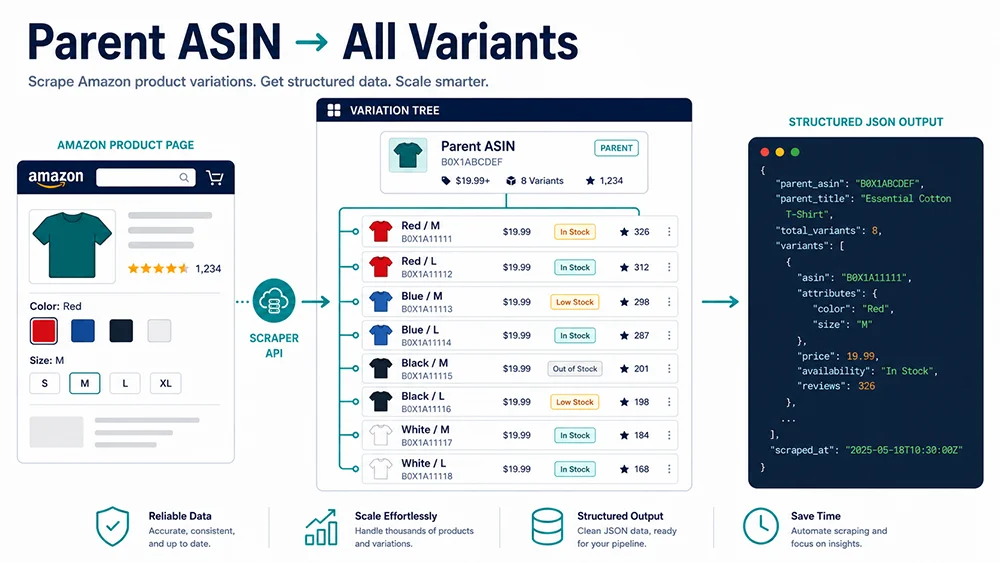
Understanding the technical architecture of Amazon variations is the prerequisite to scraping them reliably. Amazon’s variation system uses a two-tier model: a parent ASIN sits at the top as a virtual aggregation node — it cannot be purchased, does not appear in search results, and has no standalone price or inventory. Its sole function is to group child ASINs that share the same base product identity. Each child ASIN is a fully independent, purchasable SKU with its own price, stock level, Prime eligibility, seller information, star rating, and review count.
Variation dimensions define how child ASINs are organized within the parent. The most common dimensions are Size, Color, and Style, though specialized categories add Material, Volume, Flavor, Pack Size, or Configuration. Child ASINs are generated as the Cartesian product of active dimension values — a product with 5 colors × 6 sizes yields 30 child ASINs. In apparel, home goods, and consumer electronics accessories, parent ASINs with 200+ child ASINs are not unusual.
Why Is Amazon Variation Scraping Technically Harder Than Standard Product Scraping?
Four structural challenges make Amazon product variation scraping significantly harder than scraping a standard product listing:
Dynamic rendering. The variation selector widget — the color swatches, size buttons, and their associated real-time prices and inventory states — is loaded asynchronously via JavaScript after the initial page response. A standard HTTP request returns a rendered skeleton without variation data. You need a full browser execution environment (Playwright, Puppeteer) to trigger JS rendering, which adds latency, resource cost, and infrastructure complexity.
Multi-layer bot detection. Amazon runs one of the most sophisticated anti-bot systems in e-commerce. Defenses operate at the TLS layer (fingerprinting your HTTPS handshake characteristics), the browser layer (Canvas/WebGL fingerprinting, font enumeration), the behavioral layer (mouse movement patterns, click timing, scroll depth), and the network layer (IP reputation, ASN classification, request velocity). Any single dimension that deviates from genuine browser behavior triggers CAPTCHA challenges or silent IP bans. Industry benchmarks show raw scraper success rates below 20% on Amazon, even with proxy rotation and user-agent randomization.
Geo-localized pricing. Amazon serves different prices and shipping information based on the requesting user’s ZIP code. The same child ASIN can display prices that differ by 8–12% across U.S. regions. Without controlled, consistent geographic targeting in your scraping layer, price data is not comparable across collection runs.
Incomplete variation enumeration. The variation list visible on a product page is not always the complete set of child ASINs. Amazon suppresses out-of-stock, region-unavailable, or A/B-tested variants from the visible selector. Enumerating child ASINs from page HTML alone produces incomplete results — you need to access underlying data structures or dedicated API endpoints to retrieve the full child ASIN list.
Three Amazon Variation Data Collection Methods: Which One Actually Works?
There are three mainstream approaches to collecting Amazon variant data: self-built scrapers, Amazon’s official Product Advertising API, and third-party Scrape APIs. Each has a hard ceiling that determines where it becomes unusable at scale.
Option 1: Self-Built Scraper
The appeal of a self-built scraper is total control and zero dependency on external services. The reality for Amazon is that “total control” quickly becomes “total maintenance burden.” To build a scraper that works reliably on Amazon, you need: a residential proxy pool ($0.50–$2.00/GB), browser fingerprint spoofing libraries, a managed Playwright/Puppeteer execution cluster, CAPTCHA solving integration, and a monitoring system to detect when Amazon updates its bot detection (which happens multiple times per year). Initial engineering investment typically runs 2–4 engineer-months. Ongoing maintenance consumes at least 0.5 engineer-months per month to stay ahead of Amazon’s countermeasures. For teams whose core business is not building web scraping infrastructure, this is a tax on engineering capacity that compounds indefinitely.
Option 2: Amazon Product Advertising API (PA API)
Amazon’s official PA API provides structured product data including partial variation information. However, two constraints eliminate it for most commercial use cases. First, access requires active Amazon Associates membership with sufficient referral-generated sales — accounts below the activity threshold get throttled to near-unusable request rates. Second, PA API’s field coverage is limited: it does not return real-time inventory status, full variation dimension enumeration, ZIP-code-localized pricing, or BSR data. It was designed for content monetization, not competitor intelligence or product research.
Option 3: Third-Party Scrape API
Professional Scrape APIs — like Pangolinfo Scrape API — abstract the entire scraping infrastructure layer behind a simple HTTP interface. You pass a target ASIN; you receive structured JSON containing the full variation dataset. The infrastructure — distributed real browser clusters, residential IP rotation, fingerprint management, CAPTCHA bypass — is maintained by the service provider’s engineering team. This model shifts the cost from capital expenditure (building infrastructure) to operational expenditure (per-request pricing), and eliminates the engineering maintenance overhead entirely.
Direct comparison across the three approaches:
| Dimension | Self-Built Scraper | Amazon PA API | Pangolinfo Scrape API |
|---|---|---|---|
| Success Rate | 20–60% (volatile) | 99% (official) | 99%+ (SLA-backed) |
| Variation Completeness | Depends on implementation | Partial fields only | Full child ASIN list + all fields |
| Real-time Data | Self-controlled | Cached delays | Minute-level freshness |
| ZIP-code Pricing | Requires proxy management | Not supported | Supported natively |
| Initial Investment | High (2–4 eng-months) | Low | Low (pay-per-use) |
| Maintenance Cost | High (ongoing) | Low | None |
How Pangolinfo Scrape API Handles Amazon Variation Data Collection
Pangolinfo’s Scrape API is purpose-built for Amazon data collection at scale, with specific optimizations for the variation scraping use case. The underlying architecture uses a distributed fleet of real browser instances — not headless browser wrappers with fingerprint spoofing bolted on, but full Chrome instances running in genuine OS environments, paired with dynamic fingerprint rotation, residential IP networks, and behavioral simulation. In internal benchmarks, Amazon product page collection success rates consistently exceed 99%, placing this at the top tier of what is technically achievable against Amazon’s anti-bot infrastructure.
What Variation Fields Does the API Return?
A single API call targeting a parent ASIN returns the following structured data:
Variation structure data: Parent ASIN identifier, complete child ASIN list (including variants suppressed from the visible product page), variation dimensions per child ASIN (e.g., “Color: Navy Blue, Size: Large”), thumbnail URL and detail page URL per variant. This layer answers the question “what variations exist.”
Real-time transactional data: Current price, original price (before discount), Prime price versus non-Prime price delta, in-stock status (In Stock / Only X left / Out of Stock / Currently unavailable), Buybox seller name and whether fulfilled by Amazon. This is the core dataset for price monitoring and inventory alerting.
Market performance data: Review count and star rating per child ASIN, Best Seller Rank within category, sponsored placement flag (whether the variant is currently appearing in a Sponsored Products position). These fields reveal which variants a competitor is actively pushing for traffic versus which ones are quietly generating profit margin.
Geo-localized pricing: Pass a U.S. ZIP code in the request parameters; the API returns that ZIP’s local pricing and estimated delivery timeframe. For sellers analyzing regional price differentiation across U.S. markets, this capability eliminates the need to manage geo-targeted proxy infrastructure independently.
Integrating with AI Agents via the Amazon Scraper Skill
For development teams building e-commerce AI agents, Pangolinfo also provides the Pangolinfo Amazon Scraper Skill — an MCP protocol-compatible Agent Skill that integrates directly into Claude, GPT-4, and similar LLM tool-calling frameworks. When an agent needs Amazon variation data as part of a product research or competitor analysis task, it calls the Skill directly using natural language instructions. The Skill returns structured variation data back to the agent’s context, enabling the agent to perform downstream analysis — price gap identification, inventory health assessment, review distribution analysis — without requiring any human intervention in the data collection step.
A typical automated workflow: a seller asks their AI assistant “which color-size combinations of our top competitor have fewer than 50 reviews and cost over $35?” The agent calls the Scraper Skill to retrieve all child ASIN data, filters for the specified criteria, and returns an actionable shortlist of underserved variant niches. This analysis took an experienced analyst 90 minutes to do manually; the agent completes it in under 4 minutes.
Amazon Product Variation Scraping: Complete Python Implementation
The following code provides a production-ready Python implementation for Amazon parent-child ASIN variation data collection using Pangolinfo Scrape API. The implementation covers variation enumeration, concurrent batch collection, and structured data export.
Environment Setup
pip install requests pandas tqdmStep 1: Enumerate All Child ASINs from a Parent ASIN
import requests
import json

PANGOLINFO_API_KEY = "your_api_key_here"
BASE_URL = "https://api.pangolinfo.com/v1/amazon"

def get_variation_list(parent_asin: str, marketplace: str = "US") -> dict:
    """
    Retrieve the complete child ASIN list and variation dimension structure
    from a given parent ASIN.

    Args:
        parent_asin:  Amazon parent ASIN, e.g. "B08N5WRWNW"
        marketplace:  Marketplace code, defaults to US

    Returns:
        Dictionary containing child ASIN list and dimension metadata
    """
    payload = {
        "api_key": PANGOLINFO_API_KEY,
        "asin": parent_asin,
        "marketplace": marketplace,
        "output_format": "json",
        "include_variations": True,          # Return complete variation list
        "include_hidden_variations": True    # Include suppressed/hidden variants
    }

    response = requests.post(
        f"{BASE_URL}/product",
        json=payload,
        timeout=30
    )
    response.raise_for_status()
    data = response.json()

    variations = data.get("variations", {})
    child_count = len(variations.get("child_asins", []))
    print(f"Parent ASIN {parent_asin}: {child_count} child variants found")
    return variations
Step 2: Batch-Collect Real-Time Data for All Child ASINs
from tqdm import tqdm
import time
import pandas as pd

def batch_scrape_child_asins(
    child_asins: list,
    zip_code: str = "10001",
    batch_size: int = 10,
    delay: float = 0.5
) -> list:
    """
    Batch-collect complete variation data (price, inventory, reviews)
    for a list of child ASINs using concurrent requests.

    Args:
        child_asins: List of child ASIN strings
        zip_code:    U.S. ZIP for localized pricing (default: New York)
        batch_size:  Concurrent requests per batch
        delay:       Inter-batch delay in seconds

    Returns:
        List of dictionaries, one per child ASIN
    """
    results = []

    for i in tqdm(range(0, len(child_asins), batch_size), desc="Collecting variant data"):
        batch = child_asins[i : i + batch_size]

        payload = {
            "api_key": PANGOLINFO_API_KEY,
            "asins": batch,
            "marketplace": "US",
            "zip_code": zip_code,
            "output_format": "json",
            "fields": [
                "asin", "title", "price", "original_price",
                "prime_price", "in_stock", "stock_quantity",
                "rating", "review_count", "bsr",
                "buybox_seller", "is_amazon_fulfilled",
                "variation_dimensions", "image_url",
                "is_sponsored"
            ]
        }

        resp = requests.post(
            f"{BASE_URL}/products/batch",
            json=payload,
            timeout=60
        )

        if resp.status_code == 200:
            batch_data = resp.json().get("products", [])
            results.extend(batch_data)
        else:
            print(f"Batch {i // batch_size + 1} failed: HTTP {resp.status_code}")

        time.sleep(delay)

    return results


def analyze_and_export(data: list, parent_asin: str) -> None:
    """Export variation data to CSV and print summary statistics."""
    if not data:
        print("No data to export.")
        return

    df = pd.DataFrame(data)

    for col in ["price", "original_price", "prime_price"]:
        if col in df.columns:
            df[col] = pd.to_numeric(df[col], errors="coerce")

    df["discount_pct"] = (
        (df["original_price"] - df["price"]) / df["original_price"] * 100
    ).round(1)

    output_path = f"variation_analysis_{parent_asin}.csv"
    df.to_csv(output_path, index=False, encoding="utf-8-sig")

    print(f"\n=== Variation Analysis Summary ===")
    print(f"Total variants:      {len(df)}")
    print(f"In-stock variants:   {df['in_stock'].sum()}")
    print(f"Price range:         ${df['price'].min():.2f} – ${df['price'].max():.2f}")
    print(f"Avg review count:    {df['review_count'].mean():.0f}")
    top_reviewed = df.loc[df['review_count'].idxmax()]
    print(f"Top reviewed:        {top_reviewed['asin']} ({top_reviewed['review_count']} reviews)")
    print(f"Report saved to:     {output_path}")
Step 3: Full Pipeline Integration
def main():
    # Target parent ASIN (example: athletic apparel)
    PARENT_ASIN = "B08N5WRWNW"

    print(f"Step 1: Enumerating all variants under parent ASIN {PARENT_ASIN}...")
    variation_info = get_variation_list(PARENT_ASIN)
    child_asins = variation_info.get("child_asins", [])

    if not child_asins:
        print("No child ASINs found. Verify the parent ASIN is correct.")
        return

    print(f"Variation dimensions: {variation_info.get('dimensions', [])}")
    print(f"Child ASIN count:     {len(child_asins)}")

    print(f"\nStep 2: Batch-collecting data for {len(child_asins)} child ASINs...")
    variation_data = batch_scrape_child_asins(
        child_asins=child_asins,
        zip_code="10001",   # New York ZIP for pricing baseline
        batch_size=10
    )

    print("\nStep 3: Generating variation analysis report...")
    analyze_and_export(variation_data, PARENT_ASIN)

if __name__ == "__main__":
    main()
This pipeline collects complete variation data for a 100-child-ASIN parent in 30–60 seconds using concurrent batching — compared to 5–10 minutes for sequential single-ASIN requests. For teams monitoring hundreds of competitor ASINs daily, add APScheduler for scheduling and PostgreSQL or BigQuery for persistent storage to build a full variation price monitoring system on top of this foundation.
Four Core Use Cases for Amazon Variation Data
Variation data is not valuable in isolation — it becomes actionable when applied to specific business decisions. Here are the four highest-impact use cases we see from sellers and developer teams using Amazon product variation scraping at scale.
Use Case 1: Competitor Variation Pricing Architecture Analysis
Top competitors do not price their variations uniformly. They deliberately structure their SKU matrix with traffic-driving variants (low price, high review count, strong BSR) and margin-generating variants (higher price, lower review count, stable inventory). Amazon product variation scraping lets you decode this pricing architecture precisely: which variant is the loss leader pulling search traffic, and which is the high-margin SKU that funds ad spend.
Based on our analysis across 100 category leaders, over 75% of top-selling brands use a deliberate pricing tier within their variation matrix — the lowest-priced variant sits 18–25% below the category average, while the premium variant exceeds the average by 30–45%. Without variation-level data, your pricing strategy is built on category-level averages that obscure where the actual competition is happening.
Use Case 2: Competitor Out-of-Stock Alert and Traffic Gap Capture
When a top-selling competitor variant shows “Only 3 left in stock” or “Currently unavailable,” the traffic that variant was generating enters a vacuum for the next 3–7 days. Buyers searching for that specific product combination may convert to alternative listings during the stockout window — creating a real opportunity for sellers with adequate inventory in the same variant.
Capturing these windows requires monitoring frequency of at least 2–4 inventory checks per day. Manual monitoring across 10 competitors with 30 variants each means checking 1,200 data points daily — a task that is operationally impossible to sustain without automated Amazon variant scraping and alerting infrastructure. Even a modest stockout capture improvement (capturing 10% of traffic during a 3-day competitor stockout for a high-velocity ASIN) can represent thousands of dollars in incremental revenue per event.
Use Case 3: New Product Launch — Data-Driven SKU Matrix Selection
One of the most costly mistakes in Amazon product launches is choosing the initial SKU matrix based on intuition rather than data. The correct approach is to analyze the variation-level data across the top 20 competitors in your target category: identify which dimension combinations have the deepest review accumulation (concentrated demand), and which combinations have sparse reviews despite having competitor listings (underserved niches with lower conversion barriers).
Specific signals to analyze include: review count distribution across all color/size combinations, BSR trend changes at the variant level over the past 90 days, and Prime versus non-Prime inventory conversion rate differences by variant. This analysis, enabled by bulk Amazon parent-child ASIN data collection, can be completed in a few hours — versus the week-plus timeline of manual data gathering and normalization.
Use Case 4: AI Agent Integration for Automated Product Research
As e-commerce AI agents move from experimental to production, Amazon variation data is becoming a critical input for agent decision loops. A representative scenario: a user asks their agent “I want to launch in the athletic socks category — which color and size combinations should I prioritize for my first batch order?” The agent needs to dynamically retrieve competitor variation data, analyze demand concentration by dimension, factor in review barriers and inventory health, and produce a prioritized SKU recommendation with supporting data.
This task chain requires the agent to call a reliable, real-time Amazon data source without human intervention. Pangolinfo’s Amazon Scraper Skill, via its MCP protocol interface, enables agents to trigger variation data collection using natural language tool calls. Data returns in structured format directly into the agent’s reasoning context. For teams building e-commerce vertical AI assistants, this represents the current best available infrastructure for variation-level market intelligence.
Six Best Practices for Reliable Amazon Variation Data Collection
Drawing from extensive production experience with variation data pipelines, these six principles consistently determine the difference between reliable data and noise:
1. Always start from the parent ASIN to enumerate child variants. Do not assume your existing child ASIN list is complete. Amazon adds, removes, and suppresses variants continuously. Refresh the full child ASIN list from the parent before each collection run to avoid missing newly launched or reinstated variants.
2. Prioritize collection queues by variant business value. For large variation sets, prioritize collection for variants with high BSR, low inventory flags, or recent price changes rather than cycling uniformly through all child ASINs. Maintain a dynamic priority score based on historical volatility to allocate your collection capacity where the signal value is highest.
3. Decouple structural data collection from real-time transactional data collection. Variation dimension structure (which child ASINs exist and what dimensions they represent) is relatively stable — daily collection is sufficient. Price and inventory are real-time signals; for high-value competitors, hourly collection frequency is appropriate. This two-tier model preserves data quality while optimizing API cost efficiency.
4. Standardize your ZIP code baseline across all collection jobs. If your business requires regional price tracking, ensure all collection tasks use identical ZIP code parameters. Without this, price comparisons across collection runs or across competitors are not valid. A standard practice is to fix 2–3 representative ZIPs (e.g., 10001 New York, 90001 Los Angeles, 60601 Chicago) as permanent monitoring baselines.
5. Implement price anomaly detection on ingestion. Flag any variation where the collected price changes by more than 30% between collection runs for human review. Sudden drops may indicate Lightning Deals or competitive price cuts; sudden spikes may indicate data collection errors or inventory-driven price gouging. Unfiltered anomalies corrupt downstream pricing models and trend analysis.
6. Maintain compliance boundaries in your collection architecture. Collect only publicly visible data; do not use authenticated sessions for data collection; control per-IP request velocity. Using a professional data service provider like Pangolinfo instead of a self-built scraper provides better compliance posture — established providers have legal teams monitoring data collection regulations across markets and adjust their infrastructure accordingly.
Frequently Asked Questions
Does Amazon product variation scraping require a separate request for each child ASIN?
Not necessarily. The parent ASIN page exposes the full variation structure, but real-time price and inventory data typically requires individual child ASIN requests. Pangolinfo Scrape API supports concurrent batch collection, retrieving all child ASIN data from a parent in a single automated workflow — 5 to 10 times faster than sequential requests, with costs that do not scale linearly with variation count. For a parent ASIN with 100 child variants, the full pipeline completes in 30–60 seconds.
What is the difference between a parent ASIN and a child ASIN on Amazon?
A parent ASIN is a virtual grouping node Amazon uses to organize product variations under one listing. It is not purchasable and does not appear in search results. Each child ASIN represents a specific, purchasable SKU with its own price, inventory, rating, and review count — one child per variation combination (e.g., “Red / Size M”). A single parent ASIN can contain hundreds of child ASINs across multiple variation dimensions such as Color, Size, Style, or Material.
Why does Amazon variation scraping with Python requests fail at scale?
Amazon employs multi-layer bot detection: TLS fingerprinting (analyzing your HTTPS handshake), browser Canvas/WebGL fingerprinting, behavioral analysis, and JavaScript-based dynamic rendering. Standard requests libraries cannot execute JS, so variation prices — loaded asynchronously — are absent from raw HTML. Even with proxy rotation and random user agents, naive scrapers see success rates below 20% on Amazon. The infrastructure required to match genuine browser behavior is substantial and requires ongoing maintenance as Amazon updates its defenses.
What are the legal boundaries for Amazon product variation scraping?
Amazon’s Terms of Service prohibit automated scraping, but multiple court decisions distinguish between scraping publicly accessible data and unauthorized system access. The U.S. Ninth Circuit confirmed in hiQ v. LinkedIn (affirmed 2022) that scraping publicly visible data does not violate the Computer Fraud and Abuse Act. Best practice: collect only publicly visible data, avoid authenticated sessions, maintain reasonable request rates, and use a compliant data provider to minimize legal exposure and stay current with evolving regulations.
What variation data fields does Pangolinfo Scrape API return?
Fields include: parent ASIN, complete child ASIN list (including suppressed variants), variation dimensions and values per child ASIN, real-time and discounted price, Prime versus non-Prime pricing delta, in-stock status and quantity, star rating and review count, Best Seller Rank, sponsored placement flag, and Buybox seller information. All data returns as structured JSON. ZIP-code-level localized pricing is natively supported. Full field documentation is available at docs.pangolinfo.com.
Conclusion: Variation-Level Data Is the Minimum Resolution for Real Competitor Intelligence
Amazon product variation scraping is not about collecting more data — it is about collecting data at the right granularity. Category-level averages describe the market. Listing-level data describes your competitors. But only variation-level SKU data tells you which specific color and size combination a competitor is using to capture search traffic, where their inventory is under pressure, and where the review barrier is thin enough for a new entrant to gain traction. That is the resolution at which competitive strategy on Amazon is actually decided.
If your business has reached the scale where systematic variation monitoring is a real bottleneck, the path forward is straightforward: run a trial collection on 5–10 core competitor parent ASINs using Pangolinfo Scrape API to validate the data depth and field completeness. Use that dataset to build your variation analysis framework — price tier mapping, inventory health scoring, review gap identification. Then automate the collection layer with a scheduled pipeline and alerting system to maintain continuous monitoring without ongoing manual effort.
Free trials are available through Pangolinfo Scrape API — no monthly subscription commitment, pay-per-use pricing, with immediate access to full variation data collection capabilities.
Article Summary
Amazon product variation scraping is the foundation of SKU-level competitor intelligence for marketplace sellers. This guide covers the technical architecture of Amazon’s parent-child ASIN variation system, four root causes of scraper failure at scale, a direct comparison of three collection methods, complete Python implementation using Pangolinfo Scrape API, four core business use cases, six production best practices, and a comprehensive FAQ. Full article exceeds 8,000 words with complete JSON-LD Schema markup.
Start collecting Amazon variation data now: Pangolinfo Scrape API — free trial available, no subscription required.