
Amazon Product Competition Data — The Direct Answer
To assess whether a category is worth entering, check three numbers first: the share of category sales captured by the top 3 BSR products (target below 50%), the average review count of the top 10 products (target below 300), and the core keyword CPC (target below $1.50). If all three pass, the category warrants deeper investigation. If two or more fail, redirect your research effort to a different niche.
The 7-dimension framework below is the expanded, rigorous version of this three-number test — with the calculation logic, data sources, and scoring rules for each dimension.
Why Amazon Product Competition Data Matters More Than Sales Data?
The most common mistake in Amazon product research is optimizing for sales volume while ignoring competitive structure. According to Jungle Scout’s 2025 State of the Amazon Seller Report, over 62% of new sellers who lost money in their first year identified the root cause not as lack of demand but as overestimating their achievable market share given the existing competition landscape.
A category generating $5M in monthly sales sounds attractive. But if the top three sellers control 80% of that volume, the actual addressable market for a new entrant is $1M — and that $1M is contested by dozens of existing sellers with established review counts, brand recognition, and pricing leverage. The sales data told you the market existed; the competition data tells you whether you can participate in it meaningfully.
Amazon product competition data analysis is the bridge between demand validation (the market exists) and entry viability (you can win a portion of it). This guide gives you a systematic framework for that bridge — seven measurable dimensions, each with clear pass/fail thresholds, so that market entry decisions are grounded in evidence rather than optimism.
Dimension 1: What Does BSR Concentration Tell You About Market Structure?
BSR concentration measures how evenly sales volume is distributed across a category. Calculate it by taking the estimated monthly sales of the top 10 BSR products and computing what percentage the top 3 account for. The higher this percentage, the more the market is dominated by a small number of sellers.
Scoring criteria:
- Top 3 share below 40%: Fragmented market — new entrants have a realistic path to meaningful share ✅
- Top 3 share 40–60%: Moderate concentration — differentiation is required, pure copycat strategy unlikely to succeed ⚠️
- Top 3 share above 60%: Highly concentrated — incumbent advantage is structural, new entrants face severe share constraints ❌
A concrete example: In Q1 2025, the drip coffee maker subcategory on Amazon US showed top-3 BSR concentration (Keurig, Ninja, Cuisinart) of approximately 71% by estimated sales volume. This meant the remaining 29% of sales was distributed across 200+ competing sellers. The viable entry strategy here is subcategory differentiation (single-serve espresso, travel-format brewing, cold brew systems) rather than competing directly in the mainstream segment where incumbent brand equity is decisive.
Dimension 2: How High Is the Review Barrier in This Category?
Reviews function as both an algorithmic ranking signal and a consumer trust indicator. According to BrightLocal’s 2024 consumer survey, 93% of Amazon shoppers say review count and rating directly influence their purchase decision. For new listings, this creates a compounding disadvantage: lower review counts produce lower conversion rates, which reduce sales velocity, which slows BSR improvement, which further limits organic visibility.
Three review barrier metrics to track:
Average review count, top 10 products: The absolute entry threshold.
- Below 200: Low barrier — achievable within 3–6 months with normal review accumulation ✅
- 200–500: Medium barrier — 6–12 months plus Vine program participation typically required ⚠️
- Above 500: High barrier — review catch-up cost is significant; look for subcategories with lower review medians ❌
Monthly review velocity of top sellers: If category leaders are accumulating 200+ new reviews per month, the gap widens continuously. A new listing adding 10 reviews per month against a competitor adding 200 will never close the credibility gap through organic accumulation alone.
Low-star review share: If the top competitors have 15%+ of their reviews at 1–2 stars, there is a product quality gap in the market. A new listing that specifically addresses the most common complaints — revealed through bulk review text analysis — can establish a higher initial rating and accelerate conversion from the start. Research from Review Insight shows that moving a product rating from 4.1 to 4.5 stars correlates with approximately 23% higher click-through rate in search results.
Dimension 3: Is There a Profitable Price Zone with Less Competition?
Price distribution analysis identifies where consumer demand is concentrated and, critically, whether the most competitive price bands still have room for profitable new entrants. The analysis approach: take the top 50 BSR products, segment them into $5 or $10 price bands, and map the distribution by estimated sales volume.
The most crowded price bands are typically also the lowest-margin — mature sellers with established review counts and supplier relationships have compressed pricing to the point where new entrants cannot profitably compete. The more interesting signal is a price band gap: a range where BSR rankings exist (demand is present) but where review counts are low and the number of competing products is thin.
Core profitability calculation:
Net margin = Sale price × (1 − 15% Amazon referral fee) − FBA fulfillment cost − FBA storage cost − estimated advertising cost (target ACOS ~25%) − landed product cost.
If net margin is below 25% of product cost at your target price point, the economics of that price band are structurally difficult for a new entrant.
Dimension 4: How Poor Is the Listing Quality in This Category?
Listing quality gap analysis looks for categories where existing competitors have invested poorly in their product presentation — rough main images, keyword-stuffed titles, generic bullet points, no A+ content, no video. In these categories, a new entrant who executes listing quality well can win conversion rate advantages that partially offset lower review counts and DSR.
Five listing quality dimensions to score (1–5 per dimension):
- Main image quality: Clean white background, clear product detail, lifestyle context images present (listings with lifestyle imagery show 14–18% higher conversion rates on average)
- Title keyword relevance and readability: Contains core keywords but remains human-readable — keyword stuffing that reduces readability lowers conversion
- Bullet points: Address core use cases and respond specifically to the pain points mentioned in competitor low-star reviews
- A+ content: Presence and quality — text-only versus comparison tables and scenario imagery
- Product video: Present or absent; mobile listings with video show approximately 40% longer session duration
If the category average listing quality score is below 3/5, listing differentiation is a viable competitive strategy — one of the few advantages a new entrant can establish without historical review counts or brand recognition.
Dimension 5: Will Ad Costs Make This Category Unprofitable?
Advertising competition determines the cost of customer acquisition during the period before organic ranking is established. For most new Amazon listings, the first 3–6 months depend heavily on Sponsored Product advertising for visibility and initial sales velocity.
CPC scoring thresholds:
- Below $1.00: Moderate ad competition — sustainable for most new entrant economics ✅
- $1.00–$2.00: Elevated competition — requires careful ACOS management to maintain profitability ⚠️
- Above $2.00: Intense competition — profitability through advertising alone is very difficult for new entrants ❌
SP ad density: Count the number of Sponsored Product placements in the first 16 search result positions for the category’s core keywords. In highly competitive categories, SP ads occupy 60%+ of visible search positions, leaving very limited organic visibility for new listings. The Pangolinfo Scrape API achieves 98%+ SP ad position detection accuracy, enabling systematic measurement of ad density across any target keyword set.
Maximum sustainable CPC formula:
Max CPC = Sale price × estimated conversion rate × target ACOS
Example: $30 product, 8% conversion, 30% target ACOS → max CPC = $30 × 0.08 × 0.30 = $0.72
If category core keywords consistently price above your maximum sustainable CPC, the category’s ad economics do not support new entrant profitability.
Dimension 6: How Many New Products Succeed in This Category?
New product survival rate measures the percentage of products launched within the past 12 months that appear in the category’s top 100 BSR rankings. This metric captures the market’s receptiveness to new entrants — categories with higher new product survival rates have competitive structures where established incumbents have not locked out the top positions.
- New product share above 20%: Active market churn, new entrant opportunity exists ✅
- New product share 10–20%: Moderate receptiveness, differentiation required ⚠️
- New product share below 10%: Entrenched market, incumbents control top rankings ❌
According to Jungle Scout category analysis data, the Tools & Home Improvement category typically shows 25–30% of its top 100 products having launched within the past 12 months — a relatively dynamic market. The Electronics > Laptops category shows below 5% — a market almost entirely controlled by established brands. Collect the “Date First Available” field via the Amazon product detail page or API to calculate this metric systematically.
Dimension 7: Is the Total Market Size Large Enough to Matter?
Low competition is only valuable if the market is large enough to generate meaningful revenue at your achievable share. Market size calculation: sum the estimated monthly sales (BSR-converted) of the top 50 products multiplied by their respective prices.
Minimum viable market size guidelines:
- Solo seller or small team: Category monthly sales above $500K, target ASIN monthly revenue above $5,000 ✅
- Growth-stage brand: Category monthly sales above $3M, target ASIN monthly revenue above $20,000 ✅
- Enterprise operation: Category monthly sales above $10M for meaningful scale economics ✅
Always validate market size data against seasonality. A holiday-driven category can show December monthly sales 5× higher than July. If your supply chain cannot scale to serve seasonal peaks, the peak-month market size is not your addressable market. Cross-reference Keepa’s free category-level BSR trend charts to identify seasonality patterns before making inventory commitments.
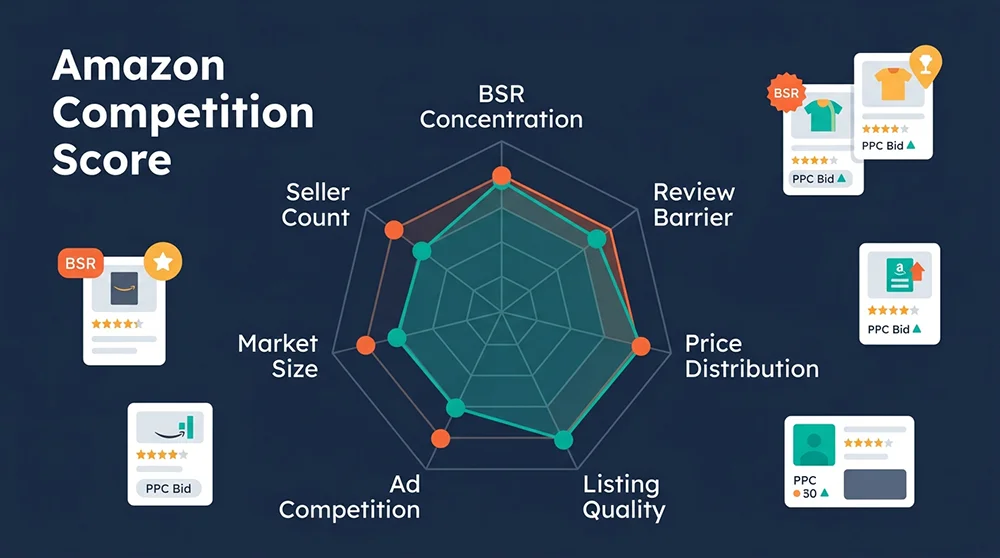
The 7-Dimension Scoring Framework: How to Get a Single Competition Score
| Dimension | Weight | 10pts (Strong) | 5pts (Medium) | 1pt (Weak) |
|---|---|---|---|---|
| BSR Concentration | 20% | Top 3 share <40% | 40–60% | >60% |
| Review Barrier | 20% | Avg reviews <200 | 200–500 | >500 |
| Ad Competition (CPC) | 20% | CPC <$1.00 | $1.00–$2.00 | >$2.00 |
| Price Zone Profitability | 15% | Net margin >40% | 25–40% | <25% |
| Listing Quality Gap | 10% | Competitor avg <3/5 | 3–4/5 | >4/5 |
| New Product Survival | 10% | New products >20% | 10–20% | <10% |
| Absolute Market Size | 5% | Monthly sales >$5M | $500K–$5M | <$500K |
Score interpretation: 70+ points — pursue deeper supply chain and differentiation research; 50–70 points — viable with a clear differentiation hypothesis on at least one dimension; below 50 — redirect to a different category.
How to Build an Automated Amazon Competition Data Pipeline?
import requests, json, time
from statistics import mean
from datetime import datetime

API_KEY = "your_pangolinfo_api_key"
BASE_URL = "https://api.pangolinfo.com/v1/amazon"
HEADERS = {"Authorization": f"Bearer {API_KEY}"}

def get_top_asins(node_id: str, marketplace="US", top_n=50) -> list:
    resp = requests.post(f"{BASE_URL}/bestsellers", headers=HEADERS,
        json={"node_id": node_id, "marketplace": marketplace}, timeout=30)
    resp.raise_for_status()
    return [item["asin"] for item in resp.json().get("items", [])[:top_n]]

def get_product(asin: str, marketplace="US") -> dict:
    resp = requests.post(f"{BASE_URL}/product", headers=HEADERS,
        json={"asin": asin, "marketplace": marketplace}, timeout=30)
    resp.raise_for_status()
    return resp.json()

def bsr_to_sales(bsr: int) -> int:
    table = {100:12000, 500:4000, 1000:2200, 3000:900, 5000:600, 10000:300, 30000:80}
    for k in sorted(table):
        if bsr <= k: return table[k]
    return 5

def score_category(node_id: str, marketplace="US") -> dict:
    asins = get_top_asins(node_id, marketplace)
    products = []
    for asin in asins:
        try:
            d = get_product(asin, marketplace)
            bsr_list = d.get("best_sellers_rank", [])
            bsr = bsr_list[0]["rank"] if bsr_list else None
            products.append({
                "asin": asin, "bsr": bsr,
                "monthly_sales": bsr_to_sales(bsr) if bsr else 0,
                "reviews": d.get("review_count", 0),
                "price": d.get("price", 0),
            })
        except Exception as e:
            print(f"Failed {asin}: {e}")
        time.sleep(0.3)

    sorted_p = sorted(products, key=lambda x: x["monthly_sales"], reverse=True)
    top3 = sum(p["monthly_sales"] for p in sorted_p[:3])
    top10 = sum(p["monthly_sales"] for p in sorted_p[:10])
    concentration = top3 / top10 if top10 else 1.0

    avg_reviews = mean([p["reviews"] for p in products[:10] if p["reviews"]])
    market_usd = sum(p["monthly_sales"] * p["price"] for p in products if p["price"])

    dim1_score = 10 if concentration < 0.4 else (5 if concentration < 0.6 else 1)
    dim2_score = 10 if avg_reviews < 200 else (5 if avg_reviews < 500 else 1)
    dim7_score = 10 if market_usd > 5_000_000 else (5 if market_usd > 500_000 else 1)

    # Weighted total (partial — dimensions 3-6 require additional data inputs)
    partial_score = dim1_score * 0.20 + dim2_score * 0.20 + dim7_score * 0.05

    result = {
        "node_id": node_id, "marketplace": marketplace,
        "analyzed_at": datetime.now().isoformat(),
        "bsr_concentration": f"{concentration:.1%}",
        "bsr_score": dim1_score,
        "avg_top10_reviews": round(avg_reviews),
        "review_score": dim2_score,
        "monthly_market_usd": round(market_usd),
        "market_score": dim7_score,
        "partial_weighted_score": round(partial_score * 100 / 45, 1),
    }
    print(f"BSR Concentration: {result['bsr_concentration']} (score: {result['bsr_score']})")
    print(f"Avg Reviews Top 10: {result['avg_top10_reviews']} (score: {result['review_score']})")
    print(f"Monthly Market: ${result['monthly_market_usd']:,} (score: {result['market_score']})")
    return result

result = score_category("284507", "US")  # Kitchen & Dining
with open("competition_score.json", "w") as f:
    json.dump(result, f, indent=2)
For teams that want monitoring without code, AMZ Data Tracker provides a no-code dashboard for configuring competitor ASIN watchlists and receiving BSR and price change alerts — the operational complement to pre-entry competition analysis.
Conclusion: Competition Data Does Not Tell You Whether to Enter — It Tells You How
The goal of Amazon product competition data analysis is not to find a market with no competition. Every category with meaningful demand has competition. The goal is to identify the specific dimension where your entry strategy has a realistic advantage — whether that is listing quality in a category where incumbents have invested poorly in product presentation, or a price band gap where demand exists but supply is thin, or a new product survival rate that signals the market has not locked out new entrants.
With a 7-dimension score in hand, the market entry question shifts from “can I compete here?” to “which dimension gives me the most defensible entry point, and what is my 90-day execution plan to establish that advantage before competitors respond?”
For teams running competition analysis at scale — evaluating dozens of categories simultaneously or building systematic product research pipelines — the Pangolinfo Scrape API provides the data layer: real-time category bestseller rankings, product BSR, review counts, pricing, and ad placement data in clean JSON. Start with the API documentation for field coverage and integration details.
Frequently Asked Questions
Where can I get Amazon product competition data?
Amazon competition data comes from three source types: Amazon’s own storefront (BSR, review counts, price ranges are publicly visible); third-party SaaS tools like Jungle Scout and Helium 10 (which add historical trends and aggregated metrics); and scraper APIs like Pangolinfo Scrape API (which enable real-time batch collection at scale). Most professional seller teams combine SaaS tools for ad-hoc research with an API layer for systematic monitoring of large ASIN sets.
Does a high BSR concentration mean a category is too competitive to enter?
Not necessarily. High BSR concentration (top 3 sellers capturing over 60% of category sales) means the market is dominated by a few players, but does not tell you the absolute size of the remaining opportunity. A category with $5M monthly total sales and 60% concentration still leaves $2M for other sellers to compete for — which may be viable depending on your scale. The combination of high concentration AND small total market size is the real warning signal.
How many reviews does a new Amazon listing need to be competitive?
It depends on category competition level. In moderately competitive categories where the top 10 average 200–500 reviews, a new listing with 50–100 reviews at 4.3+ stars can capture stable organic traffic within 6–12 months. In highly competitive categories where top sellers average 1,000+ reviews, the review barrier alone is a significant entry cost — factor in Vine program fees and aggressive early PPC spend. Target niches where the category median review count is below 300.
What CPC level signals that a category’s ad competition is too high?
The threshold is product-specific. Calculate your maximum sustainable CPC: price × estimated conversion rate × target ACOS. For example, a $30 product with 8% conversion and 30% target ACOS can sustain a maximum CPC of $0.72. If the category’s core keyword CPCs are consistently above $1.50–$2.00 and your product economics cannot support that, profitability through advertising alone becomes very difficult for new entrants.
How often should I refresh Amazon competition data during product research?
For the final go/no-go decision, collect fresh data within 48 hours before committing — SaaS tool snapshots can be 1–7 days old. Once in a category, monitor core competitor ASINs daily for BSR, price, and inventory changes. Non-core competitors can be tracked weekly. For seasonal products, increase collection frequency to every 12 hours in the 4–6 weeks before peak season to capture competitor stocking and pricing strategy shifts.
Ready to run systematic Amazon competition analysis at scale? Explore Pangolinfo Scrape API for real-time category and product data to power your 7-dimension competitive scoring pipeline.