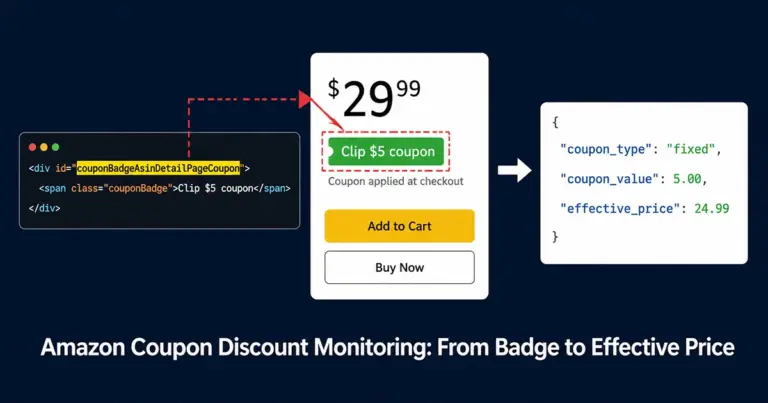


A price monitoring system is not a dashboard that refreshes prices. It is a four-layer pipeline — collect, store, detect, act — in which the data layer decides everything downstream. Only a real-time data layer plus an append-only timeline makes the system trustworthy: every price change can then be traced to a snapshot and a cause.
This article first contrasts the two architectures a monitoring system can be built on — batch cache and real-time on demand. It then examines the four layers in turn: collect, store, detect, and act. It then gives the data model for a single snapshot and a cost model at three scales.
Two Architectures: Batch Cache vs Real-Time On-Demand
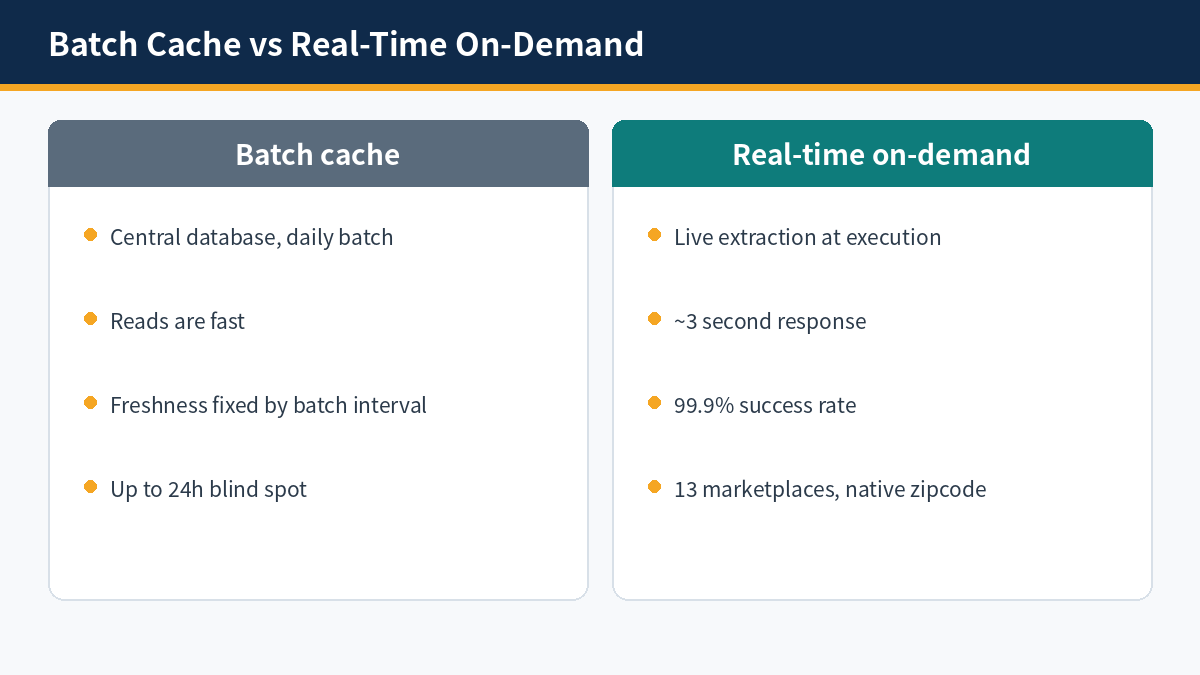
The two architectures differ not in their interface but in their data layer: a batch-cache architecture reads stale data from a central database, loaded by the previous batch job, while a real-time on-demand architecture extracts data live at the moment of execution. The first can guarantee only read speed; the second guarantees freshness, comparability, and attribution.
Batch-Cache Architecture
A batch-cache architecture is built around a central database: scheduled batch jobs fetch data and write it to the store, and reads return whatever the store holds. Between two batch runs the database does not change, so a price can move while the reading does not. Read latency is low, but data freshness is fixed by the batch interval, and the architecture cannot answer what the true price was at a given moment.
Real-Time On-Demand Architecture
A real-time on-demand architecture extracts data live at the moment of execution: each query reaches the Amazon page directly and returns structured data on demand. The interface responds in about 3 seconds, with a 99.9% success rate, across 13 marketplaces, and with native zipcode targeting. Every result is a genuine reading of that moment and that place, so read speed and freshness no longer trade against each other.
What Each Can and Cannot Guarantee
A batch cache guarantees stable read speed and query cost, but it cannot guarantee freshness, comparability, or attribution: the batch moment and the query moment differ, so consecutive readings for the same zipcode may come from different batch conditions. Real-time on-demand guarantees freshness, comparability, and attribution, but it cannot guarantee zero cost: every query performs a real extraction and is billed per result. That cost buys comparability: each reading comes from the same class of execution conditions, so consecutive snapshots on the timeline can be compared with one another.
Whether batch cache is enough depends on the question. For a display that only needs the current price, batch cache is enough. When a change must be explained, when consecutive comparable readings for the same zipcode are needed, or when a decision must be made on the day a change occurs, batch cache is no longer enough. Architecture selection comes before tool selection: first decide whether the problem needs attribution, then choose the data layer.
The cost of real-time on-demand is that every query performs a real extraction: the more queries, the more extraction. Billing, however, applies only to results returned successfully; failed queries are not billed. The cost is the price of comparability: each reading comes from the same class of execution conditions, so snapshots before and after a change on the timeline can be compared with one another.
Why the Data Layer Decides Everything
The detection layer can only compare the data the storage layer gives it, and the action layer can only execute the conclusions the detection layer gives. If the data layer feeds in stale or incomparable readings, no precision downstream can produce anything but stale or wrong conclusions. Architecture selection is therefore first a data-layer selection: freshness, comparability, and attribution are fixed at the moment of collection, and no later layer can repair them.
The Four Layers in Detail: Collect / Store / Detect / Act
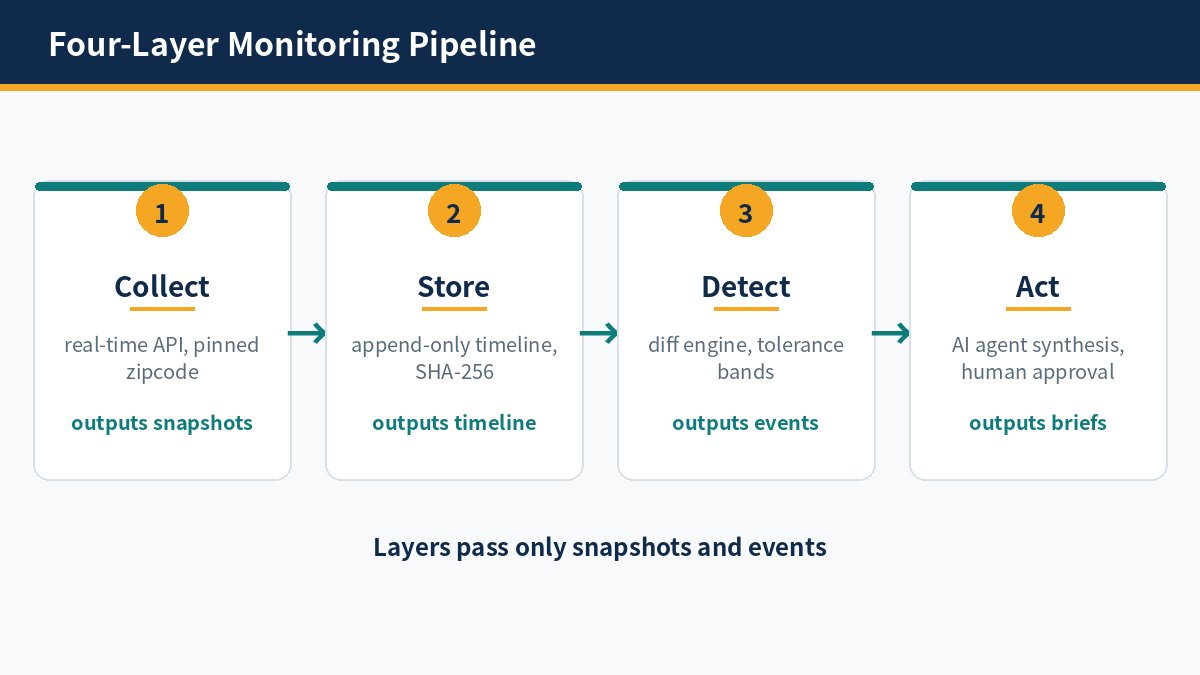
Each layer has one responsibility: the collection layer produces genuine readings, the storage layer keeps an untampered history, the detection layer filters anomalies, and the action layer delivers conclusions to decisions. Layers pass only snapshots and events to one another; mixed responsibilities are where a system begins to be untrustworthy.
Layers pass only two kinds of data: snapshots and events. The collection layer outputs only snapshots, the storage layer only stores snapshots, the detection layer reads only snapshots and outputs events, and the action layer consumes only events. Once the contract is fixed, any layer can be replaced independently: changing the collection interface does not change the storage format, and changing detection rules does not change existing history.
Layer 1: Collect
The collection layer fetches on demand through a real-time interface: the Amazon Scraper API returns structured search results page and product detail page data, with marketplace and zipcode pinned at execution time and sponsored-placement capture above 90%. For the data collection method, see the Scraper API docs.
High-frequency or bulk queries use the async mode: a callback URL callbackUrl is passed when the task is submitted, and the server pushes the result to that address once extraction completes, so the caller does not block and wait. For the async polling method, see the Async API docs.
Layer 2: Store
The storage layer keeps snapshots in an append-only timeline: each polling result is written as an immutable snapshot, and older records are never overwritten. A snapshot holds the timestamp, marketplace, zipcode, net price, coupon, Buy Box winner, delivery promise, search results page ranks, rating and review count, and BSR and subcategory node rank; each snapshot is identified by a SHA-256 hash of its content version. A different hash means different content; the same hash means no change. For the full data model, see the snapshot section below.
The storage layer is independent of the detection layer: detection rules can be rewritten and rerun without touching historical snapshots, and the same timeline can be recalculated under different tolerances to produce different alert sets, while the raw data stays as it was. With storage separated from detection, attribution conclusions can be recalculated and rechecked.
Layer 3: Detect
The detection layer compares each new snapshot with the previous one through a diff engine: a different hash first confirms that a change exists, and a tolerance band then decides whether the change is worth an alert. Tolerances are set per keyword group — narrow for low-variance terms, wide for high-variance terms. A single crossing is only written to the timeline; an alert is escalated only when crossings repeat, or when the Buy Box winner changes or the net price moves with them.
Layer 4: Act
The action layer is where the AI agent synthesizes attribution: an anomalous event is analyzed together with the snapshots before and after it, competitor movements, and the search results page layout, to distinguish causes such as a competitor coupon, a stock-out, or a change in sponsored share. The agent calls structured tools directly through the Amazon Data MCP; for the 21 tools, see the MCP tools docs. The diagnostic brief reaches Slack, Microsoft Teams, or Lark by webhook, with a human approval button, and high-impact actions require human approval before execution. For the full implementation approach, see the Amazon rank and price monitoring solution.
The action layer does not execute high-impact actions automatically: price changes and appeals are offered only as recommendations with evidence, and execution requires human approval. Automated execution is limited to low-risk defensive actions. The approval record itself is written to the timeline, so every intervention can be traced back to the event and the snapshot that triggered it.
The Snapshot Data Model
A snapshot is the smallest explanatory unit of the timeline: one snapshot must hold the rank number and all the conditions that produced it at the same time, and every field must come from the same single polling event. Any field missing leaves attribution unverifiable after the fact.
Snapshot Field List
One snapshot holds, at minimum: timestamp, marketplace, zipcode, keyword, net price and coupon, inventory and delivery promise, Buy Box winner, search results page ranks and sponsored-placement distribution, rating and review count, and BSR and subcategory node rank. All fields belong to the same single polling event and cannot be stitched together in batches; the meaning of each field is fixed before monitoring starts, so the definition is not changed midway.
Return Formats and Billing
The same snapshot can be returned in three formats, billed differently: structured JSON at 1 credit per page, HTML or Markdown at 0.75 credits per page, and reviews at 5 credits per page. The choice of format affects storage and parsing cost, not the commercial fields the snapshot carries; under pay-per-successful-result billing, only results returned successfully are billed.
Review data is billed per page at 5 credits per page. Review snapshots are stored separately from price snapshots but linked by the same timestamp and ASIN. A sudden change in review count or rating often accompanies a price or rank change, so the review timeline is supporting evidence for price attribution, not a substitute for it.
Why All Fields Must Come from One Polling Event
Fields stitched together in batches come from different moments: price, coupon, and delivery promise may each have changed already, so the assembled record corresponds to no real moment. Attribution needs a complete cross-section of one moment, not the maximum or latest value of each field at different moments; only when the cross-section is complete can a change be explained.
How long snapshots are kept should match the purpose of monitoring: short-term review needs recent snapshots, and long-term trend analysis needs snapshots across quarters. Before old snapshots are deleted, confirm that their explanatory value has been carried into attribution conclusions; each conclusion must cite the snapshot number, so it can be traced back to the raw data.
Cost Models at Three Scales
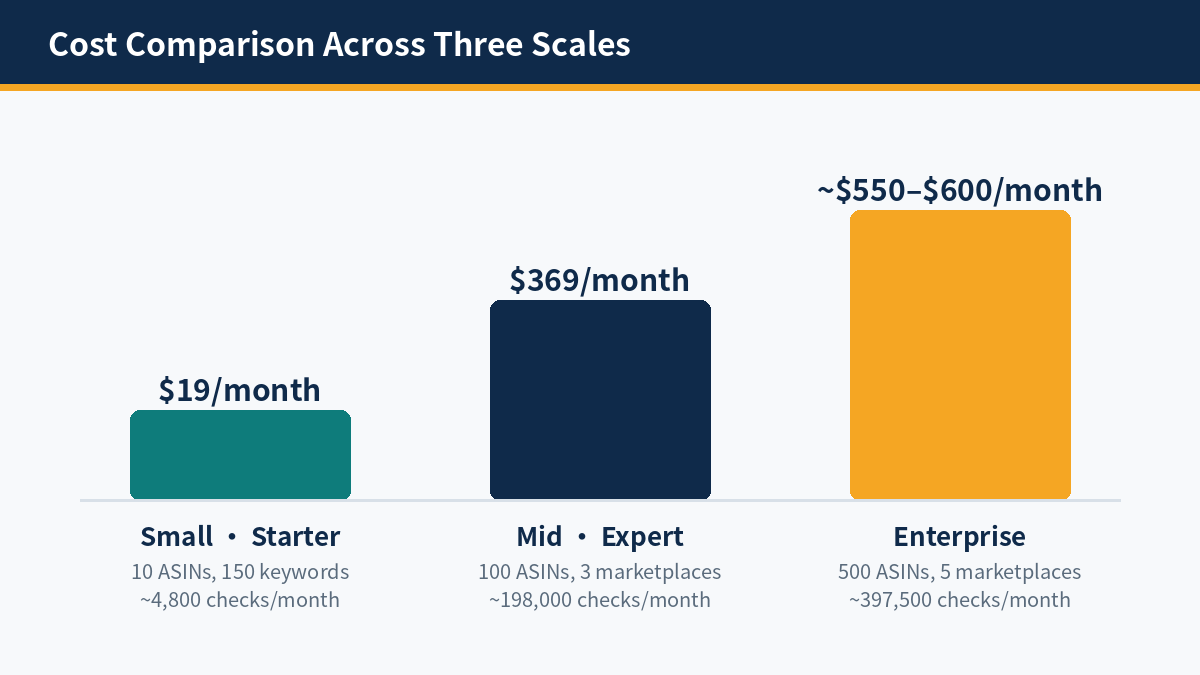
Cost separates into three scales: at small scale, pay-per-successful-result billing is far below a subscription; at mid-market scale, the allowance inside the tier decides the cost; at enterprise scale, the cost converges with high-tier SaaS, and the advantage shifts to real-time data, data ownership, and flexibility. Choose by calculating for your scale, not by comparing list prices.
To measure cost, first define the monitoring unit and the polling frequency, then convert them into monthly checks: the monitoring unit combines ASINs, keywords, marketplaces, and zipcodes, and check volume grows with the number of units and the frequency. Compare check volume with the tier allowance to find the tier needed and the overage range.
Tiers and Billing Rules
Tiers are divided by monthly credit allowance: the Free tier costs $0 with 60 credits per month; Starter costs $19 per month with 9,600 credits; Professional costs $99 per month with 60,000 credits; Expert costs $369 per month with 240,000 credits. Annual billing gives a 20% discount. Allowance is consumed by successful results, and usage above the allowance is billed in tiers. For the subscription rules, see the billing and subscription rules.
Small Scale
Small-scale monitoring covers 10 ASINs and 150 keywords, polled once per day, at about 4,800 checks per month, which the Starter tier covers at $19 per month. For comparison, a Helium 10 Platinum subscription costs $99–$129 per month (a November 2026 research figure); at small scale, pay-per-successful-result billing costs far less than that subscription.
Mid-Market
Mid-market monitoring covers 100 ASINs across 3 marketplaces, at about 198,000 checks per month, which the Expert tier covers at $369 per month. As scale grows, cost is decided by the allowance inside the tier: before check volume reaches the tier allowance ceiling, cost does not grow in proportion to check volume.
Enterprise
Enterprise monitoring covers 500 ASINs across 5 marketplaces with adaptive polling, at about 397,500 checks per month, at the Expert tier plus tiered overage of about $550–$600 per month. At this scale the cost converges with high-tier SaaS pricing, and the advantage shifts to real-time data, data ownership, and flexibility rather than absolute price.
Annual billing gives a 20% discount. Measure on monthly check volume: a peak month may trigger overage, billed in tiers; annual billing changes the unit price, not the scale a workload belongs to.
The reason small scale is cheap is the billing unit: under pay-per-successful-result billing, about 4,800 checks per month consume only a small number of credits, while a subscription charges per month regardless of usage, and small-scale usage cannot support a subscription price. The crossing point between the two billing models sits at scale, not at features.
FAQ
The five questions below cover the judgement calls most often faced when building a price monitoring system. Each answer can be used directly as an operating rule.
Q1: How do I choose between batch cache and real-time on-demand?
Look at whether the question needs a change explained: if only the current price is needed, batch cache is enough; when freshness, comparability, and attribution are needed, real-time on-demand is required.
Q2: How does async polling work?
When a task is submitted, pass a callback URL callbackUrl; once extraction completes, the server pushes the result to that address, so the caller does not block and wait.
Q3: Which fields must one snapshot store?
At minimum: timestamp, marketplace, zipcode, keyword, net price and coupon, inventory and delivery promise, Buy Box winner, search results page ranks and sponsored-placement distribution, rating and review count, and BSR and subcategory node rank.
Q4: What does small-scale monitoring cost per month?
10 ASINs, 150 keywords, polled once per day, about 4,800 checks per month: the Starter tier at $19 per month covers it. The Free tier costs $0 with 60 credits per month, enough to start at small scale.
Q5: How does the system avoid false alarms?
The detection layer judges change with tolerance bands: a single crossing is only written to the timeline, and an alert is escalated only when crossings repeat or accompany a Buy Box winner change or a net price move. Tolerances are set per keyword group.
Built on the architecture above, every price change can be traced back to a snapshot. For the full implementation approach, see the Amazon rank and price monitoring solution.